
Think about your home during a power issue. One room suddenly loses electricity, but the rest of the house is still working fine. You go to a panel on the wall, reset a switch, and everything is back to normal. That panel is called a distribution board.
A distribution board is one of the most important parts of any electrical system. It controls how electricity is distributed safely to different areas. Without it, electrical systems would be unsafe, disorganized, and difficult to manage.
For electrical students, engineers, and technicians, understanding this topic is essential. It helps in installation, troubleshooting, and ensuring safety in both residential and industrial setups.
In this article, you will learn:
- The distribution board working principle
- Types and components of distribution boards
- Real-world distribution board applications
- Distribution board advantages and disadvantages
- Practical selection tips and troubleshooting
Let’s start with the basics.
2. What is Distribution Board?
Definition
A distribution board (DB) is an electrical panel that divides incoming power into multiple circuits while providing protection and control for each circuit.
Simple Explanation
It acts like a central hub where electricity enters and is then distributed to different parts of a building.
Practical Example
In a house:
- One circuit powers lights
- Another powers sockets
- Another powers heavy appliances
All these circuits are controlled through the distribution board.
3. Working Principle
The distribution board working principle is simple but very important for safety.
Step-by-Step Operation
- Power comes from the main supply line
- It enters the distribution board through a main switch
- The power is divided into smaller circuits
- Each circuit is protected by a circuit breaker
- Electricity flows to different loads (lights, fans, machines)
Easy Analogy
Think of a water tank:
- Main pipe = incoming power
- Valves = circuit breakers
- Small pipes = circuits
If there is a problem in one pipe, you close only that valve, not the entire system.
Key Functions
- Power distribution
- Circuit protection
- Fault isolation
- Safety control
4. Types / Classification
Distribution boards come in different types based on application and design.
Single Phase Distribution Board
- Used in homes and small offices
- Operates on single-phase supply
- Suitable for light loads
Three Phase Distribution Board
- Used in industries and large buildings
- Handles heavy loads
- Provides balanced power distribution
Main Distribution Board (MDB)
- Receives power from transformer or main supply
- Distributes power to sub-boards
- Used in large installations
Sub Distribution Board (SDB)
- Receives power from MDB
- Distributes to smaller areas or sections
- Common in commercial buildings
Final Distribution Board
- Supplies power directly to end circuits
- Found in homes and small setups
Consumer Unit (Domestic DB)
- Used in residential buildings
- Contains MCBs and RCDs
- Compact and easy to operate
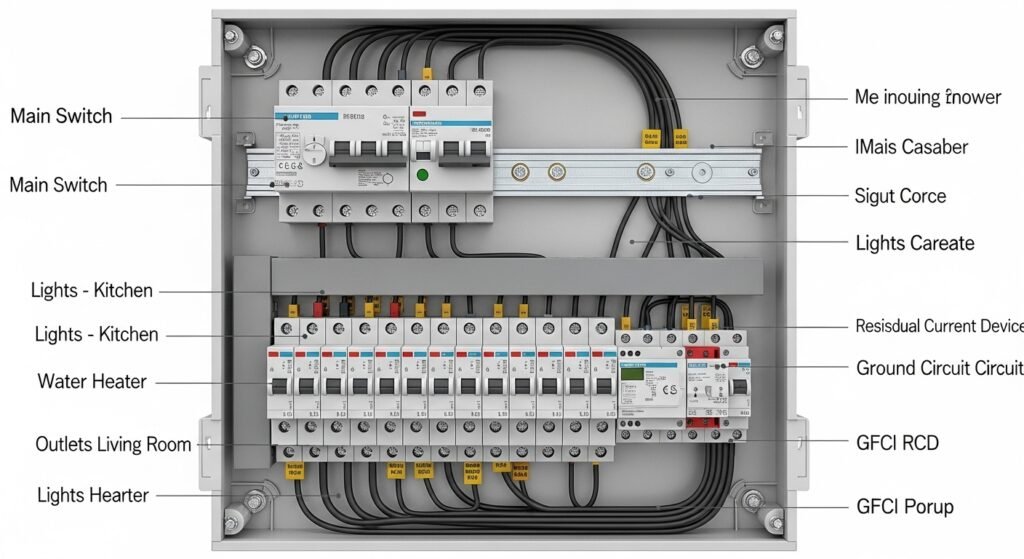
5. Main Components
A distribution board contains several important parts.
Main Switch
- Controls the entire power supply
- Used to turn ON/OFF the whole system
Circuit Breakers (MCB)
- Protect circuits from overload and short circuits
- Automatically trip when a fault occurs
Residual Current Device (RCD)
- Protects against electric shock
- Detects leakage current
Busbar
- Metal strip that distributes power to circuits
- Acts as a common connection point
Neutral Link
- Connects all neutral wires
- Ensures proper current return path
Earth Bar
- Provides grounding connection
- Improves safety by preventing shocks
Enclosure (Box)
- Protects internal components
- Prevents accidental contact
6. Advantages
Here are the key distribution board advantages and disadvantages, starting with benefits.
Advantages
- Improves electrical safety
- Allows easy control of circuits
- Prevents damage from overload
- Enables quick fault isolation
- Organizes wiring system
- Reduces risk of fire hazards
- Easy maintenance and troubleshooting
7. Disadvantages / Limitations
Disadvantages
- Initial installation cost can be high
- Requires proper design and planning
- Incorrect wiring can cause hazards
- Needs regular inspection and maintenance
- Limited capacity if not properly sized
8. Applications
The distribution board applications are wide and essential.
Residential Use
- Homes and apartments
- Lighting and power distribution
- Appliance control
Commercial Use
- Offices and malls
- Air conditioning systems
- Elevators and lighting
Industrial Use
- Factories and plants
- Heavy machinery control
- Motor distribution systems
Modern Technology
- Data centers
- Solar power systems
- Smart homes and automation systems
9. Comparison Section
Difference Between Distribution Board and Switchboard
| Feature | Distribution Board | Switchboard |
| Purpose | Distributes power to circuits | Controls and monitors large systems |
| Size | Smaller | Larger |
| Application | Homes, small buildings | Industrial plants |
| Complexity | Simple | Complex |
| Components | MCBs, RCDs | Advanced control devices |
This helps understand the difference between distribution board and switchboard clearly.
10. Selection Guide
Choosing the right distribution board is critical.
Key Factors
- Load requirement
- Number of circuits
- Type of supply (single/three phase)
- Safety features
- Future expansion needs
Tips for Beginners
- Always calculate total load before selection
- Choose quality components
- Ensure proper earthing
- Follow local electrical standards
- Leave space for future circuits
11. Common Problems & Solutions
Circuit breaker trips frequently
Cause: Overload or short circuit
Solution: Reduce load or check wiring
No power in one section
Cause: Tripped MCB
Solution: Reset breaker
Electric shock from panel
Cause: Poor earthing
Solution: Improve grounding system
Burning smell from DB
Cause: Loose connections
Solution: Tighten connections immediately
RCD trips randomly
Cause: Leakage current
Solution: Check faulty appliance
12. Future Trends
Electrical systems are becoming smarter and safer.
Smart Distribution Boards
- Remote monitoring
- Mobile app control
- Energy tracking
Integration with Renewable Energy
- Solar panel integration
- Battery storage systems
- Hybrid AC/DC systems
Advanced Protection Systems
- Arc fault detection
- Surge protection devices
- AI-based fault prediction
Modular Designs
- Easy installation
- Flexible expansion
- Compact structure
13. Conclusion
A distribution board is the heart of any electrical system. It ensures safe and efficient distribution of electricity to different circuits. Understanding the distribution board working principle helps in designing reliable systems and preventing hazards.
We explored its types, components, and real-world distribution board applications. We also discussed its advantages, limitations, and how to choose the right one for your needs.
For beginners and professionals alike, mastering this topic is essential. A well-designed distribution board not only improves safety but also enhances system performance and reliability.
Keep learning and always follow proper electrical safety practices. A small mistake in distribution systems can lead to serious consequences.