
Imagine walking into a room and turning on a switch. Instantly, the light comes on. You don’t think about what happens behind the wall, but a well-designed lighting circuit is making that simple action possible.
Lighting circuits are one of the most basic yet important parts of any electrical system. From homes and offices to factories and smart buildings, proper lighting depends on correctly designed circuits. A small mistake in wiring can cause flickering lights, energy waste, or even safety hazards.
For electrical students, technicians, and engineers, understanding lighting circuits is essential. It helps in installation, maintenance, troubleshooting, and designing efficient systems.
In this article, you will learn:
- The lighting circuits working principle
- Different types of lighting circuits
- Components and their functions
- Real-world lighting circuits applications
- Lighting circuits advantages and disadvantages
- Practical tips for selection and troubleshooting
Let’s begin with the basics.
2. What is Lighting Circuits Explained?
Definition
A lighting circuit is an electrical circuit designed to supply power to lighting devices such as bulbs, lamps, and LEDs.
Simple Explanation
It is a path through which electricity flows from the power source to the light and back, allowing the light to operate.
Practical Example
In a house:
- A switch controls a bulb
- When the switch is ON, the circuit is complete
- When the switch is OFF, the circuit breaks
This simple setup is a basic lighting circuit.
3. Working Principle
The lighting circuits working principle is based on completing and breaking an electrical path.
Step-by-Step Explanation
- Power comes from the main supply
- It flows through a protective device (like a circuit breaker)
- The current reaches the switch
- When the switch is ON, the circuit is completed
- Electricity flows to the light source
- The light produces illumination
- Current returns through the neutral wire
Easy Analogy
Think of a water pipe system:
- Water = electricity
- Tap = switch
- Bulb = output device
When you open the tap, water flows. When you close it, flow stops. Same with lighting circuits.
Key Points
- A closed circuit allows current flow
- An open circuit stops current
- Switches control the flow of electricity
4. Types / Classification
Lighting circuits are classified based on control method and wiring style.
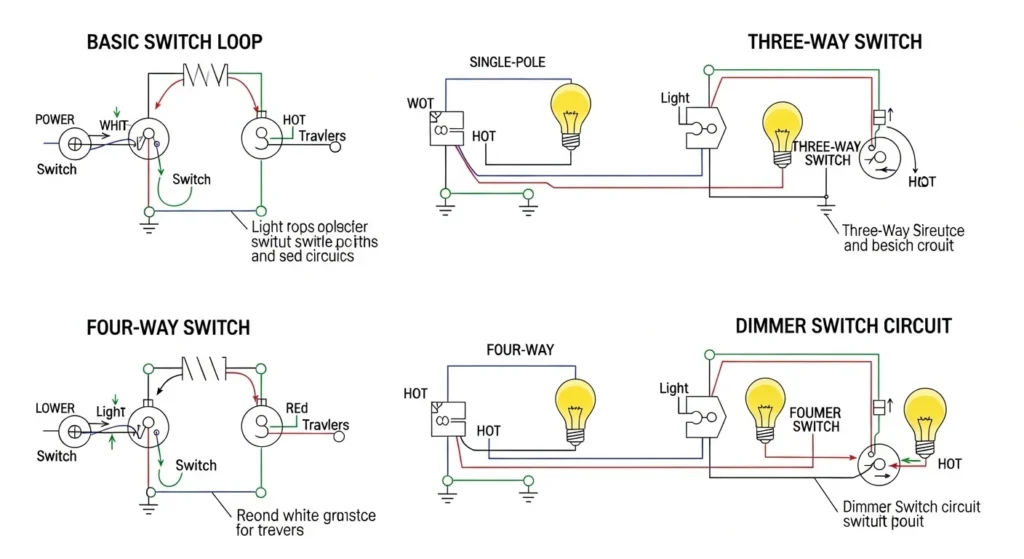
One-Way Lighting Circuit
- Controls a light from one location
- Uses a single switch
- Common in bedrooms and small rooms
Two-Way Lighting Circuit
- Controls a light from two locations
- Uses two switches
- Common in staircases and corridors
Intermediate Lighting Circuit
- Controls a light from three or more locations
- Uses intermediate switches
- Used in large halls and buildings
Radial Lighting Circuit
- Each circuit runs from the distribution board to loads
- Simple and widely used
- Easy to install
Loop-in Lighting Circuit
- Wiring loops from one light point to another
- Reduces wiring complexity
- Common in modern installations
Parallel Lighting Circuit
- All lights are connected in parallel
- Each light works independently
- Most common method in homes
5. Main Components
A lighting circuit includes several important components.
Power Supply
- Provides electrical energy
- Usually from the main grid
Switch
- Controls ON/OFF operation
- Breaks or completes the circuit
Light Fixture (Lamp/Bulb)
- Converts electrical energy into light
- Includes LED, CFL, or incandescent lamps
Wiring (Conductors)
- Carries current between components
- Includes phase, neutral, and earth wires
Circuit Breaker (MCB)
- Protects the circuit from overload
- Automatically trips during faults
Junction Box
- Connects wires safely
- Protects connections
Earthing System
- Prevents electric shock
- Provides safety path for fault current
6. Advantages
Here are the main lighting circuits advantages and disadvantages, starting with benefits.
Advantages
- Simple and easy to install
- Provides safe operation of lights
- Allows flexible control (multiple switches)
- Reduces energy waste
- Easy fault detection and repair
- Suitable for all types of buildings
- Supports modern lighting technologies
7. Disadvantages / Limitations
Disadvantages
- Poor wiring can cause flickering
- Overloading may damage circuits
- Complex circuits require skilled installation
- Maintenance needed over time
- Incorrect design increases energy consumption
8. Applications
The lighting circuits applications are found everywhere.
Residential Use
- Room lighting
- Kitchen and bathroom lights
- Outdoor lighting
Commercial Use
- Offices and shopping malls
- Parking areas
- Decorative lighting
Industrial Use
- Factory lighting
- Warehouse illumination
- Emergency lighting systems
Modern Technology
- Smart homes
- Automated lighting systems
- Motion sensor lighting
- Energy-efficient LED systems
9. Comparison Section
Difference Between Series and Parallel Lighting Circuits
| Feature | Series Circuit | Parallel Circuit |
| Connection | One after another | Separate branches |
| Brightness | Decreases with more bulbs | Same brightness |
| Failure Impact | One failure affects all | Others remain ON |
| Usage | Rarely used | Common in homes |
| Efficiency | Low | High |
This explains the difference between series and parallel lighting circuits, which is important for design decisions.
10. Selection Guide
Choosing the right lighting circuit depends on your needs.
Key Factors
- Type of building
- Number of light points
- Control requirements
- Safety standards
- Budget
Tips for Beginners
- Always use parallel circuits for homes
- Choose proper wire size
- Use quality switches and fixtures
- Ensure proper earthing
- Follow electrical codes
11. Common Problems & Solutions
Lights flicker frequently
Cause: Loose wiring or voltage fluctuation
Solution: Tighten connections and check supply
Light does not turn ON
Cause: Faulty bulb or switch
Solution: Replace the component
Circuit breaker trips
Cause: Overload or short circuit
Solution: Reduce load and inspect wiring
Dim lighting
Cause: Low voltage or poor connections
Solution: Check wiring and supply
Switch sparks when turned ON
Cause: Loose or damaged switch
Solution: Replace immediately
12. Future Trends
Lighting systems are evolving rapidly.
Smart Lighting Systems
- Controlled via mobile apps
- Remote operation
- Energy monitoring
LED Technology
- High efficiency
- Long lifespan
- Low energy consumption
Automation and Sensors
- Motion sensors
- Daylight sensors
- Automatic ON/OFF systems
IoT Integration
- Connected lighting systems
- Smart homes and buildings
- Voice-controlled lighting
Energy-Efficient Designs
- Reduced power consumption
- Sustainable solutions
- Green building integration
13. Conclusion
Lighting circuits are the foundation of safe and efficient lighting systems. Understanding the lighting circuits working principle helps you design and maintain reliable installations.
We explored different types, components, and real-world lighting circuits applications. We also covered the lighting circuits advantages and disadvantages, along with practical troubleshooting tips.
For beginners and professionals, mastering lighting circuits is essential. A well-designed system improves safety, saves energy, and enhances user comfort.
As technology advances, lighting circuits are becoming smarter and more efficient. Keeping up with these changes will help you stay ahead in the electrical field.
Always focus on safety, proper design, and quality components to ensure long-lasting performance.