
Imagine a factory where multiple machines start and stop automatically without human intervention. Behind this smooth operation, small but powerful devices are working silently—these are relays. Different machines require different types of control, and that’s why various types of relays are used.
Understanding relay types is important because not all relays are suitable for every application. Choosing the wrong relay can lead to system failure, overheating, or even safety hazards. For electrical students, engineers, technicians, and beginners, knowing the right relay type is a practical and essential skill.
In this article, you will learn about the types of relays, their working principle, classifications, advantages and disadvantages, and real-world applications. You will also understand the difference between relay types and how to select the right one for your needs. This knowledge will help you design safer and more efficient electrical systems.
2. What is Types of Relays?
Definition
Types of relays refer to the different categories of relays based on their construction, working method, application, and operating principle.
Simple Explanation
Not all relays are the same. Some use mechanical parts, while others use electronic circuits. Each type is designed for a specific purpose.
Practical Example
- A motor protection system uses thermal relays
- A control panel may use electromagnetic relays
- High-speed switching systems use solid state relays
3. Types of Relays Working Principle
The types of relays working principle is based on how each relay operates to open or close a circuit.
General Working Steps
- Electrical signal is applied to the relay
- Relay activates using its internal mechanism
- Contacts open or close
- Circuit is controlled
Based on Technology
- Mechanical relays: Use magnetic force and moving parts
- Electronic relays: Use semiconductors and circuits
Easy Analogy
Think of relays like different types of doors:
- Manual door → Mechanical relay
- Automatic sensor door → Electronic relay
4. Types / Classification
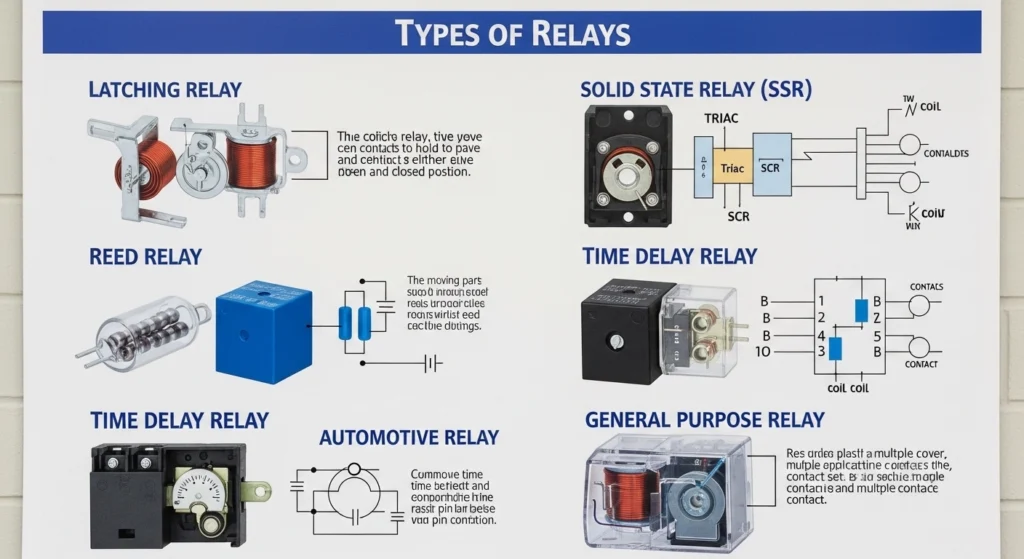
Electromagnetic Relay
- Most common type
- Uses coil and magnetic field
- Has moving parts
Use: General switching applications
Solid State Relay (SSR)
- No moving parts
- Uses electronic components
- Fast and silent operation
Use: High-speed and noise-free applications
Thermal Relay
- Works on heat generated by current
- Protects motors from overheating
Use: Motor protection systems
Reed Relay
- Uses magnetic reeds inside glass tube
- Small and fast
Use: Low-power circuits
Time Delay Relay
- Operates after a time delay
- Adjustable timing
Use: Automation and control systems
Latching Relay
- Maintains position after activation
- Does not require continuous power
Use: Energy-saving systems
Polarized Relay
- Operates based on current direction
- More sensitive
Use: Communication systems
Protective Relay
- Detects faults in power systems
- Trips circuit breakers
Use: Power system protection
Buchholz Relay
- Used in transformers
- Detects internal faults
Use: Transformer protection
Overload Relay
- Protects equipment from excess current
Use: Industrial motors
5. Main Components
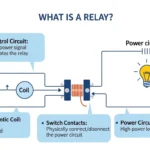
Coil
Generates magnetic field when energized.
Contacts
- Normally Open (NO)
- Normally Closed (NC)
Function: Switch the circuit
Armature
Moves when magnetic field is applied.
Core
Strengthens magnetic field.
Spring
Returns armature to original position.
Component Function Summary
Each component ensures reliable switching and control of electrical circuits.
6. Types of Relays Advantages
Benefits
- Wide range of applications
- Suitable for different voltage levels
- Provides electrical isolation
- Enables automation
- Improves safety
- Flexible design options
7. Types of Relays Disadvantages / Limitations
Limitations
- Mechanical relays wear out
- Some types are expensive
- Requires proper selection
- Maintenance needed for some types
- Limited lifespan for mechanical parts
8. Types of Relays Applications
Home Applications
- Smart home automation
- Appliance control
- Lighting systems
Industrial Applications
- Motor control
- Protection systems
- Automation processes
Commercial Applications
- HVAC systems
- Elevators
- Control panels
Modern Technology Applications
- Robotics
- PLC systems
- Renewable energy systems
9. Comparison Section
Difference Between Electromagnetic Relay and Solid State Relay
| Feature | Electromagnetic Relay | Solid State Relay |
| Working Method | Mechanical movement | Electronic switching |
| Speed | Slower | Faster |
| Noise | Produces sound | Silent |
| Lifespan | Limited | Longer |
| Maintenance | Required | Minimal |
| Cost | Lower | Higher |
10. Selection Guide
Choosing the right relay is critical.
Key Factors
- Load type (AC/DC)
- Voltage and current rating
- Switching speed
- Environment conditions
- Application type
Tips for Beginners
- Start with basic electromagnetic relays
- Use SSR for fast and silent operation
- Always check ratings before use
- Consider future expansion
11. Common Problems & Solutions
Relay not working?
Problem: No power supply
Solution: Check wiring and voltage
Contacts damaged?
Problem: Overloading
Solution: Use proper rating
Relay overheating?
Problem: Excess current
Solution: Replace with suitable relay
Slow operation?
Problem: Mechanical wear
Solution: Use solid state relay
Frequent failure?
Problem: Wrong relay type
Solution: Select correct type for application
12. Future Trends
Relay technology is evolving rapidly.
New Developments
- Smart relays with IoT
- Miniaturized designs
- Energy-efficient relays
- Digital protection relays
Industry Direction
- Automation and smart systems
- Improved reliability
- Integration with control systems
What to Expect
- Faster switching
- Longer lifespan
- Reduced maintenance
13. Conclusion
Understanding the types of relays is essential for designing safe and efficient electrical systems. Each relay type has its own working method, advantages, and limitations.
By learning the types of relays working principle, applications, and differences, you can select the right relay for any situation. This knowledge helps prevent system failures and improves performance.
As an electrical learner or professional, always focus on proper selection and practical usage. Mastering relay types will strengthen your foundation in electrical control systems and automation.