
Imagine a power transformer supplying electricity to an entire neighborhood on a hot summer day. As the load increases, the transformer heats up. If this heat is not properly removed, insulation can fail, efficiency drops, and the transformer may even burn out. This is where cooling becomes critical.
Transformers operate continuously under electrical load, and heat generation is unavoidable due to losses in windings and core. Without proper cooling, even a well-designed transformer can fail prematurely. That’s why understanding Cooling Methods of Transformers is essential for electrical students, engineers, and technicians.
In this article, you will learn the complete cooling methods of transformers working principle, different types, components involved, advantages and disadvantages, and practical applications. You will also understand how to select the right cooling method based on transformer size and usage. By the end, you will have a clear, practical understanding of how transformers stay cool and reliable in real-world systems.
2. What is Cooling Methods of Transformers?
Cooling Methods of Transformers refer to the techniques used to remove heat generated inside a transformer during operation.
Simple Explanation
When electricity flows through a transformer, it produces heat. Cooling methods act like a cooling system to keep the transformer at a safe temperature.
Practical Example
Just like a car engine uses a radiator to prevent overheating, a transformer uses air, oil, or other fluids to remove heat and maintain safe operation.
3. Working Principle
The cooling methods of transformers working principle is based on heat transfer from inside the transformer to the surrounding environment.
Step-by-Step Process
- Electrical losses generate heat inside windings and core
- Heat transfers to insulating medium (air or oil)
- Cooling medium carries heat away from internal parts
- Heat is released into the surrounding air
- Temperature is maintained within safe limits
Modes of Heat Transfer
- Conduction: Heat moves through solid parts
- Convection: Heat carried by moving fluid (air or oil)
- Radiation: Heat emitted to surroundings
Easy Analogy
Think of a cup of hot tea:
- Heat moves from tea to cup (conduction)
- Steam carries heat away (convection)
- Heat radiates into the air
The same happens inside a transformer.
4. Types / Classification
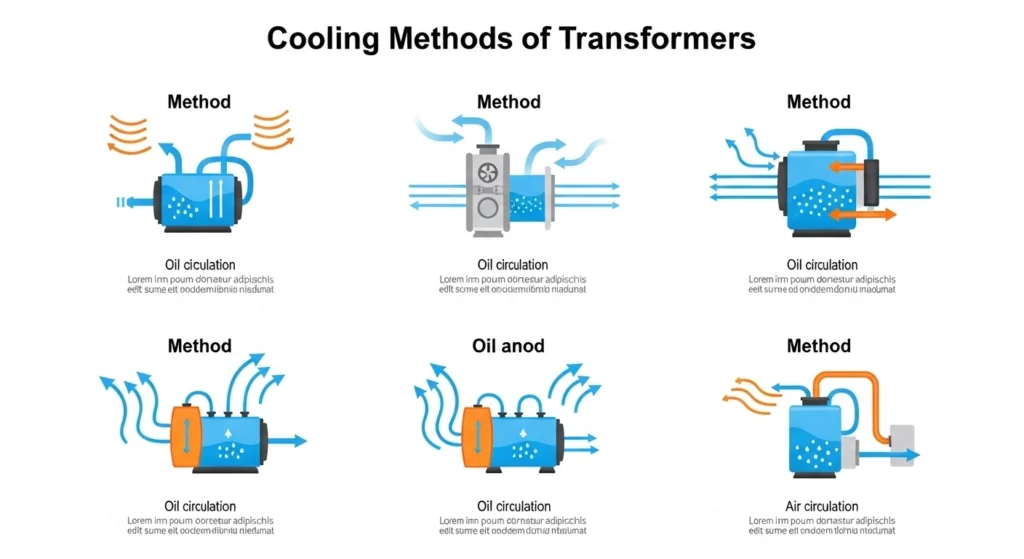
Cooling methods are mainly classified into dry-type and oil-immersed transformers.
Dry-Type Transformer Cooling Methods
Air Natural (AN)
- Uses natural air circulation
- Heat dissipates without external help
Used in: Small transformers
Air Forced (AF)
- Uses fans or blowers
- Air is forced over transformer surface
Used in: Medium-sized transformers
Oil-Immersed Transformer Cooling Methods
Oil Natural Air Natural (ONAN)
- Oil circulates naturally
- Heat released through tank surface
Used in: Distribution transformers
Oil Natural Air Forced (ONAF)
- Oil circulation is natural
- Air is forced using fans
Used in: Medium to large transformers
Oil Forced Air Forced (OFAF)
- Oil pumped using pumps
- Air cooling using fans
Used in: Large power transformers
Oil Forced Water Forced (OFWF)
- Oil circulated by pump
- Heat removed using water cooling
Used in: Very large transformers
Oil Natural Water Forced (ONWF)
- Natural oil flow
- Water used for cooling
Used in: Special applications
5. Main Components
Transformer Oil
- Acts as coolant and insulator
- Transfers heat from windings
Radiators
- Increase surface area
- Help in heat dissipation
Cooling Fans
- Improve air circulation
- Enhance cooling efficiency
Oil Pumps
- Circulate oil in forced cooling systems
- Ensure uniform heat removal
Heat Exchangers
- Transfer heat from oil to water or air
- Used in advanced cooling systems
Temperature Sensors
- Monitor transformer temperature
- Trigger alarms or shutdown
6. Advantages
Cooling Methods of Transformers Advantages
- Prevents overheating
- Increases transformer lifespan
- Improves efficiency
- Ensures safe operation
- Reduces maintenance costs
- Supports high load conditions
- Enhances reliability
7. Disadvantages / Limitations
Cooling Methods of Transformers Disadvantages
- Initial cost can be high
- Requires maintenance (fans, pumps)
- Oil systems may leak
- Complex systems need skilled handling
- Risk of fire in oil-based systems
8. Applications
Cooling Methods of Transformers Applications
Home Applications
- Small distribution transformers
- Residential power supply systems
Industrial Applications
- Manufacturing plants
- Heavy machinery operations
- Power distribution systems
Modern Technology
- Renewable energy systems
- Smart grids
- Data centers
- Electric vehicle charging stations
Cooling methods are essential in all transformer installations.
9. Comparison Section
Difference Between Dry-Type and Oil-Immersed Cooling
| Feature | Dry-Type Cooling | Oil-Immersed Cooling |
| Cooling Medium | Air | Oil |
| Maintenance | Low | Moderate |
| Fire Risk | Low | Higher |
| Efficiency | Moderate | High |
| Cost | Higher initial | Cost-effective for large units |
| Applications | Indoor use | Outdoor, industrial use |
10. Selection Guide
Choosing the right cooling methods of transformers depends on several factors.
Tips for Beginners
- Small transformer → Air Natural
- Medium transformer → Air Forced or ONAN
- Large transformer → ONAF or OFAF
Key Factors to Consider
- Transformer rating
- Load conditions
- Installation location
- Environmental conditions
- Budget and maintenance
Practical Advice
- Always consider future load increase
- Choose reliable cooling system
- Regularly monitor temperature
- Follow manufacturer guidelines
11. Common Problems & Solutions
Why does a transformer overheat?
- Overloading
- Poor cooling system
- Blocked radiators
Reduce load and clean cooling components.
What happens if cooling fails?
Transformer insulation may fail, leading to damage.
Why is oil level important?
Low oil reduces cooling efficiency.
Check and maintain oil level regularly.
Why are fans not working?
Electrical fault or mechanical failure.
Inspect and repair fan system.
How to improve cooling efficiency?
- Clean radiators
- Ensure proper airflow
- Maintain oil quality
12. Future Trends
Cooling technology is evolving rapidly.
Key Trends
- Smart Cooling Systems: Automatic control based on temperature
- Eco-Friendly Fluids: Safer alternatives to transformer oil
- IoT Monitoring: Real-time temperature tracking
- Advanced Heat Exchangers: Improved efficiency
- AI-Based Systems: Predictive maintenance
Future cooling systems will focus on efficiency, safety, and automation.
13. Conclusion
Understanding Cooling Methods of Transformers is essential for safe and efficient transformer operation. Heat management is a critical factor that directly affects performance, lifespan, and reliability.
From simple air cooling to advanced oil and water systems, each method has its own advantages and limitations. Choosing the right method depends on transformer size, load, and application.
By learning the cooling methods of transformers working principle, types, and applications, you can design better systems and prevent costly failures. As technology advances, cooling methods will become smarter and more efficient.
Focus on proper selection, regular maintenance, and monitoring to ensure long-term transformer performance.