
On a hot summer day, you switch on your air conditioner and expect instant cooling. But behind that simple action is a carefully designed electrical system that ensures the unit runs safely and efficiently. If the wiring is done incorrectly, the air conditioner may not work properly—or worse, it could cause electrical hazards.
Understanding air conditioner wiring basics is essential for electrical students, technicians, and engineers. Proper wiring ensures safe operation, energy efficiency, and long equipment life. It also helps in troubleshooting faults and preventing costly damage.
In real-world practice, many AC failures are not due to mechanical issues but incorrect wiring or poor connections. That is why learning the correct wiring principles is critical.
In this article, you will learn:
- The air conditioner wiring basics working principle
- Types of AC wiring systems
- Important components and their functions
- Real-world air conditioner wiring basics applications
- Air conditioner wiring basics advantages and disadvantages
- Practical troubleshooting and selection tips
Let’s begin with a clear understanding of what this topic means.
What Is Air Conditioner Wiring?
Air conditioner wiring is the arrangement of electrical wires, circuit breakers, switches, control connections, and grounding conductors used to safely supply power and control an air conditioning system. Proper wiring allows the indoor unit, outdoor unit, compressor, fan motor, thermostat, and other electrical components to operate correctly.
In simple words, AC wiring connects the power source to the air conditioner and allows different components of the system to communicate and work together.
Correct wiring is important because an air conditioner can draw significant electrical current, especially when the compressor starts and operates under load. Incorrect wire size, loose connections, poor grounding, or an incorrectly rated circuit breaker can cause overheating, nuisance tripping, equipment damage, or electrical hazards.
Simple Explanation of AC Wiring
An air conditioning wiring system normally includes:
- Power supply: Provides electrical energy to the AC system.
- Circuit breaker: Protects the circuit from excessive current and short circuits.
- Disconnect switch: Allows the AC unit to be safely isolated during maintenance.
- Power wires: Carry electrical power to the equipment.
- Control wires: Carry signals between compatible AC components.
- Grounding conductor: Provides a safe path for fault current.
- Indoor and outdoor unit connections: Allow the system components to operate together.
The exact wiring arrangement depends on the type, voltage, capacity, and manufacturer design of the air conditioner. Always follow the manufacturer’s wiring diagram and applicable electrical code.
Practical Example: Split Air Conditioner Wiring
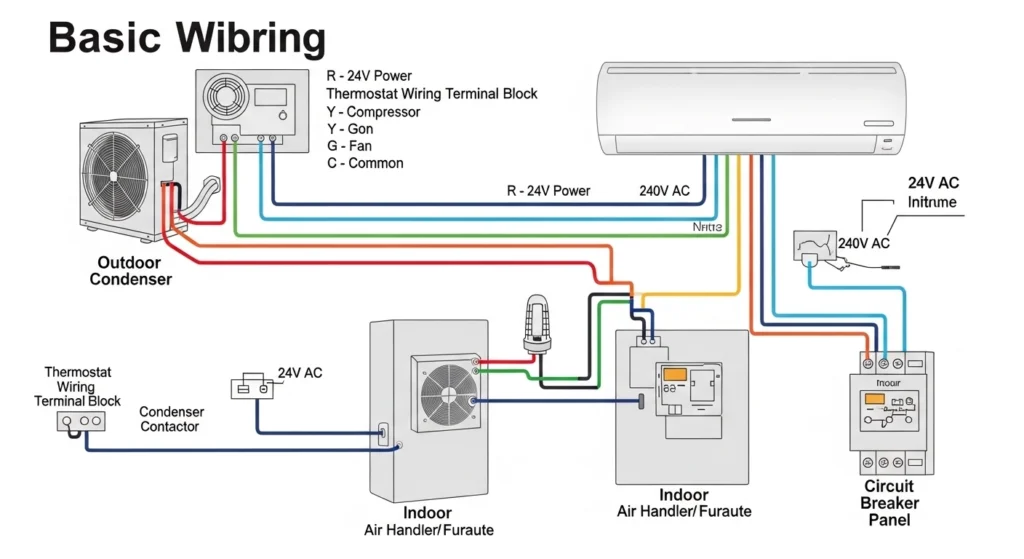
In a typical split AC installation, electrical power may be supplied from the distribution board through a dedicated protective device to the air conditioner. Depending on the model, the indoor and outdoor units may also be connected through power and communication/control conductors.
For example, the system may include:
Distribution Board → Circuit Breaker → Disconnect/Isolator → AC Unit
The indoor and outdoor units can then be connected according to the manufacturer’s terminal markings and wiring diagram.
Important: AC terminal arrangements are not universal. Never connect wires based only on wire color. Check the equipment’s wiring diagram, terminal labels, voltage rating, and installation instructions.
How Does Air Conditioner Wiring Work?
The basic working principle of AC wiring is to provide a safe electrical path for power while allowing the control system to operate the compressor, fan motors, and other components.
Step-by-Step Working Principle
- Electrical power enters the circuit
Power is supplied from the building’s distribution board to the air-conditioning circuit. - Circuit protection is provided
A correctly rated circuit breaker or other required protective device protects the wiring and equipment from abnormal current conditions. - Power reaches the AC equipment
The supply conductors carry electrical power to the appropriate AC terminals. - The control system sends operating commands
Depending on the AC design, a thermostat, remote-control system, PCB, or other controller determines when cooling is required. - Indoor and outdoor units communicate
In systems designed for communication between units, dedicated conductors carry the required signals according to the manufacturer’s wiring arrangement. - The compressor and fans operate
The control system starts or regulates the compressor, indoor fan, outdoor fan, and other components as required. - The cooling cycle continues
The controller monitors operating conditions and adjusts the system to maintain the desired temperature.
Air Conditioner Wiring Diagram Basics
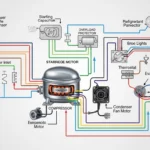
An air conditioner wiring diagram shows how electrical components are connected. It helps electricians and technicians understand the power circuit, control circuit, protection devices, terminals, and grounding connections.
A simplified arrangement can be understood as:
Main Supply → Circuit Breaker → Disconnect → AC Power Terminals → Indoor/Outdoor Components
The actual circuit can be much more detailed. Modern inverter and split AC systems may include electronic control boards, sensors, communication circuits, variable-speed drives, and additional protection devices.
Why the Wiring Diagram Is Important
A manufacturer’s wiring diagram helps technicians:
- Identify correct terminals
- Understand power connections
- Identify control and communication conductors
- Locate protective devices
- Check grounding connections
- Troubleshoot electrical faults
- Avoid incorrect connections
- Perform maintenance safely
Power Wiring vs Control Wiring in an Air Conditioner
One important concept for beginners is the difference between power wiring and control wiring.
Power Wiring
Power wiring carries electrical energy required to operate the air conditioner’s electrical loads. Depending on the equipment design, these loads may include the compressor, fan motors, heaters, or electronic components.
The conductor size and protective device must be selected according to the equipment requirements and applicable electrical regulations.
Control Wiring
Control wiring is used to transmit operating signals between components. In modern systems, communication wiring may also connect electronic control boards between indoor and outdoor units.
Control wiring must be connected exactly according to the manufacturer’s specifications because incorrect connections can damage electronic components.
Important Safety Points for Air Conditioner Wiring
Before working on AC electrical wiring, isolate the equipment from the power supply and verify that the circuit is de-energized using appropriate test equipment.
Important practices include:
- Use the correct circuit protection.
- Select conductors according to the equipment requirements and local electrical code.
- Provide proper grounding/earthing.
- Make secure terminal connections.
- Protect cables from physical damage.
- Keep electrical connections dry and properly enclosed.
- Do not rely on wire color alone.
- Follow the manufacturer’s wiring diagram.
- Check voltage before connecting equipment.
- Use a qualified electrician or technician for work that requires professional electrical skills.
Key Takeaways
- Air conditioner wiring connects the power supply, protection devices, control system, and AC components.
- A circuit breaker helps protect the electrical circuit from abnormal current conditions.
- Power wiring supplies electrical energy to the equipment.
- Control or communication wiring allows compatible components to exchange operating signals.
- Proper grounding/earthing is essential for electrical safety.
- Wire size and protection must match the equipment requirements and applicable electrical code.
- The manufacturer’s AC wiring diagram should always be followed.
Types of Air Conditioner Wiring
Air conditioner wiring can be classified according to the type of AC system, power supply, installation method, and electrical load. Different air conditioners require different wiring arrangements, so the correct wiring method should always be based on the manufacturer’s wiring diagram, equipment rating, and applicable electrical code.
Split AC Wiring
Split AC wiring is one of the most common wiring arrangements used in homes, offices, shops, and small commercial buildings. A split air conditioner has separate indoor and outdoor units that are connected through electrical and, depending on the model, communication wiring.
A typical system may include:
- Dedicated power supply
- Circuit breaker or protective device
- Indoor unit connections
- Outdoor unit connections
- Communication/control conductors
- Grounding connection
The exact terminal arrangement varies between manufacturers and models, so technicians should always follow the supplied wiring diagram.
Window AC Wiring
Window AC wiring is generally simpler because the main components are installed within a single unit. The unit is normally supplied from a suitable electrical circuit through the required protective device.
A typical window AC electrical system may include:
- Power supply
- Circuit protection
- Compressor
- Fan motor
- Thermostat or electronic controller
- Grounding connection
The circuit rating and conductor size must be suitable for the air conditioner’s rated current and installation requirements.
Central AC Wiring
Central AC wiring is used in larger residential, commercial, and industrial buildings where one system serves multiple areas. Compared with a small room AC, central air-conditioning systems can have more complicated power and control circuits.
These systems may include:
- Large compressors
- Multiple fan motors
- Air-handling equipment
- Thermostats and controllers
- Control panels
- Contactors and relays
- Safety and protection devices
Because central AC systems can involve higher electrical loads and multiple control circuits, installation and troubleshooting should be performed according to the equipment documentation and applicable electrical standards.
Inverter AC Wiring
Inverter AC wiring is used with air conditioners that control compressor speed electronically instead of simply switching the compressor fully on and off. These systems contain sensitive electronic components and control boards.
Inverter AC systems may include:
- Electronic control boards
- Variable-speed compressor
- Power electronics
- Sensors
- Communication circuits
- Indoor and outdoor unit connections
Correct voltage, grounding, conductor connections, and communication wiring are especially important. Incorrect wiring can damage electronic components or cause communication and operating faults.
Single-Phase AC Wiring
Single-phase AC wiring is commonly used for residential and smaller air-conditioning systems. The electrical circuit normally uses the required line/phase, neutral, and grounding conductors according to the system design.
Before installation, technicians should check:
- Rated voltage
- Rated current
- Recommended conductor size
- Circuit breaker requirements
- Grounding requirements
- Manufacturer’s wiring diagram
The actual connection should never be assumed from wire colors alone.
Three-Phase AC Wiring
Three-phase AC wiring is commonly used for larger commercial and industrial air-conditioning systems because it is suitable for higher electrical loads and larger motors.
A three-phase AC system can provide advantages such as:
- Efficient operation of larger motors
- Better handling of high electrical loads
- More suitable power supply for commercial equipment
- Improved motor performance when phases are properly balanced
Technicians should verify phase sequence, voltage, current, grounding, and protection settings before commissioning three-phase equipment.
Portable AC Wiring
Portable air conditioners are designed to be moved between locations and are commonly used for individual rooms or temporary cooling. Their electrical wiring is usually contained within the unit, with power supplied through a suitable cord and plug or the connection method specified by the manufacturer.
The circuit should be capable of handling the unit’s rated electrical load without overheating or excessive voltage drop.
Commercial AC Wiring
Commercial AC wiring is used in offices, shops, restaurants, hotels, hospitals, and other large buildings. These systems can include multiple indoor units, outdoor units, control panels, thermostats, sensors, and communication networks.
Because commercial systems can involve many interconnected components, proper circuit protection, grounding, cable identification, and documentation are important for safe operation and maintenance.
Industrial AC Wiring
Industrial air-conditioning wiring is designed for heavy-duty cooling systems used in factories, warehouses, process areas, and other industrial facilities. These installations may involve large motors, compressors, control panels, and three-phase power supplies.
Industrial installations require careful consideration of load current, conductor sizing, protection, motor starting requirements, grounding, environmental conditions, and maintenance access.
Quick Comparison of Air Conditioner Wiring Types
| AC Type | Common Application | Wiring Complexity |
|---|---|---|
| Split AC | Homes and offices | Medium |
| Window AC | Small rooms | Low |
| Central AC | Large buildings | High |
| Inverter AC | Homes and commercial spaces | Medium to High |
| Single-Phase AC | Residential systems | Low to Medium |
| Three-Phase AC | Commercial and industrial systems | High |
| Portable AC | Individual rooms | Low |
| Commercial AC | Offices and businesses | High |
| Industrial AC | Factories and industrial facilities | High |
Main Components of Air Conditioner Wiring
Understanding the main components of air conditioner wiring is important for anyone learning AC installation, troubleshooting, or electrical maintenance. Each component has a specific function, from supplying electrical power to protecting the circuit and allowing indoor and outdoor units to communicate.
The exact components and wiring arrangement can vary depending on the AC type, capacity, voltage, and manufacturer. Always follow the equipment wiring diagram and applicable electrical requirements.
Power Supply Cable
The power supply cable carries electrical power from the distribution board or approved supply point to the air conditioner. The cable must have the correct conductor size, insulation rating, and current-carrying capacity for the equipment.
An undersized cable can overheat when the AC operates under load. Proper cable selection helps maintain safe and reliable operation.
Circuit Breaker (MCB)
A circuit breaker, such as an MCB where appropriate, provides protection against abnormal current conditions such as overload and short circuits. It is normally installed in the distribution board or designated electrical panel.
The breaker rating should be selected according to the equipment requirements and applicable electrical code. An incorrectly rated breaker can reduce the effectiveness of circuit protection.
Isolator Switch
An isolator switch allows the air conditioner to be disconnected from its electrical supply during servicing and maintenance. It provides a convenient means of isolation near the equipment where required by the installation.
Before electrical maintenance, the circuit should be isolated and the absence of voltage verified with suitable test equipment.
Indoor Unit Wiring
Indoor unit wiring connects the electrical and control components located inside the air conditioner. Depending on the model, these may include the indoor fan motor, control PCB, sensors, display, and other electronic components.
In systems with separate indoor and outdoor units, the indoor unit may also exchange power or communication signals with the outdoor unit according to the manufacturer’s design.
Outdoor Unit Wiring
Outdoor unit wiring supplies and controls components such as the compressor, outdoor fan motor, and electronic control equipment. The outdoor unit may handle a significant portion of the AC’s electrical load.
Correct terminal connections, conductor sizing, grounding, and circuit protection are essential for safe operation. Technicians should always use the manufacturer’s wiring diagram rather than assuming terminal connections.
Communication Cable
The communication cable connects the indoor and outdoor units in air-conditioning systems that use electronic communication between them. It allows control boards to exchange operating information and commands.
Communication wiring is especially important in modern inverter and electronically controlled AC systems. Incorrect connections can cause communication errors, fault codes, or improper operation.
Earthing Wire
The earthing wire, also called the grounding conductor, provides a low-resistance path for fault current and helps reduce the risk of electric shock when properly installed.
A reliable grounding connection is an important part of AC electrical safety. The grounding conductor should be installed according to the equipment manufacturer’s instructions and local electrical requirements.
Quick Summary of AC Wiring Components
| Component | Main Function |
|---|---|
| Power Supply Cable | Supplies electrical power to the AC |
| Circuit Breaker (MCB) | Protects the circuit from abnormal current conditions |
| Isolator Switch | Disconnects the AC for maintenance |
| Indoor Unit Wiring | Connects indoor electrical and control components |
| Outdoor Unit Wiring | Supplies and controls outdoor equipment |
| Communication Cable | Transfers signals between compatible AC units |
| Earthing Wire | Provides a protective grounding path |
6. Advantages
Here are the key air conditioner wiring basics advantages and disadvantages, starting with benefits.
Advantages
- Ensures safe AC operation
- Improves energy efficiency
- Reduces risk of electrical faults
- Supports smooth communication between units
- Increases equipment lifespan
- Easy maintenance with proper design
- Prevents overheating and fire hazards
7. Disadvantages / Limitations
Disadvantages
- Requires proper technical knowledge
- Incorrect wiring can damage AC
- Installation cost may be high
- Regular inspection is needed
- Poor-quality wires can cause failures
8. Applications
The air conditioner wiring basics applications are widely seen.
Residential Use
- Split AC systems
- Window AC units
- Home cooling systems
Commercial Use
- Offices and shopping malls
- Hotels and restaurants
- Server rooms
Industrial Use
- Factories
- Large HVAC systems
- Cooling for machinery
Modern Technology
- Smart AC systems
- IoT-based climate control
- Energy-efficient inverter systems
9. Comparison Section
Difference Between Single-Phase and Three-Phase AC Wiring
| Feature | Single-Phase Wiring | Three-Phase Wiring |
| Power Capacity | Low | High |
| Usage | Homes | Industries |
| Wiring Complexity | Simple | Complex |
| Efficiency | Moderate | High |
| Cost | Lower | Higher |
This shows the difference between single-phase and three-phase AC wiring, which is important for system design.
10. Selection Guide
Choosing the right wiring setup is critical.
Key Factors
- AC capacity (BTU or tonnage)
- Type of AC (split, window, central)
- Power supply type
- Distance between units
- Safety requirements
Tips for Beginners
- Always follow manufacturer wiring diagram
- Use correct wire size
- Ensure proper earthing
- Avoid loose connections
- Use high-quality cables and breakers
Common Air Conditioner Wiring Problems and Solutions
Air conditioner wiring problems can affect cooling performance, electrical safety, and equipment reliability. Some faults are caused by loose connections or damaged wires, while others may result from circuit overload, communication problems, or poor grounding.
Identifying the symptoms correctly can help technicians troubleshoot the system more efficiently. However, electrical work should be performed only after safely isolating the power supply and verifying that the circuit is de-energized.
AC Not Turning On
Possible Cause: No power supply, tripped circuit breaker, loose connection, or damaged wiring.
If the air conditioner does not turn on, the first step is to check whether electrical power is reaching the equipment. A tripped breaker, disconnected isolator, damaged cable, or loose terminal connection can prevent the AC from operating.
Solution:
- Check the circuit breaker.
- Verify the isolator or disconnect switch.
- Inspect accessible wiring and terminal connections.
- Measure the supply voltage using appropriate test equipment.
- Check for damaged conductors or loose connections.
AC Circuit Breaker Trips Frequently
Possible Causes: Overload, short circuit, ground fault, or equipment fault.
Frequent breaker tripping should not be ignored or solved simply by repeatedly resetting the breaker. It may indicate excessive current, a short circuit, insulation failure, or a problem with the air conditioner’s electrical components.
Solution:
- Isolate the AC before inspection.
- Check the wiring for damage or short circuits.
- Measure operating current.
- Inspect connections and insulation.
- Check whether the equipment load is within its rated limits.
- Investigate the underlying fault before restoring operation.
Indoor and Outdoor Units Are Not Communicating
Possible Cause: Faulty communication cable, incorrect terminal connection, damaged wiring, or electronic control fault.
Modern split and inverter AC systems may use communication circuits between the indoor and outdoor units. A wiring or communication fault can prevent the system from starting or may produce a fault code.
Solution:
- Turn off the power before checking connections.
- Compare terminal connections with the manufacturer’s wiring diagram.
- Inspect the communication cable for damage.
- Check terminals for loose connections.
- Test the communication circuit according to the manufacturer’s service instructions.
Burning Smell From AC Wiring
Possible Cause: Loose terminal, overheated conductor, damaged insulation, or excessive current.
A burning smell around an air conditioner is a serious warning sign. It can indicate that a wire, terminal, connector, or electrical component is overheating.
Solution:
- Turn off the AC and isolate the electrical supply.
- Do not continue operating the equipment until the cause is identified.
- Inspect terminals, cables, and connectors for signs of overheating.
- Replace damaged wiring or components where required.
- Check the cause of excessive current or poor connection before restarting the system.
Electric Shock From AC Body
Possible Cause: Poor grounding, damaged insulation, or an electrical fault.
If a person feels an electric shock or tingling sensation when touching the AC body, the equipment should be treated as electrically unsafe. A grounding problem or insulation fault may allow dangerous voltage to appear on exposed metal parts.
Solution:
- Switch off and isolate the equipment.
- Do not continue using the AC until it has been inspected.
- Check the grounding/earthing system.
- Test insulation and fault conditions using suitable procedures.
- Have a qualified electrician investigate and correct the problem.
Future Trends in Air Conditioner Wiring
Air-conditioning technology is moving toward smarter controls, higher efficiency, connected monitoring, and better electrical protection. These developments are changing how AC systems are installed, monitored, maintained, and integrated into modern buildings.
Smart Wiring Systems
Smart air-conditioning systems can connect electrical equipment with digital control and monitoring platforms. This allows users and technicians to monitor system operation and identify abnormal conditions more quickly.
Common features include:
- Remote system monitoring
- App-based control
- Energy consumption tracking
- Digital fault notifications
- Automated operating schedules
Energy-Efficient AC Wiring Designs
Modern air-conditioning systems are designed to reduce unnecessary energy consumption. Proper circuit design, efficient equipment, and appropriate conductor selection can contribute to reliable and efficient operation.
Important developments include:
- Optimized wiring layouts
- Reduced electrical losses
- High-efficiency motors and compressors
- Inverter-based operation
- Improved energy management
Integration With Renewable Energy
Air-conditioning systems are increasingly being integrated with renewable energy technologies such as solar power. This can help reduce dependence on conventional grid electricity when the system is properly designed.
Potential applications include:
- Solar-powered AC systems
- Hybrid power systems
- Battery energy storage
- Solar and grid combined operation
- Energy management systems
Advanced AC Protection Systems
Modern AC installations can use advanced protection technologies to improve equipment safety and reliability. Protection requirements depend on the equipment and installation.
Examples include:
- Surge protection
- Advanced circuit breakers
- Overcurrent protection
- Ground-fault protection where required
- Temperature monitoring
- Electronic fault detection
Automation and IoT
The Internet of Things (IoT) is making it possible for air-conditioning equipment to communicate with smart building and home automation systems. Connected sensors can provide information about temperature, energy consumption, operating status, and faults.
Future AC systems may offer:
- Smart-home integration
- Remote monitoring
- Voice-controlled operation
- Automated temperature control
- Predictive maintenance alerts
- Real-time energy monitoring
What These Trends Mean for Electrical Technicians
As AC systems become more electronic and connected, electrical technicians need knowledge beyond traditional wiring. Understanding circuit protection, grounding, control wiring, communication circuits, sensors, inverter technology, and basic electrical troubleshooting will become increasingly important.
13. Conclusion
Understanding air conditioner wiring basics is essential for safe and efficient AC operation. Proper wiring ensures that all components work together smoothly and reliably.
We explored the air conditioner wiring basics working principle, types, components, and real-world air conditioner wiring basics applications. We also discussed its advantages, limitations, and troubleshooting techniques.
For beginners and professionals, correct wiring is not just about functionality—it is about safety and long-term performance. A well-installed system reduces energy consumption and prevents costly repairs.
As technology advances, wiring systems are becoming smarter and more efficient. Staying updated with these trends will help you build better and safer electrical systems.
Always prioritize safety, follow standards, and double-check connections before powering any system.