
Think about a hot summer day when you open your refrigerator to grab a cold drink. Within seconds, you enjoy chilled water without thinking about how it became cold. Behind this simple convenience is a well-designed refrigerator electrical system working continuously.
Understanding this system is important for electrical students, engineers, technicians, and beginners. It helps in troubleshooting faults, improving efficiency, and safely handling appliances. Whether you are repairing a fridge or studying electrical systems, knowing how it works is essential.
In this article, you will learn the complete refrigerator electrical system working principle, its main components, types, advantages and disadvantages, applications, and common problems. The explanation is simple, practical, and based on real-world experience so you can easily understand and apply it.
2. What Is a Refrigerator Electrical System?
A refrigerator electrical system is a combination of electrical and electronic components that supplies power, controls the compressor, regulates temperature, operates fans, and manages other functions required for proper refrigerator operation.
The electrical system works together with the refrigeration system. While the refrigeration system moves heat from inside the refrigerator to the surrounding environment, the electrical system controls the components that make this process possible.
Simple Explanation
In simple terms, the refrigerator electrical system acts as the control and power system of the refrigerator. It determines when the compressor and other electrical components should operate based on temperature and operating conditions.
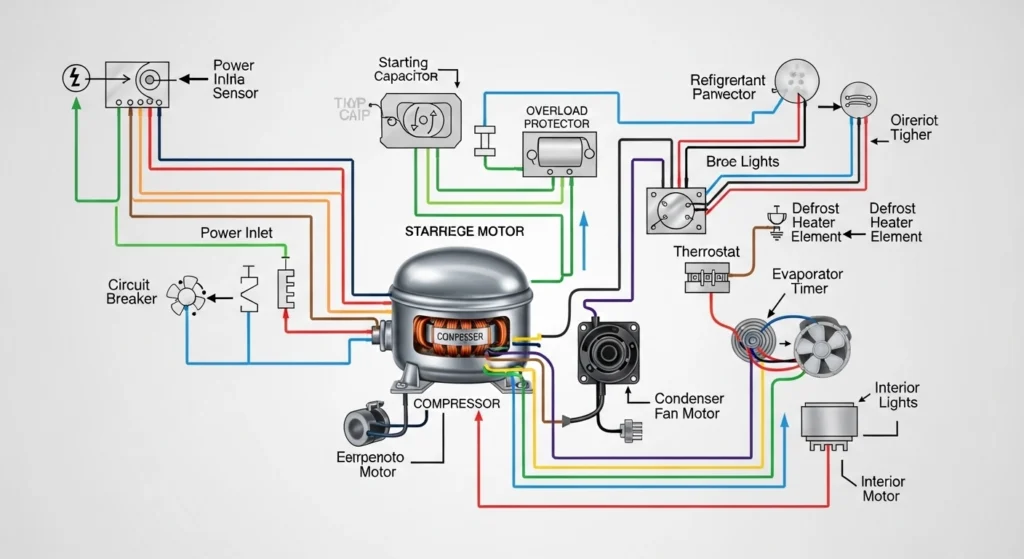
Depending on the refrigerator design, the system may include:
- Power cord and wiring
- Fuse or circuit protection
- Thermostat or electronic temperature sensor
- Compressor
- Overload protector
- Start relay or PTC relay
- Capacitor, where applicable
- Evaporator and condenser fans
- Defrost heater
- Defrost thermostat or sensor
- Electronic control board
- Interior lighting and switches
Not every refrigerator uses all of these components. The exact electrical arrangement depends on the refrigerator type and model.
Practical Example
Suppose the temperature inside a refrigerator rises above the selected setting.
The temperature-control system detects the increase and allows the compressor to start. The compressor then circulates refrigerant through the refrigeration system, allowing heat to be removed from the refrigerator compartment.
When the required temperature is reached, the control system stops the compressor or changes its operating state.
This automatic operation helps maintain the desired temperature without requiring the user to switch the compressor ON and OFF manually.
3. Working Principle of a Refrigerator Electrical System
The working principle of a refrigerator electrical system is based on supplying electrical power to the refrigerator and automatically controlling components such as the compressor, fans, and defrost system according to temperature and operating conditions.
The electrical system does not produce cooling by itself. Instead, it controls the electrical components that operate the refrigeration cycle.
Step-by-Step Working
Step 1: AC Power Enters the Refrigerator
Electrical power from the AC supply enters the refrigerator through the power cord and internal wiring.
Depending on the design, the incoming supply passes through appropriate protection and switching components before reaching the control and operating circuits.
Step 2: Temperature Is Monitored
A thermostat or electronic temperature sensor monitors the temperature inside the refrigerator.
In a mechanical system, the thermostat responds directly to temperature changes. In an electronic refrigerator, sensors send temperature information to a control board.
Step 3: Cooling Is Requested
When the internal temperature rises above the selected temperature, the control system determines that cooling is required.
It then provides the appropriate electrical command to operate the compressor.
Step 4: Compressor Starts
The compressor is the main electrical load responsible for driving the refrigeration cycle.
During startup, a start relay, PTC device, or other starting arrangement may be used to help the compressor motor start. Some refrigerator designs may also use a capacitor as part of the motor-starting or running circuit.
Step 5: Refrigeration Cycle Operates
Once the compressor is running, it circulates refrigerant through the refrigeration system.
The refrigerant passes through components such as:
- Compressor
- Condenser
- Expansion device
- Evaporator
The evaporator absorbs heat from inside the refrigerator, while the condenser releases that heat to the surrounding environment.
Step 6: Fans Operate When Required
Many modern refrigerators use fans to circulate air or improve heat transfer.
For example, an evaporator fan can circulate cold air through the refrigerator and freezer compartments. A condenser fan may also be used in some designs to improve condenser cooling.
Fan operation depends on the refrigerator’s design and control system.
Step 7: Required Temperature Is Reached
When the refrigerator reaches the desired temperature, the thermostat or electronic control system detects the condition.
The control system then stops the compressor or changes its operation according to the refrigerator design.
Step 8: Cooling Cycle Repeats
As warm air enters the refrigerator or heat naturally enters the compartment, the internal temperature gradually increases again.
When cooling is required, the control system starts the compressor again.
This repeated process maintains the refrigerator within the desired temperature range.
Simple Working Flow
AC Power Supply → Protection & Control Circuit → Temperature Sensor/Thermostat → Compressor Starting Circuit → Compressor → Refrigeration Cycle → Temperature Reached → Compressor Stops
The exact sequence can vary between mechanical and electronic refrigerator designs.
Easy Analogy
A refrigerator electrical system can be compared to an automatic water pump controlled by a float switch.
- When the water level becomes low → the pump starts.
- When the tank becomes full → the pump stops.
Similarly, in a refrigerator:
- Temperature becomes too high → cooling is required → compressor operates
- Desired temperature is reached → cooling demand decreases → compressor stops
The important point is that the compressor does not normally run continuously in a conventional refrigerator. Its operation is controlled according to the temperature and the refrigerator’s control system.
4. Types and Classification of Refrigerator Electrical Systems
Refrigerator electrical systems can be classified according to their control method, defrost method, and compressor technology. Different refrigerator models use different combinations of these systems depending on their design, efficiency requirements, temperature-control needs, and features.
Types Based on Control System
Mechanical Refrigerator Control System
A mechanical refrigerator uses a mechanical thermostat to control the compressor based on the temperature inside the refrigerator.
Main features include:
- Uses a mechanical thermostat.
- Controls the compressor through temperature-sensitive switching.
- Has a relatively simple electrical control arrangement.
- Generally easier to troubleshoot and repair.
- Common in older and basic refrigerator models.
In this system, the thermostat opens or closes its electrical contacts according to the internal temperature. When cooling is required, the contacts allow the compressor circuit to operate.
Electronic Refrigerator Control System
An electronic refrigerator uses temperature sensors, electronic control circuits, and a control board to manage refrigerator operation.
Main features include:
- Uses electronic temperature sensors.
- Uses a control board to process sensor information.
- Provides more precise temperature control.
- Can control compressors, fans, lighting, and defrost functions.
- Common in many modern refrigerators.
Electronic control systems can also provide additional functions such as digital temperature displays, alarm systems, automatic defrost control, and diagnostic features.
Types Based on Defrost System
Manual Defrost Refrigerator
A manual-defrost refrigerator does not automatically remove accumulated frost from the evaporator or freezer area.
Main features include:
- Frost gradually builds up during operation.
- Requires the user to switch off the refrigerator and remove accumulated ice.
- Has a relatively simple control system.
- Generally has fewer defrost-related electrical components.
Manual defrost systems are simple, but regular defrosting may be necessary to maintain effective cooling.
Automatic Defrost Refrigerator
An automatic-defrost system periodically removes accumulated frost without requiring the user to manually clean the evaporator.
Depending on the design, the system may use a defrost heater, temperature sensor or thermostat, and electronic control board or timer.
Main features include:
- Automatically removes accumulated frost.
- Uses a defrost heater in many designs.
- Uses a timer, control board, or electronic control system to initiate the defrost cycle.
- Reduces the need for manual defrosting.
- Common in frost-free refrigerators.
During a defrost cycle, the compressor may stop while the defrost heater operates for a controlled period. Once the required conditions are reached, the system ends defrosting and returns to normal cooling operation.
Types Based on Compressor Technology
Fixed-Speed Compressor
A fixed-speed or conventional compressor operates at a relatively fixed motor speed when it is running.
Main features include:
- Operates at a fixed speed.
- Typically starts and stops according to cooling demand.
- Uses a relatively simple control arrangement.
- Common in conventional refrigerators.
- Can have higher starting current than an inverter compressor.
The compressor runs when cooling is required and stops when the desired temperature is reached.
Inverter Compressor
An inverter refrigerator uses an inverter drive to vary the compressor motor speed according to cooling demand.
Main features include:
- Compressor speed can be adjusted according to cooling requirements.
- Can operate at lower speeds for longer periods instead of frequently switching fully ON and OFF.
- Can provide more stable temperature control.
- Generally produces less operating noise under suitable conditions.
- Can improve energy efficiency compared with conventional fixed-speed operation.
The actual energy savings depend on the refrigerator design, ambient temperature, usage pattern, and operating conditions.
Other Common Refrigerator Electrical Control Arrangements
Direct-Control System
In a simple refrigerator, the thermostat or control circuit directly controls the compressor circuit.
This arrangement has fewer electronic components and is relatively straightforward to understand and troubleshoot.
Electronic Control Board System
Modern refrigerators may use a central electronic control board to coordinate multiple functions.
The control board can receive information from temperature sensors and control:
- Compressor operation
- Evaporator fan
- Condenser fan, where fitted
- Defrost heater
- Interior lighting
- Alarms and indicators
- Other electronic functions
This type of system provides greater flexibility but can be more complex to diagnose.
Quick Comparison of Refrigerator Electrical Systems
| Classification | Type | Main Characteristic |
|---|---|---|
| Control System | Mechanical | Uses a mechanical thermostat |
| Control System | Electronic | Uses sensors and electronic controls |
| Defrost System | Manual Defrost | Frost is removed manually |
| Defrost System | Automatic Defrost | Frost is removed automatically |
| Compressor Technology | Fixed-Speed | Compressor operates at a relatively fixed speed |
| Compressor Technology | Inverter | Compressor speed varies according to cooling demand |
A refrigerator can combine different technologies. For example, a modern frost-free refrigerator may use an electronic control system, automatic defrost, and an inverter compressor in the same appliance.
5. Main Components of a Refrigerator Electrical System
Understanding the main components of a refrigerator electrical system is important for learning how a refrigerator receives electrical power, controls temperature, operates the compressor and fans, performs defrosting, and protects its electrical components.
The exact components vary by refrigerator model. A basic refrigerator may use a mechanical thermostat and start relay, while a modern refrigerator may use temperature sensors, an electronic control board, inverter electronics, multiple fans, and automatic defrost controls.
Compressor
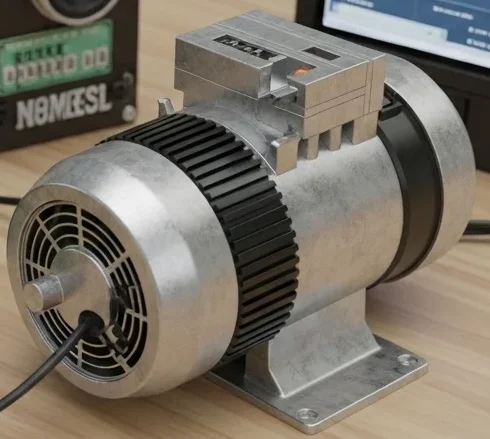
The compressor is the main electrically driven component of the refrigeration system. Its motor drives the compressor mechanism, which circulates refrigerant through the refrigeration circuit.
Main functions:
- Compresses the low-pressure refrigerant vapor.
- Raises the pressure and temperature of the refrigerant.
- Circulates refrigerant through the refrigeration system.
- Enables continuous heat transfer between the evaporator and condenser.
The compressor is not simply an electrical pump; it is a motor-driven refrigeration component that performs the compression process required for the cooling cycle.
Thermostat or Temperature Sensor
The thermostat or temperature sensor monitors the temperature inside the refrigerator and helps control the cooling operation.
Mechanical refrigerators commonly use a thermostat, while modern electronic refrigerators generally use temperature sensors connected to a control board.
Main functions:
- Detects changes in internal temperature.
- Determines when cooling is required.
- Helps control compressor operation.
- Maintains the selected temperature range.
- Provides temperature information to the electronic control system in modern refrigerators.
In a mechanical system, the thermostat can directly switch the compressor circuit. In an electronic system, the sensor normally sends a signal to the control board.
Compressor Start Relay or PTC Relay
A start relay helps the compressor motor start when electrical power is applied. Many household refrigerators use a PTC relay or another starting device rather than a conventional electromagnetic relay.
Main functions:
- Assists the compressor motor during startup.
- Provides the required starting circuit arrangement.
- Changes the motor winding connection after startup, depending on the design.
- Helps the compressor reach normal operating speed.
The exact starting method depends on the compressor design. Some systems also use a capacitor as part of the compressor motor circuit.
Capacitor
A capacitor may be used in certain refrigerator compressor or fan-motor circuits. Its purpose depends on the particular motor and electrical design.
Possible functions include:
- Providing phase shift in suitable motor circuits.
- Supporting motor starting.
- Improving motor operating characteristics.
- Supporting auxiliary winding operation where required.
Not every refrigerator uses the same type of capacitor, and some compressor designs do not require a separate external capacitor. Therefore, the correct capacitor specification must always match the appliance design.
Overload Protector
The overload protector protects the compressor motor from excessive current and overheating.
It is commonly connected in the compressor electrical circuit and can interrupt power when the compressor temperature or current becomes excessively high.
Main functions:
- Protects the compressor against overload conditions.
- Helps prevent excessive motor temperature.
- Interrupts the circuit during abnormal operating conditions.
- Automatically resets in many refrigerator designs after cooling.
An overload protector can operate because of conditions such as a locked compressor, excessive current, high ambient temperature, or other abnormal operating conditions.
Defrost Timer or Electronic Control Board
The defrost control system manages the automatic defrost process in refrigerators that use automatic or frost-free defrosting.
Older systems may use a mechanical timer, while modern refrigerators commonly use an electronic control board together with temperature sensors.
Main functions:
- Initiates the defrost cycle at appropriate intervals.
- Controls the operation of the defrost heater.
- Coordinates compressor and fan operation during defrosting.
- Ends the defrost cycle when the required temperature or time condition is reached.
- Helps prevent excessive frost accumulation on the evaporator.
A properly functioning defrost system is important because excessive frost can restrict airflow and reduce cooling performance.
Defrost Heater
The defrost heater is used in many frost-free refrigerators to melt frost that accumulates on the evaporator.
During the defrost cycle, the compressor is normally stopped and the heater operates for a controlled period.
Main functions:
- Melts accumulated frost from the evaporator.
- Maintains proper airflow through the evaporator area.
- Supports efficient cooling after the defrost cycle.
- Prevents excessive ice accumulation.
The heater is controlled by the refrigerator’s defrost-control system and is not continuously energized during normal cooling operation.
Evaporator Fan Motor
The evaporator fan motor circulates cold air through the refrigerator or freezer compartments in many frost-free designs.
Main functions:
- Circulates cold air inside the appliance.
- Helps distribute cooling more evenly.
- Improves heat transfer at the evaporator.
- Supports temperature consistency between compartments where applicable.
If the evaporator fan fails, the refrigerator may experience poor airflow and uneven cooling even when the compressor is operating.
Condenser Fan Motor
Some refrigerators use a condenser fan motor to improve airflow around the condenser and compressor compartment.
Main functions:
- Moves air across the condenser.
- Helps remove heat from the refrigerant.
- Supports proper condenser operation.
- Helps control the temperature of components in the machine compartment.
Not all refrigerators use a separate condenser fan. Its presence depends on the appliance design.
Electronic Control Board
Modern refrigerators often contain an electronic control board that coordinates several electrical functions.
The control board receives information from sensors and controls different components according to programmed operating conditions.
It may control:
- Compressor operation
- Evaporator fan
- Condenser fan
- Defrost heater
- Interior lighting
- Temperature-control functions
- Alarms and indicators
- Communication with user-interface components
Because several refrigerator functions may depend on the control board, a failure in this component can affect multiple operations.
Power Supply and Wiring
The refrigerator requires a properly designed power supply and wiring system to deliver electrical energy to its control and operating components.
The wiring connects components such as the compressor, thermostat, sensors, fans, heaters, relays, and control board.
Important functions include:
- Delivering electrical power to the appliance.
- Connecting control and operating circuits.
- Providing appropriate circuit protection.
- Maintaining reliable electrical connections.
- Supporting safe operation of the refrigerator.
All wiring and protective components must be correctly rated for the refrigerator’s electrical requirements.
6. Advantages of a Refrigerator Electrical System
A properly designed refrigerator electrical system provides automatic control, protection, reliable operation, and efficient management of the cooling process.
Automatic Temperature Control
The system automatically responds to temperature changes and controls the compressor or other cooling components as required. This reduces the need for manual operation.
Energy-Efficient Operation
Modern electronic controls and inverter compressor systems can adjust operation according to cooling demand. This can reduce unnecessary energy consumption compared with some conventional operating methods.
Electrical and Thermal Protection
Components such as overload protectors, fuses, and appropriate control circuits help protect the refrigerator from abnormal electrical or thermal conditions.
Automatic Defrosting
Frost-free refrigerators can automatically operate a defrost cycle, reducing the need for manual ice removal and helping maintain proper airflow.
Improved Temperature Stability
Electronic sensors and control systems can provide more precise monitoring of internal temperature, helping maintain suitable operating conditions.
Reduced Manual Effort
Automatic compressor control, defrosting, fan operation, and electronic monitoring reduce the amount of manual maintenance and operation required from the user.
Integration with Modern Technology
Advanced refrigerators can incorporate digital displays, electronic sensors, inverter compressors, alarms, diagnostic functions, and other smart features.
7. Disadvantages and Limitations of a Refrigerator Electrical System
Although modern refrigerator electrical systems provide many benefits, they also have certain limitations.
Electrical Faults Can Stop Cooling
A failure in an important electrical component such as the compressor circuit, control board, start device, thermostat, or power supply can prevent the cooling system from operating correctly.
More Complex Troubleshooting
Modern refrigerators can contain multiple sensors, electronic boards, motors, relays, and control circuits. Diagnosing a fault may therefore require electrical knowledge and suitable test equipment.
Control Board Failure Can Be Expensive
Electronic control boards can be relatively expensive to replace. A fault in the board may also affect several refrigerator functions at the same time.
Voltage Fluctuations Can Cause Problems
Unstable or incorrect supply voltage can affect electrical and electronic components. Suitable protection and a correctly rated power supply are important for reliable operation.
Higher Cost of Advanced Systems
Refrigerators with inverter compressors, electronic controls, multiple sensors, and smart features generally have more complex and potentially more expensive electrical systems than basic models.
Electronic Components Require Proper Handling
Sensors, control boards, inverter circuits, and other electronic components can be sensitive to electrical faults, moisture, overheating, and incorrect connections. Proper diagnosis and replacement procedures are therefore important.
Overall Assessment
The electrical system is essential for the safe, automatic, and efficient operation of a refrigerator. Although advanced systems can be more complex and expensive to repair, they provide better temperature control, automatic defrosting, improved monitoring, and greater energy-management capabilities.
8. Applications of a Refrigerator Electrical System
The refrigerator electrical system is used in a wide range of refrigeration equipment. Its main purpose is to provide electrical power, control cooling components, regulate temperature, operate fans and defrost systems, and protect the equipment during operation.
The complexity of the electrical system depends on the type and size of the refrigeration equipment.
Residential Applications
Refrigerator electrical systems are commonly used in household appliances for food and beverage storage.
Examples include:
- Domestic refrigerators
- Freezer compartments
- Deep freezers
- Water coolers
- Beverage refrigerators
- Household ice makers
In residential appliances, the electrical system controls components such as the compressor, temperature-control system, fans, lighting, and automatic defrost system where provided.
Commercial Refrigeration Applications
Commercial refrigeration equipment requires reliable electrical control because it often operates for long periods and stores large quantities of temperature-sensitive products.
Common applications include:
- Supermarket refrigerators
- Display refrigerators
- Commercial freezers
- Beverage coolers
- Restaurant refrigeration equipment
- Refrigerated storage cabinets
- Ice-making equipment
These systems may use electronic controllers, temperature sensors, multiple fans, and advanced protection devices.
Industrial Refrigeration Applications
Large industrial facilities use refrigeration systems for production, processing, storage, and temperature control.
Examples include:
- Cold storage facilities
- Food processing plants
- Industrial freezers
- Ice production plants
- Large refrigerated warehouses
- Dairy processing facilities
- Industrial cooling systems
Industrial refrigeration systems generally require more advanced electrical controls, monitoring systems, motor protection, and safety devices than small household refrigerators.
Medical and Laboratory Refrigeration
Temperature-controlled refrigeration is important in healthcare and laboratory environments where certain products must be stored within specific temperature ranges.
Applications include:
- Vaccine storage refrigerators
- Medical refrigerators
- Laboratory refrigerators
- Pharmaceutical storage equipment
- Blood-bank refrigeration systems
These systems may include temperature alarms, monitoring sensors, backup systems, and electronic controllers to help maintain the required storage conditions.
Smart Refrigerator Applications
Modern smart refrigerators combine conventional refrigeration technology with electronic controls and connected features.
Common features include:
- Digital temperature monitoring
- Electronic control boards
- Touchscreen or digital displays
- Temperature sensors
- Remote monitoring
- Internet or Wi-Fi connectivity
- Fault and door-open alerts
These features allow users to monitor refrigerator conditions more conveniently.
Overall Applications
The refrigerator electrical system is therefore used in homes, supermarkets, restaurants, industrial facilities, medical environments, laboratories, and smart appliances. Its specific design depends on the cooling capacity, temperature requirements, control method, and operating environment.
9. Comparison of Mechanical and Electronic Refrigerator Systems
Mechanical and electronic refrigerator systems perform the same basic purpose—controlling refrigeration operation—but they use different methods to monitor temperature and control electrical components.
Difference Between Mechanical and Electronic Refrigerator Systems
| Feature | Mechanical Refrigerator System | Electronic Refrigerator System |
|---|---|---|
| Temperature Control | Mechanical thermostat | Electronic sensors and control board |
| Control Method | Thermostat contacts switch the circuit | Electronic controller processes sensor signals |
| Temperature Accuracy | Generally lower | Generally more precise |
| System Complexity | Simple | More complex |
| Initial Cost | Usually lower | Usually higher |
| Troubleshooting | Relatively simple | Requires more technical diagnosis |
| Maintenance | Generally easier | Can require specialized knowledge |
| Defrost Control | May use a simple timer or manual system | Can be electronically controlled |
| Temperature Display | Usually not available | Common in modern models |
| Energy Management | Basic | Can provide advanced control |
| Additional Features | Limited | Supports alarms, sensors, diagnostics, and smart functions |
| Inverter Compatibility | Generally limited | Can support inverter-based systems |
| Remote Monitoring | Normally unavailable | Possible in connected models |
Mechanical Refrigerator System
A mechanical system relies mainly on a thermostat and electromechanical components. When the internal temperature changes, the thermostat mechanically operates its electrical contacts to control the compressor.
Main advantages:
- Simple design
- Lower component cost
- Easier basic troubleshooting
- Less electronic complexity
However, mechanical systems generally provide fewer advanced monitoring and control features.
Electronic Refrigerator System
An electronic system uses temperature sensors and a control board to monitor conditions and control different refrigerator components.
The control system can manage:
- Compressor operation
- Fan motors
- Defrost cycles
- Temperature display
- Alarms
- Lighting
- Other electronic functions
Electronic systems provide more precise and flexible control, but they can be more complex to diagnose and repair.
Which System Is Better?
Neither system is universally better for every application. A mechanical system can be suitable where simplicity, low cost, and easy maintenance are priorities. An electronic system is more suitable when precise temperature control, automatic functions, energy management, diagnostics, or smart features are required.
The overall performance also depends on the refrigerator’s compressor, insulation, refrigeration design, operating conditions, and maintenance—not only on whether its controls are mechanical or electronic.
10. Selection Guide for a Refrigerator Electrical System
Choosing the right refrigerator depends on more than just cooling capacity. The electrical control system, compressor type, energy efficiency, maintenance requirements, and available features should also be considered. The best choice depends on whether the refrigerator is intended for home use, commercial refrigeration, or industrial applications.
Important Factors to Consider
Before selecting a refrigerator, consider the following factors:
- Power consumption: Choose a model with good energy efficiency to reduce electricity costs.
- Compressor type: Inverter compressors can adjust their speed according to cooling demand and may provide better energy efficiency.
- Usage: Residential, commercial, and industrial applications have different cooling and operating requirements.
- Temperature control: Electronic control systems generally provide more precise temperature management.
- Budget: Consider both the initial purchase price and long-term operating costs.
- Maintenance requirements: A simpler system may be easier and less expensive to troubleshoot and repair.
- Voltage compatibility: Make sure the refrigerator is designed for the available supply voltage and frequency.
- Safety features: Look for suitable overload protection, proper grounding, and other electrical protection features.
- Defrost system: Frost-free refrigerators require an automatic defrost system to maintain proper evaporator airflow.
- Available space: Check the refrigerator size and ensure there is enough ventilation around the condenser area.
When to Choose a Mechanical System
A mechanical refrigerator control system may be suitable when:
- A lower initial cost is important.
- Simple temperature control is sufficient.
- Easy basic troubleshooting is preferred.
- Advanced electronic features are not required.
- The refrigerator is used in a simple residential or basic commercial application.
Mechanical systems have fewer electronic control components, which can make basic diagnosis easier. However, they may provide fewer advanced features than modern electronic systems.
When to Choose an Electronic System
An electronic refrigerator system is a better choice when:
- More precise temperature control is required.
- Energy efficiency is an important consideration.
- Automatic defrost is required.
- Digital temperature displays are useful.
- Alarm and diagnostic functions are needed.
- Smart or connected features are desired.
- An inverter compressor is being used.
Electronic systems can monitor temperature through sensors and adjust refrigerator operation according to cooling demand. They are common in modern refrigerators and advanced commercial refrigeration equipment.
When to Choose an Inverter Refrigerator
An inverter refrigerator can be considered when:
- Long-term energy efficiency is important.
- The refrigerator operates for many hours each day.
- More stable temperature control is desired.
- Reduced compressor cycling is preferred.
- Variable-speed compressor operation is beneficial.
An inverter system can change compressor speed according to cooling demand instead of simply switching the compressor fully on and off. Actual energy savings depend on the refrigerator design, ambient temperature, usage, installation, and maintenance.
Tips for Beginners
When selecting or installing a refrigerator, beginners should:
- Check the rated voltage and frequency.
- Use the correct electrical supply and protection.
- Ensure proper grounding for electrical safety.
- Avoid using unsuitable extension cords or overloaded outlets.
- Leave sufficient ventilation around the refrigerator.
- Check the energy-efficiency rating before purchasing.
- Consider an inverter model when lower energy consumption is a priority.
- Follow the manufacturer’s installation and maintenance instructions.
11. Common Refrigerator Electrical Problems and Solutions
Refrigerator electrical problems can affect cooling, compressor operation, defrosting, fans, lighting, and temperature control. Some faults are simple, such as a disconnected power supply, while others may involve the compressor, relay, sensors, control board, or wiring.
Before troubleshooting, disconnect the refrigerator from the power supply when inspection requires access to electrical components. Refrigerators contain mains voltage and components that may become hot during operation, so electrical repairs should be performed by a qualified technician.
Refrigerator Not Cooling
Possible Causes:
- No electrical power
- Faulty thermostat or temperature sensor
- Compressor not operating
- Defective start relay or starting device
- Overload protector opening repeatedly
- Control board fault
- Evaporator fan not operating
- Defrost system problem
- Refrigeration-system fault
Possible Solutions:
- Check the power supply and outlet.
- Check whether the refrigerator receives the correct voltage.
- Inspect the thermostat or temperature sensor.
- Check the compressor starting circuit.
- Inspect the overload protector.
- Check evaporator and condenser fans where fitted.
- Inspect the defrost system in frost-free models.
- If the compressor operates but cooling remains poor, have the sealed refrigeration system checked by a qualified technician.
A refrigerator that has power but does not cool should not automatically be assumed to have a compressor fault. Several electrical and refrigeration-related problems can produce similar symptoms.
Compressor Not Starting
Possible Causes:
- Faulty start relay or PTC device
- Overload protector problem
- Wiring or connection fault
- Low or incorrect supply voltage
- Compressor motor problem
- Control board not supplying the required command
- Capacitor fault where a capacitor is used
Possible Solutions:
- Check the incoming power supply.
- Inspect wiring and electrical connections.
- Test the start relay or PTC device.
- Check the overload protector.
- Test the capacitor if the refrigerator design uses one.
- Check whether the control system is providing the required compressor command.
- Have the compressor motor tested if the starting components are operating correctly.
Not every refrigerator uses a separate compressor-start capacitor, so technicians should always check the manufacturer’s circuit and component specifications before replacing parts.
Excessive Ice or Frost Buildup
Possible Causes:
- Defrost heater failure
- Defrost sensor or thermostat fault
- Electronic control board problem
- Defrost timer fault in systems that use one
- Evaporator fan problem
- Door gasket leakage
- Door being left open frequently
Possible Solutions:
- Inspect the defrost heater.
- Check the defrost thermostat or temperature sensor.
- Test the defrost control circuit.
- Check the control board where applicable.
- Inspect the evaporator fan.
- Check the door gasket for air leakage.
- Make sure the refrigerator door closes properly.
Heavy frost can restrict airflow across the evaporator and reduce cooling performance. Simply removing the ice may provide temporary improvement if the underlying defrost problem is not repaired.
Refrigerator Making Unusual Noise
Possible Causes:
- Evaporator fan motor problem
- Condenser fan motor problem
- Compressor vibration
- Loose mounting components
- Ice contacting a fan blade
- Refrigerant flow or normal operating sounds
Possible Solutions:
- Check whether a fan blade is contacting ice or another component.
- Inspect fan motors for abnormal noise.
- Tighten loose mounting parts where appropriate.
- Check compressor mounting and vibration.
- Make sure the refrigerator is standing level.
- Have unusual compressor or sealed-system noises inspected by a qualified technician.
Some clicking, humming, bubbling, or occasional sounds can be normal during refrigerator operation. The important factor is whether the noise is new, unusually loud, or accompanied by a cooling problem.
High Electricity Consumption
Possible Causes:
- Poor door sealing
- Frequent door opening
- Dirty condenser area
- Excessive frost buildup
- Compressor operating continuously
- Faulty temperature control
- Poor ventilation around the refrigerator
- Aging or inefficient components
Possible Solutions:
- Check the door gasket for proper sealing.
- Clean the condenser area according to the manufacturer’s instructions.
- Make sure sufficient ventilation is available.
- Check the defrost system if excessive frost is present.
- Verify that the temperature setting is appropriate.
- Have continuous compressor operation investigated.
- Consider an efficient inverter model when replacing an older refrigerator.
High electricity consumption is not always caused by the compressor alone. Poor airflow, door leakage, excessive frost, incorrect temperature settings, and control-system faults can also increase operating time.
12. Future Trends in Refrigerator Electrical Systems
Refrigerator technology is continuing to develop as manufacturers focus on energy efficiency, precise temperature control, automation, connectivity, and environmental performance. Electrical and electronic systems are becoming more important because they allow refrigerators to respond automatically to changing cooling requirements.
Smart Refrigerators and IoT Connectivity
Smart refrigerators can use sensors, communication systems, and electronic control boards to provide additional monitoring and control features.
Depending on the model, smart functions may include:
- Remote temperature monitoring
- Mobile notifications
- Door-open alerts
- Fault or maintenance alerts
- Energy monitoring
- Connected appliance control
- Digital temperature management
These features can help users monitor refrigerator operation without physically checking the appliance.
Advanced Inverter Compressors
Inverter compressor technology is becoming increasingly common in modern refrigeration equipment. Instead of operating only at a fixed speed, an inverter-driven compressor can adjust its operating speed according to cooling demand.
This can help provide:
- Improved energy efficiency
- More stable temperatures
- Reduced frequent starting and stopping
- Lower operating noise in some designs
- Better adaptation to changing cooling loads
The actual performance depends on the compressor, inverter drive, refrigerator design, ambient conditions, and operating pattern.
Advanced Temperature Sensors
Future refrigerators are expected to use more accurate and strategically placed temperature sensors. Multiple sensors can monitor different areas of the refrigerator and provide information to the control system.
The controller can use this information to manage:
- Compressor operation
- Fan speed
- Defrost cycles
- Airflow
- Temperature stability
- Energy consumption
AI-Assisted Temperature Control
Artificial intelligence and advanced control algorithms may increasingly be used to analyze operating conditions and optimize refrigerator performance.
A smart control system could consider factors such as:
- Internal temperature
- Ambient temperature
- Door-opening frequency
- Cooling demand
- Compressor operating conditions
- Historical usage patterns
The goal is to provide the required cooling while avoiding unnecessary energy consumption.
Solar-Powered Refrigeration
Solar-powered refrigeration is especially useful in locations where grid electricity is limited or unreliable. Solar panels can provide electrical energy to refrigeration equipment through suitable power electronics and energy-storage systems.
These systems can be useful for:
- Remote food storage
- Off-grid homes
- Rural applications
- Medical and vaccine storage
- Emergency refrigeration
Proper system sizing, battery capacity, temperature requirements, and environmental conditions must be considered when designing a solar refrigeration system.
Eco-Friendly Refrigeration Technology
Future refrigerator designs are also focusing on refrigerants with lower environmental impact. Manufacturers are increasingly considering refrigerants and system designs that reduce greenhouse-gas impact while maintaining safe and efficient cooling.
Electrical control systems can support this development by improving compressor operation, temperature management, and overall energy efficiency.
Better Diagnostics and Predictive Maintenance
Modern electronic systems can monitor operating conditions and detect abnormal behavior. Future refrigerators may provide more advanced diagnostic information before a major failure occurs.
For example, the control system may identify unusual:
- Compressor operating time
- Temperature changes
- Fan operation
- Defrost behavior
- Sensor readings
- Electrical conditions
This can help technicians identify problems faster and reduce unnecessary component replacement.
Conclusion of Future Trends
The future of refrigerator electrical systems is moving toward greater energy efficiency, automation, connectivity, precise temperature control, and intelligent diagnostics. Inverter compressors, advanced sensors, smart controls, solar power, and improved refrigerant technologies are likely to play an important role in next-generation refrigeration systems.
These developments can make refrigerators more efficient and easier to monitor while helping reduce operating costs and environmental impact.
13. Conclusion
The refrigerator electrical system is the backbone of modern cooling technology. It controls temperature, manages power, and ensures safe and efficient operation. From simple mechanical systems to advanced electronic controls, each type serves different needs.
By understanding its working principle, components, and applications, you can easily troubleshoot problems and make better decisions when selecting or maintaining a refrigerator. As technology advances, electrical systems in refrigeration will continue to improve in efficiency and intelligence.
Keep learning and practicing—strong fundamentals in such systems will make you a skilled and confident electrical professional.