
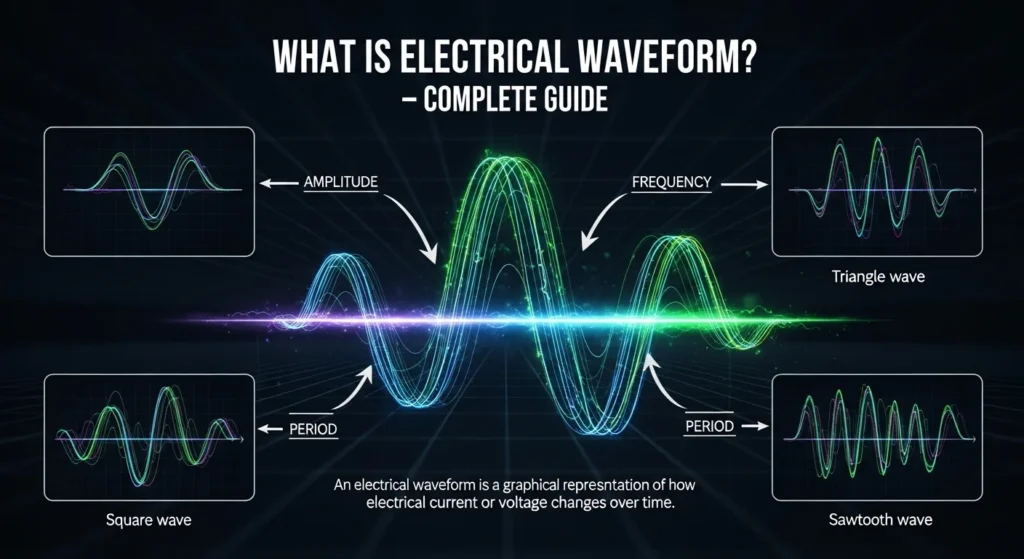

Imagine you are listening to music through your headphones. The sound you hear is actually an electrical signal traveling in a specific pattern. This pattern is called a waveform. Similarly, when electricity flows in your home wiring or electronic devices, it follows a certain shape over time—this is known as an electrical waveform.
Electrical waveforms are fundamental to understanding how electricity behaves in circuits. Whether it’s AC power in your home, signals in communication systems, or pulses in digital electronics, everything depends on waveform shapes.
Understanding what is electrical waveform is essential for electrical students, engineers, technicians, and beginners. It helps in analyzing circuits, designing systems, troubleshooting faults, and improving efficiency.
In this article, you will learn the complete electrical waveform working principle, types, components, applications, advantages and disadvantages, and practical insights. By the end, you will clearly understand how waveforms represent electrical signals and why they are critical in modern electrical and electronic systems.
2. What is Electrical Waveform?
An electrical waveform is a graphical representation of how voltage or current changes over time.
Simple Explanation
It shows how electrical signals rise and fall, repeat, or vary with time.
Practical Example
- The power supply in your home follows a sine wave
- A digital signal uses square waves
- Audio signals use complex waveforms
3. Working Principle
The electrical waveform working principle is based on how electrical signals vary with time.
Step-by-Step Explanation
- A voltage or current source generates an electrical signal
- The signal changes over time
- This variation is plotted on a graph
- X-axis → Time
- Y-axis → Voltage or Current
- The resulting shape is called a waveform
Example of a Sinusoidal Wave
y = A \sin(\omega t + \phi)
Where:
- A = Amplitude
- ω = Angular frequency
- t = Time
- φ = Phase angle
Easy Analogy
Think of ocean waves:
- Water rises and falls in a pattern
- Similarly, voltage rises and falls in a waveform
Key Points
- Waveform shape defines signal behavior
- Frequency determines how fast it repeats
- Amplitude shows signal strength
4. Types / Classification
Sinusoidal Waveform
- Smooth and continuous
- Most common in AC systems
Square Waveform
- Alternates between high and low levels
- Used in digital electronics
Triangular Waveform
- Linear rise and fall
- Used in signal processing
Sawtooth Waveform
- Gradual rise and sharp drop
- Used in timing circuits
Pulsed Waveform
- Short bursts of signals
- Used in communication systems
DC Waveform
- Constant value
- No variation with time
5. Main Components
Amplitude
- Maximum value of waveform
- Indicates signal strength
Frequency
- Number of cycles per second
- Measured in Hertz (Hz)
Time Period
- Time taken for one cycle
- Inverse of frequency
Phase
- Position of waveform relative to another
- Important in AC circuits
Wavelength
- Distance between repeating points
- Important in signal transmission
6. Advantages
Electrical Waveform Advantages
- Helps in analyzing electrical signals
- Essential for circuit design
- Improves signal understanding
- Enables accurate measurements
- Supports communication systems
- Helps in troubleshooting faults
7. Disadvantages / Limitations
Electrical Waveform Disadvantages
- Complex waveforms are difficult to analyze
- Requires instruments like oscilloscopes
- Distortion can affect performance
- Sensitive to noise and interference
- Requires proper interpretation skills
8. Applications
Electrical Waveform Applications
Home Applications
- AC power supply
- Audio systems
Industrial Applications
- Motor control systems
- Power electronics
- Signal processing
Modern Technology
- Communication systems
- Digital electronics
- Computers and microcontrollers
- Renewable energy systems
Waveforms are essential in all electrical and electronic systems.
9. Comparison Section
Difference Between Analog and Digital Waveforms
| Feature | Analog Waveform | Digital Waveform |
| Nature | Continuous | Discrete |
| Shape | Smooth | Square or pulse |
| Accuracy | High detail | Limited levels |
| Noise Sensitivity | High | Low |
| Application | Audio, signals | Computers, digital systems |
10. Selection Guide
Choosing the right waveform depends on application.
Tips for Beginners
- For power systems → Use sinusoidal waveform
- For digital circuits → Use square waveform
- For signal analysis → Choose appropriate waveform
Key Factors to Consider
- Application type
- Signal requirement
- Frequency range
- Noise sensitivity
- System efficiency
Practical Advice
- Use oscilloscopes to analyze waveforms
- Avoid distortion in signals
- Maintain proper frequency and amplitude
11. Common Problems & Solutions
What is waveform distortion?
Change in original waveform shape.
Use filters and proper design.
Why is waveform noisy?
External interference.
Use shielding and grounding.
Why frequency changes?
Unstable power supply.
Use stable sources.
How to measure waveform?
Using an oscilloscope.
Why waveform is important?
It represents signal behavior and performance.
12. Future Trends
Waveform technology is advancing rapidly.
Key Trends
- Digital Signal Processing (DSP): Advanced waveform control
- Smart Measurement Devices: Real-time waveform analysis
- AI-Based Systems: Automatic signal optimization
- High-Speed Communication: Complex waveform usage
- Renewable Energy Systems: Improved waveform quality
Future systems will focus on clean, efficient, and intelligent waveforms.
13. Conclusion
Understanding what is electrical waveform is fundamental for analyzing electrical and electronic systems. Waveforms represent how voltage and current change over time, making them essential for system design and troubleshooting.
By learning the electrical waveform working principle, types, and applications, you can better understand signal behavior and improve system performance. While waveforms can be complex, proper tools and knowledge make analysis easier.
As technology advances, waveform analysis will become even more important in communication, automation, and smart systems. Building strong knowledge in this area will help you grow as a skilled electrical engineer or technician.


Pingback: Skin Effect in Conductors: Causes & How to Reduce It
Pingback: AC vs DC: 15 Key Differences Explained Simply