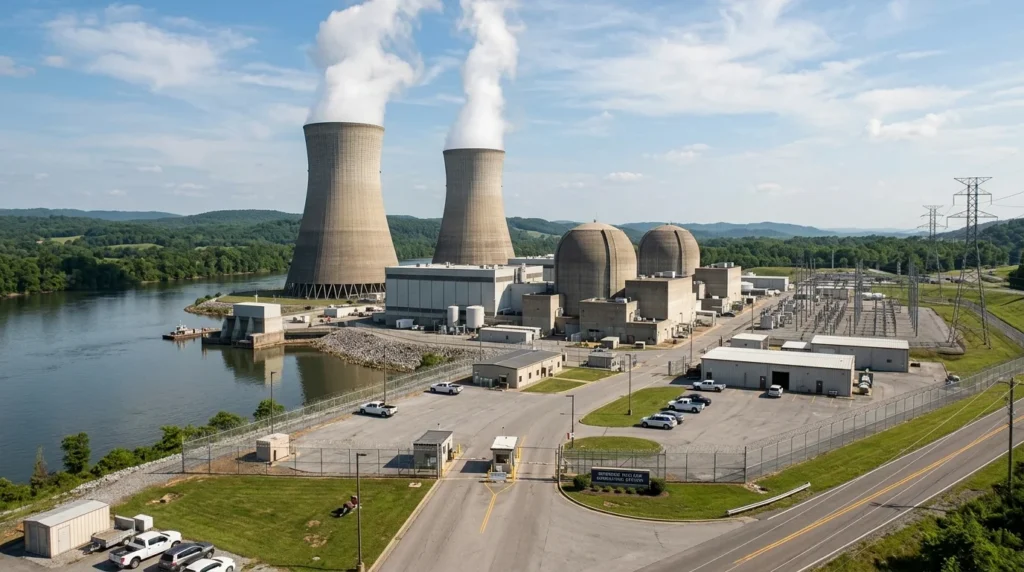

Imagine a city that never sleeps—factories running day and night, hospitals operating life-saving machines, and homes continuously powered even during peak demand. Behind part of this reliable electricity supply, one of the most powerful systems in the world is working silently: the nuclear power plant.
A nuclear power plant produces a huge amount of electricity using energy released from atoms. Unlike coal or gas plants, it does not burn fuel in the traditional way. Instead, it uses controlled nuclear reactions to generate heat, which is then converted into electricity.
This topic is very important for electrical students, engineers, and technicians because nuclear energy is a major part of global power systems. Understanding it helps you learn advanced power generation, safety systems, and energy conversion processes.
In this article, you will learn what a nuclear power plant is, how it works, its types, components, advantages, disadvantages, applications, and future trends in simple and clear language.
What is Nuclear Power Plant?
A nuclear power plant is a facility where electricity is generated by using heat produced from nuclear reactions, mainly nuclear fission.
Simple Definition
A nuclear power plant is a system that converts nuclear energy into electrical energy through heat and steam turbines.
Easy Explanation
Think of it like a very powerful kettle. Instead of gas or coal, the heat comes from splitting atoms. This heat produces steam, which rotates a turbine and generates electricity.
Practical Example
In many countries, nuclear plants supply electricity to millions of homes continuously without interruption. For example, one nuclear reactor can produce as much electricity as a large coal power station.
This is the basic idea behind the Nuclear Power Plant working principle.
Working Principle
The working of a nuclear power plant is based on:
Nuclear energy → Heat energy → Mechanical energy → Electrical energy
Step-by-Step Working Process
Nuclear Fission Reaction
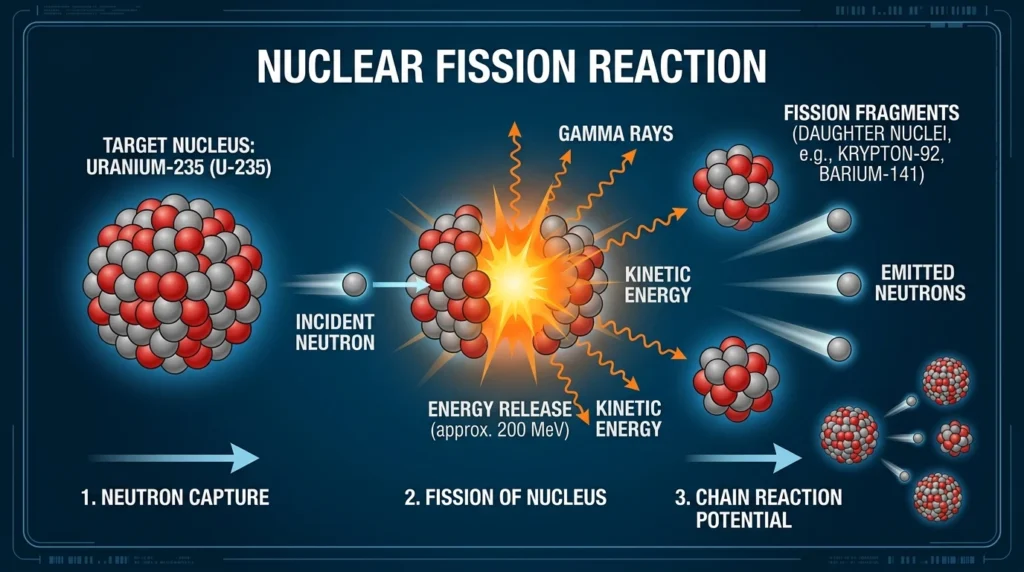
Nuclear Fission Reaction is a process in which the nucleus of a heavy atom, such as uranium or plutonium, splits into two or more smaller nuclei when struck by a neutron. During this reaction, a large amount of energy is released in the form of heat, along with additional neutrons that can trigger further fission reactions, creating a chain reaction. In nuclear power plants, the heat produced by nuclear fission is used to generate steam, which drives turbines connected to electrical generators. This process allows a small amount of nuclear fuel to produce a significant amount of electricity efficiently. Nuclear fission is widely used for large-scale power generation because of its high energy output and low greenhouse gas emissions during operation.
- Uranium atoms are split inside the reactor.
- This releases a large amount of heat energy.
Heat Transfer
- The heat is transferred to a coolant (usually water).
Steam Formation
- Water turns into high-pressure steam.
Turbine Rotation
- Steam rotates the turbine blades at high speed.
Electricity Generation
- The turbine drives a generator that produces electricity.
Cooling and Recycling
- Steam is cooled back into water and reused.
Simple Analogy
Imagine pressure cooker steam:
Heat creates steam
Steam pushes the lid
In a nuclear plant, steam pushes turbines instead of a lid.
Key Points
Small fuel → large energy output
Continuous energy production
Highly controlled reaction system
Types / Classification
Nuclear power plants are classified based on reactor design and coolant type.
Pressurized Water Reactor (PWR)
Pressurized Water Reactor (PWR) is the most widely used type of nuclear reactor for electricity generation. It uses ordinary water as both a coolant and a neutron moderator. The water in the reactor core is kept under very high pressure to prevent it from boiling, even at extremely high temperatures. Heat produced by nuclear fission is transferred from the primary water loop to a secondary loop through a steam generator. The steam produced in the secondary loop drives a turbine connected to an electrical generator, producing electricity. PWRs are known for their high safety, reliable operation, and efficient power generation, making them a common choice for nuclear power plants around the world.
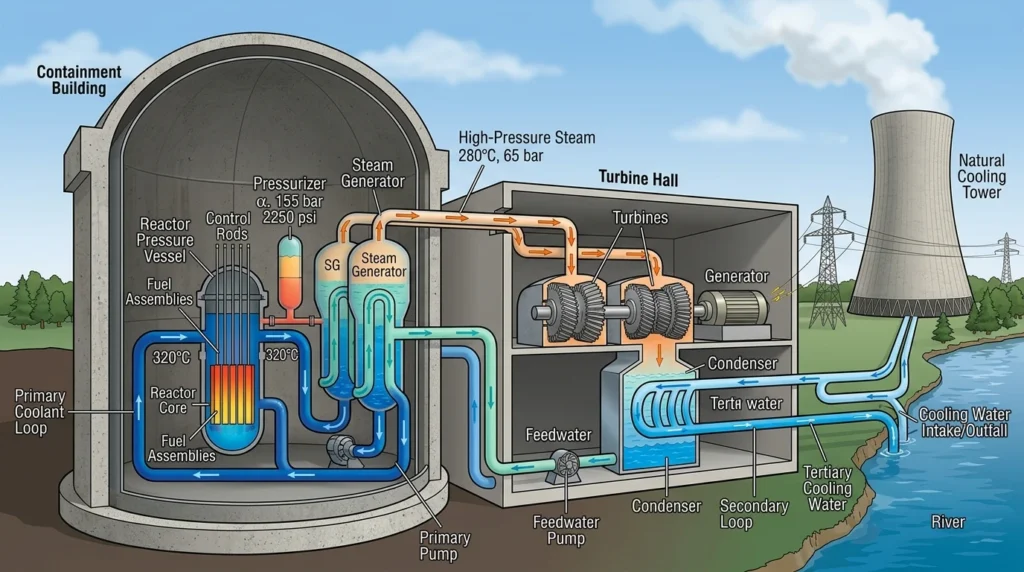
This is the most common type worldwide.
Uses high-pressure water as coolant
Water does not boil inside reactor
Heat is transferred to a secondary loop
Boiling Water Reactor (BWR)
In this type, water boils directly in the reactor.
Steam is produced inside the reactor
Simpler system design
Direct turbine operation
Heavy Water Reactor (HWR)
Uses heavy water (deuterium oxide) as moderator.
Efficient fuel usage
Can use natural uranium
Popular in some countries
Fast Breeder Reactor
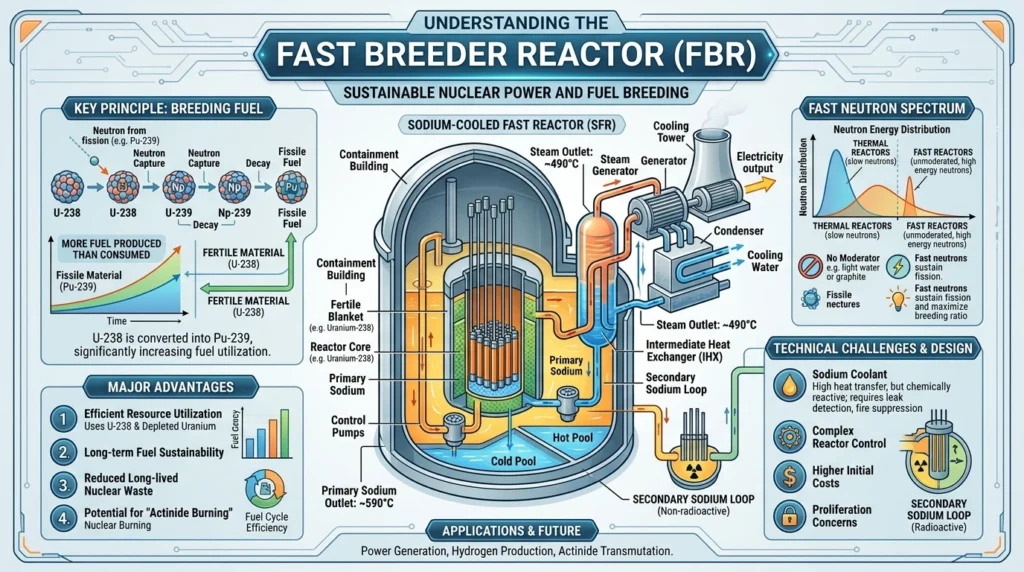
Fast Breeder Reactor (FBR) is a special type of nuclear reactor that not only generates electrical energy but also produces more nuclear fuel than it consumes. It operates using fast neutrons without a moderator, allowing the reactor to convert fertile materials such as uranium-238 or thorium into fissile fuel like plutonium-239. During operation, the heat generated by nuclear fission is transferred to a coolant, typically liquid sodium, which is then used to produce steam for driving turbines and electrical generators. Fast breeder reactors are highly efficient because they make better use of nuclear fuel resources and reduce nuclear waste. They are considered an important technology for the future of sustainable nuclear power generation due to their ability to extend fuel availability and improve overall energy production efficiency.
Produces more fuel than it consumes.
Uses fast neutrons
Highly efficient fuel cycle
Advanced nuclear technology
Each reactor type has different safety, efficiency, and design features.
Main Components
A nuclear power plant contains several critical systems:
Nuclear Reactor
The core where nuclear fission takes place and heat is produced.
Fuel Rods
Contain uranium or plutonium that undergo fission.
Moderator
Slows down neutrons to control reaction speed.
Control Rods
Absorb neutrons to control or stop the reaction.
Coolant
Transfers heat from reactor to steam generator.
Steam Generator
Converts water into steam using reactor heat.
Turbine
Steam rotates turbine blades to produce mechanical energy.
Generator
Converts mechanical energy into electrical energy.
Cooling Tower
Removes excess heat and cools water for reuse.
Shielding System
Protects workers and environment from radiation.
All these components work together in a highly controlled system.
Advantages
The Nuclear Power Plant advantages and disadvantages must be clearly understood.
Advantages:
Very high energy output from small fuel
Low greenhouse gas emissions
Continuous power generation (24/7)
Small fuel requirement
Low operating cost after setup
Reliable base-load electricity supply
Reduces dependence on fossil fuels
Nuclear energy is one of the most efficient large-scale power sources.
Disadvantages / Limitations
Despite its benefits, nuclear power has serious challenges:
High construction cost
Radioactive waste disposal issues
Risk of radiation accidents
Requires advanced safety systems
Long time for plant construction
Public safety concerns
Limited availability of fuel resources
These risks make nuclear energy highly controlled and strictly regulated.
Applications
The Nuclear Power Plant applications are mainly in large-scale energy systems.
Home Applications
Electricity supply for households
Urban grid power supply
Industrial Applications
Powering heavy industries
Steel, chemical, and manufacturing plants
Medical Applications
Production of medical isotopes
Cancer treatment (radiotherapy support systems)
Modern Technology Applications
Large data centers
Space research energy systems
Military naval ships (submarines and aircraft carriers)
Nuclear energy is mainly used for large-scale, continuous power demand.
Comparison Section
Difference Between Nuclear Power Plant and Thermal Power Plant
| Feature | Nuclear Power Plant | Thermal Power Plant |
| Energy Source | Nuclear fission | Coal, gas, oil |
| Fuel Requirement | Very low | Very high |
| Pollution | Very low emissions | High emissions |
| Initial Cost | Very high | Moderate |
| Safety Risk | High (radiation) | Medium (fire, pollution) |
| Efficiency | Very high energy density | Medium efficiency |
This clearly shows the difference between nuclear and thermal power plant.
Selection Guide
Choosing a nuclear power plant depends on several engineering and safety factors:
Availability of uranium fuel
National energy demand
Safety infrastructure
Government regulations
Cooling water availability
Skilled workforce availability
Environmental impact assessment
Tips for Beginners
Understand nuclear fission basics first
Learn reactor types and their differences
Focus on safety systems and control rods
Study energy conversion process clearly
Understand radiation protection principles
Common Problems & Solutions
Overheating of Reactor
Cause: Cooling system failure
Solution: Backup cooling systems and constant monitoring
Radiation Leakage Risk
Cause: Shielding failure or accidents
Solution: Strong containment structures and safety protocols
Radioactive Waste Storage
Cause: Long-term waste accumulation
Solution: Secure underground storage and reprocessing
Equipment Failure
Cause: High-pressure and temperature conditions
Solution: Regular maintenance and strict inspection
Operational Shutdown
Cause: Safety system activation
Solution: Automatic control and system reset procedures
Safety is the highest priority in nuclear engineering.
Future Trends
The future of nuclear power plants is moving toward safer and more efficient designs.
Key Trends:
Small Modular Reactors (SMRs)
Advanced safety reactor designs
Fusion energy research
Improved waste recycling methods
Digital monitoring and AI control systems
Higher efficiency fuel usage
Reduced construction time reactors
Nuclear energy is evolving toward safer, cleaner, and more flexible systems.
Conclusion
A nuclear power plant is one of the most powerful and efficient electricity generation systems in the world. It uses nuclear fission to produce heat, which is then converted into electricity through steam turbines and generators. Despite its high energy output and low emissions, it requires strict safety systems and careful handling of radioactive materials.
For electrical students and engineers, understanding nuclear power plants is essential because it represents advanced power generation technology used globally. While challenges like cost and safety exist, future innovations are making nuclear energy safer and more efficient.
With proper knowledge and control systems, nuclear power will continue to play a major role in meeting global energy demands.


Pingback: Types of Turbines: Complete Guide for Electrical Engineers
Pingback: Electrical Power Plant (Complete Engineering Guide)