
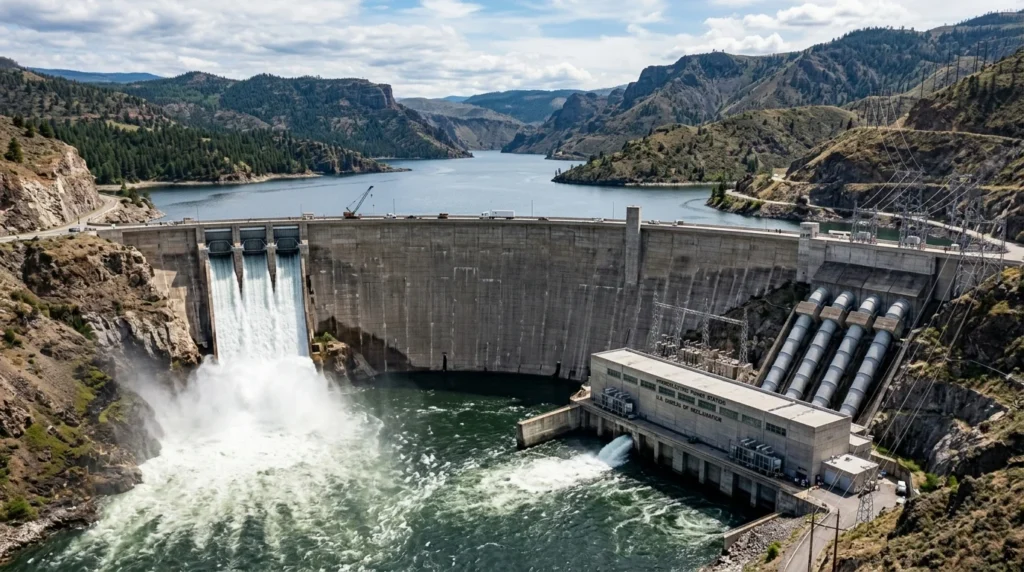

Imagine standing near a large dam. You hear rushing water being released with strong force, flowing through huge pipes, and then quietly inside a powerhouse electricity is being generated. That electricity travels hundreds of kilometers and lights up cities, runs industries, and powers homes. This is the real-world operation of a hydroelectric power plant.
Hydroelectric energy is one of the oldest and most reliable sources of electricity. It uses the natural flow of water to produce power, making it clean, renewable, and efficient. For countries with rivers and dams, it is a backbone of sustainable energy production.
This topic is extremely important for electrical students, engineers, and technicians because it explains how mechanical water energy is converted into electrical energy on a large scale. In this article, you will learn what a hydroelectric power plant is, how it works, its types, components, advantages, disadvantages, applications, and future trends in simple language.
What is Hydroelectric Power Plant?
A hydroelectric power plant is a facility that generates electricity by using the energy of flowing or falling water.
Simple Definition
A hydroelectric power plant is a system that converts water energy into electrical energy using turbines and generators.
Easy Explanation
Think of a river flowing from a high place to a low place. When this fast-moving water is directed through a turbine, it spins the turbine. This spinning motion produces electricity.
Practical Example
The Tarbela Dam in Pakistan uses water stored in a reservoir. When water is released, it flows through turbines and generates large amounts of electricity for the national grid.
This is the core idea behind the Hydroelectric Power Plant working principle.
Working Principle
The working of a hydroelectric power plant is based on a simple idea:
Potential energy of water → Mechanical energy → Electrical energy
Step-by-Step Working Process
Water Storage
- Water is stored in a dam or reservoir at a high level.
Water Release
- Gates are opened, and water flows down due to gravity.
Turbine Rotation
- Fast-moving water strikes turbine blades and rotates them.
Generator Operation
- The turbine is connected to a generator that converts mechanical energy into electricity.
Voltage Increase
- Transformers increase voltage for long-distance transmission.
Power Distribution
- Electricity is sent to homes, industries, and cities.
Simple Analogy
Imagine a water wheel in a river mill. The flowing water turns the wheel and does mechanical work. A hydroelectric plant works on the same principle but produces electricity instead of mechanical work.
Key Points
- Higher water height = more energy
- Faster water flow = more electricity
- Efficient turbine design = better output
Types / Classification
Hydroelectric power plants are classified based on structure and water usage.
Storage (Reservoir) Hydroelectric Plant
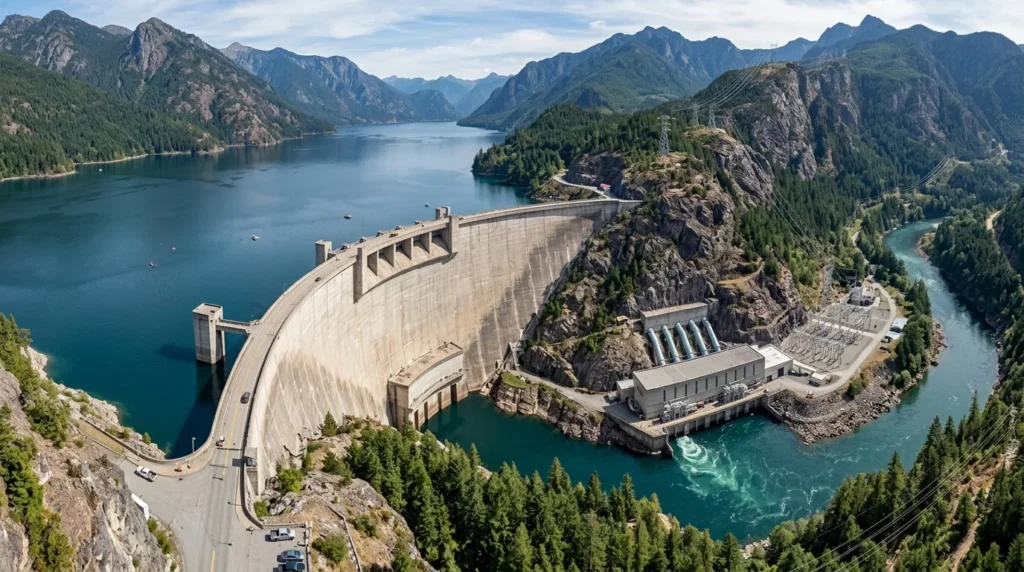
A storage (reservoir) hydroelectric plant generates electricity by storing water behind a dam in a large reservoir. When electricity is needed, water is released through gates and flows down to spin turbines connected to generators. The rotating turbines produce electricity, which is then transmitted to the power grid. This type of hydroelectric plant provides a reliable and controllable source of renewable energy and can meet both regular and peak electricity demands.
This type stores water in a large dam.
- Water is stored during low demand
- Released when electricity demand increases
- Provides stable and controlled power
Run-of-River Plant
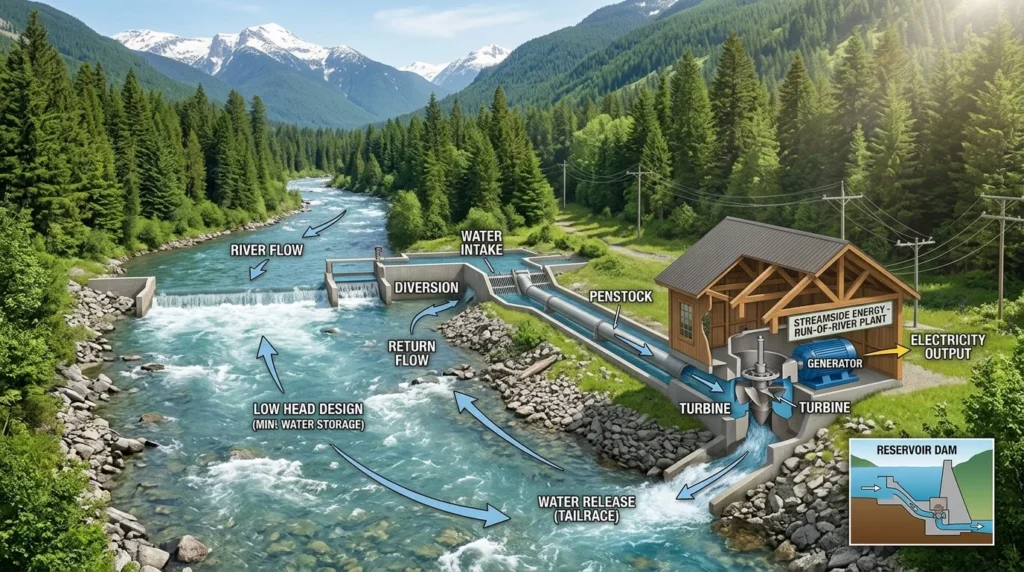
A run-of-river hydroelectric plant generates electricity by using the natural flow of a river without storing large amounts of water in a reservoir. River water is diverted through a canal or pipeline to spin turbines connected to generators. After producing electricity, the water is returned to the river. This type of hydroelectric plant has a lower environmental impact than large dam projects, but its electricity production depends on the river’s flow throughout the year.
This plant uses natural river flow.
- No large reservoir required
- Less environmental impact
- Power depends on river flow
Pumped Storage Plant
This system works like a battery.
- Water is pumped back to upper reservoir during low demand
- Released again during peak demand
- Used for energy storage and grid stability
Small Hydropower Plant
Used for local or rural electricity supply.
- Low capacity generation
- Suitable for remote areas
- Cost-effective for small communities
Each type plays a different role in the power system depending on demand and geography.
Main Components
A hydroelectric power plant consists of several important parts:
Dam
It stores water and creates a height difference (head) for energy generation.
Reservoir
It stores large quantities of water for controlled release.
Penstock
A large pipe that carries water from the dam to the turbine.
Turbine
Water strikes turbine blades and causes rotation.
Generator
Converts mechanical energy into electrical energy.
Surge Tank
Draft Tube
Helps recover pressure and improve efficiency.
Transformer
Increases voltage for transmission.
Powerhouse
Building that contains turbine and generator systems.
Each component works together to ensure smooth and efficient power generation.
Advantages
The Hydroelectric Power Plant advantages and disadvantages must be understood clearly.
Advantages:
- Renewable energy source (uses water)
- No fuel cost required
- Very low pollution
- High efficiency (up to 90%)
- Long operational life
- Low operating and maintenance cost
- Quick start and stop operation
- Helps in flood control and irrigation
Hydropower is one of the cleanest and most reliable energy sources available today.
Disadvantages / Limitations
Despite many benefits, hydroelectric plants also have limitations:
- High initial construction cost
- Requires suitable geographical location
- Large dam construction may affect ecosystems
- Displacement of local communities
- Depends on rainfall and water availability
- Sedimentation reduces dam capacity over time
These challenges must be carefully managed during planning and design.
Applications
The Hydroelectric Power Plant applications are widely seen in different sectors.
Home Applications
- Electricity supply for lighting and appliances
- Rural electrification projects
Industrial Applications
- Running factories and manufacturing units
- Powering heavy machinery
Agricultural Applications
- Irrigation systems
- Water pumping stations
Modern Technology Applications
- Smart grids and energy storage systems
- Electric vehicle charging infrastructure
- National power grid stabilization
Hydropower plays a major role in both developed and developing countries.
Comparison Section
Difference Between Hydroelectric Power Plant and Thermal Power Plant
| Feature | Hydroelectric Power Plant | Thermal Power Plant |
| Energy Source | Water | Coal, gas, oil |
| Pollution | Very low | High |
| Operating Cost | Very low | High fuel cost |
| Setup Cost | Very high | Moderate |
| Efficiency | High | Medium |
| Location Dependence | River/dam required | Flexible location |
This shows the difference between hydroelectric and thermal power plant clearly for better understanding.
Selection Guide
Choosing a hydroelectric power plant depends on several factors:
- Availability of water resources
- River flow rate and height difference
- Environmental impact assessment
- Electricity demand in the region
- Construction cost and budget
- Geological stability of the site
Tips for Beginners
- Understand the concept of head and flow rate
- Study turbine types (Kaplan, Francis, Pelton)
- Focus on energy conversion process
- Learn real-world dam examples
- Understand grid integration
Common Problems & Solutions
Low Water Flow
- Cause: Dry season or drought
- Solution: Reservoir storage management
Turbine Wear and Tear
- Cause: Continuous high-speed operation
- Solution: Regular maintenance and blade inspection
Sedimentation
- Cause: Sand and soil accumulation
- Solution: Dredging and sediment control systems
Cavitation in Turbines
- Cause: Low pressure zones in water flow
- Solution: Proper turbine design and pressure control
Dam Safety Issues
- Cause: Structural stress or water pressure
- Solution: Regular monitoring and reinforcement
These are real engineering challenges in hydro plants.
Future Trends
The future of hydroelectric power plants is evolving with modern technology.
Key Trends:
- Small-scale hydropower expansion
- Integration with smart grid systems
- Pumped storage as large-scale energy storage
- Eco-friendly dam designs
- Automation and remote monitoring
- Hybrid systems combining solar and hydro
- Improved turbine efficiency using advanced materials
Hydropower will continue to play a major role in clean energy transition.
Conclusion
A hydroelectric power plant is one of the most efficient and reliable systems for generating electricity using water energy. It works on a simple principle of converting the potential energy of water into mechanical energy and then into electrical energy. Due to its clean and renewable nature, it is widely used across the world.
Understanding its working, types, components, advantages, and limitations is essential for electrical students and engineers. While it requires high initial investment and specific geographical conditions, its long-term benefits make it one of the best energy solutions available.
Hydropower is not just a technology—it is a sustainable approach toward meeting global energy needs. With advancements in smart systems and eco-friendly designs, its importance will continue to grow in the future.



Pingback: 10 Synonyms for Generate (With Meanings & Examples)