
Imagine a large city on a hot summer afternoon. Thousands of homes are running air conditioners, factories are operating at full capacity, hospitals depend on uninterrupted electricity, and businesses cannot afford power failures. Behind this reliable electricity supply is a powerful network of transmission lines and grid stations. One of the most important parts of this network is the 500kV grid station, which transfers huge amounts of electrical power safely and efficiently over long distances.
A 500kV grid station plays a vital role in connecting power generation plants with regional and national electricity networks. It helps reduce transmission losses, improves system stability, and ensures reliable power delivery to millions of consumers. Without these high-voltage grid stations, modern power systems would struggle to meet growing electricity demand.
In this article, you will learn what a 500kV grid station is, its working principle, types, major components, advantages, disadvantages, applications, comparison with lower-voltage grid stations, selection guidelines, common problems and solutions, and future developments. Whether you are an electrical engineering student, technician, engineer, or beginner, this guide explains the topic in simple and practical English.
What is a 500kV Grid Station 2026
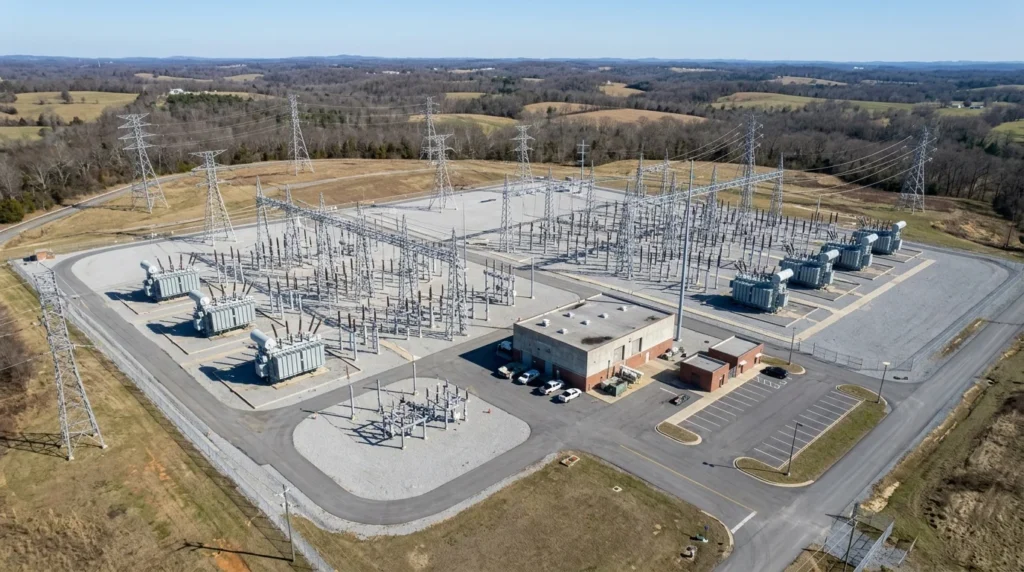
A 500kV grid station is a high-voltage electrical substation designed to receive, control, transform, and distribute electrical power at 500 kilovolts (kV). It serves as a connection point between power generation stations and lower-voltage transmission or distribution networks.
Simply put, a 500kV grid station acts like a major highway interchange for electricity. Just as vehicles move from one highway to another through an interchange, electrical power flows through the grid station before reaching different regions.
The main purpose of a 500kV grid station is to:
- Receive electricity from power plants.
- Switch transmission lines safely.
- Step up or step down voltage using transformers.
- Protect the electrical system during faults.
- Monitor and control power flow.
Practical Example
Suppose a hydroelectric power plant generates electricity that needs to travel 500 kilometers to a major city. Instead of sending electricity at a lower voltage, it is transmitted through a 500kV transmission system connected by a 500kV grid station. The high voltage reduces power losses during transmission. Near the city, another grid station lowers the voltage for further transmission and distribution.
500kV Grid Station Working Principle 2026
The 500kV grid station working principle is based on transmitting large amounts of electrical power at very high voltage. Increasing the transmission voltage allows the same power to be transferred with lower current, which generally reduces resistive transmission losses and improves the efficiency of long-distance power transmission.
The process can be compared to transporting water through a pipeline: a suitable pressure and pipeline system allows water to move efficiently over long distances. Similarly, high-voltage electrical networks enable large amounts of power to be transmitted efficiently when the system is properly designed.
Step-by-Step Working Process of a 500kV Grid Station
Power Generation at the Power Plant
Electricity is first generated at a power plant, such as a thermal, hydroelectric, nuclear, wind, or solar power facility.
Increasing Voltage to 500kV
A step-up power transformer increases the generated voltage to a suitable transmission level, such as 500kV, before electricity enters the long-distance transmission network.
Receiving Power at the 500kV Grid Station

The 500kV grid station receives electrical power through high-voltage transmission lines and manages the incoming and outgoing power flows.
Switching and Power Flow Control
Circuit breakers, isolators, and other switchgear control electrical circuits and allow transmission equipment to be safely isolated during faults, maintenance, or system switching operations.
Power Distribution Through 500kV Busbars
Busbars provide common electrical connection points for incoming and outgoing circuits and distribute power to different transmission lines and transformers.
Protection and Fault Detection
Protective relays, current transformers, voltage transformers, and monitoring systems continuously observe electrical conditions. If an abnormal condition or fault occurs, the protection system can command the appropriate circuit breaker to disconnect the affected section.
Voltage Reduction at Receiving Stations

At suitable receiving grid stations, power transformers reduce the voltage to lower transmission or distribution levels according to the requirements of downstream networks.
Electricity Distribution to Consumers
After voltage transformation through the appropriate network stages, electricity is supplied through distribution systems to residential, commercial, industrial, and other consumers.
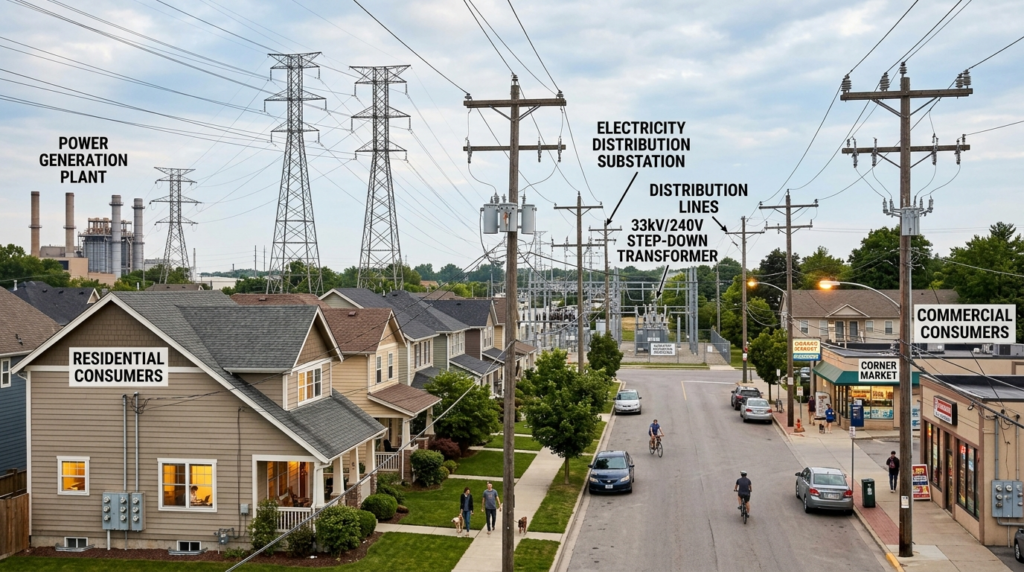
Simple 500kV Grid Station Working Flow
- Power generation
- Voltage increased to 500kV
- Long-distance transmission through high-voltage lines
- Switching and protection at grid stations
- Voltage reduction at receiving stations
- Supply to lower-voltage networks
- Distribution to consumers
This coordinated process helps provide safe, reliable, and efficient electricity transmission across large power networks.
Types of 500kV Grid Stations: AIS, GIS, Hybrid, Indoor and Outdoor Substations in 2026
Different types of 500kV grid stations are designed according to installation location, insulation technology, land availability, environmental conditions, and transmission system requirements. The main types include Air Insulated Substations (AIS), Gas Insulated Substations (GIS), hybrid substations, indoor grid stations, and outdoor grid stations.
Air Insulated Substation (AIS) for 500kV Power Transmission
An Air Insulated Substation (AIS) uses atmospheric air as the primary insulation medium between high-voltage electrical equipment and conductors.
Key Features of 500kV AIS Grid Stations
- Requires a large installation area
- Generally lower construction cost than GIS
- Easier access for inspection and maintenance
- Widely suitable for rural and open areas
- Allows straightforward future expansion
Gas Insulated Substation (GIS) for 500kV Power Transmission
A Gas Insulated Substation (GIS) uses enclosed switchgear with an insulating gas or gas mixture to provide electrical insulation and achieve a compact design. Traditional GIS commonly uses SF₆, while newer projects may consider alternative lower-environmental-impact insulating technologies.
Key Features of 500kV GIS Grid Stations
- Compact design
- Suitable for space-constrained urban locations
- High operational reliability
- Better protection of enclosed equipment from environmental pollution
- Requires less land than comparable AIS arrangements
Hybrid 500kV Grid Station Using AIS and GIS Technology
A hybrid grid station combines selected AIS and GIS equipment to achieve a balance between compactness, cost, operational flexibility, and available site space.
Key Features of Hybrid 500kV Grid Stations
- Saves installation space
- Can reduce cost compared with a complete GIS installation
- Flexible equipment configuration
- Suitable for sites with specific space and operational requirements
Indoor 500kV Grid Station for Space-Constrained Locations
An indoor grid station is installed inside specially designed buildings or enclosed facilities where environmental protection, land availability, or site conditions make indoor installation preferable.
Key Benefits of Indoor 500kV Grid Stations
- Better protection from environmental conditions
- Suitable for space-constrained locations
- Improved protection of equipment from pollution and weather exposure
Outdoor 500kV Grid Station for National Transmission Networks
Outdoor 500kV grid stations are installed in open areas and are commonly used for large-scale transmission systems where sufficient land is available.
Key Benefits of Outdoor 500kV Grid Stations
Convenient future expansion where additional land is available
Suitable for large transmission projects
Easier access to major outdoor equipment
Flexible equipment arrangement
Main Components 2026
A 500kV grid station contains several critical electrical, protection, control, and monitoring components. Each component performs a specific function to ensure reliable high-voltage power transmission, equipment protection, system stability, and safe station operation.
500kV Power Transformer and Its Functions
The power transformer changes voltage levels according to the requirements of the transmission system.
500kV Power Transformer Functions
- Step up voltage
- Step down voltage
- Support efficient long-distance power transmission
500kV Circuit Breaker and Its Functions
Circuit breakers interrupt electrical current when faults or abnormal operating conditions occur.
500kV Circuit Breaker Functions
- Protect electrical equipment
- Disconnect faulty sections
- Improve system safety and reliability
500kV Isolator or Disconnect Switch
An isolator provides visible electrical isolation of equipment during maintenance and servicing.
500kV Isolator Functions
- Enable safe equipment servicing
- Provide visible isolation
- Perform no-load switching
500kV Busbar System and Its Functions
Busbars connect multiple incoming and outgoing circuits within the grid station and provide flexible power-flow arrangements.
500kV Busbar Functions
- Distribute electrical power
- Provide flexible circuit connections
- Support reliable network operation
500kV Current Transformer (CT) and Its Functions
A Current Transformer (CT) safely reduces high transmission current to suitable levels for measurement, metering, monitoring, and protection systems.
500kV Current Transformer Functions
- Electrical metering
- Protection relay operation
- Current monitoring
500kV Voltage Transformer (VT) and Its Functions
A Voltage Transformer (VT) provides a reduced and measurable voltage signal for monitoring, metering, and protection applications.
500kV Voltage Transformer Functions
- Voltage measurement
- Protection relay operation
- System monitoring
500kV Lightning Arrester and Its Functions
Lightning arresters protect high-voltage equipment from lightning and switching surges by diverting excessive surge energy toward the earthing system.
500kV Lightning Arrester Functions
- Divert surge current to earth
- Protect insulation
- Reduce equipment damage from overvoltage surges
500kV Protective Relay and Its Functions
Protective relays continuously monitor electrical conditions and identify faults or abnormal operating states.
500kV Protective Relay Functions
- Identify electrical faults
- Send trip signals to circuit breakers
- Protect transformers and other equipment
- Support fast fault isolation
500kV Grid Station Control Room and Monitoring Systems
The control room provides centralized monitoring, protection, communication, and operational control for the grid station.
Main Control Room Equipment
- SCADA system
- Protection panels
- Communication equipment
- Monitoring displays
- Control and automation systems
500kV Grid Station Advantages, Disadvantages, Applications and Power Transmission Benefits in 2026
Understanding the advantages, disadvantages, limitations, and applications of 500kV grid stations is important for studying modern high-voltage power transmission systems. A 500kV grid station can support large-scale electricity transfer over long distances and play a major role in national and regional transmission networks.
Advantages of 500kV Grid Stations for Long-Distance Power Transmission
- Efficient long-distance power transmission
- Lower transmission losses for comparable power transfer
- Improved voltage stability
- High system reliability
- Supports national and regional transmission networks
- Enables transfer of large amounts of electrical power
- Effective fault isolation and protection
- Improved power system performance
- Advanced monitoring and control capabilities
- Supports large-scale renewable energy integration
- Can reduce transmission-related operating costs over the system lifetime
- Enhances overall grid stability
Disadvantages and Limitations of 500kV Grid Stations
Despite their significant benefits, 500kV grid stations also involve considerable technical, financial, land, maintenance, and safety requirements.
- Very high installation and construction costs
- Large land requirement, particularly for outdoor AIS installations
- Requires highly skilled engineers and technicians
- Strict electrical safety and clearance requirements
- Expensive high-voltage equipment
- Long construction and commissioning periods
- Environmental considerations associated with SF₆ in applicable GIS equipment
- Complex fault diagnosis and system coordination
- High insulation and clearance requirements
- Regular testing, inspection, and preventive maintenance are necessary
500kV Grid Station Applications in Power Transmission Systems 2026
500kV grid stations are used in major power transmission systems where large amounts of electricity must be transferred efficiently across long distances. Their applications include power generation, national grids, industrial supply, renewable energy integration, and interconnected power networks.
500kV Grid Stations for Power Generation
500kV grid stations can connect large thermal, hydroelectric, nuclear, wind, and solar power plants with major transmission networks, enabling bulk power transfer to distant load centers.
500kV Grid Stations for National Transmission Networks
500kV transmission systems can transfer large amounts of electricity between regions, provinces, and major load centers while supporting interconnected national power networks.
500kV Grid Stations for Large Industrial Areas
High-capacity transmission infrastructure can supply major industrial facilities such as:
- Steel plants
- Cement factories
- Oil refineries
- Chemical industries
- Large manufacturing facilities
500kV Grid Stations for Large Urban Areas
500kV transmission networks can support the bulk power requirements of large metropolitan areas by delivering electricity to regional and lower-voltage grid stations.
500kV Grid Stations for Renewable Energy Integration
500kV grid stations can connect large-scale renewable energy projects, including wind farms and solar power plants, to national and regional transmission networks.
500kV Grid Stations for International Power Exchange
High-voltage transmission networks can support cross-border electricity exchange between interconnected neighboring countries where suitable transmission infrastructure and grid agreements exist.
500kV Grid Stations for Railway Electrification
Where system design requires high-capacity transmission support, 500kV networks can supply power to grid infrastructure serving large railway electrification systems through appropriate intermediate substations.
500kV Grid Stations in Smart Grid Systems
500kV grid stations can serve as important transmission-level nodes in modern smart grid systems by integrating digital monitoring, advanced protection, automation, communication, and remote-control technologies.
500kV Grid Station vs 220kV 2026
Understanding the difference between a 500kV grid station and a 220kV grid station helps electrical engineers and power system planners select the appropriate voltage level for different transmission network requirements.
| Feature | 500kV Grid Station | 220kV Grid Station |
|---|---|---|
| Operating Voltage | 500kV | 220kV |
| Power Capacity | Very High | Medium to High |
| Transmission Distance | Very Long | Moderate to Long |
| Transmission Losses | Generally Lower for comparable power transfer | Generally Higher for comparable power transfer |
| Construction Cost | Higher | Lower |
| Land Requirement | Larger | Smaller |
| Equipment Size | Larger | Medium |
| Typical Use | Major or national transmission networks | Regional transmission networks |
| Maintenance Complexity | Higher | Moderate |
| Reliability | Very High with appropriate system design | High with appropriate system design |
The appropriate voltage level depends on factors such as power demand, transmission distance, network configuration, equipment cost, land availability, reliability requirements, and future expansion plans.
Selection Guide 2026
Choosing the right grid station depends on several technical and economic factors.
Consider Power Demand
Higher demand requires higher transmission capacity.
Transmission Distance
Long-distance transmission benefits from 500kV systems.
Available Budget
Higher-voltage stations require greater initial investment.
Land Availability
Choose GIS where land is limited.
Environmental Conditions
Consider pollution, humidity, and climate before selecting insulation technology.
Future Expansion
Design the station with additional capacity for future growth.
Reliability Requirements
Critical infrastructure requires highly reliable equipment.
Maintenance Resources
Ensure trained personnel and spare parts are available.
Tips for Beginners
- Understand voltage levels before selecting equipment.
- Learn basic substation layouts.
- Focus on safety standards.
- Study protection systems carefully.
- Always consider future load growth.
Common Problems and Solutions 2026
Why does a circuit breaker trip frequently?
Causes
- Short circuit
- Equipment fault
- Relay operation
- Overload
Solution
Inspect the faulty feeder, test protection relays, and repair damaged equipment.
Why does transformer temperature increase?
Causes
- Overloading
- Cooling failure
- Poor ventilation
Solution
Reduce loading, inspect cooling fans, and maintain oil quality.
Why does voltage fluctuate?
Causes
- Load variation
- Faulty transformer tap changer
- Weak transmission network
Solution
Adjust transformer taps and improve voltage regulation.
Why does insulation fail?
Causes
- Aging
- Moisture
- Dust
- Lightning
Solution
Perform insulation testing, cleaning, and preventive maintenance.
Why does a relay operate incorrectly?
Causes
- Wrong settings
- Wiring problems
- CT or VT faults
Solution
Verify protection settings and inspect measurement circuits.
How can maintenance improve reliability?
Regular inspection, testing, thermal scanning, oil analysis, relay calibration, and equipment cleaning significantly reduce unexpected failures.
Future Trends 2026
Modern electrical power networks are evolving rapidly, and 500kV grid stations are adopting advanced digital, automation, monitoring, protection, renewable energy, and cybersecurity technologies. These developments are designed to improve grid reliability, operational efficiency, equipment life, and environmental sustainability.
Smart Digital Substations and 500kV Grid Stations
Digital monitoring and automation technologies improve operational efficiency, provide real-time system information, and help reduce unnecessary maintenance.
Artificial Intelligence for 500kV Grid Station Monitoring
AI-based monitoring and predictive analytics can identify abnormal equipment conditions and help predict potential equipment failures before they result in major outages.
Online Condition Monitoring of 500kV Grid Station Equipment
Advanced online sensors continuously monitor the condition and performance of critical equipment such as power transformers, circuit breakers, and other high-voltage components.
Renewable Energy Integration with 500kV Grid Stations
Future 500kV grid stations will play an increasingly important role in connecting large-scale solar and wind power projects to high-voltage transmission networks.
Advanced Protection Systems for 500kV Power Networks
Modern digital protection relays provide faster fault detection and improved system protection, helping isolate faults quickly and maintain overall grid security and stability.
Eco-Friendly Technologies for 500kV Grid Stations
Utilities are exploring alternative insulating technologies and gases as well as improved equipment designs to reduce environmental impact and decrease dependence on SF₆ where suitable alternatives are available.
Remote Operation and Control of 500kV Grid Stations
Advanced communication and automation systems allow operators to monitor and control grid stations from centralized control centers, improving response times and reducing the need for continuous on-site operation.
Cybersecurity Improvements for Digital 500kV Substations
As grid stations become increasingly connected and digitalized, stronger cybersecurity measures are being implemented to protect control systems, communication networks, operational data, and critical power infrastructure from cyber threats.
Conclusion
A 500kV grid station is one of the most important parts of a modern electrical power system. It enables efficient long-distance transmission, reduces power losses, improves voltage stability, and supports reliable electricity delivery to industries, cities, and critical infrastructure. Understanding the 500kV grid station working principle, components, classifications, and operational practices helps students, technicians, and engineers build a strong foundation in power system engineering. Although these stations require significant investment and careful maintenance, their advantages far outweigh their limitations for large-scale power transmission. As smart grids, renewable energy, digital monitoring, and advanced protection technologies continue to develop, 500kV grid stations will remain essential to building stronger, safer, and more efficient electrical networks. Continuous learning and practical experience will help you understand their operation and contribute to the future of modern power systems.