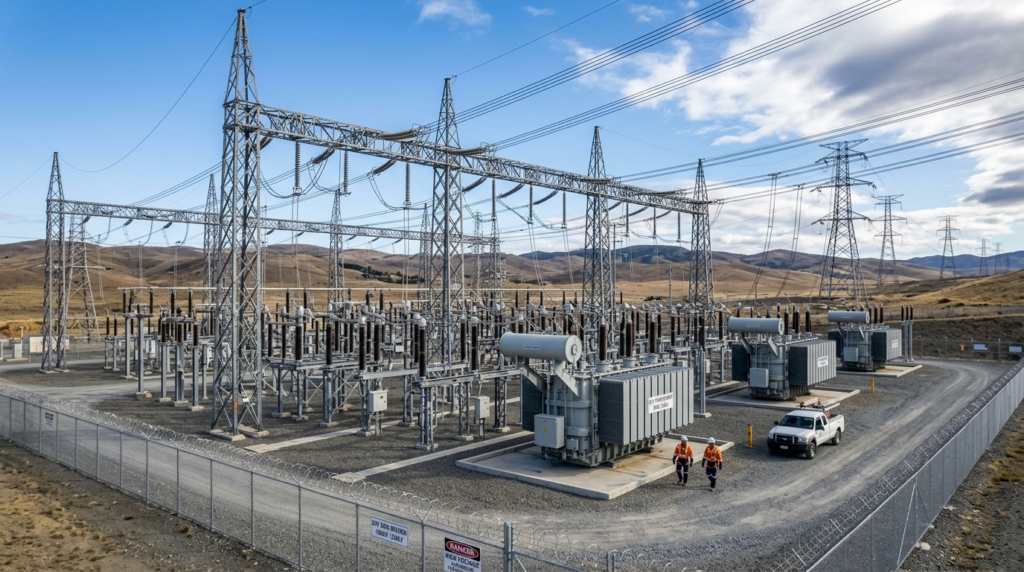

Imagine a large city during a hot summer afternoon. Homes, hospitals, factories, shopping malls, and offices all need electricity at the same time. If power is not delivered safely and efficiently, blackouts can happen within minutes. Behind the scenes, Extra High Voltage (EHV) Grid Stations play a major role in ensuring that electricity travels over long distances with minimum power loss before reaching consumers.
As electricity demand continues to grow, EHV grid stations have become one of the most important parts of modern power systems. They connect power generation plants with transmission and distribution networks while maintaining voltage stability, system reliability, and safe operation.
Whether you are an electrical engineering student, a technician, a beginner, or an experienced engineer, understanding EHV grid stations is essential. In this article, you will learn what an Extra High Voltage (EHV) Grid Station is, its working principle, types, major components, applications, advantages and disadvantages, common problems, future developments, and practical selection tips—all explained in simple and easy English.
What is an Extra High Voltage (EHV) Grid Station 2026
An Extra High Voltage (EHV) Grid Station is a high-voltage electrical substation that receives electrical power from generating stations or transmission lines at extra high voltages, controls and protects the power, and then transfers it to other transmission or distribution networks.
Generally, voltages of 132 kV, 220 kV, 400 kV, 500 kV, and above are considered Extra High Voltage levels, depending on the country’s power system.
In simple words, an EHV grid station works like a major traffic junction for electricity. Instead of cars moving through roads, electrical energy moves through transmission lines. The grid station directs the electricity safely to different destinations.
Practical Example
Suppose a power plant produces electricity and sends it through a 220 kV transmission line. Before this electricity reaches cities and industries, it passes through an EHV grid station. The station monitors the voltage, protects the network from faults, and sends electricity onward through different transmission or distribution lines.
Extra High Voltage (EHV) Grid Station Working Principle and Step-by-Step Operation 2026
Understanding the Extra High Voltage (EHV) Grid Station working principle becomes easier when the electrical transmission process is compared with a water distribution system. Electricity flows through transmission lines in a similar way that water moves through large pipelines, while the EHV grid station controls, protects, transforms, and directs the flow of electrical power.
- Power plants generate electricity.
- EHV transmission lines carry electricity over long distances.
- The EHV grid station controls and directs electrical power flow.
- Protection systems continuously monitor the network for faults.
- Power transformers adjust voltage levels when required.
- Electricity is transmitted safely toward other substations and consumers.
Step-by-Step Working Process of an EHV Grid Station
Receiving Electrical Power at the EHV Grid Station
The grid station receives electricity from power generation stations through high-voltage or extra-high-voltage transmission lines.
Voltage and Current Monitoring in EHV Grid Stations
Voltage transformers (VTs/PTs) and current transformers (CTs) continuously measure important electrical parameters. These measurements are used for metering, monitoring, and protection systems.
Protection and Fault Detection in EHV Grid Stations
Protective relays continuously monitor the electrical system and detect abnormal conditions such as:

- Short circuits
- Overcurrent
- Earth faults
- Overvoltage
When a serious fault occurs, the protection system sends a trip command to the appropriate circuit breaker to isolate the faulty section and protect the remaining network.
Switching Operations in EHV Grid Stations
High-voltage switchgear allows operators to connect or disconnect transmission lines and equipment safely during maintenance, system operation, or emergency conditions.
Voltage Transformation Using EHV Power Transformers
Power transformers increase or decrease voltage according to transmission and distribution requirements. Step-up and step-down transformers help maintain efficient power transfer while controlling transmission losses.
Power Transmission and Distribution from EHV Grid Stations

After monitoring, protection, switching, and voltage transformation, electricity is transmitted toward other grid stations, substations, industrial loads, or distribution networks. This coordinated process helps maintain reliable and stable power delivery.
Types of Extra High Voltage (EHV) Grid Stations and Their Applications 2026
Different types of Extra High Voltage (EHV) grid stations are designed for specific functions within modern power transmission networks. They can be classified according to their voltage transformation, switching function, installation design, and insulation technology.
Step-Up EHV Grid Station for Power Transmission
Step-up grid stations increase the voltage generated by power plants before electricity enters the high-voltage transmission network.
Purpose of Step-Up EHV Grid Stations
- Reduce transmission losses
- Improve long-distance power transfer
- Increase transmission efficiency
Common Locations
- Thermal power plants
- Hydroelectric power stations
- Nuclear power plants
Step-Down EHV Grid Station for Power Distribution
Step-down grid stations reduce transmission voltage to suitable levels for supplying cities, industrial areas, and downstream distribution substations.
Purpose of Step-Down EHV Grid Stations
- Supply electricity to cities
- Feed large industrial areas
- Connect transmission networks with distribution substations
Switching EHV Grid Station for Network Control

Switching grid stations primarily control and redirect power flow without significantly changing the voltage level.
Features of Switching Grid Stations
- Switching operations
- Power network control
- Fault isolation
- Transmission line management
Indoor EHV Grid Station for High-Voltage Applications
In an indoor EHV grid station, major electrical equipment is installed inside specially designed buildings or enclosed facilities.
Advantages of Indoor EHV Grid Stations
- Better protection from environmental conditions
- Reduced exposure to pollution and weather
- Lower routine maintenance requirements
- Suitable for areas with high pollution or limited outdoor space
Outdoor EHV Grid Station for Power Transmission
Outdoor EHV grid stations are one of the most common substation configurations. Major electrical equipment is installed in open-air switchyards with appropriate clearances and safety arrangements.
Advantages of Outdoor EHV Grid Stations
- Generally lower construction cost
- Easier access for maintenance
- Straightforward equipment arrangement
- Greater flexibility for future expansion
Gas Insulated Substation (GIS) for EHV Power Systems
A Gas Insulated Substation (GIS) uses insulating gas within enclosed switchgear to provide electrical insulation and allow a compact substation design. Modern projects may also consider lower-environmental-impact gas technologies as alternatives to conventional SF₆-based systems.
Advantages of GIS EHV Substations
- Compact design
- High operational reliability
- Reduced land requirement
- Suitable for urban and space-constrained locations
- Protected equipment in an enclosed environment
Main Components (EHV) 2026
An Extra High Voltage (EHV) grid station consists of several critical electrical, protection, control, and safety components. Each component performs a specific function to ensure reliable power transmission, equipment protection, system stability, and safe operation.
Power Transformer in EHV Grid Stations
The power transformer changes voltage levels according to the requirements of the transmission and power system.
Power Transformer Functions
- Step-up voltage
- Step-down voltage
- Electrical isolation
Circuit Breaker in EHV Grid Stations
Circuit breakers safely interrupt fault currents and isolate faulty sections of the power system.
Circuit Breaker Functions
- Fault protection
- Equipment safety
- System isolation
Isolator or Disconnect Switch in EHV Substations
An isolator disconnects electrical equipment after the circuit breaker has opened the circuit, providing a visible isolation point for maintenance.
Isolator Functions
- Maintenance safety
- Visual electrical isolation
Busbar System in EHV Grid Stations
Busbars connect multiple incoming and outgoing circuits within the grid station and provide flexible power flow arrangements.
Busbar Functions
- Power distribution
- Flexible circuit connections
Current Transformer (CT) in EHV Grid Stations
Current transformers measure electrical current and provide suitable signals to protection relays, meters, and monitoring systems.
Current Transformer Functions
- Current measurement
- Protection relay operation
- Electrical monitoring
Voltage Transformer (VT/PT) in EHV Grid Stations
Voltage transformers, also known as potential transformers, measure system voltage for protection, monitoring, and metering applications.
Voltage Transformer Functions
- Voltage monitoring
- Electrical metering
- Protection system operation
Protective Relays in EHV Grid Stations
Protective relays detect abnormal electrical conditions and initiate circuit breaker operation when a fault is identified.
Protective Relay Functions
- Fault detection
- Circuit breaker tripping
- Equipment protection
Lightning Arresters in EHV Grid Stations
Lightning arresters protect transformers, transmission equipment, and other electrical components from lightning and switching surges.
Lightning Arrester Functions
- Surge protection
- Equipment safety
- Overvoltage protection
Earthing System in EHV Grid Stations
The earthing system provides a safe path for fault currents and helps protect personnel and electrical equipment from dangerous touch and step voltages.
Earthing System Functions
- Personnel safety
- Equipment protection
- Fault-current dissipation
Control Room in EHV Grid Stations
The control room contains monitoring equipment, communication systems, protection panels, control systems, and supervisory equipment used to operate and monitor the EHV grid station safely and efficiently.
Extra High Voltage (EHV) Grid Station Advantages, Disadvantages and Applications in Power Systems 2026
Understanding the advantages, disadvantages, and applications of Extra High Voltage (EHV) grid stations is important for designing, operating, and maintaining modern power transmission systems. EHV grid stations play a major role in efficient long-distance electricity transmission, grid stability, and renewable energy integration.
Advantages of Extra High Voltage (EHV) Grid Stations
EHV grid stations provide several important benefits for modern power transmission and electricity distribution networks.
- Efficient long-distance power transmission
- Lower transmission losses
- Improved voltage regulation
- Better power system reliability
- High operational safety
- Supports large industrial loads
- Faster fault detection
- Flexible transmission network operation
- Reduces power interruptions
- Enables renewable energy integration
- Improves overall grid stability
- Supports future power system expansion
Disadvantages and Limitations of EHV Grid Stations
Despite their many benefits, EHV grid stations also have several technical, financial, environmental, and operational limitations.
- Very high installation and construction costs
- Large land requirements, especially for outdoor EHV stations
- Complex inspection and maintenance procedures
- Requires highly skilled electrical engineers and technicians
- Expensive protection and control equipment
- Long construction and commissioning periods
- High insulation and clearance requirements
- Environmental concerns associated with certain insulating gases
- Significant electrical safety risks if maintenance procedures are not properly followed
Applications Systems 2026
EHV grid station applications cover almost every major sector of modern electricity generation, transmission, and industrial power supply. These stations help transfer large amounts of electrical power efficiently over long distances.
EHV Grid Stations for Power Generation
EHV grid stations connect large power plants with high-voltage transmission networks, allowing generated electricity to be transmitted efficiently to major load centers.
EHV Grid Stations in National Transmission Networks
EHV transmission networks transfer large amounts of electricity between cities, provinces, regions, and major load centers while supporting overall grid stability.
EHV Grid Stations for Industrial Areas
EHV grid stations provide reliable and high-capacity electricity supplies to energy-intensive industries such as:
- Steel industries
- Cement plants
- Oil refineries
- Chemical factories
EHV Grid Stations for Renewable Energy Integration
Modern EHV grid stations help connect large renewable energy projects to transmission networks, including:
- Wind farms
- Solar power plants
- Hydroelectric stations
EHV Grid Stations for Urban Power Supply
EHV grid stations support stable and reliable electricity supplies for large cities and rapidly growing urban areas.
EHV Grid Stations for Commercial Centers
EHV transmission and grid infrastructure can support major commercial facilities and critical services, including:
- Shopping malls
- Hospitals
- Airports
- Universities
- Data centers
EHV Grid Stations for Rural Electrification
Interconnected EHV transmission systems can support reliable electricity delivery to remote and developing regions by connecting them with larger national and regional power networks.
EHV Grid Station vs Distribution 2026
Many beginners and electrical engineering students want to understand the difference between an Extra High Voltage (EHV) Grid Station and a Distribution Substation. Although both are important parts of the electrical power system, they differ in voltage level, purpose, equipment capacity, service area, and overall system role.
Difference Between EHV Grid Station and Distribution Substation
| Feature | Extra High Voltage (EHV) Grid Station | Distribution Substation |
|---|---|---|
| Voltage Level | 132 kV and above | Usually 33 kV, 11 kV, or lower |
| Primary Purpose | High-voltage and long-distance power transmission | Local power distribution |
| Size | Very large | Smaller |
| Equipment Rating | Very high | Moderate |
| Service Area | Regional or national | Local communities and areas |
| Installation Cost | High | Lower |
| Power Capacity | Very high | Medium |
| Primary Users | Transmission utilities | Distribution companies |
EHV Grid Station Selection Guide for Power Transmission Systems
Choosing the right EHV grid station requires careful consideration of several electrical, geographical, operational, and safety factors.
Voltage Level for EHV Grid Station
Select the appropriate voltage level according to the requirements of the transmission system and expected power transfer capacity.
Electrical Load Demand and Future Growth
Evaluate the present electrical load and estimate future demand to ensure the grid station can handle increasing power requirements.
EHV Grid Station Location
The location should be selected based on:
- Available land
- Weather and environmental conditions
- Pollution levels
- Accessibility
- Proximity to transmission lines and load centers
Future Expansion Capability
Provide sufficient space and infrastructure for future transformers, circuit breakers, transmission lines, and other electrical equipment.
Reliability and Protection Systems
Select reliable equipment with proven performance, effective protection systems, and appropriate fault-clearing capabilities.
Electrical Safety Standards
Ensure that the EHV grid station complies with applicable national and international electrical safety and design standards.
EHV Grid Station Maintenance Requirements
Prefer equipment that is easy to inspect and maintain, with reliable technical support and readily available spare parts.
EHV Grid Station Tips for Beginners in 2026
- Learn electrical single-line diagrams first.
- Understand power transformer ratings and applications.
- Study circuit breakers and protection systems carefully.
- Practice identifying major EHV grid station equipment.
- Learn basic power transmission and substation concepts.
- Always prioritize electrical safety when working around high-voltage equipment.
Common Problems and Solutions 2026
EHV grid stations can experience various operational and equipment-related problems. Understanding the common causes and solutions helps improve power system reliability, reduce unexpected failures, and maintain safe grid station operation.
Why Does an EHV Circuit Breaker Trip Frequently?
Cause:
Fault current, short circuits, protection system issues, or connected equipment failure.
Solution:
Inspect protection relays, cables, circuit breakers, and connected equipment before restoring service.
Why Is EHV Transformer Temperature Increasing?
Cause:
Transformer overloading, inadequate cooling, low oil level, or cooling system problems.
Solution:
Reduce the transformer load and inspect cooling fans, transformer oil level, radiators, and other cooling equipment.
Why Does Voltage Fluctuate in an EHV Grid Station?
Cause:
Changing load conditions, voltage instability, or incorrect transformer tap settings.
Solution:
Check system loading, monitor voltage levels, and adjust the transformer tap changer when required.
Why Do Lightning Arresters Fail in EHV Substations?
Cause:
Repeated lightning or switching surge exposure, insulation deterioration, contamination, or aging.
Solution:
Inspect and test lightning arresters regularly and replace damaged or degraded units.
Why Does Insulation Fail in EHV Electrical Equipment?
Cause:
Moisture, contamination, aging, overheating, or insulation deterioration.
Solution:
Perform insulation resistance testing, cleaning, condition monitoring, and scheduled preventive maintenance.
Why Is Regular EHV Grid Station Maintenance Important?
Routine inspection and preventive maintenance help identify small equipment problems before they develop into major failures. Regular maintenance improves grid reliability, reduces unplanned outages, increases equipment service life, and supports safe operation of EHV power transmission systems.
Future Trends 2026
Power transmission technology continues to evolve rapidly. Several new developments are shaping the future of EHV grid stations, improving reliability, efficiency, automation, and environmental sustainability.
Smart Grid Integration in EHV Grid Stations
Digital monitoring enables faster fault detection, real-time data analysis, and improved system control. Smart grid technologies are helping EHV substations operate more efficiently and reliably.
Artificial Intelligence for Power Grid Monitoring
AI-based monitoring and predictive analytics can help identify abnormal equipment conditions and predict potential failures before they occur, reducing unexpected outages and maintenance costs.
Digital Substations and EHV Power Systems
Modern digital substations use advanced communication and automation systems to replace many traditional copper control cables. This improves data exchange, system flexibility, and operational efficiency.
Renewable Energy Integration into EHV Grid Stations
More EHV grid stations are being designed to connect large-scale solar and wind power projects efficiently. Advanced transmission infrastructure helps transfer renewable electricity over long distances while maintaining grid stability.
Condition-Based Maintenance for EHV Equipment
Sensors continuously monitor the health and performance of critical equipment. This allows utilities to perform maintenance based on actual equipment condition rather than relying only on fixed maintenance schedules.
Environment-Friendly Technologies for EHV Substations
Power companies are exploring alternative insulating gases, improved equipment designs, and more sustainable technologies to reduce environmental impact while maintaining high levels of electrical reliability and safety.
Remote Monitoring and Control of EHV Grid Stations
Modern control centers can supervise multiple EHV grid stations from a centralized location. Remote monitoring improves operational efficiency, reduces operating costs, and enables faster responses to faults and abnormal conditions.
Conclusion
Extra High Voltage (EHV) Grid Stations are the backbone of modern electrical transmission systems. They receive, control, protect, and distribute electrical power over long distances with high efficiency and reliability. Understanding the Extra High Voltage (EHV) Grid Station working principle, major components, types, applications, and advantages and disadvantages helps students, engineers, and technicians build a strong foundation in power system engineering. As electricity demand grows and renewable energy becomes more common, EHV grid stations will continue to play an even greater role in maintaining stable and secure power networks. By learning the basics today and exploring advanced protection, automation, and smart grid technologies, you can develop the practical knowledge needed for a successful career in the electrical power industry.


Pingback: Corona Effect in Transmission Lines: Causes & Fixes