
On a quiet night near a high-voltage transmission line, you can sometimes hear a faint crackling or hissing sound — and if you look closely, you might see a pale violet glow clinging to the conductors. This is the corona effect: one of the most visually striking phenomena in power engineering, and one that costs utilities real money every day.
Corona is essentially the air around a conductor breaking down and becoming partially conductive. It wastes energy, creates noise, interferes with radio signals, and slowly eats away at conductor surfaces. Understanding the corona effect in transmission lines — what causes it, what it does, and how engineers fight it — is essential for anyone studying power systems.
What Is the Corona Effect?
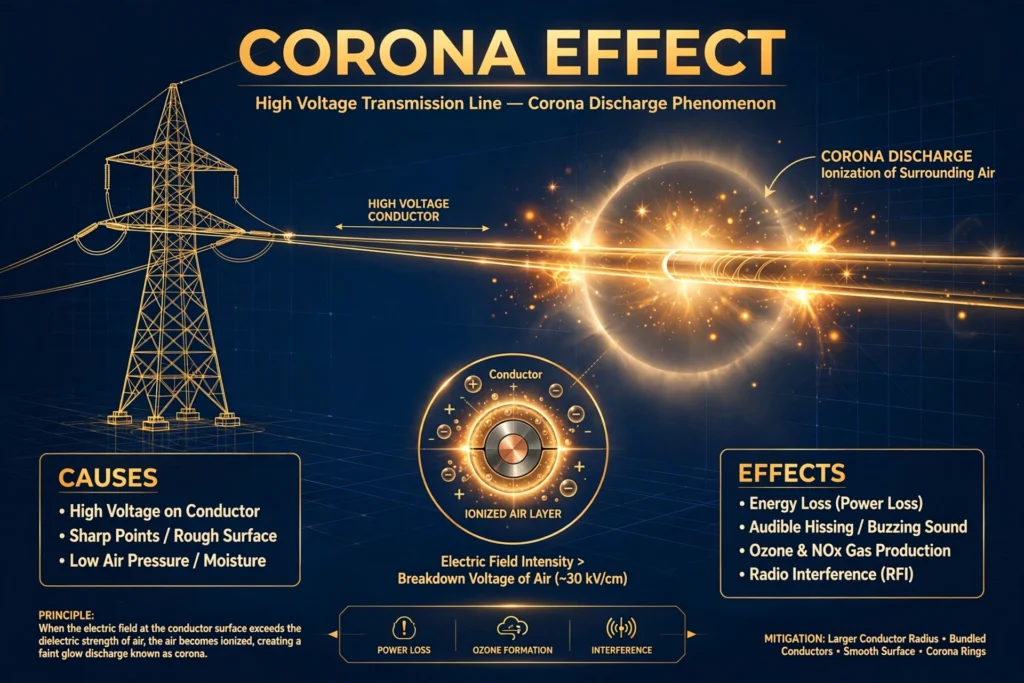
Corona (from the Latin word for “crown,” describing the glowing halo around conductors) is a partial electrical breakdown of air surrounding a high-voltage conductor. When the electric field strength at the conductor’s surface exceeds the breakdown strength of air (about 21.1 kV/cm at standard conditions), the air molecules near the surface become ionized — they lose electrons and turn into a faintly glowing plasma.
Crucially, corona is incomplete breakdown: the ionization stays confined to a thin layer around the conductor instead of bridging the full gap to another conductor or to earth. If it did bridge the gap, you would get a complete flashover or arc instead. Think of corona as air “beginning” to break down but stopping halfway.
The phenomenon appears most often on extra-high voltage lines (220 kV and above), because the surface electric field on those conductors is intense enough to ionize air — especially in bad weather.
Causes of Corona
Corona occurs when the surface voltage gradient of a conductor exceeds the critical disruptive voltage of air. The main factors that cause or worsen it are:
- High system voltage: Higher voltage means a stronger electric field at the conductor surface — the primary driver of corona.
- Small conductor diameter: A thinner conductor concentrates the electric field on a smaller surface, raising the gradient. This is why EHV lines use large or bundled conductors.
- Close conductor spacing: Conductors placed near each other distort and intensify the field.
- Rough conductor surface: Scratches, dust, insects, or strands sticking out create sharp points where the field concentrates. A smooth, clean conductor resists corona far better.
- Bad weather: Rain drops, snow, and fog on the conductor surface create sharp water points that dramatically lower the corona onset voltage. Corona is far worse in rain — this is called wet-weather corona.
- High altitude: Thinner air at altitude breaks down more easily, so mountain lines suffer more corona.
- Air density and humidity: Low air density and high humidity both reduce the breakdown strength of air.
Effects of Corona
1. Power loss (corona loss)
Every corona discharge consumes energy — ionizing air molecules takes power drawn from the line itself. Corona loss increases rapidly once the operating voltage passes the critical value, roughly following a square law with the excess voltage. On a long EHV line in rainy weather, corona losses can reach several kilowatts per kilometer — a real, continuous drain that utilities must account for in line design.
2. Audible noise
The crackling and hissing of corona is a genuine nuisance for people living near transmission lines. The noise is worst in rain and at night when background noise is low. Modern line design includes strict audible-noise limits, especially near residential areas.
3. Radio and TV interference
Corona discharges generate high-frequency electrical noise that interferes with AM radio reception and, historically, analog TV signals. This radio interference (RI) is a standard design constraint for new lines.
4. Ozone production and conductor corrosion
Corona ionizes oxygen into ozone, a corrosive gas that slowly attacks the conductor surface and nearby hardware. Over decades, this chemical erosion, combined with the mechanical vibration corona can induce, ages conductors prematurely.
5. The violet glow and its one benefit
The faint glow is harmless, and corona has one accidental benefit: the ionized air slightly increases the effective diameter of the conductor, which marginally reduces the line’s surge impedance. Engineers do not design for this, but it is a real (tiny) side effect.
How to Reduce Corona Effect
Engineers have developed several proven methods to control corona:
- Increase conductor diameter: A larger conductor spreads the electric field over more surface, lowering the gradient below the critical value.
- Use bundled conductors: Instead of one large conductor per phase, EHV lines use 2, 3, 4, or even 6 smaller conductors spaced a few centimeters apart (a “bundle”). The bundle behaves electrically like one fat conductor, drastically cutting the surface gradient. This is the single most effective anti-corona measure on modern lines.
- Increase spacing between phases: More separation weakens the field interaction between conductors — though it requires taller, costlier towers.
- Keep conductors smooth and clean: Proper installation without surface damage, plus designs that discourage dirt accumulation, keep the corona onset voltage high.
- Use corona rings (grading rings): Metal rings fitted at insulator and hardware ends smooth out the electric field around sharp fittings, suppressing local corona at those points.
- Operate below critical voltage with margin: Lines are designed so the maximum operating voltage stays comfortably below the corona inception voltage in fair weather.
Corona vs Arc: Know the Difference
| Feature | Corona Discharge | Arc / Flashover |
|---|---|---|
| Breakdown type | Partial — confined near conductor | Complete — bridges the full gap |
| Appearance | Faint violet glow, hissing | Bright flash, loud bang |
| Current | Small (milliamperes) | Very large (kiloamperes) |
| Effect on supply | Continuous small power loss | Short circuit, protection trips |
| Occurrence | Normal on EHV lines in bad weather | Fault condition only |
Corona in the Power System Context
Corona is one of several phenomena that make power transmission systems lossy and noisy. It is closely related to the electrical waveform on the line — the alternating voltage that drives the repeated ionization 100 times per second. Line designers balance corona performance against cost: bigger conductors and wider towers reduce corona but cost more steel, aluminum, and land.
FAQs
What is corona discharge in simple words?
Corona discharge is what happens when the air around a high-voltage wire starts to break down electrically but doesn’t fully arc. The air near the wire becomes ionized, producing a faint glow, a hissing sound, and a small continuous waste of power.
Why does corona happen more in rainy weather?
Rain drops sitting on the conductor act like tiny sharp points that concentrate the electric field. Water also lowers the breakdown strength of the air. Both effects mean corona starts at a much lower voltage in rain than in dry weather.
Is corona dangerous to people under the line?
No — corona itself is not dangerous to people on the ground. The ionized region stays within centimeters of the conductor, hundreds of feet in the air. The concerns are power loss, noise, and radio interference, not safety.
How is corona loss calculated?
The classic formula is Peek’s law, which estimates corona power loss from the operating voltage, the critical disruptive voltage, frequency, conductor size and spacing, and air density. It shows that loss grows roughly with the square of the voltage above the critical value.
Do underground cables have corona?
Practically no. In a cable, the conductor is surrounded by solid insulation, not air, so there is no air to ionize. This is one reason underground cable systems are preferred in dense cities despite their higher cost.
What are bundled conductors and why do they reduce corona?
Bundled conductors are groups of 2–6 sub-conductors per phase, held apart by spacers. Electrically the bundle acts like one large-diameter conductor, which lowers the surface electric field gradient below the corona threshold — the most effective corona control method on EHV lines.
Conclusion
The corona effect is a perfect example of physics imposing a tax on engineering ambition: push voltages higher for efficient transmission, and the air itself starts to conduct. Its costs — power loss, audible noise, radio interference, and slow corrosion — are real enough that every EHV line in the world is designed around controlling it.
The engineer’s toolkit is straightforward: bigger or bundled conductors, generous spacing, smooth surfaces, and corona rings. Remember the core idea — corona begins when the surface electric field exceeds air’s breakdown strength — and every prevention method becomes intuitive. For the mathematics behind corona loss estimation, Wikipedia’s article on corona discharge gives a solid treatment of Peek’s law and related theory.