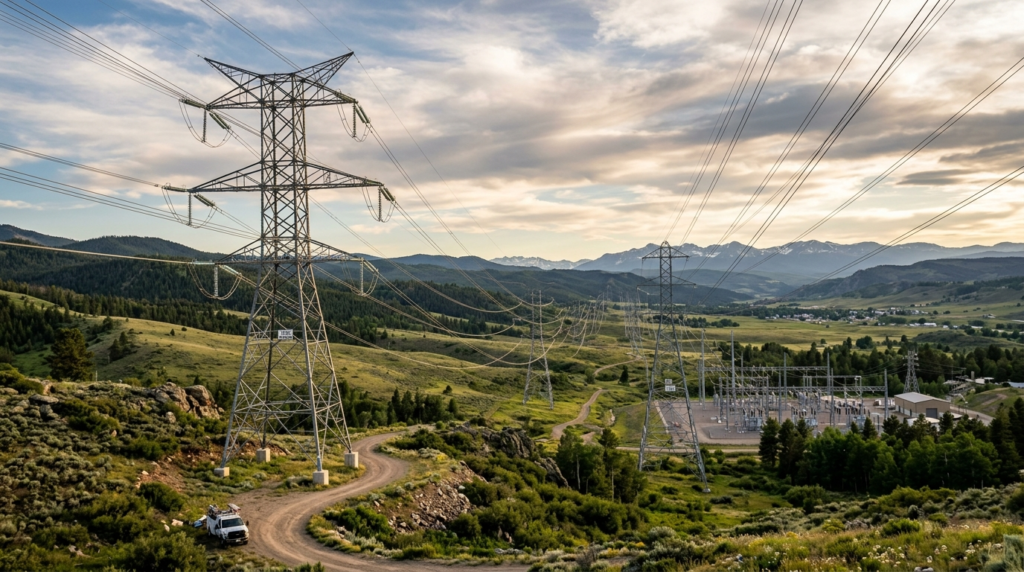

Imagine electricity generated at a hydroelectric dam located far away in a mountain area. That electricity must travel hundreds of kilometers to reach your home, school, or factory. This long-distance movement of electrical power is possible only because of the Power Transmission System.
Without an efficient transmission system, the electricity produced at power plants would never reach end users safely or economically. Engineers design transmission networks to carry large amounts of power at high voltage with minimum losses.
Understanding the Power Transmission System is very important for electrical students, technicians, and engineers because it forms the backbone of modern power systems. In this article, you will learn what it is, how it works, its types, components, advantages, disadvantages, applications, and future trends in a simple and practical way.
What is Power Transmission System?
A Power Transmission System is a network used to transfer electrical energy from power plants to distribution systems over long distances.
In simple words, it is the system that carries electricity from generation stations to cities and industries.
Practical Example
Electricity produced at a thermal or hydro power plant is transmitted through high-voltage transmission lines before reaching local transformers and then homes.
The Power Transmission System working principle is based on reducing energy loss by increasing voltage and decreasing current.
Working Principle
The Power Transmission System working principle is based on one main idea: high voltage reduces energy loss during transmission.
Step-by-Step Working
Power Generation


Power generation is the process of converting various forms of energy into electrical energy for use in homes, industries, and commercial facilities. Electricity is generated in power plants by converting energy from sources such as coal, natural gas, water (hydroelectric), wind, solar, and nuclear energy into mechanical energy, which drives an alternator (AC generator). The alternator converts this mechanical energy into alternating current (AC) using the principle of electromagnetic induction. The generated electricity is then stepped up to high voltage by transformers for efficient transmission through the power grid and later stepped down for safe distribution to consumers. Power generation is the first and most important stage of the electrical power system, ensuring a continuous and reliable supply of electricity.
- Electricity is produced at power plants (11 kV to 25 kV).
Step-Up Transformation
- Voltage is increased using a step-up transformer.
High Voltage Transmission
- Electricity is transmitted through overhead lines or cables.
Substations


A substation is a key part of the electrical power system that receives, controls, transforms, and distributes electrical power. It contains equipment such as power transformers, circuit breakers, isolators, busbars, relays, and protective devices. Substations are used to step up the voltage generated at power plants for efficient long-distance transmission and to step down the transmission voltage to lower levels for safe distribution to homes, commercial buildings, and industries. They also provide switching, protection, voltage regulation, and fault isolation to ensure the reliable and continuous operation of the power system. Substations are classified into generating substations, transmission substations, distribution substations, and switching substations, depending on their function within the electrical network.
- Voltage is reduced at substations for safe distribution.
Distribution System
- Electricity reaches homes, industries, and commercial areas.
Easy Analogy
Think of water flowing in pipes:
- High pressure (high voltage) allows water (electricity) to travel long distances.
- Low pressure reduces flow efficiency.
Key Principle
P = VI
To transmit the same power with less loss, voltage is increased and current is reduced.
Types / Classification
Overhead Transmission System


6
An overhead transmission system is a method of transmitting electrical power through conductors suspended on transmission towers or poles above the ground. It is the most common and economical method of transmitting electricity over long distances from power plants to substations. Overhead transmission systems operate at high voltages, such as 132 kV, 220 kV, 400 kV, and higher, to reduce power losses and improve transmission efficiency. They are easy to install, inspect, maintain, and repair compared to underground systems. However, overhead transmission lines are exposed to weather conditions, lightning, strong winds, and falling trees, which can sometimes cause faults or interruptions. Despite these limitations, they remain the most widely used transmission method due to their low cost, high reliability, and ease of maintenance.
This system uses conductors supported by towers.
Features
- Most widely used
- Lower cost
- Easy maintenance
Applications
- Rural and urban power transmission
Underground Transmission System


6
An underground transmission system is a method of transmitting electrical power through high-voltage insulated cables buried beneath the ground instead of using overhead transmission lines. It is commonly used in densely populated urban areas, airports, tunnels, environmentally sensitive locations, and places where overhead lines are impractical or undesirable. Underground transmission systems are protected from weather, storms, and falling trees, making them more reliable and improving the appearance of the surroundings. However, they are much more expensive to install and maintain, and locating and repairing faults is more difficult than with overhead transmission lines. Despite these challenges, underground transmission systems provide a safe, reliable, and efficient means of delivering electrical power where space or environmental considerations require buried cables.
In this system, cables are buried underground.
Features
- High safety
- No visual pollution
- Expensive installation
Applications
- Cities
- High-density areas
HVDC Transmission System


6
An HVDC (High Voltage Direct Current) transmission system is a method of transmitting electrical power over long distances using high-voltage direct current (DC) instead of alternating current (AC). In an HVDC system, AC power generated at a power station is converted into DC by a converter station, transmitted through high-voltage DC transmission lines or cables, and then converted back into AC at the receiving converter station for distribution to consumers. HVDC transmission offers lower power losses, higher efficiency, improved voltage control, and better stability over long distances compared with AC transmission. It is widely used for long-distance overhead transmission, underground and submarine cables, and for interconnecting power grids that operate at different frequencies or are not synchronized.
HVDC stands for High Voltage Direct Current.
Features
- Used for long-distance transmission
- Low power loss
- Suitable for underwater cables
Applications
- Inter-country power exchange
- Long-distance grids
Main Components
Power Generating Station
Produces electrical energy.
Step-Up Transformer
Increases voltage for long-distance transmission.
Transmission Lines


5
Transmission lines are high-voltage electrical conductors used to carry electricity over long distances from power generation stations to distribution substations. They transmit electrical power at very high voltages, such as 132 kV, 220 kV, 400 kV, or higher, to reduce power losses and improve transmission efficiency. Transmission lines are usually installed on tall steel towers or pylons and consist of conductors, insulators, and supporting structures. They form the backbone of the electrical power system, connecting power plants with substations and ensuring the reliable delivery of electricity to cities, industries, and residential areas. High-voltage transmission enables large amounts of electrical energy to be transported safely and efficiently over long distances.
Carry electricity at high voltage.
Transmission Towers


6
A transmission tower is a tall steel structure that supports high-voltage overhead transmission lines used to carry electrical power over long distances. These towers keep the conductors at a safe height above the ground and maintain proper spacing between the wires to prevent electrical faults. Transmission towers are designed to withstand heavy loads, strong winds, and adverse weather conditions while ensuring the safe and reliable operation of the power system. They are commonly used for transmission voltages such as 132 kV, 220 kV, 400 kV, and higher. Transmission towers are an essential part of the electrical transmission network, connecting power generation stations to substations and enabling efficient delivery of electricity across large distances.
Support overhead lines.
Substations
Reduce voltage for distribution.
Circuit Breakers
Protect the system from faults.
Insulators
Prevent leakage of current.
Advantages
Advantages of Power Transmission System
- Efficient long-distance power transfer
- Reduced power loss
- Reliable electricity supply
- Supports large industrial loads
- Easy integration with grid systems
- Cost-effective for large-scale distribution
Real-World Benefits
- Stable electricity for cities
- Continuous industrial production
- Improved national power security
Disadvantages / Limitations
Common Limitations
- High initial setup cost
- Complex infrastructure
- Requires regular maintenance
- Power loss still occurs in long lines
- Weather can damage overhead lines
Practical Issues
Storms, lightning, and tree contact can cause faults in overhead systems.
Applications
Home Applications
- Electricity supply to residential areas
Industrial Applications
- Heavy machinery operation
- Manufacturing plants
Commercial Applications
- Shopping malls
- Office buildings
Modern Applications
- Smart grids
- Renewable energy integration
- Cross-border electricity trade
The Power Transmission System applications are essential for modern infrastructure development.
Comparison Section
AC Transmission vs DC Transmission
| Feature | AC Transmission | DC Transmission |
| Cost | Lower | Higher |
| Efficiency | Good for short distance | Best for long distance |
| Losses | Higher | Lower |
| Control | Easy | Complex |
| Usage | General power supply | Specialized applications |
Understanding the difference between AC and DC transmission helps engineers select the right system.
Selection Guide
How to Choose Transmission System
- Distance of transmission
- Power capacity required
- Cost constraints
- Environmental conditions
- Load type (industrial or residential)
Beginner Tips
- Learn transformer basics first
- Understand voltage levels
- Study grid structure
- Focus on safety standards
Proper selection improves system performance and efficiency.
Common Problems & Solutions
Power Loss in Transmission
Cause
- Resistance in lines
Solution
- Use high voltage transmission
Line Faults
Cause
- Weather conditions, tree contact
Solution
- Regular maintenance and protective relays
Voltage Drop
Cause
- Long transmission distance
Solution
- Use proper conductor size and substations
Overloading
Cause
- Excess demand
Solution
- Load management and grid expansion
Why is High Voltage Used?
High voltage reduces current, which reduces heat loss in transmission lines.
Future Trends
Smart Grid Technology
Modern grids use digital monitoring and automation.
HVDC Expansion
HVDC is becoming more common for long-distance and underwater transmission.
Renewable Integration
Solar and wind energy are being added to transmission networks.
AI-Based Monitoring
Artificial intelligence helps detect faults early.
Wireless Power Transmission (Research Stage)
Future systems may reduce dependency on wires.
The future of Power Transmission System is smarter, cleaner, and more efficient.
Conclusion
The Power Transmission System is the backbone of electrical power delivery. It ensures that electricity generated at power plants reaches homes, industries, and commercial areas safely and efficiently. By using high-voltage transmission, energy losses are reduced, making the system more economical and reliable.
In this article, we explored its working principle, types, components, applications, advantages, and challenges. We also discussed future trends like smart grids and HVDC systems. For electrical students and engineers, understanding transmission systems is essential for building strong foundational knowledge in power engineering.
With increasing demand for electricity and renewable integration, transmission systems will continue to evolve and play a critical role in modern infrastructure.



Pingback: Corona Effect in Transmission Lines: Causes & Fixes