
Imagine a power plant generating electricity and sending it hundreds of kilometers away to cities, factories, hospitals, and homes. If this electricity were transmitted at a low voltage, a large amount of energy would be wasted as heat in the transmission lines. To solve this problem, electrical engineers use a Step-Up Grid Station to increase the voltage before electricity enters the transmission network.
A Step-Up Grid Station is one of the most important parts of a modern power system. It improves transmission efficiency, reduces power losses, and helps deliver electricity safely over long distances. Without it, reliable power supply to large cities and industries would not be possible.
In this article, you will learn what a Step-Up Grid Station is, the Step-Up Grid Station working principle, its types, major components, Step-Up Grid Station applications, advantages and disadvantages, comparison with other substations, selection tips, troubleshooting methods, and future trends. Whether you are an electrical engineering student, technician, beginner, or practicing engineer, this guide will help you understand the topic in simple and practical language.
What is a Step-Up Grid Station?
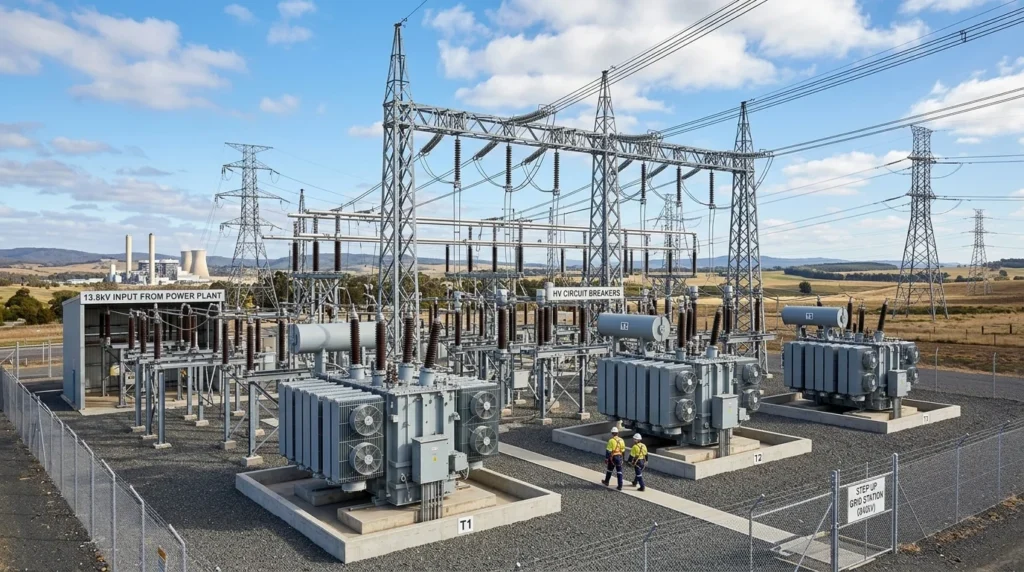
A Step-Up Grid Station is an electrical substation that increases the voltage generated by a power plant before sending electricity into high-voltage transmission lines.
Electricity produced by generators usually ranges from 11 kV to 25 kV. This voltage is suitable for generation but not efficient for long-distance transmission. Therefore, a power transformer inside the grid station increases the voltage to higher levels such as 132 kV, 220 kV, 400 kV, or even 765 kV, depending on the transmission system.
In simple words, a Step-Up Grid Station acts like a pressure booster for electricity. Just as a water pump increases water pressure for long pipelines, a step-up grid station increases electrical voltage so electricity can travel farther with less energy loss.
Practical Example
Suppose a thermal power plant generates electricity at 15 kV. Before the electricity travels 300 km to a nearby city, a Step-Up Grid Station raises the voltage to 220 kV. This higher voltage reduces transmission current, minimizing power losses and improving overall efficiency.
Step-Up Grid Station Working Principle
The Step-Up Grid Station working principle is based on electromagnetic induction and transformer operation.
The transformer increases voltage while reducing current, keeping the electrical power nearly constant except for small losses.
Step-by-Step Working
Electricity is generated in the power plant.
The generator sends medium-voltage power to the grid station.
Circuit breakers and isolators protect the incoming supply.
Current transformers (CTs) and voltage transformers (VTs) measure electrical values.
The step-up transformer increases the voltage.
Protection relays continuously monitor system conditions.
High-voltage switchgear connects the transformer to transmission lines.
Electricity travels through high-voltage transmission lines to receiving substations.
Easy Analogy
Think of carrying water through a long pipe.
- Low pressure causes more loss.
- High pressure delivers water efficiently.
Similarly:
- Low voltage causes higher current.
- Higher current creates greater line losses.
- Increasing voltage reduces current and saves energy.
This simple concept forms the basis of every Step-Up Grid Station.
Types of Step-Up Grid Stations
Different grid stations are designed according to system requirements.
Outdoor Step-Up Grid Station
Outdoor substations are installed in open areas.
Features
- Lower construction cost
- Easy maintenance
- Suitable for power plants
- Good natural cooling
Indoor Step-Up Grid Station
Indoor stations keep equipment inside buildings.
Features
- Better environmental protection
- Reduced exposure to weather
- Suitable for urban locations
- Higher installation cost
Gas Insulated Step-Up Grid Station (GIS)
GIS stations use sulfur hexafluoride (SF₆) gas for insulation.
Features
- Compact design
- High reliability
- Minimal maintenance
- Ideal where land is limited
Air Insulated Step-Up Grid Station (AIS)
AIS stations use air as the insulating medium.
Features
- Lower initial investment
- Easy inspection
- Large installation area
- Widely used in transmission systems
Main Components of a Step-Up Grid Station
A Step-Up Grid Station contains several important electrical components working together.
Power Transformer
This is the heart of the grid station.
Function
- Increases voltage
- Reduces transmission losses
- Transfers electrical energy efficiently
Generator Circuit Breaker
Protects the generator and transformer from faults.
Isolator (Disconnect Switch)
Provides safe isolation during maintenance.
Busbars
Busbars distribute electrical power among different circuits.
Current Transformer (CT)
Measures high current safely for protection and metering.
Voltage Transformer (VT)
Reduces high voltage to safe measurement levels.
Protection Relays
Detect abnormal conditions such as:
- Short circuits
- Overcurrent
- Earth faults
- Overvoltage
Lightning Arresters
Protect equipment against lightning and switching surges.
Earthing System
Provides a safe path for fault current and protects personnel.
Control Room
Contains:
- Protection panels
- SCADA system
- Monitoring equipment
- Communication systems
Advantages
The Step-Up Grid Station advantages and disadvantages should be understood before studying power transmission systems.
Advantages
- Reduces transmission power losses
- Improves transmission efficiency
- Supports long-distance power transfer
- Reduces conductor size requirements
- Improves overall grid reliability
- Enables stable voltage regulation
- Protects valuable electrical equipment
- Supports renewable energy integration
- Makes bulk power transfer economical
- Enhances system safety through protective devices
Disadvantages / Limitations
Despite many benefits, Step-Up Grid Stations also have some limitations.
- High installation cost
- Requires skilled engineers
- Large land requirement for AIS systems
- Regular maintenance is necessary
- Transformer failures can interrupt supply
- Protection systems increase project cost
- Environmental effects may impact outdoor equipment
- GIS systems require specialized maintenance
Step-Up Grid Station Applications
Modern electrical power systems cannot operate efficiently without Step-Up Grid Stations.
Power Plants
Installed at:
- Thermal power plants
- Hydroelectric plants
- Nuclear stations
- Gas power plants
Renewable Energy Plants
Used in:
- Solar farms
- Wind farms
- Biomass plants
- Hydroelectric projects
Industrial Power Systems
Large industries use them for transmitting generated power to utility networks.
National Transmission Networks
They connect generating stations to high-voltage transmission systems.
Smart Grids
Modern smart grids use advanced step-up stations equipped with automation and remote monitoring.
Difference Between Step-Up Grid Station and Step-Down Grid Station
Many students ask about the difference between Step-Down Grid Station and Step-Up Grid Station.
| Feature | Step-Up Grid Station | Step-Down Grid Station |
| Purpose | Increase voltage | Reduce voltage |
| Location | Near power plants | Near consumers |
| Transformer | Step-up transformer | Step-down transformer |
| Voltage Level | Low to High | High to Low |
| Main Use | Transmission | Distribution |
| Current | Decreases | Increases |
| Power Loss | Reduced during transmission | Not intended for long-distance transmission |
| Consumers | Transmission companies | Homes, industries, commercial areas |
Selection Guide
Choosing the right Step-Up Grid Station depends on several engineering factors.
Voltage Rating
Select the voltage level according to transmission requirements.
Power Capacity
Transformer rating should match the generator output.
Location
- Outdoor stations for large areas
- GIS stations for limited space
- Indoor stations for harsh environments
Future Expansion
Leave room for additional transformers and transmission lines.
Protection System
Choose modern digital protection relays with communication capability.
Budget
Balance installation cost with long-term maintenance expenses.
Tips for Beginners
- Always understand the voltage level first.
- Study transformer ratings carefully.
- Learn standard protection schemes.
- Follow electrical safety standards.
- Consider future load growth during planning.
Common Problems & Solutions
Why is the transformer overheating?
causes
- Overloading
- Poor cooling
- Low oil level
Solution
Reduce load, inspect cooling systems, and check transformer oil.
Why does the circuit breaker trip repeatedly?
causes
- Short circuit
- Earth fault
- Relay malfunction
Solution
Inspect protection settings and locate the fault before re-energizing.
Why is voltage lower than expected?
causes
- Transformer tap setting
- Heavy loading
- Transmission line losses
Solution
Check tap changer settings and system loading.
Why is the protection relay giving alarms?
causes
- Fault current
- Incorrect settings
- Instrument transformer problems
Solution
Verify relay configuration and inspect CTs and VTs.
Why is insulation resistance decreasing?
causes
- Moisture
- Aging insulation
- Dirt contamination
Solution
Perform insulation testing, cleaning, and preventive maintenance.
Future Trends
Step-Up Grid Stations continue to evolve with modern electrical technology.
Important future developments include:
- Digital substations with intelligent electronic devices (IEDs)
- AI-assisted predictive maintenance
- Remote monitoring using SCADA and IoT
- Condition-based transformer maintenance
- Integration with renewable energy systems
- Smart protection systems
- Eco-friendly insulating gases replacing SF₆
- Advanced cybersecurity for digital substations
- Improved automation and self-healing power grids
- Higher voltage transmission systems for growing energy demand
These innovations will make power transmission safer, more efficient, and more reliable.
Conclusion
A Step-Up Grid Station is a vital part of every electrical power transmission system. By increasing generator voltage before transmission, it minimizes energy losses, improves efficiency, and enables reliable electricity delivery over long distances. Understanding the Step-Up Grid Station working principle, major components, types, applications, and its advantages and disadvantages provides a strong foundation for anyone studying power systems. As electrical networks become smarter and renewable energy continues to expand, Step-Up Grid Stations will play an even greater role in ensuring stable and efficient power delivery. For students, technicians, and engineers, mastering this topic is an essential step toward understanding modern electrical infrastructure and building a successful career in the power industry.