
Volt, ampere, and watt are the three most confused words in basic electricity. Students mix them up in exams, and beginners mix them up when buying appliances. Yet the difference is simple once you see it clearly: volts push, amperes flow, and watts measure the work done.
This guide explains each unit with a simple water analogy, shows how they connect through easy formulas, and gives you a complete comparison table. (For a broader tour of all electrical units, see our electrical units guide.)
What Is a Volt?
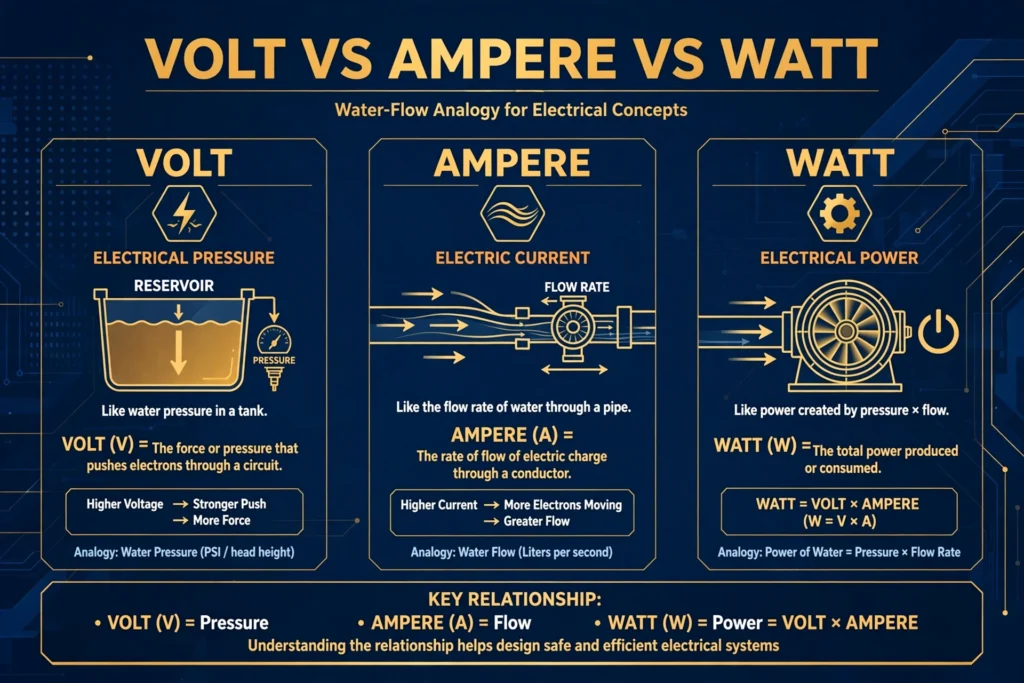
A volt (V) measures electrical pressure — the force that pushes current through a wire. It is named after Alessandro Volta, the inventor of the battery. Think of water in a tank: voltage is like the water pressure. More pressure pushes more water through the pipe.
Your home socket supplies about 230 volts; a phone battery gives about 3.7 volts. Voltage exists even when nothing is flowing — a battery has voltage sitting in it, waiting, just like a full water tank has pressure even with the tap closed. Learn more in our what is voltage guide.
What Is an Ampere?
An ampere (A), often shortened to amp, measures the actual flow of electric current — how many electrons pass a point each second. In the water analogy, amperes are the amount of water flowing through the pipe. Named after André-Marie Ampère, it is the SI base unit of electric current.
A phone charger supplies about 2 amps; a room heater draws about 8–10 amps. Unlike voltage, current only flows when a complete path exists and something is switched on. Read our what is electric current guide for the full picture.
What Is a Watt?
A watt (W) measures power — the rate at which electrical energy is used or produced. Named after James Watt of steam-engine fame. In the water analogy, watts tell you how much useful work the flowing water does — like how fast a water wheel spins.
A 60-watt bulb uses energy faster than a 10-watt LED. Your electricity bill, however, charges for total energy (watt-hours), not just the rate. The key formula connecting all three is beautifully simple:
Watts = Volts × Amperes (for DC and resistive AC loads)
So a 230-volt supply pushing 2 amps delivers 460 watts of power. See more formulas in our electric power formula guide.
The Water Analogy (Remember This)
- Volts = water pressure (how hard the water is pushed)
- Amperes = water flow (how much water passes per second)
- Watts = work done (pressure × flow = power of the water wheel)
High pressure with little flow, or low pressure with huge flow, can both spin the same wheel — just as 230 V × 2 A and 115 V × 4 A both give 460 W. This is why both voltage and current matter, and why watts combine them into one useful number.
Volt vs Ampere vs Watt: Comparison Table
| Point | Volt (V) | Ampere (A) | Watt (W) |
|---|---|---|---|
| Measures | Electrical pressure (potential difference) | Rate of current flow | Rate of energy use (power) |
| Water analogy | Water pressure | Water flow rate | Work done by the water |
| Named after | Alessandro Volta | André-Marie Ampère | James Watt |
| Symbol | V | A (amp) | W |
| Exists without flow? | Yes — a battery has voltage at rest | No — current needs a closed path | No — power needs both V and A |
| Typical values | 3.7 V (phone), 230 V (home) | 2 A (charger), 10 A (heater) | 10 W (LED), 2000 W (heater) |
| Measured with | Voltmeter (across two points) | Ammeter (in series with the flow) | Wattmeter (V × A together) |
| Formula link | V = W ÷ A | A = W ÷ V | W = V × A |
Where VA (Volt-Ampere) Fits In
You may also see VA (volt-ampere) on UPS and transformer ratings. VA is apparent power — simply volts times amperes — while watts are the real, usable power. They are equal only when voltage and current are perfectly in step (resistive loads like heaters). With motors and other inductive loads, some current is “borrowed and returned” each cycle, so watts are less than VA.
The ratio between them is the power factor: Watts = VA × power factor. A 1000 VA UPS with 0.8 power factor delivers 800 real watts. This is exactly why generators are rated in kVA and motors in kW. Explore it visually in our power triangle guide, dive deeper with apparent power explained, and see the full kW/kVA story in kW vs kVA complete guide.
Everyday Examples
- Phone charger (5 V, 2 A): 10 W — low pressure, small flow, little power.
- Room heater (230 V, 8.7 A): 2000 W — normal pressure, heavy flow, lots of heat.
- Electric car fast charger (400 V, 250 A): 100,000 W (100 kW) — high pressure AND huge flow.
Notice the pattern: watts always tell you the size of the job, while volts and amperes tell you how it is delivered. Check what power factor is to understand why AC adds one more twist to the story.
FAQs
Can you have volts without amps?
Yes. A disconnected battery shows full voltage but zero current — pressure with the tap closed. Current (amps) only appears when a circuit is completed.
Which kills — volts or amps?
It is the current (amps) through the body that causes harm, but voltage is what pushes it there. High voltage can drive dangerous current through skin resistance — respect both.
Is watt the same as volt-ampere?
Not exactly. VA is apparent power (V × A always); watts are real usable power. They match only for purely resistive loads. The difference is the power factor.
Why are batteries rated in amp-hours (Ah) instead of watts?
Amp-hours measure stored charge (how long a current can flow), which is what matters for runtime. Multiply by voltage to get watt-hours — the stored energy. See our battery types guide.
How do I calculate watts from volts and amps?
Multiply them: W = V × A. A 12-volt battery supplying 5 amps delivers 60 watts. (For AC with motors, also multiply by the power factor.)
Conclusion
Volts push, amperes flow, watts work. Voltage is the pressure, current is the flow, and power is pressure times flow. Keep the water analogy in mind — pressure, flow, and the spinning wheel — and these three units will never confuse you again. And when you meet VA on a UPS nameplate, remember: it is the apparent size of the supply, while watts are what you actually get to use.
See the Wikipedia article on the volt.