
Imagine receiving your electricity bill and wondering why it increased even though you did not add any new appliances. The answer often lies in how much electrical power your devices consume and how long they run. From a simple light bulb to heavy industrial machinery, every electrical device uses power, and understanding how to calculate it is essential for efficiency and cost control.
For electrical students, engineers, technicians, and beginners, learning the electric power formula is fundamental. It helps in designing circuits, selecting equipment, estimating energy consumption, improving efficiency, and ensuring safe operation. Without understanding power calculations, it becomes difficult to size wires, choose protection devices, or manage energy use effectively.
In this article, you will learn what the electric power formula is, the electric power working principle, different power equations, components involved, advantages and limitations, practical applications, and troubleshooting tips. The concepts are explained in simple, clear language to build strong technical understanding.
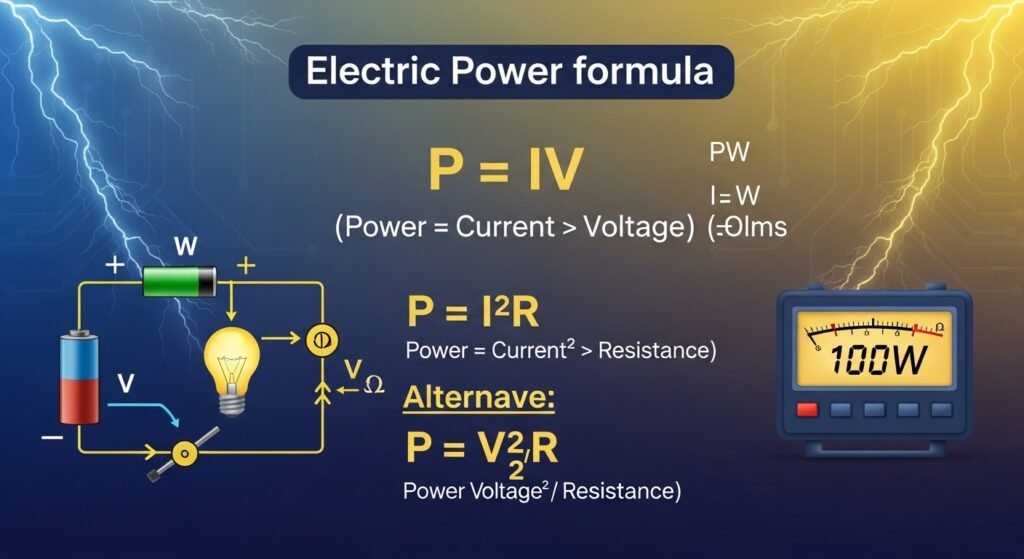
The electric power formula is used to calculate the rate at which electrical energy is consumed or produced in a circuit.
Standard Electric Power Formula
P=V×IP = V \times IP=V×I
Where:
- P = Power (Watts)
- V = Voltage (Volts)
- I = Current (Amperes)
Simple Explanation
Electric power tells us how fast electrical energy is being used. Higher power means more energy is consumed in less time.
Practical Example
If a device operates at:
- Voltage = 220 V
- Current = 2 A
Then,
P=220×2=440 wattsP = 220 \times 2 = 440 \text{ watts}P=220×2=440 watts
This means the device consumes 440 watts of power.
Electric Power Working Principle (2026)
The working principle of electric power is based on the generation, transfer, and conversion of electrical energy from a power source to an electrical load. Electric power represents the rate at which electrical energy is produced, transferred, or consumed within an electrical circuit. Whenever a voltage source applies electrical pressure across a conductor and current begins to flow, electrical energy is delivered to connected devices where it is converted into useful forms such as light, heat, motion, or sound.
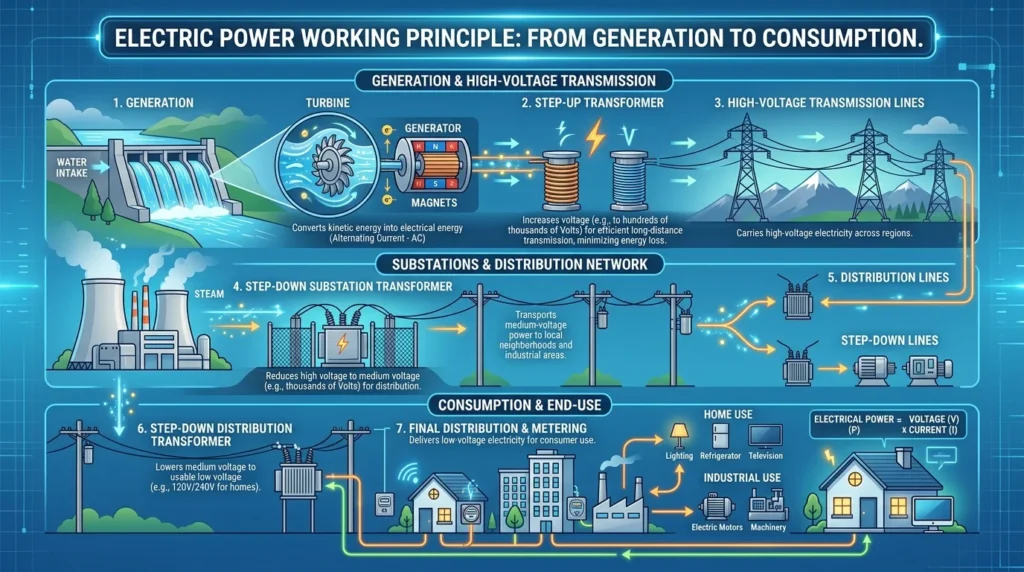
Electric power is one of the most important concepts in electrical and electronic engineering because it determines how efficiently electrical equipment performs. From household appliances and industrial machinery to electric vehicles, renewable energy systems, and smart electronic devices, every electrical system depends on the effective transfer and utilisation of electric power. As technology continues to advance 2026 efficient power management remains essential for reducing energy losses, improving reliability, and supporting sustainable energy solutions.
Understanding Electric Power with a Simple Analogy
A simple way to understand electric power is to compare it with a water pump system.
- Voltage (V) = Water pressure that pushes water through a pipe.
- Current (I) = The amount or flow rate of water moving through the pipe.
- Power (P) = The force or strength of the flowing water turning a water turbine.
When both the water pressure and the flow rate increase, the turbine produces more useful work. Similarly, in an electrical circuit, higher voltage and higher current result in greater electrical power being delivered to the load.
This analogy makes it easier to understand how electrical energy is transferred from the source to electrical equipment.
Step-by-Step Working Principle of Electric Power
Voltage Source Supplies Electrical Energy
Every electrical circuit begins with a voltage source such as a battery, generator, solar panel, or power supply. The voltage creates the electrical pressure needed to move electrons through the circuit.
Electric Current Begins to Flow
When the circuit is complete, electrons move through the conductor, creating an electric current. The amount of current depends on the applied voltage and the circuit’s resistance.
Electrical Energy Reaches the Load
The flowing current carries electrical energy to the connected load, such as a lamp, motor, heater, fan, or electronic device. The load uses this energy to perform a specific function.
Energy Is Converted into Useful Forms
Inside the load, electrical energy is converted into other forms of energy depending on the application.
- Light in electric lamps and LEDs
- Heat in electric heaters, irons, and ovens
- Mechanical motion in electric motors and fans
- Sound in speakers and audio systems
- Magnetic energy in transformers and electromagnets
Electric Power Represents the Rate of Energy Conversion
Electric power indicates how quickly electrical energy is converted into useful work. Devices with higher power ratings consume or deliver energy at a faster rate than lower-powered devices.
Factors Affecting Electric Power
Several important factors determine the amount of electric power delivered in a circuit.
- Voltage: Increasing voltage generally increases power when current also flows.
- Current: Higher current allows more electrical energy to be transferred each second.
- Resistance: Resistance limits current flow and directly affects overall power consumption.
- Power Factor (AC Circuits): In alternating current systems, the power factor influences how effectively electrical power is converted into useful work.
- Load Characteristics: Different electrical loads consume power differently depending on their design and operating conditions.
Key Points to Remember
- Electric power is the rate of electrical energy transfer or consumption.
- Power increases when voltage increases, provided current can also increase.
- Power also increases with higher current.
- Resistance affects current flow and overall power consumption.
- Electrical energy is converted into useful forms such as light, heat, motion, and sound.
- Efficient power management improves system performance, reduces energy losses, and lowers operating costs.
Practical Applications of Electric Power
The working principle of electric power is applied in almost every area of modern life, including:
- Residential electrical systems and household appliances
- Industrial machinery and manufacturing equipment
- Commercial buildings and office automation
- Electric vehicles (EVs)
- Solar power systems and wind energy installations
- Battery energy storage systems
- Smart grids and intelligent power distribution
- Consumer electronics and communication devices
- Medical equipment and healthcare technology
Types and Classification of Electric Power Formulas (2026)
Electric power can be calculated using different formulas depending on the electrical values available in a circuit. Engineers, electricians, technicians, and students use specific power equations based on whether voltage, current, resistance, or power factor is known. Choosing the correct formula helps in designing efficient electrical systems, analysing circuit performance, reducing energy losses, and ensuring the safe operation of electrical equipment. As electrical technologies continue to advance 2026 , understanding the classification of electric power formulas remains essential for residential wiring, industrial automation, renewable energy systems, electric vehicles, and modern electronic devices.
Electric Power Using Voltage and Current
The most common electric power formula is used when the voltage and current of a circuit are known.
Formula:
P = V × I
Where:
- P = Power (Watts, W)
- V = Voltage (Volts, V)
- I = Current (Amperes, A)
This equation calculates the amount of electrical power delivered to or consumed by a load. It is widely used in DC circuits and in AC circuits with purely resistive loads where voltage and current are in phase.
Common Applications
- Household electrical appliances
- LED lighting systems
- Battery-powered devices
- DC power supplies
- Mobile phone chargers
- Consumer electronics
This is the simplest and most frequently used power equation in electrical engineering.
Electric Power Using Current and Resistance
When the current flowing through a circuit and the resistance of the load are known, electric power is calculated using the following equation.
Formula:
P = I² × R
Where:
- P = Power (Watts)
- I = Current (Amperes)
- R = Resistance (Ohms)
This equation is derived from Ohm’s Law and is particularly useful for calculating the heat generated in resistive electrical components.
Common Applications
- Electric heating elements
- Electric irons
- Water heaters
- Resistance furnaces
- High-power resistors
- Fuse and resistor power calculations
This formula is widely used when analysing electrical heating and energy dissipation in resistive circuits.
Electric Power Using Voltage and Resistance
If the voltage and resistance are known, power can be calculated without measuring current.
Formula:
P = V² / R
Where:
- P = Power (Watts)
- V = Voltage (Volts)
- R = Resistance (Ohms)
This equation is especially useful when designing resistive loads or evaluating power consumption in electrical appliances.
Common Applications
- Electric heaters
- Incandescent lamps
- Heating coils
- Laboratory electrical experiments
- Domestic heating appliances
Engineers frequently use this formula during electrical system design and equipment selection.
Real Power in AC Circuits
Alternating current (AC) circuits often contain inductive or capacitive loads. Therefore, the power factor must be included in the power calculation.
Formula:
P = V × I × cos φ
Where:
- P = Real Power (Watts)
- V = RMS Voltage (Volts)
- I = RMS Current (Amperes)
- cos φ = Power Factor
- φ = Phase angle between voltage and current
Real power represents the useful electrical power that performs actual work, such as producing light, heat, or mechanical motion.
Common Applications
- Electric motors
- Industrial machinery
- Air-conditioning systems
- Pumps and compressors
- Transformers
- Commercial electrical installations
Improving the power factor reduces energy losses and increases overall electrical system efficiency.
Apparent Power and Reactive Power
In AC systems, power is divided into different components to accurately analyse electrical performance and improve power quality.
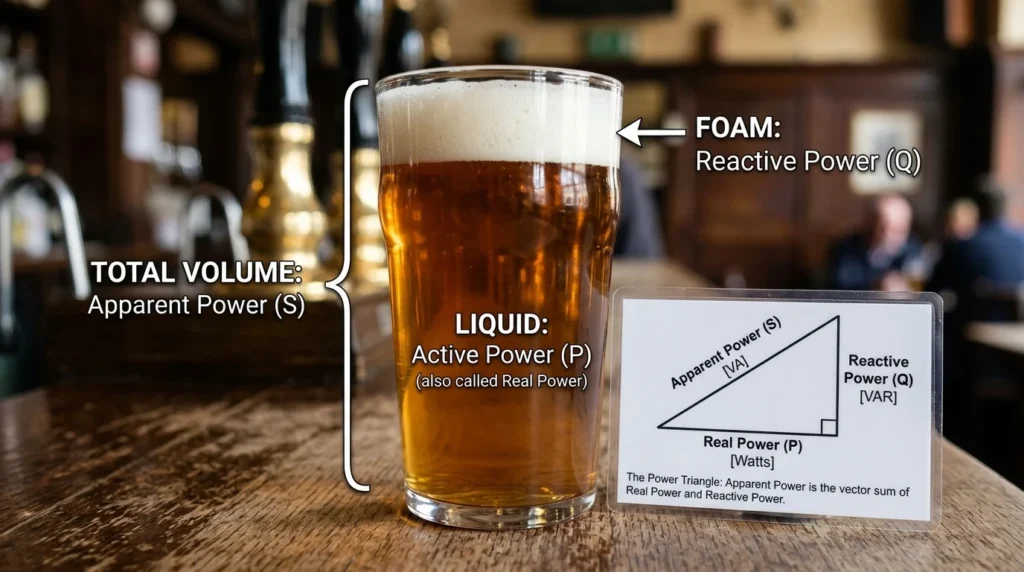
Apparent Power
Formula:
S = V × I
Where:
- S = Apparent Power
- Unit: Volt-Ampere (VA)
Apparent power represents the total electrical power supplied by the source before considering the effects of the power factor.
Reactive Power
Formula:
Q = V × I × sin φ
Where:
- Q = Reactive Power
- Unit: Volt-Ampere Reactive (VAR)
Reactive power does not produce useful work directly. Instead, it creates and maintains the magnetic and electric fields required for inductive and capacitive equipment.
Common Applications
- Induction motors
- Transformers
- Generators
- Industrial power systems
- HVAC equipment
- Power transmission networks
Proper management of reactive power improves voltage stability and reduces unnecessary transmission losses.
Difference Between Real, Apparent, and Reactive Power
| Power Type | Formula | Unit | Purpose |
|---|---|---|---|
| Real Power (P) | P = V × I × cos φ | Watt (W) | Performs useful work such as heating, lighting, and mechanical motion. |
| Apparent Power (S) | S = V × I | Volt-Ampere (VA) | Represents the total power supplied by the electrical source. |
| Reactive Power (Q) | Q = V × I × sin φ | Volt-Ampere Reactive (VAR) | Maintains magnetic and electric fields required by AC equipment. |
Understanding the relationship between these three types of power enables engineers to design efficient AC power systems, improve power factor, and optimise energy utilisation.
Importance of Choosing the Correct Power Formula
Selecting the appropriate electric power formula helps engineers and technicians to:
Improve the performance of renewable energy and smart grid technologies.
Calculate electrical power accurately.
Design safer and more reliable circuits.
Prevent equipment overload and overheating.
Improve overall energy efficiency.
Reduce electrical transmission losses.
Select the correct electrical components.
Optimise industrial and commercial power systems.
Main Components Affecting Electric Power in Electrical Systems (2026)
Electric power is influenced by several key electrical components that work together to determine how efficiently energy is generated, transmitted, and consumed in a circuit. Understanding these components is essential for students, electricians, technicians, and engineers because they directly affect the performance, safety, and efficiency of electrical systems. Whether in residential wiring, industrial machinery, renewable energy installations, or modern electronic devices, these components play a vital role in controlling power consumption and ensuring reliable operation. As electrical technology continues to evolve 2026 proper knowledge of these components has become increasingly important for designing energy-efficient and sustainable electrical systems.
Voltage (V)
Voltage is the electrical pressure or electromotive force (EMF) that pushes electric charges through a conductor. It is measured in volts (V) and is supplied by sources such as batteries, generators, solar panels, or electrical power grids.
Functions of Voltage
- Provides the force needed to move electrons through a circuit.
- Determines the potential difference between two points.
- Directly influences the amount of electrical power delivered to a load.
- Works together with current to determine total power consumption.
- Enables electrical devices to operate correctly.
Practical Examples
- Household power outlets
- Battery-powered devices
- Solar photovoltaic systems
- Industrial power supplies
Without sufficient voltage, electrical current cannot flow effectively, and connected equipment will not operate properly.
Current (I)
Current is the flow of electric charge through a conductor and is measured in amperes (A). It represents the quantity of electrons passing through a circuit each second.
Functions of Current
- Transfers electrical energy from the power source to the load.
- Determines how much electrical work can be performed.
- Directly affects electric power consumption.
- Produces useful outputs such as heat, light, and mechanical motion.
Practical Examples
- Electric motors
- LED lighting circuits
- Battery charging systems
- Electronic control circuits
Higher current generally results in greater power consumption, provided the voltage remains constant.
Resistance (R)
Resistance is the opposition offered by a material to the flow of electric current. It is measured in ohms (Ω) and influences how much current can pass through a circuit.
Functions of Resistance
- Controls current flow.
- Protects sensitive electrical components.
- Regulates voltage distribution.
- Converts electrical energy into heat in heating devices.
- Prevents excessive current that could damage equipment.
Practical Examples
- Current-limiting resistors
- Electric heaters
- Electric irons
- Heating elements
- Electronic circuits
Proper resistance selection improves electrical safety, efficiency, and circuit reliability.
Power Factor (cos φ)
The power factor is a measure of how effectively electrical power is converted into useful work in an AC (Alternating Current) system. It is expressed as cos φ, where φ is the phase angle between voltage and current.
Functions of Power Factor
- Indicates the efficiency of AC electrical systems.
- Reduces unnecessary power losses.
- Improves voltage regulation.
- Increases overall system efficiency.
- Helps lower electricity distribution costs in industrial installations.
Practical Examples
- Industrial motors
- Transformers
- Air-conditioning systems
- Manufacturing equipment
- Commercial power distribution
A power factor close to 1.0 indicates highly efficient power utilisation, while a lower power factor means more energy is wasted.
Electrical Load
An electrical load is any device or equipment that consumes electrical power and converts it into another form of energy such as light, heat, sound, or mechanical motion.
Functions of the Load
- Consumes electrical energy supplied by the source.
- Converts electricity into useful work.
- Determines the amount of current drawn from the circuit.
- Influences total power consumption and system efficiency.
Common Example of Electrical Loads
- Electric lamps
- Ceiling fans
- Refrigerators
- Air conditioners
- Electric motors
- Water pumps
- Computers and electronic equipment
- Industrial machines
Different types of loads require different amounts of electrical power depending on their design and operating conditions.
How These Components Work Together
All of these components interact to determine the total electric power consumed by a circuit.
- Voltage provides the electrical pressure.
- Current carries electrical energy.
- Resistance controls the flow of current.
- Power Factor determines the efficiency of AC power utilisation.
- Load converts electrical energy into useful output.
When these components are properly balanced, electrical systems operate safely, efficiently, and with minimal energy loss.
Advantages, Limitations, and Applications of Electric Power (2026)
Electric power is one of the most important concepts in electrical and electronic engineering because it measures the rate at which electrical energy is generated, transferred, and consumed. Understanding the advantages, limitations, and practical applications of electric power helps engineers, technicians, electricians, and students design efficient electrical systems, minimise energy losses, and ensure the safe operation of electrical equipment. As electrical technologies continue to advance 2026 accurate power calculations have become increasingly important in renewable energy systems, electric vehicles, smart grids, industrial automation, and modern electronic devices.
Advantages of Electric Power
Electric power calculations provide numerous benefits that improve the performance, efficiency, and safety of electrical systems.
Accurate Energy Consumption Calculations
Electric power formulas help determine how much electrical energy a device consumes during operation. This information is essential for estimating electricity usage, planning energy requirements, and reducing unnecessary power consumption.
Essential for Electrical Design
Power calculations are a fundamental part of electrical system design. Engineers use electric power formulas to select appropriate conductors, switches, transformers, generators, and protective devices that match the expected electrical load.
Improves Energy Efficiency
By calculating power accurately, engineers can identify inefficient equipment and optimise electrical systems to reduce energy losses. Efficient power management lowers operating costs while improving system performance.
Helps Reduce Electricity Costs
Knowing the power consumption of electrical equipment allows homeowners and industries to manage electricity usage more effectively. Selecting energy-efficient appliances and optimising operating schedules can significantly reduce electricity bills.
Ensures Safe Equipment Operation
Correct power calculations prevent electrical equipment from operating beyond its rated capacity. This reduces the risk of overheating, insulation failure, equipment damage, and electrical fires.
Supports Proper Wire and Breaker Selection
Electric power calculations help determine the correct size of electrical cables, circuit breakers, fuses, and protective devices. Proper sizing improves safety, minimises voltage drop, and ensures reliable operation.
Improves System Reliability
Accurate power analysis enables engineers to balance electrical loads, avoid overload conditions, and maintain stable system performance in residential, commercial, and industrial installations.
Conclusion on Advantages
The proper use of electric power formulas improves electrical safety, enhances energy efficiency, supports cost-effective system design, and ensures reliable operation across all types of electrical installations.
Limitations and Challenges of Electric Power Calculations (2026)
Although electric power calculations are extremely useful, they also have several practical limitations that engineers and technicians must consider when designing and operating electrical systems.
Requires Accurate Measurements
Reliable power calculations depend on accurate measurements of voltage, current, resistance, and other electrical parameters. Incorrect measurements can produce inaccurate results and affect system performance.
AC Power Calculations Are More Complex
Unlike DC circuits, alternating current (AC) systems require additional factors such as phase angle and power factor. This makes AC power analysis more complex, especially in large industrial installations.
Power Factor Must Be Considered
Industrial facilities often use inductive equipment such as motors and transformers, which reduce the power factor. Ignoring the power factor can lead to incorrect power calculations, poor efficiency, and higher electricity costs.
Incorrect Calculations Can Cause Overloads
Improper power calculations may result in overloaded circuits, overheated conductors, damaged electrical equipment, and increased fire hazards. Careful engineering analysis is essential to prevent these problems.
Does Not Directly Indicate Energy Cost
Electric power indicates the rate of energy consumption but does not directly determine electricity cost. Total energy usage depends on both power and operating time, usually measured in kilowatt-hours (kWh).
Environmental and Operational Factors
Power consumption may vary because of temperature, equipment ageing, load fluctuations, and operating conditions. These factors should be considered when designing high-performance electrical systems.
Conclusion on Limitations
Understanding these limitations allows engineers to perform more accurate calculations, improve system efficiency, and reduce operational risks in both residential and industrial electrical installations.
Practical Applications of Electric Power (2026)
Electric power formulas are used in almost every area of electrical engineering. They help determine energy consumption, equipment capacity, and system performance in a wide range of residential, commercial, industrial, and modern technological applications.
Home Applications
Electric power calculations are widely used in homes to improve energy management and electrical safety.
Common Applications
- Calculating household electricity usage
- Selecting energy-efficient appliances
- Estimating monthly energy consumption
- Designing residential electrical wiring
- Choosing appropriate circuit breakers and fuses
- Managing home solar power systems
These applications help homeowners reduce electricity costs while improving electrical safety.
Industrial Applications
Industrial facilities rely heavily on electric power calculations for efficient operation and equipment protection.
Common Applications
- Motor power calculations
- Load distribution planning
- Generator sizing
- Transformer selection
- Power factor correction
- Industrial automation systems
- Electrical panel design
- Manufacturing process optimisation
Accurate power calculations improve production efficiency and reduce operating costs.
Modern Technology Applications
Advanced technologies depend on precise electric power analysis to achieve maximum efficiency and reliability.
Common Applications
- Renewable energy system design
- Solar photovoltaic (PV) installations
- Wind energy systems
- Electric vehicle (EV) charging stations
- Battery energy storage systems
- Smart grid load management
- Data centre power planning
- Artificial intelligence (AI) infrastructure
- Robotics and industrial automation
- Internet of Things (IoT) devices
These technologies require accurate power calculations to ensure reliable operation and minimise energy losses.
Importance of Electric Power Applications
Understanding the practical applications of electric power enables engineers and technicians to:
Improve sustainability and environmental performance.
Optimise energy consumption.
Improve electrical system reliability.
Reduce operating and maintenance costs.
Increase equipment lifespan.
Design safer electrical installations.
Support renewable energy integration.
Electric Power vs Electrical Energy Comparison and Power Rating Selection Guide (2026)
Understanding the difference between electric power and electrical energy is essential for anyone studying electrical engineering or working with electrical systems. Although these terms are often used interchangeably, they describe different concepts. Electric power indicates how quickly electrical energy is produced or consumed, while electrical energy represents the total amount of electricity used over a period of time. Knowing this distinction helps in selecting electrical equipment, estimating electricity consumption, reducing energy costs, and designing safe and efficient electrical installations. As technology advances2026 understanding both concepts has become increasingly important for smart homes, renewable energy systems, electric vehicles, and industrial power management.
Comparison Between Electric Power and Electrical Energy
| Feature | Electric Power | Electrical Energy |
|---|---|---|
| Definition | The rate at which electrical energy is generated, transferred, or consumed. | The total amount of electrical energy consumed over a period of time. |
| Unit | Watt (W), Kilowatt (kW) | Watt-hour (Wh), Kilowatt-hour (kWh) |
| Time Factor | Time is not included in the calculation. | Time is included because energy depends on both power and operating duration. |
| Formula | P = V × I (or other power formulas) | Energy = Power × Time |
| Purpose | Measures how much power a device requires at any given moment. | Measures the total electricity consumed over time. |
| Example | A heater rated at 1000 W consumes power at a rate of 1000 watts while operating. | If the same 1000 W heater operates for 1 hour, it consumes 1 kWh of electrical energy. |
| Common Usage | Equipment ratings, electrical design, motor selection, and circuit calculations. | Electricity billing, energy monitoring, battery capacity, and consumption analysis. |
Why the Difference Matters
Electric power and electrical energy are closely related but serve different purposes. Power tells us how fast electricity is being used, while energy tells us how much electricity has been consumed over a specific period. For example, two appliances may have the same power rating, but the appliance that operates for a longer time will consume more electrical energy and contribute more to the electricity bill.
Understanding this relationship helps engineers optimise electrical systems and enables consumers to make better decisions regarding energy efficiency and operating costs.
Power Rating Selection Guide for Electrical Systems (2026)
Choosing the correct power rating for electrical equipment is essential for ensuring efficiency, reliability, and safety. Selecting equipment with an incorrect power rating can lead to overloaded circuits, overheating, reduced equipment life, excessive energy consumption, and even electrical fires. Proper power selection is therefore an important part of electrical design in residential, commercial, and industrial applications.
Choosing Power Ratings for Household Appliances
Before purchasing or installing any household appliance, always verify its power rating.
Best Practices
- Check the watt (W) or kilowatt (kW) rating before purchase.
- Ensure that household wiring can safely carry the expected electrical load.
- Avoid connecting several high-power appliances to the same outlet.
- Select energy-efficient appliances to reduce electricity consumption.
- Confirm that plugs, sockets, and extension cords are rated for the expected load.
These practices improve electrical safety and help reduce monthly electricity costs.
Choosing Power Ratings for Circuit Design
During electrical system design, engineers calculate the total connected load before selecting electrical components.
Best Practices
- Calculate the total power demand of all connected equipment.
- Select the correct wire size based on current-carrying capacity.
- Choose circuit breakers and fuses that provide adequate protection.
- Consider voltage drop for long cable runs.
- Leave additional capacity for future expansion whenever possible.
Proper circuit design improves system reliability and reduces the risk of overload.
Choosing Power Ratings for Industrial Systems
Industrial electrical systems require more detailed power analysis because they often supply large motors and heavy machinery.
Best Practices
- Consider the power factor when calculating power requirements.
- Use three-phase power systems for heavy industrial loads.
- Balance electrical loads across all phases.
- Select transformers and generators with sufficient capacity.
- Monitor demand to improve energy efficiency and reduce operating costs.
These measures increase system performance while extending equipment lifespan.
Tips for Beginners
If you are new to electrical systems, follow these practical safety guidelines:
- Never exceed the rated capacity of a socket or extension board.
- Add together the power ratings of all connected devices before plugging them into the same circuit.
- Leave a 20′‘–’‘25 ‘‘margin” when selecting electrical equipment and protective devices.
- Always use certified and high-quality electrical equipment.
- Switch off the power before performing maintenance or replacing components.
- Read the manufacturer’s specifications before installation.
- If unsure, consult a qualified electrician or electrical engineer.
Importance of Proper Power Rating Selection
Selecting the correct power rating offers several important benefits:
- Improves electrical safety.
- Prevents equipment overload and overheating.
- Reduces energy losses.
- Extends equipment service life.
- Improves energy efficiency.
- Lowers maintenance and operating costs.
- Ensures reliable performance in residential, commercial, and industrial systems.
Common Electric Power Problems, Practical Solutions, and Future Trends (2026)
Understanding common electric power problems is essential for maintaining safe, reliable, and energy-efficient electrical systems. Incorrect power calculations, overloaded circuits, poor power factor, and excessive energy consumption can reduce system performance, increase operating costs, and damage electrical equipment. By identifying the root causes of these problems and applying the correct solutions, engineers, electricians, and technicians can improve electrical safety and maximise system efficiency. As electrical technology continues to evolve 2026 advanced monitoring systems, artificial intelligence, and renewable energy technologies are transforming the way electric power is managed.
Common Electric Power Problems and Practical Solutions (2026)
Electrical power systems may experience various problems during normal operation. The following are some of the most common issues along with their causes and recommended solutions.
Why Do Electrical Wires Heat Up?
Cause
Electrical wires usually become hot because excessive current flows through them. This often occurs due to overloaded circuits, undersized conductors, loose electrical connections, or damaged insulation. High current increases electrical losses and generates excessive heat, which may reduce the lifespan of wiring and create fire hazards.
Solution
- Reduce the connected electrical load.
- Use the correct wire size according to the expected current.
- Tighten loose terminals and replace damaged wiring.
- Install properly rated circuit breakers and fuses.
- Avoid connecting multiple high-power appliances to the same circuit.
Proper cable sizing and load management help prevent overheating and improve electrical safety.
Why Does a Circuit Breaker Trip Frequently?
Cause
Frequent breaker tripping usually indicates that the power demand exceeds the circuit’s rated capacity. It may also result from short circuits, ground faults, faulty appliances, or deteriorated wiring.
Solution
- Calculate the total electrical load connected to the circuit.
- Redistribute heavy electrical loads across different circuits.
- Replace faulty appliances if necessary.
- Ensure the circuit breaker rating matches the electrical design.
- Have the electrical installation inspected if tripping continues.
Correct load distribution protects both equipment and electrical wiring.
Why Is the Electricity Bill So High?
Cause
High electricity bills are often caused by operating high-power appliances for long periods, poor energy management, inefficient equipment, or standby power consumption.
Solution
- Reduce unnecessary appliance operating time.
- Replace old equipment with energy-efficient models.
- Turn off unused electrical devices completely.
- Install LED lighting and energy-saving appliances.
- Monitor electricity usage using smart energy meters.
Improving energy efficiency reduces electricity costs while maintaining comfort and productivity.
Why Do Electric Motors Overheat?
Cause
Electric motors commonly overheat because of overloading, poor power factor, inadequate ventilation, low supply voltage, or mechanical problems such as bearing wear.
Solution
- Verify that the motor operates within its rated load.
- Improve the power factor using capacitor banks where appropriate.
- Ensure proper cooling and ventilation.
- Perform regular preventive maintenance.
- Check voltage balance and supply quality.
Routine maintenance significantly improves motor efficiency and extends service life.
Importance of Practical Troubleshooting
Accurate power calculations and systematic troubleshooting enable technicians to identify faults quickly, reduce equipment downtime, and improve the reliability of electrical systems. Regular inspections, proper maintenance, and correct component selection are essential for preventing common electrical power problems.
Future Trends in Electric Power Calculation and Management (2026)
Modern electrical engineering is moving towards intelligent, automated, and highly efficient power management systems. Emerging technologies are making power calculations more accurate while helping reduce energy waste and improve system performance.
Smart Energy Monitoring
Advanced smart meters and intelligent monitoring systems provide real-time information about voltage, current, power consumption, and energy usage.
Benefits
- Real-time electricity monitoring.
- Early detection of overload conditions.
- Better energy management.
- Reduced electricity costs.
- Improved maintenance planning.
Smart monitoring enables consumers and industries to make informed energy-saving decisions.
Power Factor Optimisation
Industries increasingly use automated power factor correction systems to improve electrical efficiency and reduce reactive power losses.
Benefits
- Lower electricity costs.
- Reduced transmission losses.
- Improved voltage regulation.
- Increased equipment efficiency.
- Better utilisation of electrical infrastructure.
Power factor optimisation is especially important for large industrial facilities and commercial buildings.
Renewable Energy Integration
Renewable energy technologies such as solar photovoltaic (PV) systems and wind power require accurate electric power calculations for efficient operation.
Applications
- Solar panel sizing.
- Inverter selection.
- Battery energy storage systems.
- Grid integration.
- Hybrid renewable energy systems.
Accurate power calculations maximise renewable energy output and improve system reliability.
AI-Based Load Management
Artificial Intelligence (AI) is transforming modern power systems by automatically analysing electricity demand and optimising load distribution.
Benefits
- Automatic load balancing.
- Predictive energy management.
- Reduced peak demand.
- Lower operating costs.
- Increased electrical system reliability.
AI-based energy management is becoming a key feature of smart grids and intelligent buildings.
Energy-Efficient Appliances
Modern electrical appliances are designed to deliver the same or better performance while consuming significantly less power.
Examples
- High-efficiency air conditioners.
- LED lighting systems.
- Inverter refrigerators.
- Smart washing machines.
- Energy-efficient industrial motors.
These technologies reduce electricity consumption while supporting environmental sustainability.
Smart Grids and Digital Power Systems
Future power networks are becoming more intelligent through digital communication and automated control.
Key Features
- Real-time fault detection.
- Automatic power distribution.
- Integration of renewable energy sources.
- Remote monitoring and control.
- Improved grid stability and reliability.
Smart grids are expected to become the foundation of future electrical infrastructure.
Conclusion
The electric power formula is a fundamental concept that helps determine how much electrical energy is being used or delivered in a circuit. By understanding formulas such as P = V × I, I²R, and V²/R, electrical professionals can design safer systems, prevent overloads, and improve efficiency.
Knowing the electric power working principle allows students and technicians to calculate loads, select equipment, and troubleshoot problems effectively. While power calculations may appear simple, they play a crucial role in energy management, cost control, and system reliability.
As electrical systems evolve with smart grids, renewable energy, and automation, mastering power calculations becomes even more important. A strong understanding of electric power ensures better design decisions, improved safety, and efficient energy usage.