
From blast furnaces to food processing lines, one humble sensor measures temperature in the harshest places on earth: the thermocouple. It has no moving parts, needs no external power to generate its signal, survives temperatures that would destroy most electronics, and costs a fraction of other temperature sensors. Understanding how thermocouples work — and which type to choose — is essential knowledge for electrical and instrumentation engineers.
What Is a Thermocouple?
A thermocouple is a temperature sensor made by joining two dissimilar metal wires at one end. When the joined end (the measuring or “hot” junction) and the open ends (the reference or “cold” junction) are at different temperatures, a small voltage is generated between the open ends. This voltage — typically a few millivolts — varies predictably with the temperature difference, so measuring the voltage tells you the temperature.
Thermocouples are passive devices: the sensing element itself generates the signal, so no excitation power is needed at the sensor. They are rugged, fast-responding, and cover an enormous temperature range from about −270 °C to over 1800 °C depending on the type.
Working Principle: The Seebeck Effect
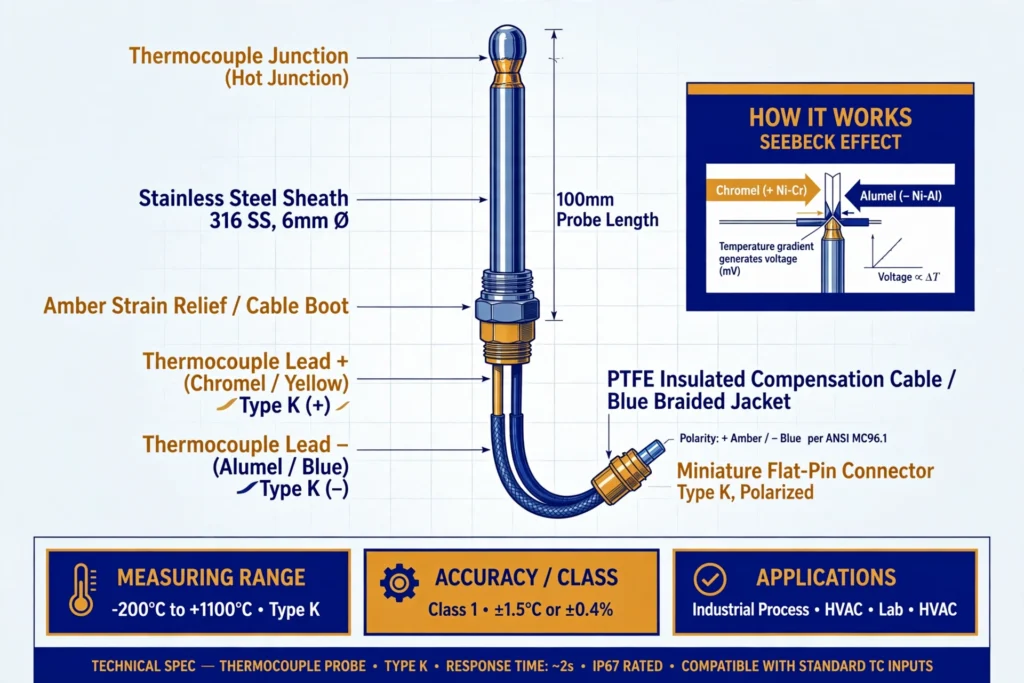
The thermocouple operates on the Seebeck effect, discovered by Thomas Johann Seebeck in 1821. When two dissimilar conductors are joined at two junctions held at different temperatures, an electromotive force (EMF) is produced around the loop, and a current flows if the circuit is closed.
In practice, one junction is the measuring junction placed at the point of interest, and the other is the reference junction kept at a known temperature (traditionally 0 °C in an ice bath; modern instruments use electronic cold-junction compensation with a built-in temperature sensor). The generated voltage is approximately proportional to the temperature difference between the two junctions: E ≈ α × (T_hot − T_cold), where α is the Seebeck coefficient, which depends on the metal pair and is typically tens of microvolts per degree Celsius. Because α itself varies slightly with temperature, real instruments convert the measured millivolts to temperature using standardized reference tables (such as IEC 60584) rather than a simple linear formula.
Why the Reference Junction Matters
A thermocouple only measures a temperature difference. If the reference junction drifts with ambient temperature, the reading drifts too. Modern transmitters and meters measure the terminal temperature with a separate sensor and mathematically compensate, so the displayed temperature is accurate without an ice bath.
Construction of a Thermocouple
- Thermocouple wires: Two dissimilar metal/alloy wires, joined at the measuring tip by welding.
- Insulation: Ceramic beads or mineral insulation (MgO) separating the wires along their length.
- Protection sheath: A metal or ceramic tube shielding the wires from corrosive atmospheres, mechanical damage, and process fluids. Grounded, ungrounded, or exposed junction styles trade off speed of response against electrical isolation.
- Connection head: A terminal block housing where thermocouple wires transition to extension-grade cable running back to the instrument.
Grounded junctions respond fastest but are electrically connected to the sheath; ungrounded junctions are slower but isolated from electrical noise; exposed junctions are fastest of all but fragile and limited to clean, non-corrosive environments.
Thermocouple Types and Their Ranges
| Type | Metal pair (+) / (−) | Typical range | Notes |
|---|---|---|---|
| K | Chromel / Alumel | −200 to +1260 °C | Most popular general-purpose type; good oxidation resistance |
| J | Iron / Constantan | −40 to +750 °C | Inexpensive; iron leg rusts — not for oxidizing/moist environments above ~550 °C |
| T | Copper / Constantan | −200 to +350 °C | Excellent for low/cryogenic temperatures; stable and accurate |
| E | Chromel / Constantan | −200 to +900 °C | Highest output (mV/°C) among common base-metal types |
| N | Nicrosil / Nisil | −200 to +1300 °C | Improved stability over type K at high temperatures |
| R | Platinum–13% Rhodium / Platinum | 0 to +1600 °C | Noble metal; high accuracy, expensive — furnaces, labs |
| S | Platinum–10% Rhodium / Platinum | 0 to +1600 °C | Similar to R; long-established standard |
| B | Platinum–30% Rhodium / Platinum–6% Rhodium | 600 to +1700 °C | Highest range; negligible output below ~600 °C |
Type K dominates general industry because it is cheap, reasonably accurate (±2.2 °C or ±0.75% typical), and covers most process temperatures. Types R, S, and B (noble-metal) are reserved for very high temperatures and calibration laboratories.
Accuracy and Response Time
Standard thermocouples are typically accurate to ±1–2 °C or ±0.5–0.75% of reading, whichever is greater — adequate for most process control but coarser than RTDs. Accuracy depends on wire quality, the reference-junction compensation, and degradation of the wires over time at high temperature (drift).
Response time ranges from milliseconds (exposed fine-wire junctions) to many seconds (heavy sheathed assemblies). Smaller diameter probes respond faster but are more fragile and drift sooner.
Thermocouple vs RTD: Quick Comparison
| Feature | Thermocouple | RTD (Pt100) |
|---|---|---|
| Temperature range | Very wide (−270 to 1800 °C) | Narrower (−200 to 600 °C typical) |
| Accuracy | Moderate (±1–2 °C) | High (±0.1–0.3 °C) |
| Signal | Self-generated mV | Needs excitation current |
| Ruggedness | Very rugged, vibration-tolerant | Fragile thin-film/platinum element |
| Cost | Low | Higher |
| Response | Fast (small probes) | Slower |
Choose thermocouples for high temperatures, harsh environments, and fast response; choose RTDs where accuracy and stability matter most.
Applications of Thermocouples
- Furnaces, kilns, and heat treatment: Types K, N, R, S, and B monitor and control high-temperature processes in steel, glass, and ceramics.
- Power plants: Metal and exhaust-gas temperatures in boilers, gas turbines, and steam lines.
- HVAC and refrigeration: Type T thermocouples handle low-temperature and differential measurements.
- Food processing: Fast-response probes verify cooking, pasteurization, and cold-chain temperatures.
- Automotive and aerospace: Exhaust gas temperature (EGT) monitoring and engine testing.
- Laboratories and calibration: Noble-metal thermocouples serve as transfer standards.
Installation and Best Practices
- Use matched extension wire (same thermocouple type or compensating cable) all the way to the instrument — ordinary copper wire in between creates parasitic junctions and errors.
- Observe polarity: thermocouple extension cables are color-coded; reversed polarity inverts the reading.
- Avoid electrical noise: run thermocouple wiring away from power cables, use twisted/shielded pairs, and prefer ungrounded junctions in noisy plants.
- Ensure good thermal contact: the measuring tip must truly reach process temperature — immersion depth should be 10–15 times the sheath diameter in fluids.
- Calibrate periodically: wires degrade, especially above 1000 °C; compare against a reference standard on a schedule. See our guide to calibration of instruments.
Frequently Asked Questions
What is a thermocouple in simple terms?
A temperature sensor made of two different metal wires joined at one end. A temperature difference between the joined end and the open ends produces a small voltage that indicates the temperature.
How does a thermocouple work?
It works on the Seebeck effect: two dissimilar metals joined at junctions at different temperatures generate a voltage proportional to the temperature difference. An instrument measures this voltage and converts it to a temperature reading.
Which thermocouple type is most commonly used?
Type K (Chromel/Alumel) — it covers −200 to +1260 °C, is inexpensive, and suits most industrial applications.
Do thermocouples need a power supply?
The sensing element itself generates its own millivolt signal and needs no excitation, but the measuring instrument (transmitter, meter, or PLC input) does need power.
What is cold junction compensation?
Since a thermocouple measures a temperature difference, the instrument must know the reference (cold) junction temperature. Modern instruments measure it with a built-in sensor and compensate automatically, replacing the old ice-bath method.
Thermocouple or RTD — which is better?
Neither is universally better. Thermocouples win on range, ruggedness, speed, and cost; RTDs win on accuracy and long-term stability. Match the sensor to the application. For measurement tools, see our electrical testing tools and digital panel meter guides. Also see Wikipedia.
Conclusion
The thermocouple remains the workhorse of industrial temperature measurement for good reason: it is simple, self-powered, rugged, fast, and spans a temperature range no other single sensor type can match. Its working principle — the Seebeck effect — is elegant physics turned into practical engineering. Success with thermocouples comes down to choosing the right type for the temperature range, using correct extension wiring, compensating the reference junction, and calibrating on schedule. Get those fundamentals right, and a thermocouple will deliver reliable temperature data for years in the toughest environments industry has to offer.