
When an electrical technician repairs a faulty circuit board, the first step is usually testing the system using proper tools. Without electrical testing tools, identifying faults becomes difficult and time-consuming.
In real electrical work, testing tools act like the “eyes and ears” of an engineer. They help verify voltage levels, current flow, resistance values, and circuit continuity. Whether you are working in home wiring, industrial control panels, or electronic circuit design, testing tools are essential.
Electrical testing tools are widely used in maintenance, troubleshooting, and quality control. Using the correct tool not only saves time but also improves safety.
In this article, you will learn about electrical testing tools working principle, types of testing tools, electrical testing tools applications, advantages and disadvantages, and selection tips for beginners.
If you are a student, technician, or beginner engineer, this guide will help you understand electrical testing equipment in a simple and practical way.
2. What are Electrical Testing Tools?
Electrical testing tools are instruments used to measure, test, and analyze electrical parameters such as voltage, current, resistance, continuity, and signal quality.
Simple Definition
Electrical testing tools are devices used to check the performance and safety of electrical circuits.
Practical Example
If a light bulb is not working, a technician may use a multimeter to check whether voltage is reaching the bulb or not.
These tools help engineers diagnose electrical problems quickly and accurately.
3. Electrical Testing Tools Working Principle
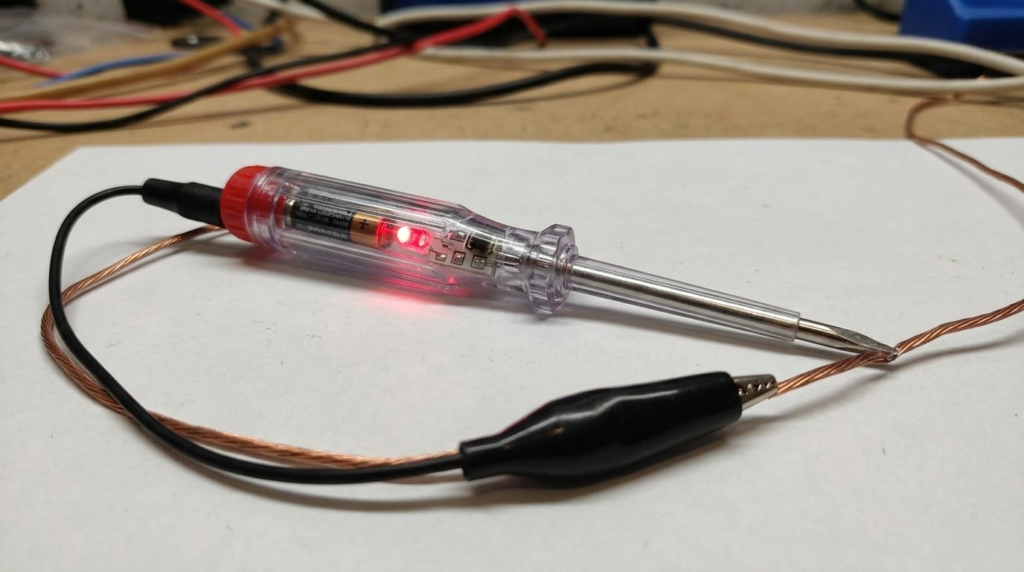
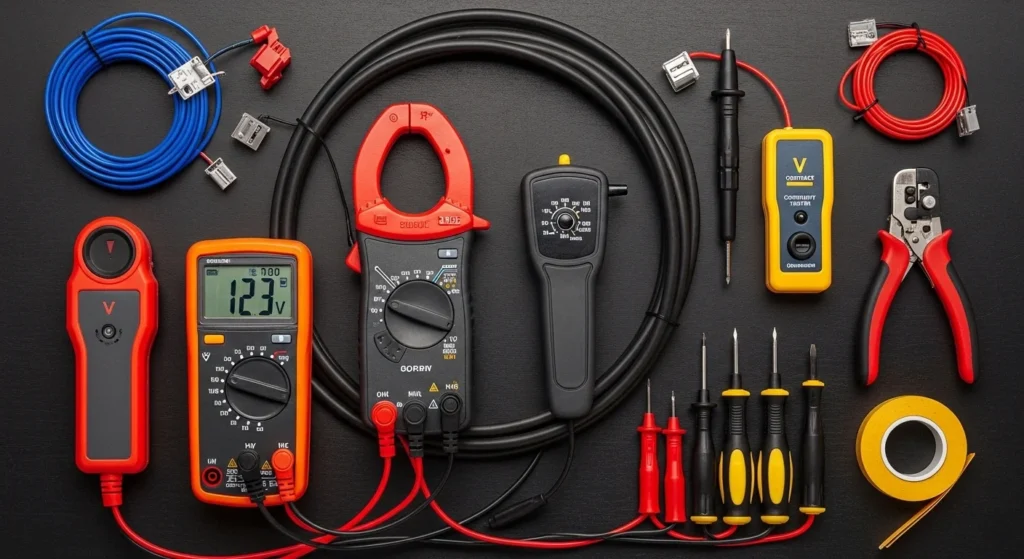
The working principle of electrical testing tools depends on signal measurement and electrical parameter detection.The electrical testing tools working principle is based on measuring, detecting, and analyzing electrical parameters such as voltage, current, resistance, continuity, frequency, and insulation condition in electrical circuits and equipment. Electrical testing tools operate by connecting to a circuit and sensing electrical signals through internal electronic components, sensors, or measuring mechanisms. Different tools use different methods for operation. For example, a multimeter measures voltage and current by using internal circuits and displays the readings digitally or through a moving pointer, while a clamp meter detects magnetic fields around a conductor to measure current without direct contact. Insulation testers apply high voltage to check insulation resistance, and continuity testers verify whether a circuit path is complete or broken. These tools help engineers and technicians identify faults, test equipment performance, ensure electrical safety, and maintain system reliability. Electrical testing tools are widely used in homes, industries, power plants, laboratories, automation systems, and maintenance work because they improve troubleshooting accuracy and reduce electrical hazards. Understanding the electrical testing tools working principle is important for electrical students, engineers, and technicians because proper testing and measurement are essential for safe and efficient electrical system operation.
Step-by-Step Working Process
- The tool is connected to the electrical circuit.
- The circuit signal (voltage, current, or resistance) enters the instrument.
- Internal electronic components process the signal.
- The measured value is displayed on analog or digital screen.
Simple Analogy
Think of electrical testing tools like medical diagnostic machines. Just as doctors check body signals, engineers check electrical signals.
Important Points
- Accurate calibration is required.
- Proper connection is necessary.
- Safety precautions must be followed.
4. Types of Electrical Testing Tools
Electrical testing tools are classified into several categories.
Multimeter
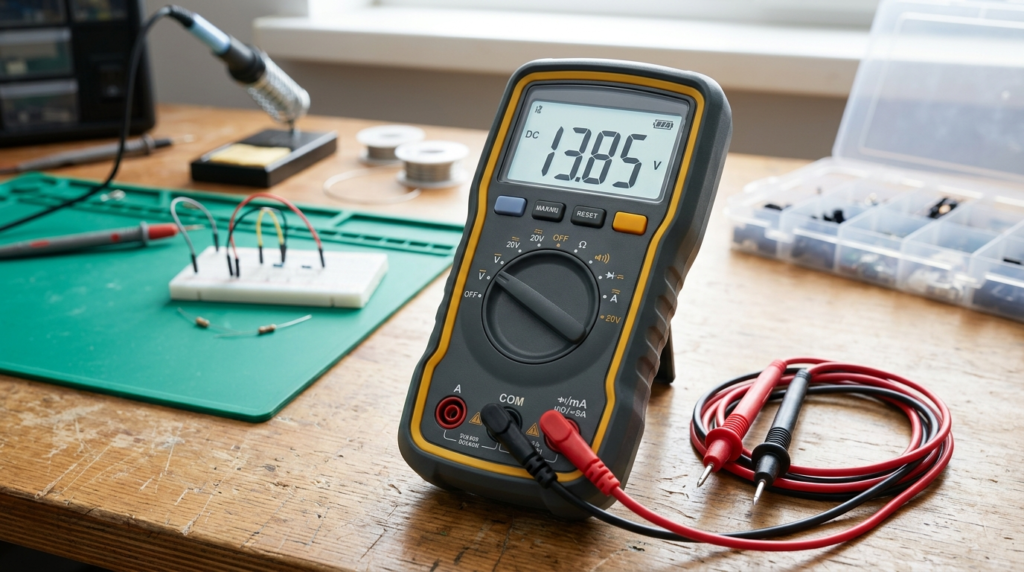
A multimeter is the most common testing tool used in electrical work.A multimeter is an electrical measuring instrument used to test and measure important electrical parameters such as voltage, current, resistance, continuity, and sometimes frequency and capacitance in electrical and electronic circuits. It is one of the most commonly used testing tools by electricians, engineers, technicians, and students because it helps diagnose faults and verify circuit performance accurately. A multimeter works by connecting its probes to a circuit and using internal electronic circuits to measure electrical values, which are then displayed on an analog scale or digital screen. There are two main types of multimeters: analog multimeters and digital multimeters (DMM). Digital multimeters are more popular because they provide higher accuracy, easy readability, and additional testing features. Multimeters are widely used in homes, industries, laboratories, automotive systems, power plants, and electronic repair work for testing batteries, switches, wiring systems, motors, power supplies, and electrical appliances. Proper use of a multimeter improves electrical safety, troubleshooting accuracy, and maintenance efficiency. Understanding the multimeter is important for electrical students, engineers, and technicians because it is a basic and essential instrument for electrical measurement, circuit testing, and fault diagnosis.
It can measure:
- Voltage (AC and DC)
- Current
- Resistance
- Continuity
It is suitable for beginners and maintenance technicians.
Clamp Meter
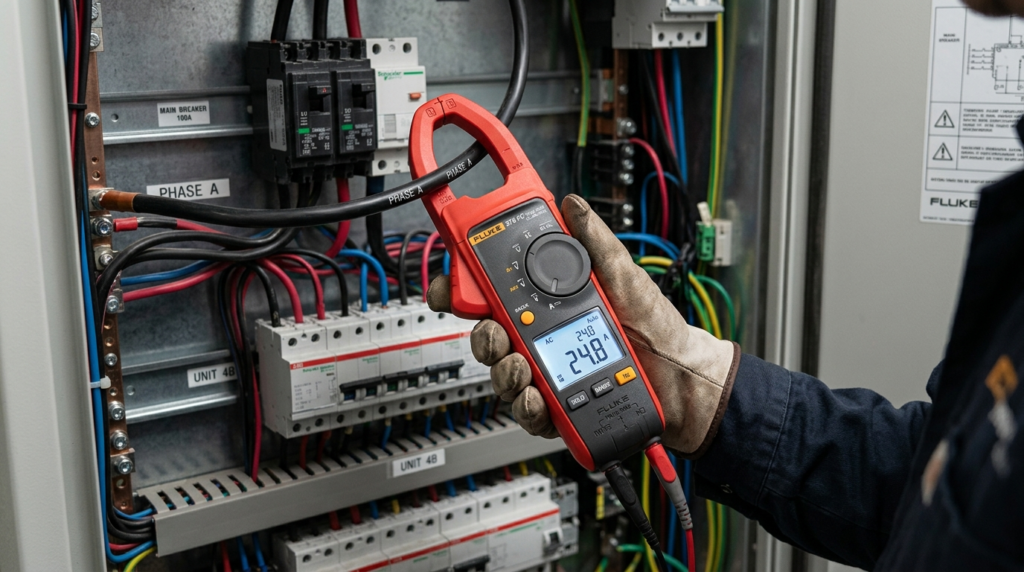
A clamp meter measures current without disconnecting the circuit.A clamp meter is an electrical measuring instrument used to measure electric current in a conductor without disconnecting or touching the wiring directly. It works by detecting the magnetic field produced around a current-carrying conductor and converting it into a measurable electrical value. The main feature of a clamp meter is its clamp-shaped jaw, which opens and closes around a wire to measure current safely and quickly. Modern clamp meters can also measure voltage, resistance, continuity, frequency, and power depending on their design and features. These instruments are widely used by electricians, engineers, technicians, and maintenance workers because they provide safe current measurement in high-power electrical systems without interrupting the circuit. Clamp meters are commonly used in industrial machines, power distribution systems, motor testing, HVAC systems, electrical panels, and home wiring inspections. Digital clamp meters offer higher accuracy, automatic range selection, and easy-to-read displays for efficient troubleshooting. Understanding the clamp meter is important for electrical students, engineers, and technicians because it is an essential testing tool for safe current measurement, fault diagnosis, and electrical maintenance in modern electrical systems.
Advantages include:
- Safe measurement
- Easy operation
- Useful in high-current systems
Oscilloscope
An oscilloscope is used to observe waveform signals.
It is mainly used in:
- Electronics testing
- Communication circuits
- Signal analysis
Insulation Tester
Insulation testers check the insulation strength of cables and equipment.
They are important for:
- Industrial systems
- High-voltage installations
Voltage Tester
Voltage testers are simple tools used to confirm the presence of voltage.
They are commonly used in household electrical maintenance.
5. Main Components of Testing Tools
Display Unit
Shows measured values in digital or analog form.
Measurement Probe
Used to connect the instrument with circuit points.
Internal Processing Circuit
Processes electrical signals and converts them into readable values.
Power Supply Section
Provides energy for instrument operation.
6. Advantages of Electrical Testing Tools
- Improves electrical safety
- Helps in quick fault detection
- Reduces maintenance time
- Improves system reliability
- Supports accurate measurement
- Useful in both industrial and home systems
7. Disadvantages / Limitations
- High-quality instruments are expensive
- Requires calibration
- Improper use may cause measurement errors
- Sensitive electronic parts can be damaged
- Needs technical knowledge for accurate reading
8. Electrical Testing Tools Applications
Home Electrical Work
Testing tools are used for:
- Checking wiring faults
- Testing switches and sockets
- Verifying supply voltage
Industrial Maintenance
In industry, testing tools help monitor:
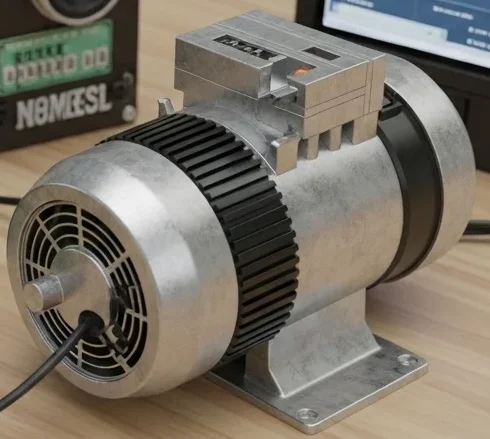
- Motor performance
- Control panel circuits
- Power distribution systems
Electronic Circuit Testing
Used in:
- PCB testing
- Communication device maintenance
- Signal debugging
9. Comparison: Multimeter vs Oscilloscope
| Feature | Multimeter | Oscilloscope |
| Main Function | Measure electrical quantities | Observe waveform signals |
| Complexity | Simple | Advanced |
| Cost | Low to medium | High |
| Beginner Friendly | Yes | Requires training |
| Applications | Basic testing | Signal analysis |
10. Selection Guide for Beginners
If you are buying your first testing tool, follow these tips.
Choose Digital Instruments
Digital meters are easier to read and more accurate.
Check Accuracy Rating
Higher accuracy means better measurement quality.
Look for Safety Certification
Always choose certified instruments.
Consider Working Environment
Select tools suitable for your voltage and current range.
11. Common Problems & Solutions
Why does the multimeter show unstable readings?
Possible causes:
- Loose probe connection
- Electrical noise
- Low battery
Solution:
- Check connections
- Replace battery
- Measure again
Why is measurement different from actual value?
Causes may include:
- Calibration error
- Instrument aging
- Environmental factors
Solution:
- Calibrate instrument regularly.
How often should tools be calibrated?
Industrial tools are usually calibrated once per year.
12. Future Trends in Electrical Testing Tools
Modern technology is improving testing systems.
Smart Testing Devices
- Automatic measurement
- Bluetooth data transfer
- Mobile monitoring
Artificial Intelligence Integration
AI systems help detect faults automatically.
Portable Testing Equipment
New designs are becoming smaller and more efficient.
13. Conclusion
Electrical testing tools are essential instruments for modern electrical and electronic work. Understanding electrical testing tools working principle helps technicians and engineers perform accurate measurements and safe troubleshooting.
These tools are widely used in home maintenance, industry, and electronic circuit testing. Learning about different types such as multimeters, clamp meters, and oscilloscopes is very important for beginners.
While testing tools provide many advantages, proper handling and calibration are necessary to maintain accuracy.
For electrical students and technicians, mastering electrical testing tools applications is a fundamental step toward professional engineering practice.