
A 3 point starter is a manual starter designed for DC shunt (and compound) motors. When a DC motor is switched directly onto the supply, its low-resistance armature draws an enormous starting current because back EMF is zero at standstill — enough to damage the commutator and overheat the windings. The 3 point starter solves this by inserting a stepped starting resistance in series with the armature and cutting it out gradually as the motor speeds up.
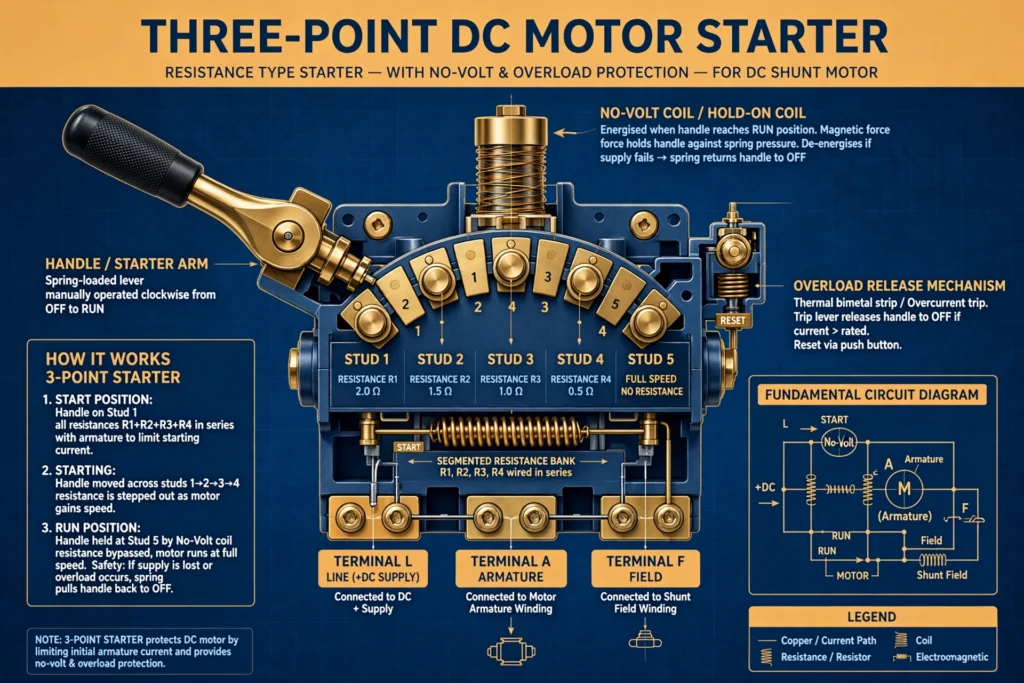
It gets its name from its three terminals: Line (L), Armature (A), and Field (F). A pivoted lever, moved manually across contact studs, controls the resistance in the armature circuit, while two small electromagnet coils — the no-volt (hold-on) coil and the overload release coil — add automatic protection.
Construction of a 3 Point Starter
The starter is built on an insulating base (traditionally slate or modern FRP) and contains the following parts:
- Starting resistance: A set of resistor sections connected between numbered contact studs. At the OFF position the full resistance is in series with the armature; as the lever moves toward the RUN position, the resistance is progressively shorted out.
- Operating lever: A pivoted brass or copper arm with a contact that slides over the studs. A spring tends to pull it back to the OFF position.
- No-volt coil (NVC): An electromagnet connected across the supply (in series with the field winding). It holds the lever in the RUN position against the spring as long as the supply is healthy.
- Overload release coil (OLR): An electromagnet in series with the motor line current. On excessive current it attracts an armature that short-circuits the no-volt coil, releasing the lever to the OFF position.
- Brass arc and studs: The current path through which the lever makes contact at each step.
Working Principle of 3 Point Starter
Starting the Motor
To start the motor, the operator moves the lever from the OFF position to the first stud. At this point the full starting resistance is in series with the armature, so the armature current is limited to a safe value (typically 1.5 to 2 times the rated current). The field winding, however, receives full supply voltage immediately through the field terminal — this is important because a DC shunt motor must have full field flux at start to develop maximum torque and to keep the speed stable.
As the motor accelerates, back EMF builds up in the armature, naturally reducing the current. The operator then moves the lever step by step toward the RUN position, cutting out one resistance section at a time. Each step causes a small, controlled rise in current. When the lever reaches the final stud, all starting resistance is out of circuit and the motor runs at full speed with the armature directly across the supply.
Role of the No-Volt Coil
The no-volt coil is wired so that it carries the field current. When the lever reaches the RUN position, an iron piece on the lever is attracted by the energized no-volt coil, which holds the lever against the return spring. If the supply fails or the field circuit opens, the coil de-energizes, the spring pulls the lever back to OFF, and the motor cannot restart unexpectedly when power returns — a vital safety feature. Note that because the NVC is in the field circuit, any accidental opening of the field (for example, a loose field connection) also releases the lever, protecting the motor from the dangerous overspeed that a loss of field would otherwise cause.
Role of the Overload Release Coil
The overload coil carries the total motor current. When current exceeds the set value, the coil attracts its armature, which closes a contact that short-circuits the no-volt coil. The NVC loses magnetism, the spring returns the lever to OFF, and the motor disconnects — the starter’s overload protection, complementing the thermal protection in our motor overload guide.
Wiring Connections (L, A, F)
The three terminals are connected as follows:
- L (Line): To the positive side of the DC supply through the main switch and fuses.
- A (Armature): To one armature terminal; the other armature terminal goes to the negative side.
- F (Field): To one end of the shunt field winding; the other end goes to the negative side, in series with the no-volt coil.
A common mistake is connecting the field through the starting resistance — the field must see full supply voltage from the first stud onward, otherwise starting torque drops and the motor can race dangerously as resistance is cut out.
3 Point Starter vs 4 Point Starter
The 4 point starter adds a fourth terminal (N) and connects the no-volt coil through its own current-limiting resistance directly across the supply, independent of the field winding. This matters for speed control by field weakening: in a 3 point starter, reducing field current to raise speed also weakens the no-volt coil, which may release the lever spuriously. The 4 point starter’s NVC is unaffected by field changes, so it is the correct choice when field-weakening speed control is used. For constant-speed DC shunt motors, the 3 point starter is fine.
Advantages and Disadvantages
Advantages:
- Limits the starting current to a safe value with simple, robust construction
- Provides both no-volt protection and overload protection automatically
- Protects against accidental loss of field, which would otherwise cause dangerous overspeed
- Cheap and easy to maintain; no electronics involved
- Gives the operator direct manual control over the acceleration steps
Disadvantages:
- Requires manual operation — the operator must move the lever at the right pace; moving too fast causes current surges
- Cannot be used with field-weakening speed control (use a 4 point starter instead)
- Bulky resistor bank dissipates starting energy as heat
- Not suitable for automatic or remote starting; modern DC drives have largely replaced it in automated plants
- The sliding contacts need periodic cleaning and maintenance
Applications of 3 Point Starter
- Laboratory and teaching setups demonstrating DC machine principles
- Small workshops running DC shunt motors on lathes and drilling machines
- Old industrial installations (cranes, hoists, rolling mills) where the original manual starters remain in service
- Battery-powered traction and winch applications with simple control requirements
The same starting-current problem exists for AC motors, where it is handled differently — see our guides to the DOL starter and star delta starter for the AC equivalents, and our overview of starting induction motor methods for the full comparison. Also see DC motor fundamentals on Wikipedia.
FAQs
What is a 3 point starter?
A 3 point starter is a manual starter for DC shunt and compound motors. It inserts a stepped resistance in series with the armature to limit the starting current, and includes a no-volt coil for undervoltage protection and an overload release coil for overcurrent protection. Its three terminals are Line (L), Armature (A), and Field (F).
Why is a starter needed for a DC motor?
At standstill, a DC motor produces no back EMF, so its low-resistance armature would draw a dangerously high current if connected directly to the supply. The starter limits this current with series resistance that is gradually removed as the motor speeds up and back EMF builds.
What are the three points in a 3 point starter?
The three points are the three main terminals: L for the supply line, A for the armature circuit, and F for the shunt field winding. The name distinguishes it from the 4 point starter, which has an additional N terminal for the no-volt coil.
What is the function of the no-volt coil?
It holds the operating lever in the RUN position while the supply is healthy. If the supply fails or the field circuit opens, it releases the lever, the spring returns it to OFF, and the motor cannot restart on its own.
What is the difference between a 3 point and a 4 point starter?
In a 3 point starter the no-volt coil is in series with the field winding, so weakening the field for speed control can cause nuisance tripping. In a 4 point starter the no-volt coil has its own separate supply connection, making it suitable for motors with field-weakening speed control.
Can a 3 point starter be used for DC series motors?
No. A 3 point starter is designed for shunt and compound motors where the field is connected across the supply. DC series motors are started with a 2 point starter, which has no field terminal because the field is in series with the armature.
Conclusion
The 3 point starter is a classic of electrical engineering: a purely electromechanical solution that tames the DC motor’s fierce starting current while building in automatic protection against power failure, overload, and loss of field. Its principles of current limiting and fail-safe release live on in every motor starter built since.