
Imagine a water pump running continuously in a small factory. At first, everything works smoothly. But after some time, the motor becomes hot, starts making noise, and suddenly stops. When checked, the motor windings are damaged. This situation is a classic example of motor overload.
Motor overload is one of the most common problems in electrical systems. It happens when a motor draws more current than it is designed to handle. If not controlled, it can lead to overheating, insulation failure, and permanent damage.
Understanding this topic is critical for electrical students, engineers, and technicians because motors are used everywhere—from household appliances to heavy industrial machines. Proper knowledge helps in preventing failures, improving efficiency, and increasing equipment life.
In this article, you will learn what motor overload is, its working principle, types, components, advantages and disadvantages, applications, and troubleshooting methods. By the end, you will be able to identify overload conditions and protect motors effectively.
Motor Overload: A Complete Guide for Beginners
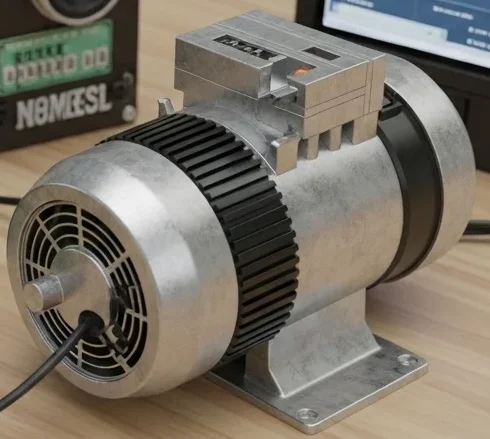
Motor Overload is a condition in which an electric motor draws more current than its rated capacity for a prolonged period. This happens when the motor is forced to work harder than its designed limit. Overloading can cause excessive heat generation, insulation damage, reduced efficiency, and even complete motor failure if protection systems are not used properly. Motor overload is one of the most common problems in industrial and commercial electrical systems.
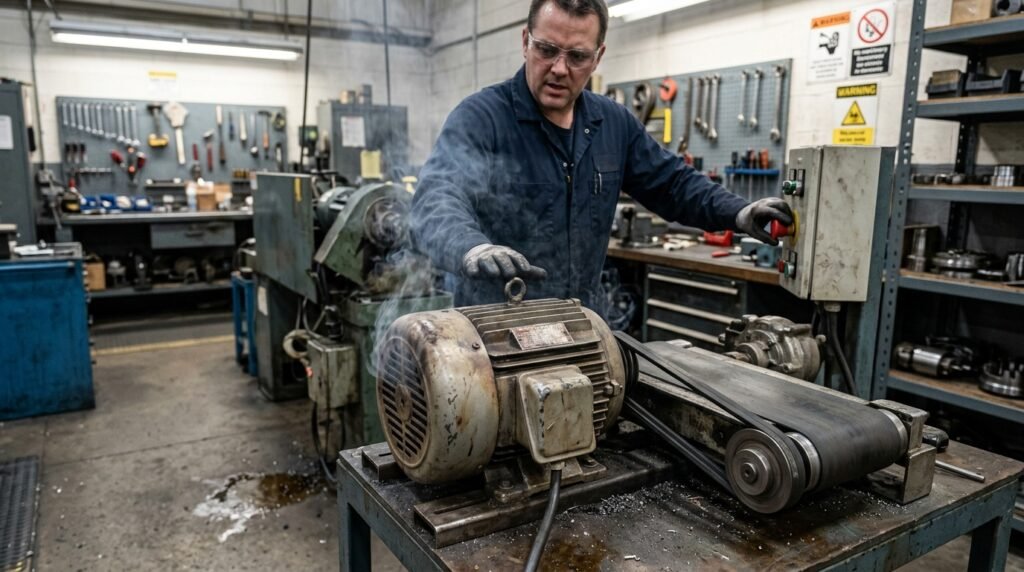
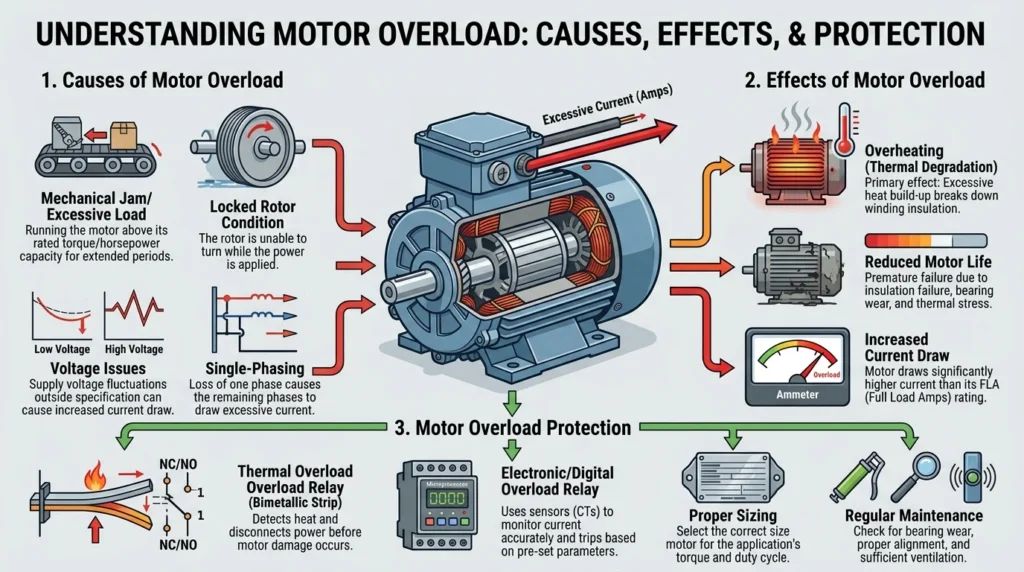
The working principle behind motor overload is related to Joule Heating. When a motor carries excessive current, heat is produced in the windings due to electrical resistance. If the current remains high for a long time, the temperature rises beyond safe operating limits. This overheating damages insulation, weakens motor components, and reduces motor lifespan. To prevent this, overload protection devices such as thermal relays and overload relays are installed in motor circuits.
Motor overload can occur due to several reasons, including:
- Excessive mechanical load
- Low supply voltage
- Single phasing in three-phase motors
- Poor ventilation or cooling
- Frequent starting and stopping
- Bearing failure or shaft misalignment
When overload conditions occur, the motor may run slowly, produce unusual noise, or become excessively hot. In severe cases, smoke or burning smell may appear.
The main components involved in overload protection include overload relays, contactors, circuit breakers, and temperature sensors. Thermal overload relays are commonly used because they detect excess heat generated by high current and disconnect the motor automatically.
One of the main advantages of overload protection is increased motor safety and longer equipment life. It prevents costly breakdowns and reduces maintenance expenses. However, incorrect relay settings may cause nuisance tripping or insufficient protection.
Modern motor protection systems now use digital overload relays and smart monitoring devices that provide accurate protection and fault diagnostics.
Overall, motor overload is a serious operating condition that can damage electrical motors if ignored. Proper understanding, protection devices, and regular maintenance are essential for safe and efficient motor operation in industrial and commercial systems.
2. What Is Motor Overload? Definition, Causes, Working, and Practical Example
A motor overload occurs when an electric motor is forced to operate beyond its rated load or power capacity for an extended period. As the mechanical load increases, the motor draws more electrical current to produce additional torque. This extra current generates excessive heat inside the motor windings, which can damage the insulation, reduce efficiency, shorten the motor’s lifespan, or even cause complete motor failure if the condition is not corrected.
Unlike a short circuit, a motor overload develops gradually. The motor continues to run while drawing more current than its rated value until an overload protection device disconnects the power supply or the motor overheats.
Definition
Motor overload is an operating condition in which an electric motor draws more current than its rated full-load current (FLC) for a sustained period due to excessive mechanical load, improper operating conditions, or mechanical faults. If left unprotected, this excessive current causes overheating, insulation deterioration, reduced performance, and permanent motor damage.
Simple Explanation
Every electric motor is designed to handle a specific amount of work, known as its rated load. When the connected equipment demands more power than the motor is designed to provide, the motor must work harder. To produce the extra torque, it draws additional current from the power supply.
As the current increases, the motor windings become hotter. If this condition continues without protection, the insulation around the windings begins to deteriorate, reducing the motor’s efficiency and increasing the risk of burnout. This operating condition is called motor overload.
Practical Example
Consider a conveyor belt motor designed to move 50 kg of material continuously.
- The conveyor is overloaded with 100 kg of material.
- The motor requires more torque to move the heavier load.
- It draws significantly more current than its rated value.
- The winding temperature rises rapidly.
- An overload relay detects the excessive current and trips the motor to prevent damage.
- If no overload protection is installed, the motor may overheat, damage its insulation, or burn out completely.
3. Motor Overload Working Principle: How Overload Protection Works
The motor overload working principle is based on continuously monitoring the motor’s current and the heat generated during operation. When the motor operates within its rated capacity, the current remains within safe limits. However, if the mechanical load increases, the motor draws more current, causing the windings to heat up.
Motor overload protection devices, such as thermal overload relays and electronic overload relays, monitor this increase in current or temperature. If the overload condition persists beyond a safe limit, the protection device automatically disconnects the motor from the power supply, preventing overheating and permanent damage.
Step-by-Step Working Process
1. Normal Motor Operation
- The motor operates within its rated load.
- Current remains at or below the rated full-load current.
- Temperature stays within the safe operating range.
2. Load Increases
- The connected machine demands more torque.
- The motor works harder to meet the increased load.
- Current begins to rise above its normal operating value.
3. Heat Builds Up
- Higher current produces more heat in the motor windings.
- The winding insulation temperature gradually increases.
- Continuous overheating starts reducing insulation life.
4. Overload Detection
- The overload relay senses the excessive current or temperature.
- It measures whether the overload lasts longer than the allowable time.
- Temporary starting currents are ignored, but sustained overloads are detected.
5. Protective Trip
- If the overload continues, the overload relay trips.
- Power to the motor is disconnected automatically.
- The motor stops before serious overheating or winding damage occurs.
6. Motor Reset and Restart
- After the motor cools and the cause of the overload is removed, the overload relay can be reset manually or automatically (depending on its design).
- The motor can then be restarted safely.
Current increases
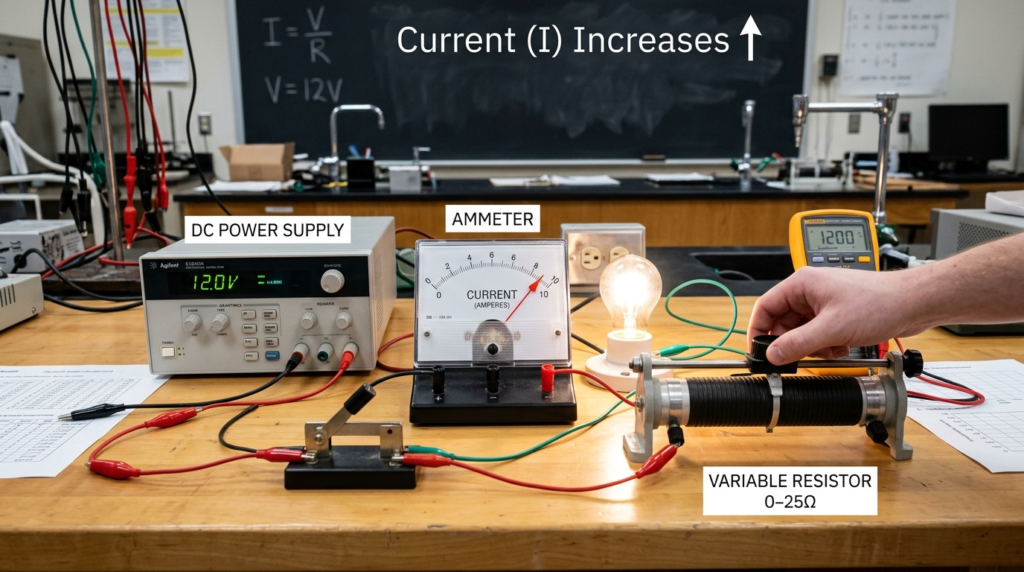
Current increases in an electrical circuit when the flow of electric charge becomes higher due to changes in voltage, resistance, or load conditions. According to Ohm’s Law, current is directly proportional to voltage and inversely proportional to resistance. This means that if the voltage in a circuit increases while resistance remains constant, the current will also increase. Similarly, if the resistance decreases, more current can flow through the circuit. For example, when more electrical appliances are connected to a supply, the total load increases, causing higher current demand. In transformers, current can also increase on the secondary side when voltage is stepped down. However, excessive increase in current can lead to overheating, insulation damage, and equipment failure, so proper protection devices like circuit breakers and fuses are used. Understanding how and why current increases is very important for electrical safety, circuit design, and system performance.
- Motor draws more current to meet demand
Heat generation
- Excess current produces heat in windings
Protection activates
- Overload relay trips and stops motor
Easy Analogy
Think of a person lifting weights:
- Light weight = normal effort
- Heavy weight = more strain
- Too much weight = injury
Similarly, a motor gets “injured” under overload.
Key Points
- Overload is different from short circuit
- Happens gradually, not instantly
- Can be detected using current monitoring
4. Types / Classification
Motor overload can be classified based on its cause and nature.
4. Types of Motor Overload: Thermal, Electrical, Mechanical, Intermittent, and Continuous Overload
Motor overload can occur in different forms depending on the cause and operating conditions. Understanding these types helps engineers and technicians identify problems quickly and select the right protection method. The most common types of motor overload are explained below.
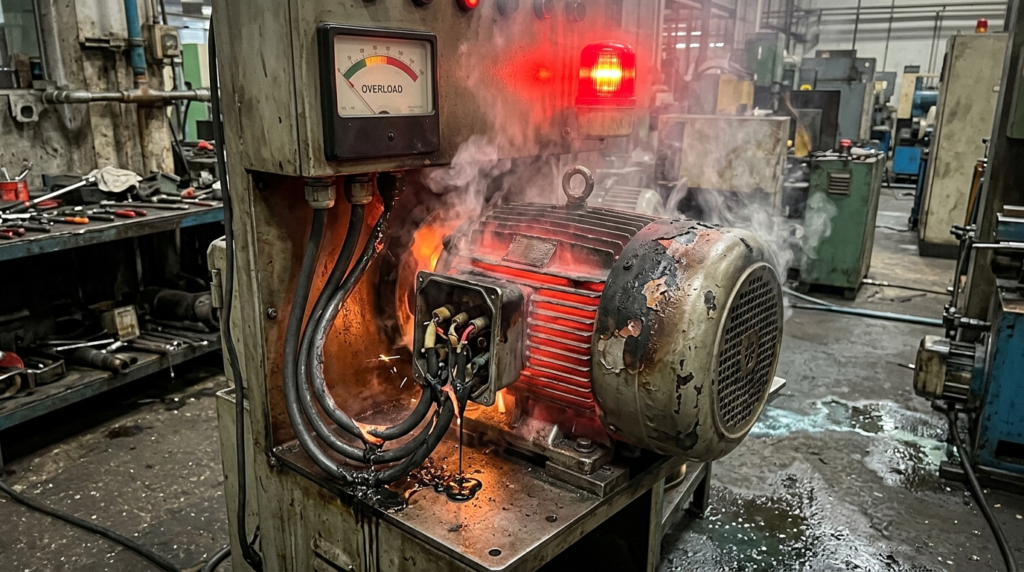
1. Thermal Overload
A thermal overload occurs when an electric motor or other electrical equipment generates more heat than it can safely dissipate. This usually happens when the motor operates above its rated load for an extended period, causing it to draw excessive current. The increased current produces heat in the motor windings due to electrical resistance (I²R losses).
If the heat continues to build up, the insulation around the windings begins to deteriorate, reducing the motor’s efficiency and lifespan. In severe cases, the motor may fail completely.
To prevent damage, thermal overload relays monitor the heat produced by excessive current. When the temperature exceeds a safe limit, the relay automatically disconnects the motor from the power supply, allowing it to cool before restarting.
Common Causes
- Prolonged motor overload
- Blocked cooling vents or failed cooling fan
- High ambient temperature
- Poor ventilation around the motor
Example
An industrial water pump runs continuously while pumping more water than its rated capacity. As the motor works harder, it draws extra current and its temperature rises. The thermal overload relay detects the overheating and trips the motor before the windings are damaged.
Key Features
- Caused by excessive heat buildup
- Develops gradually over time
- Usually results from prolonged overload
- Most common type of motor overload
- Protected using thermal overload relays
2. Electrical Overload
An electrical overload occurs when the motor draws more electrical current than its rated full-load current due to electrical problems rather than excessive mechanical load. This abnormal current increases the winding temperature and can damage the motor if it continues for too long.
Electrical overload may result from voltage imbalance, low supply voltage, phase loss, frequent starting, or electrical faults within the system.
Common Causes
- High current draw
- Voltage imbalance
- Single phasing
- Low or fluctuating supply voltage
- Electrical faults
Example
A three-phase motor continues operating after losing one phase. The remaining phases carry excessive current, causing the motor to overheat until the overload protection trips.
3. Mechanical Overload
A mechanical overload happens when the motor is required to drive a load that exceeds its designed mechanical capacity. As the load increases, the motor draws more current to produce additional torque, eventually leading to overheating.
Mechanical overload is common in industrial machinery where moving parts become blocked or overloaded.
Common Causes
- Jammed conveyor belts
- Seized bearings
- Blocked pumps
- Overloaded compressors
- Excessive belt tension
Example
A conveyor belt becomes jammed with heavy material. The motor continues trying to rotate the belt, drawing excessive current until the overload relay disconnects the supply.
4. Intermittent Overload
An intermittent overload occurs when the motor experiences short periods of excessive load followed by normal operating conditions. Since the overload lasts only briefly, the motor often has enough time to cool before permanent damage occurs.
Occasional intermittent overloads are usually acceptable if they remain within the motor manufacturer’s specified limits. However, frequent overload cycles can gradually reduce insulation life.
Characteristics
- Occurs for short periods
- Motor usually recovers after the load decreases
- Repeated occurrences shorten motor life
- Common in machines with varying loads
Example
A crane motor experiences a temporary overload each time it lifts a heavy object but returns to normal current once the load is lifted.
5. Continuous Overload
A continuous overload occurs when the motor operates above its rated capacity continuously for a long period. Because the overload never stops, heat continues to build up until the motor overheats.
This is one of the most dangerous overload conditions because it rapidly reduces insulation life and can eventually burn out the motor if protection devices fail.
Common Causes
- Incorrect motor sizing
- Constant excessive mechanical load
- Continuous overproduction demands
- Poor system design
Example
A motor rated for a 5 kW load is continuously used to drive equipment requiring 7 kW. The motor remains overloaded throughout operation, causing continuous overheating until the overload relay trips.
Key Features
- Constant excessive load
- Continuous high current
- Rapid heat buildup
- Significantly reduces motor lifespan
- Can lead to complete motor failure without proper protection
5. Main Components
Motor overload protection involves several key components.
Main Components of a Motor Overload Protection System
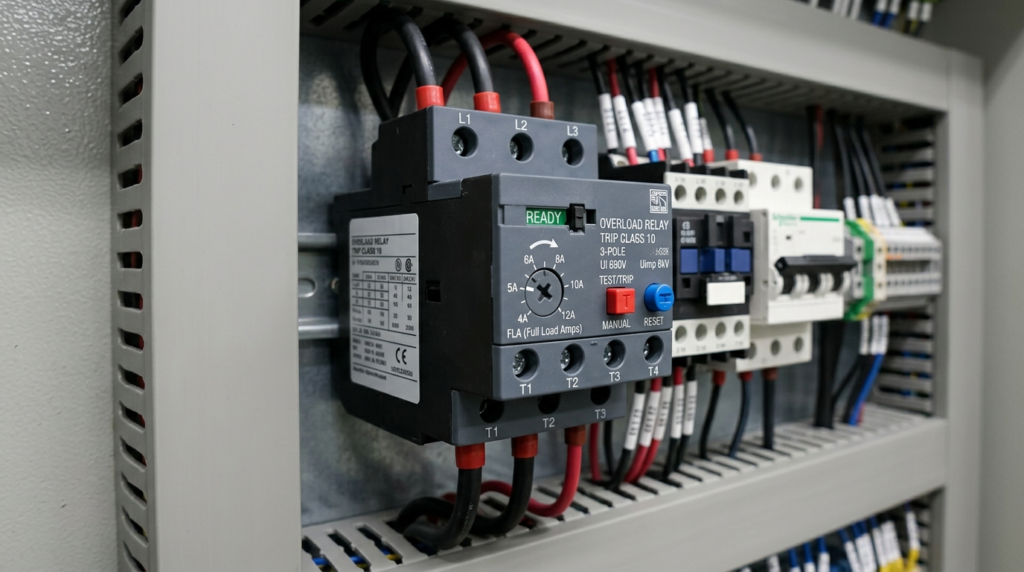
An overload relay is an electrical protection device used to protect motors and other electrical equipment from damage
Motor overload protection devices are designed to protect electric motors from damage caused by excessive current, overheating, and overload conditions. These devices continuously monitor the motor’s operating current and disconnect the power supply whenever the current remains above the safe limit for a specified period.
Unlike short-circuit protection, which reacts instantly to extremely high fault currents, motor overload protection allows temporary current increases, such as those that occur during motor starting. However, if the motor continues to draw excessive current because of an overload, the protection device trips the circuit before the motor overheats.
Motor overload protection devices are widely used in motor control centers (MCCs), industrial machinery, pumps, compressors, conveyor systems, HVAC equipment, and manufacturing plants. Depending on the application, they may operate using thermal, electronic, or digital sensing technologies.
Once the overload condition is removed and the motor has cooled to a safe temperature, the overload relay can be reset either manually or automatically, depending on its design. Proper overload protection not only prevents motor burnout but also improves equipment reliability, reduces maintenance costs, minimizes downtime, and enhances overall electrical safety.
1. Overload Relay
The overload relay is the primary protective device in a motor protection system. Its main purpose is to detect prolonged overcurrent conditions and disconnect the motor before excessive heat damages the windings.
Thermal overload relays operate using heat generated by excessive current, while electronic overload relays use sensors and microprocessors to provide more accurate protection.
Functions
- Detects motor overload conditions
- Monitors excessive current over time
- Trips the control circuit when current exceeds the preset limit
- Protects the motor from overheating and insulation damage
2. Current Sensor
The current sensor continuously measures the amount of current flowing through the motor. It provides accurate current information to the overload relay or motor protection controller.
Modern electronic protection systems use current transformers (CTs) or electronic current sensors for precise monitoring.
Functions
- Measures motor current continuously
- Detects abnormal current increases
- Sends current data to the overload protection device
- Helps prevent false tripping while ensuring reliable protection
3. Contactor
A contactor is an electrically operated switch used to control the motor’s power supply. Under normal conditions, it keeps the motor connected to the electrical supply. When the overload relay detects an unsafe condition, it de-energizes the contactor coil, causing the contactor to open and disconnect power to the motor.
Functions
- Controls motor starting and stopping
- Disconnects power during overload conditions
- Prevents further overheating and equipment damage
- Enables automatic motor protection
4. Thermal Element
The thermal element is the sensing component used in thermal overload relays. It usually consists of a bimetallic strip that bends when heated by excessive current.
When the strip bends beyond a certain point, it activates the relay mechanism and trips the motor circuit.
Functions
- Responds to heat generated by overcurrent
- Simulates the heating characteristics of the motor
- Triggers overload protection after sustained overload
- Helps prevent motor winding burnout
5. Control Circuit
The control circuit coordinates the operation of all motor protection components. It receives signals from the overload relay and controls the contactor to safely disconnect the motor whenever an overload occurs.
In advanced motor control systems, the control circuit may also communicate with PLCs, motor protection relays, and SCADA systems for monitoring and fault indication.
Functions
Supports automatic or manual reset after a trip
Coordinates the motor protection system
Receives overload signals from the relay
Opens the contactor during overload conditions
Ensures safe and reliable motor operation
6. Advantages of Motor Overload Protection
Motor overload protection plays a vital role in improving the safety, reliability, and efficiency of electrical systems. By detecting excessive current and disconnecting the motor before overheating occurs, it helps prevent costly damage and extends the service life of equipment.
The following are the major advantages of motor overload protection:
1. Protects the Motor from Damage
Overload protection prevents excessive current from overheating the motor windings, reducing the risk of insulation failure and motor burnout.
2. Prevents Overheating
By disconnecting the motor during prolonged overload conditions, the protection system keeps the operating temperature within safe limits.
3. Increases Motor Lifespan
Preventing repeated overheating reduces wear on the winding insulation, allowing the motor to operate reliably for many years.
4. Reduces Maintenance Costs
Early detection of overload conditions minimizes costly repairs, replacement of damaged components, and unexpected maintenance expenses.
5. Improves System Reliability
Proper overload protection ensures smooth and reliable operation of motors, reducing unexpected shutdowns and improving productivity.
6. Enhances Electrical Safety
Disconnecting overloaded motors helps prevent electrical fires, equipment damage, and safety hazards for operators.
7. Minimizes Downtime
Quick detection and isolation of overload conditions reduce production interruptions and improve overall operational efficiency.
8. Protects Connected Equipment
Overload protection not only safeguards the motor but also protects pumps, compressors, conveyors, and other machines driven by the motor.
9. Improves Energy Efficiency
A properly protected motor operates within its rated capacity, reducing energy losses caused by excessive current and overheating.
7. Disadvantages and Limitations of Motor Overload Protection
Although motor overload protection is essential for safe motor operation, it also has some limitations that should be considered during system design and maintenance.
1. Requires Correct Settings
Overload relays must be calibrated according to the motor’s rated current. Incorrect settings can reduce protection effectiveness.
2. May Cause Nuisance Tripping
Frequent motor starting, temporary heavy loads, or incorrect relay settings may cause unnecessary trips even when no serious fault exists.
3. Does Not Protect Against All Electrical Faults
Motor overload protection is designed for overload conditions only. Separate protective devices are required for short circuits, earth faults, phase failure, and overvoltage.
4. Higher Initial Cost
Advanced electronic overload relays and digital motor protection systems increase the initial installation cost.
5. Requires Periodic Inspection
Thermal and electronic overload relays should be tested and maintained regularly to ensure accurate operation.
6. Environmental Conditions Can Affect Performance
High ambient temperatures, dust, moisture, or vibration may influence the performance of some overload protection devices.
7. Temporary Shutdown of Equipment
When an overload occurs, the motor stops automatically. Although this protects the motor, it may temporarily interrupt production until the fault is corrected.
8. Applications of Motor Overload Protection
Motor overload protection is used wherever electric motors operate continuously or under varying load conditions. It is essential in residential, commercial, industrial, and modern automated systems to ensure safe and reliable motor operation.
Home Applications
Motor overload protection is commonly used in household appliances to prevent overheating and extend equipment life.
Examples include:
- Water pumps
- Air conditioners
- Washing machines
- Refrigerators
- Ceiling and exhaust fans
- Domestic pressure pumps
Industrial Applications
Industrial motors often operate under heavy loads, making overload protection critical for preventing equipment damage and production losses.
Common applications include:
- Conveyor systems
- Air compressors
- Pumps
- Heavy manufacturing machinery
- Crushers
- Mixers
- Industrial fans and blowers
- Machine tools
Commercial Applications
Commercial buildings use overload protection to ensure reliable operation of motor-driven equipment.
Examples include:
- HVAC systems
- Elevators
- Escalators
- Water supply systems
- Fire pumps
- Shopping mall ventilation systems
- Commercial refrigeration units
Modern Technology Applications
With increasing automation, motor overload protection has become even more important in advanced electrical systems.
Applications include:
- Electric vehicles (EVs)
- Robotics systems
- Automated manufacturing plants
- CNC machines
- Packaging machines
- Smart factories
- Renewable energy systems
- Automated warehouse equipment
Motor overload protection remains one of the most important safety features in modern electrical engineering because it protects valuable equipment, improves operational reliability, reduces maintenance costs, and ensures the long-term performance of electric motors.
9. Comparison Section
Difference Between Overload and Short Circuit
| Feature | Overload | Short Circuit |
| Cause | Excess load | Direct connection of phases |
| Current Rise | Gradual | Instant |
| Damage | Heating | Severe damage |
| Protection Device | Overload relay | Circuit breaker |
| Response Time | Slow | Very fast |
Understanding this difference between overload and short circuit is very important.
10. Motor Overload Protection Selection Guide: How to Choose the Right Overload Relay
Selecting the correct motor overload protection is essential for ensuring safe, reliable, and efficient motor operation. An overload relay that is too small may trip unnecessarily, while one that is too large may fail to protect the motor from overheating.
When choosing an overload protection device, always consider the motor’s electrical characteristics, operating conditions, starting current, and the environment in which it will be installed.
Selection Tips for Beginners
If you are new to electrical engineering or motor control systems, follow these basic guidelines when selecting motor overload protection:
1. Check the Motor Rating
Always read the motor nameplate and note the rated voltage, full-load current (FLC), power rating, and frequency before selecting an overload relay.
2. Choose the Correct Relay Size
Select an overload relay whose adjustable current range matches the motor’s rated full-load current. Never use an oversized or undersized relay.
3. Set the Relay Properly
Adjust the overload relay according to the manufacturer’s recommended settings, usually based on the motor’s full-load current.
4. Use Certified Standard Equipment
Choose overload relays that comply with international standards such as IEC or NEMA to ensure reliable protection and long service life.
5. Install the Relay Correctly
Proper wiring, secure mounting, and good electrical connections help ensure accurate overload detection and safe motor operation.
6. Test the Protection System
After installation, perform functional tests to verify that the overload relay trips correctly under overload conditions.
Selection Tips for Engineers
For industrial and commercial applications, engineers should evaluate several additional factors before selecting motor overload protection.
1. Analyze Load Characteristics
Determine whether the motor operates under constant load, variable load, intermittent duty, or heavy starting conditions. This helps in selecting the appropriate relay type.
2. Consider Motor Starting Current
Electric motors draw high inrush current during startup. Choose an overload relay that tolerates normal starting current without nuisance tripping.
3. Coordinate with Other Protection Devices
Ensure proper coordination between overload relays, circuit breakers, fuses, and motor protection relays to achieve complete electrical protection.
4. Evaluate Environmental Conditions
Consider ambient temperature, humidity, dust, vibration, altitude, and ventilation, as these factors can affect relay performance.
5. Select the Appropriate Relay Technology
Choose thermal overload relays for standard applications and electronic overload relays where higher accuracy, adjustable settings, and advanced protection features are required.
6. Plan for Future Expansion
If the motor load may increase in the future, select a protection system that allows easy adjustment or integration with advanced motor control systems.
7. Perform Regular Testing and Maintenance
Inspect, calibrate, and test overload protection devices periodically to ensure they continue operating accurately throughout the motor’s service life.
Quick Checklist for Choosing Motor Overload Protection
- ✔ Verify the motor nameplate rating.
- ✔ Match the relay current range to the motor’s full-load current.
- ✔ Account for motor starting current.
- ✔ Choose the correct relay type (thermal or electronic).
- ✔ Coordinate with circuit breakers and fuses.
- ✔ Consider the installation environment.
- ✔ Follow IEC/NEMA standards.
- ✔ Test and maintain the protection system regularly.
By selecting the right overload protection and configuring it correctly, you can significantly improve motor reliability, reduce maintenance costs, minimize downtime, and extend the operating life of electrical equipment.
11. Common Motor Overload Problems and Solutions (Troubleshooting Guide)
Motor overload problems are common in residential, commercial, and industrial electrical systems. Identifying the root cause early can prevent motor failure, reduce downtime, and lower maintenance costs. The following are some of the most frequently encountered motor overload issues and their practical solutions.
Why Does My Motor Trip Frequently?
Frequent motor tripping usually indicates that the motor is drawing more current than its rated capacity or that the overload protection settings are incorrect. While occasional tripping may occur during abnormal operating conditions, repeated tripping should never be ignored because it often points to an underlying mechanical or electrical problem.
Possible Causes
- Motor overload due to excessive mechanical load
- Incorrect overload relay settings
- Low supply voltage
- Voltage imbalance between phases
- Jammed bearings or mechanical blockage
- Frequent motor starting and stopping
- Undersized motor for the application
Solutions
- Reduce the mechanical load on the motor.
- Verify that the overload relay is set according to the motor’s full-load current.
- Check the supply voltage and correct any imbalance.
- Inspect bearings, belts, pumps, or conveyors for mechanical resistance.
- Ensure the motor is properly sized for the connected equipment.
- Perform regular preventive maintenance.
Why Is My Motor Overheating?
Motor overheating is one of the most common signs of an overload condition. Excessive heat shortens insulation life and can eventually cause complete motor failure if not corrected.
Possible Causes
- Excessive current draw
- Continuous overload
- Blocked cooling vents
- Faulty cooling fan
- High ambient temperature
- Poor ventilation
- Low or unbalanced voltage
- Worn bearings causing additional friction
Solutions
- Reduce the motor load to its rated capacity.
- Clean cooling vents and ensure proper airflow.
- Replace damaged cooling fans if necessary.
- Check voltage levels and phase balance.
- Lubricate or replace worn bearings.
- Install adequate ventilation around the motor.
What Is Nuisance Tripping?
Nuisance tripping occurs when the overload relay disconnects the motor even though no actual overload or dangerous condition exists. Although this protects the motor, frequent unnecessary trips can interrupt production and reduce efficiency.
Common Causes
- Relay current setting is too low
- High motor starting current
- Temporary heavy loads
- Faulty overload relay
- Incorrect relay selection
Solutions
- Recalibrate the overload relay according to the motor’s rated current.
- Use an overload relay with the correct trip class.
- Check the relay for faults or aging.
- Ensure the relay matches the motor starting characteristics.
- Verify that temporary starting currents are within acceptable limits.
Can Motor Overload Damage a Motor Instantly?
In most cases, motor overload does not cause immediate damage. Instead, the damage develops gradually as excessive current generates heat inside the motor windings.
If overload protection is working correctly, the relay trips before serious damage occurs. However, if the overload continues for a long period without protection, the winding insulation begins to deteriorate. Eventually, the insulation may fail completely, resulting in motor burnout.
Key Points
- Damage is usually gradual.
- Continuous overheating shortens insulation life.
- Repeated overloads significantly reduce motor lifespan.
- Proper overload protection prevents permanent damage.
How Do You Test Motor Overload Protection?
Testing overload protection ensures that the relay operates correctly whenever an overload occurs. Regular testing is an important part of preventive maintenance.
Testing Procedure
- Turn off the motor and follow lockout/tagout safety procedures.
- Inspect the overload relay for physical damage.
- Verify that the current setting matches the motor’s rated full-load current.
- Use a relay test kit or motor protection tester to simulate overload conditions.
- Confirm that the relay trips within the specified time.
- Reset the relay and verify normal operation.
- Record the test results for maintenance documentation.
Best Practice
Industrial facilities should test motor overload protection periodically according to the manufacturer’s recommendations and plant maintenance schedules.
12. Future Trends in Motor Overload Protection
Motor overload protection is becoming more advanced as industries adopt smart manufacturing, automation, and digital monitoring technologies. Traditional thermal relays are increasingly being replaced by intelligent protection systems capable of providing real-time diagnostics, remote monitoring, and predictive maintenance.
These innovations improve equipment reliability, reduce maintenance costs, minimize downtime, and extend motor life.
1. Smart Overload Relays
Modern smart overload relays provide much more than simple overload protection. They continuously monitor motor performance and communicate important operating data to maintenance personnel.
Features
- Real-time current monitoring
- Temperature monitoring
- Digital trip settings
- Event recording
- Fault history
- Self-diagnostics
- Higher protection accuracy
Benefits
- Faster fault detection
- Improved motor reliability
- Reduced maintenance time
- Better operational efficiency
2. IoT Integration
The Internet of Things (IoT) is transforming motor protection by enabling remote monitoring and control of electrical equipment.
IoT-enabled overload protection devices can send operating data to cloud-based monitoring systems, allowing engineers to supervise motors from anywhere.
Applications
- Remote motor monitoring
- Mobile notifications during faults
- Cloud-based performance analysis
- Remote configuration
- Predictive maintenance scheduling
Benefits
- Reduced downtime
- Faster troubleshooting
- Improved maintenance planning
- Better asset management
3. AI-Based Motor Protection
Artificial Intelligence (AI) is becoming an important part of advanced motor protection systems.
Instead of simply reacting to overload conditions, AI analyzes operating patterns to identify early warning signs before a failure occurs.
Capabilities
- Predict motor failures
- Detect abnormal operating conditions
- Analyze current and temperature trends
- Recommend preventive maintenance
- Optimize motor performance automatically
Benefits
- Prevents unexpected breakdowns
- Increases equipment lifespan
- Reduces maintenance costs
- Improves plant productivity
4. Energy-Efficient Smart Motors
Modern high-efficiency motors increasingly include built-in protection features that continuously monitor operating conditions.
Many premium motors now integrate electronic sensors and intelligent controllers directly into the motor.
Features
- Built-in thermal protection
- Internal temperature sensors
- Overcurrent monitoring
- Automatic shutdown
- Digital communication capability
Benefits
- Simplified installation
- Improved protection accuracy
- Lower energy consumption
- Reduced maintenance requirements
5. Advanced Sensors and Digital Monitoring
New sensor technologies are making overload protection more accurate and reliable than ever before.
Instead of monitoring current alone, advanced systems simultaneously measure multiple operating parameters.
Parameters Monitored
- Motor current
- Winding temperature
- Bearing temperature
- Vibration
- Voltage
- Power factor
- Motor speed
Benefits
- Earlier fault detection
- Greater protection accuracy
- Better equipment diagnostics
- Improved predictive maintenance
6. Integration with Industry 4.0
As factories become more automated, motor overload protection systems are increasingly integrated with PLCs, SCADA systems, Industrial Ethernet networks, and digital control platforms.
These systems provide centralized monitoring, automatic fault reporting, and detailed performance analytics for thousands of motors across a facility.
Advantages
- Centralized motor monitoring
- Automated fault alarms
- Data-driven maintenance decisions
- Increased production reliability
- Reduced operational costs
The Future of Motor Overload Protection
The future of motor overload protection lies in smart, connected, and intelligent systems that not only protect motors from overheating but also predict failures before they occur. By combining AI, IoT, advanced sensors, and digital monitoring, next-generation protection systems will deliver higher reliability, greater energy efficiency, lower maintenance costs, and improved safety for residential, commercial, and industrial electrical applications.
13. Conclusion
Motor overload is a critical condition that can seriously damage electrical motors if not properly managed. It occurs when a motor operates beyond its capacity, leading to excessive current and heat. Understanding the motor overload working principle, types, applications, and limitations is essential for safe and efficient operation.
By using proper overload protection devices and following correct practices, you can prevent failures, reduce maintenance costs, and extend motor life. Knowing the difference between overload and short circuit also helps in better system design.
As an electrical professional, always prioritize motor protection. A well-protected motor ensures reliability, safety, and long-term performance.