
Imagine electricity being generated at a power station and needing to travel hundreds of kilometers to reach your home. If this electricity were transmitted at low voltage, huge energy losses would occur in the wires. To solve this, engineers use transformers—specifically step-up and step-down transformers—to efficiently manage voltage levels.
A step-up transformer increases voltage for long-distance transmission, while a step-down transformer reduces voltage to safe levels for homes and appliances. Without these devices, modern power systems would not function efficiently or safely.
Understanding the difference between these two types of transformers is essential for electrical students, engineers, and technicians. It helps in designing power systems, improving efficiency, and ensuring safety.
In this article, you will learn what step-up vs step-down transformer means, their working principle, types, components, advantages and disadvantages, applications, and how to choose the right transformer. By the end, you will have a clear and practical understanding of these essential devices.
What is Step-Up vs Step-Down Transformer?
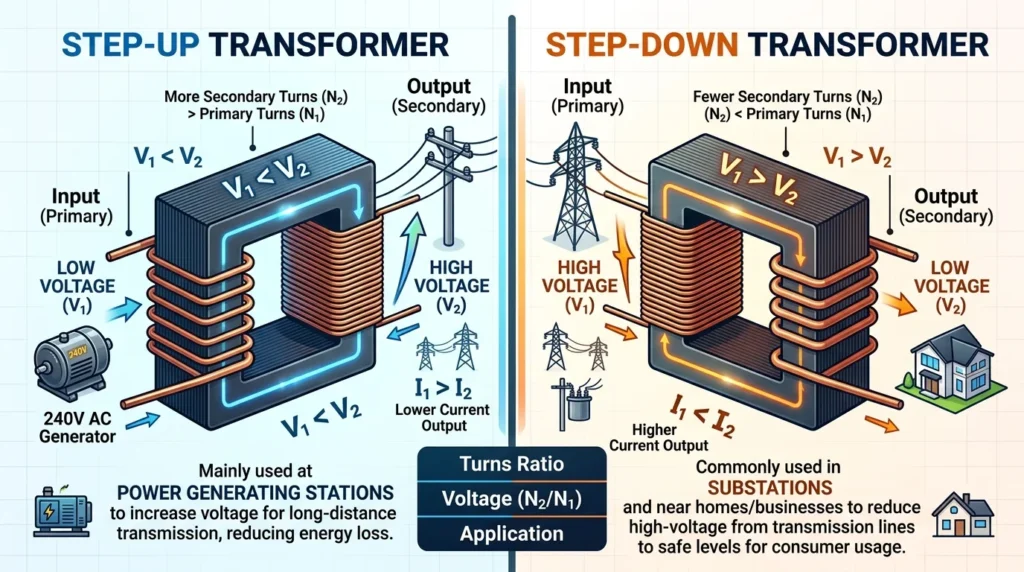
Step-Up vs Step-Down Transformer refers to two types of transformers based on how they change voltage levels in an electrical system.
Definition
- Step-Up Transformer: Increases voltage from primary to secondary winding
- Step-Down Transformer: Decreases voltage from primary to secondary winding
Simple Explanation
A transformer transfers electrical energy between circuits using electromagnetic induction. The number of turns in the coils determines whether voltage increases or decreases.
Practical Example
- Power plant uses step-up transformer: 11 kV → 220 kV
- Home supply uses step-down transformer: 11 kV → 220 V
Working Principle
The step-up vs step-down transformer working principle is based on electromagnetic induction.
Key Formula
\frac{V_1}{V_2} = \frac{N_1}{N_2}
Where:
- V = Voltage
- N = Number of turns
Step-by-Step Explanation
AC voltage is applied to primary coil
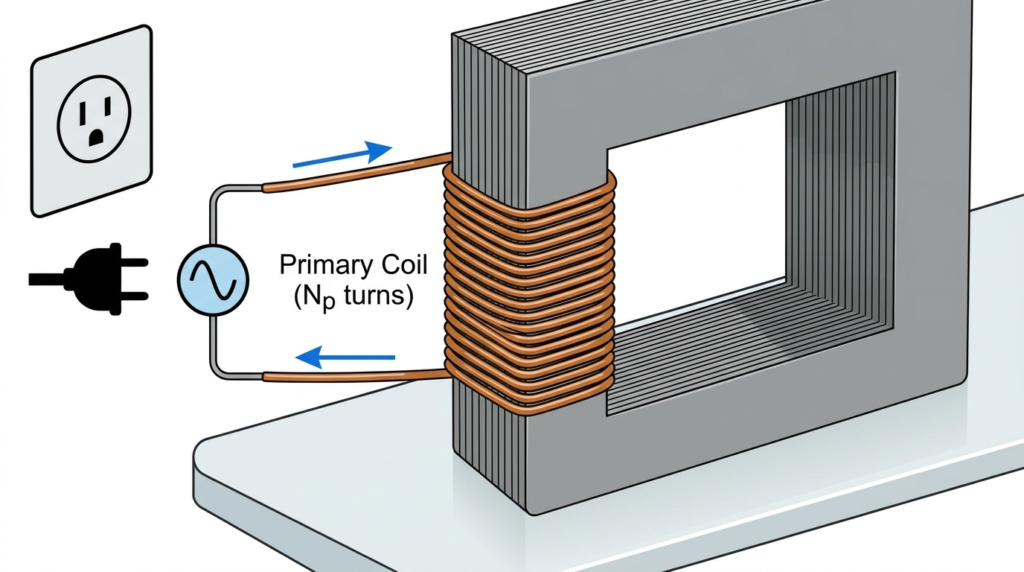
When AC voltage is applied to the primary coil of a transformer, an alternating current starts flowing through the winding. This alternating current produces a changing magnetic field around the primary coil. According to the principle of electromagnetic induction, the changing magnetic field passes through the transformer core and links with the secondary coil. As a result, a voltage is induced in the secondary winding without any direct electrical connection between the two coils. The induced voltage depends on the number of turns in the primary and secondary windings. If the secondary winding has more turns than the primary, the transformer acts as a step-up transformer, while fewer turns make it a step-down transformer. This process allows electrical energy to transfer efficiently from one circuit to another using magnetic flux. Transformers operating on this principle are widely used in power transmission, distribution systems, electrical appliances, and industrial equipment.Creates alternating magnetic field
Magnetic field passes through core
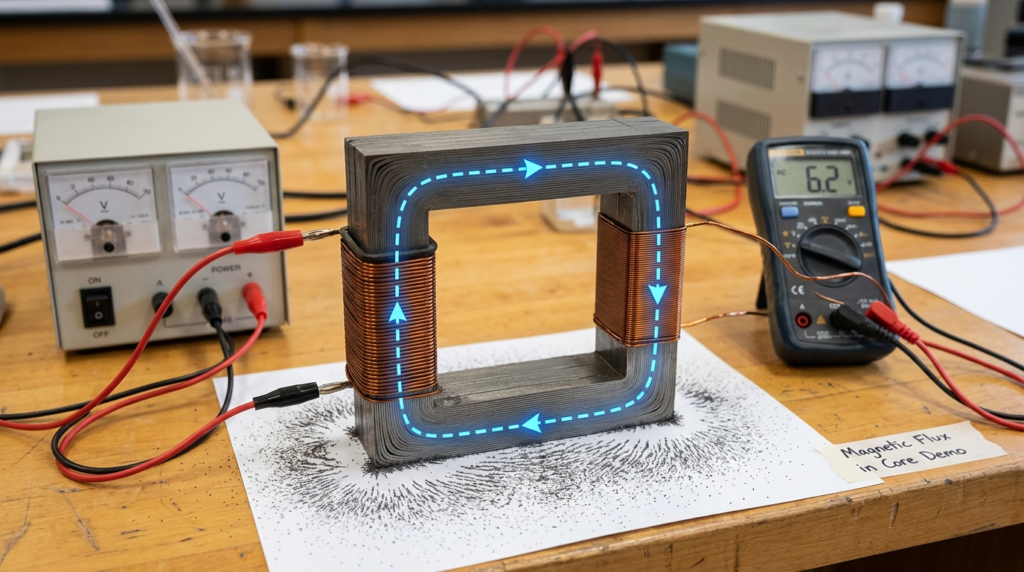
When an alternating current flows in the primary winding of a transformer, it creates a changing magnetic field around the coil. This magnetic field is concentrated and guided through the transformer’s iron core, which is designed to provide a low-reluctance path for magnetic flux. As the magnetic field passes through the core, it links both the primary and secondary windings efficiently. This continuous change in magnetic flux is very important because it induces a voltage in the secondary coil according to electromagnetic induction. The iron core ensures that maximum magnetic energy is transferred with minimum loss, improving the overall efficiency of the transformer. In simple terms, the core acts like a bridge that carries magnetic energy from the primary side to the secondary side. This principle is widely used in all types of transformers found in power systems, electrical machines, and industrial applications.Links both coils
Voltage induced in secondary coil
- Based on number of turns
Voltage changes
- More turns → higher voltage (step-up)
- Fewer turns → lower voltage (step-down)
Easy Analogy
Think of it like a gear system:
- Small gear to large gear = increase (step-up)
- Large gear to small gear = decrease (step-down)
Key Points
- Works only with AC supply
- No direct electrical connection between coils
- Power remains nearly constant
Types / Classification
Transformers can be classified based on their function and design.
Step-Up Transformer
- Secondary turns > primary turns
- Increases voltage
- Decreases current
Used in: Power generation and transmission
Step-Down Transformer
- Secondary turns < primary turns
- Decreases voltage
- Increases current
Used in: Distribution and domestic supply
Isolation Transformer
- Equal number of turns
- Voltage remains same
Used for: Safety and isolation
Auto Transformer
- Single winding
- Can step-up or step-down
Used in: Voltage control applications
Main Components
Transformers consist of several important parts.
Core
Made of laminated iron.
Function: Provides path for magnetic flux
Primary Winding
Connected to input supply.
Function: Generates magnetic field
Secondary Winding
Delivers output voltage.
Function: Receives induced voltage
Insulation
Separates windings.
Function: Prevents short circuits
Tank and Cooling System
Contains oil or air cooling.
Function: Removes heat
Advantages
Here are the key step-up vs step-down transformer advantages and disadvantages, starting with benefits:
- Efficient power transmission
- Reduces energy losses
- Ensures safe voltage levels
- Improves system reliability
- Supports long-distance power supply
- Simple and robust design
- Low maintenance
Disadvantages / Limitations
Some limitations include:
- Works only with AC
- Cannot change frequency
- Size can be large
- Initial cost is high
- Losses occur (copper and core losses)
Applications
The step-up vs step-down transformer applications are widely used.
Power Generation
- Step-up transformers increase voltage for transmission
Power Distribution
- Step-down transformers reduce voltage for consumers
Industrial Applications
- Machinery and equipment
- Control systems
Home Applications
- Adapters and chargers
- Electronic devices
Modern Technology
- Renewable energy systems
- Electric vehicle charging
- Smart grids
Comparison Section
Difference Between Step-Up and Step-Down Transformer
| Feature | Step-Up Transformer | Step-Down Transformer |
| Voltage | Increases | Decreases |
| Turns Ratio | Secondary > Primary | Secondary < Primary |
| Current | Decreases | Increases |
| Usage | Transmission | Distribution |
| Example | Power plants | Homes |
Understanding this difference between step-up and step-down transformer is essential.
Selection Guide
Choosing the right transformer depends on your application.
Tips for Beginners
- Identify voltage requirement
- Check load capacity
- Choose correct transformer type
- Ensure safety standards
- Consider efficiency
For Engineers
- Calculate load demand
- Analyze losses
- Select proper insulation
- Consider cooling method
- Plan for future expansion
Common Problems & Solutions
Why transformer overheats?
Overload or poor cooling
Reduce load or improve cooling
Why voltage is not stable?
Faulty transformer or load variation
Check system and connections
What causes transformer losses?
Copper and core losses
Can transformer work on DC?
No, it requires AC
How to maintain transformer?
Regular inspection and oil testing
Future Trends
Transformers are evolving with modern technology.
Smart Transformers
- Real-time monitoring
- Automatic control
Solid-State Transformers
- High efficiency
- Compact design
Renewable Integration
- Used in solar and wind systems
IoT-Based Monitoring
- Remote diagnostics
Energy Efficiency Improvements
- Reduced losses
- Better materials
Conclusion
Step-up and step-down transformers are essential components of modern electrical systems. They help in efficiently transmitting and distributing power by adjusting voltage levels as needed. Without them, long-distance power transmission would be inefficient and unsafe.
Understanding the step-up vs step-down transformer working principle, types, applications, and limitations allows engineers and technicians to design better systems. Knowing the difference between step-up and step-down transformer is also critical for practical applications.
As you continue your learning journey, focus on real-world examples and practical use. Mastering transformers will give you strong control over electrical power systems.