
Imagine placing a small iron nail near a magnet. Without touching it, the nail suddenly moves and sticks to the magnet. You cannot see what is happening, but a force is clearly acting at a distance. This invisible effect is due to a magnetic field.
Magnetic fields are present everywhere—from simple magnets on your refrigerator to complex electrical machines like motors, transformers, and generators. Even the Earth itself behaves like a giant magnet, guiding compasses for navigation.
Understanding magnetic fields is essential for electrical students, engineers, and technicians because they form the foundation of many electrical and electronic systems. Without magnetic fields, devices like motors, transformers, and inductors would not work.
In this article, you will learn what a magnetic field is, its working principle, types, components, advantages and disadvantages, and real-world applications. By the end, you will have a clear and practical understanding of how magnetic fields operate and why they are so important in electrical engineering.
What is Magnetic Field?
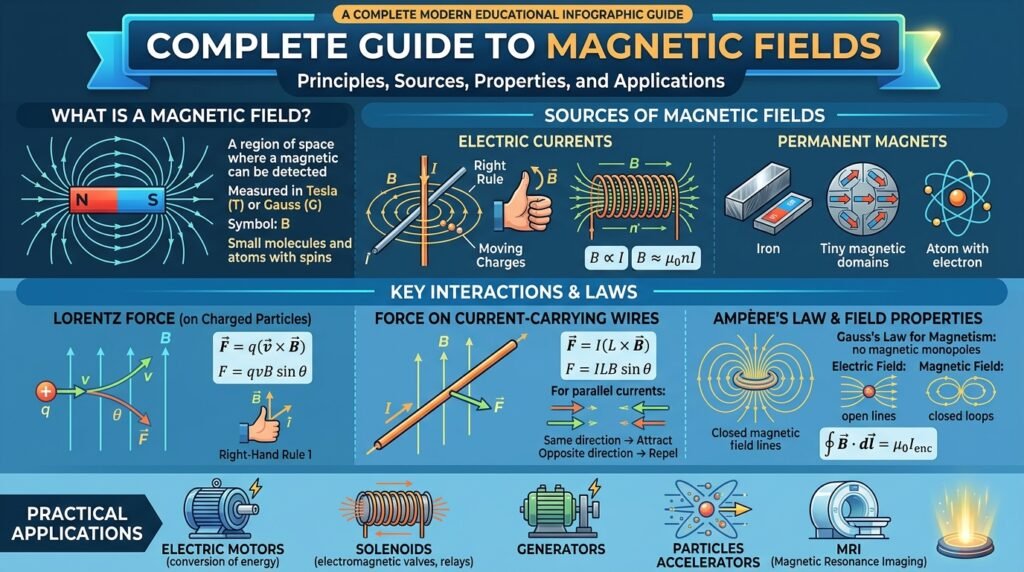
A magnetic field is a region around a magnet or a current-carrying conductor where magnetic force can be felt.
Definition
A magnetic field is the space in which magnetic forces act on moving charges, magnetic materials, or other magnets.
Simple Explanation
Whenever electricity flows through a wire or a magnet is present, an invisible field is created around it. This field can attract or repel objects.
Practical Example
- A current-carrying wire produces a magnetic field around it
- A compass needle aligns with Earth’s magnetic field
- A motor uses magnetic fields to rotate
Working Principle
The magnetic field working principle is based on the interaction between electric current and magnetic forces.
Step-by-Step Explanation
Electric current flows
- Charges move through a conductor
Magnetic field is generated
- Field forms around the conductor
Field direction is defined
- Given by right-hand rule
Interaction occurs
- Magnetic field exerts force on nearby objects
Energy conversion
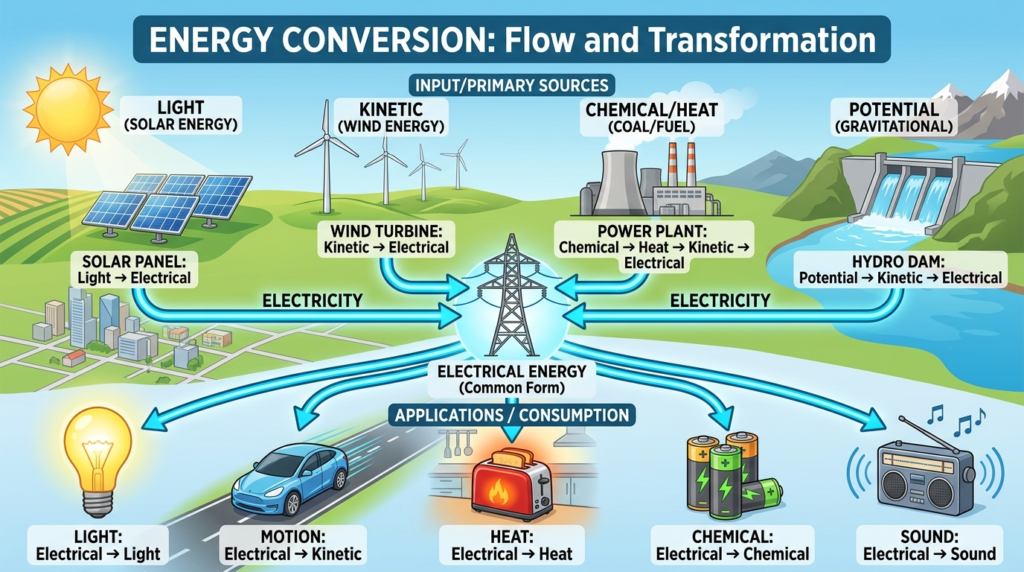
Energy Conversion is the process of changing energy from one form into another while conserving the total amount of energy, according to the law of conservation of energy. In electrical engineering, energy conversion is essential because electrical machines and devices continuously transform energy to perform useful work. For example, an electric motor converts electrical energy into mechanical energy to drive machines, while a generator converts mechanical energy into electrical energy to produce electricity. Similarly, solar panels convert solar energy into electrical energy, batteries convert chemical energy into electrical energy, and electric heaters convert electrical energy into heat energy. Although no energy conversion process is 100% efficient due to unavoidable losses such as heat, friction, and sound, modern technologies are designed to maximize efficiency and minimize these losses. Energy conversion plays a vital role in power generation, transportation, industrial automation, renewable energy systems, household appliances, and countless other applications, making it one of the most important concepts in electrical and mechanical engineering.
- Electrical energy converts into mechanical energy
Key Formula
F = q v B \sin\theta
This shows force on a moving charge in a magnetic field.
Easy Analogy
Think of a fan creating airflow:
- Fan = source
- Airflow = field
- Objects in air feel force
Similarly, magnetic fields influence objects around them.
Key Points
- Magnetic fields are invisible but measurable
- Strength depends on current and distance
- Direction follows specific rules
Types / Classification
Magnetic fields can be classified based on their source and nature.
Permanent Magnetic Field
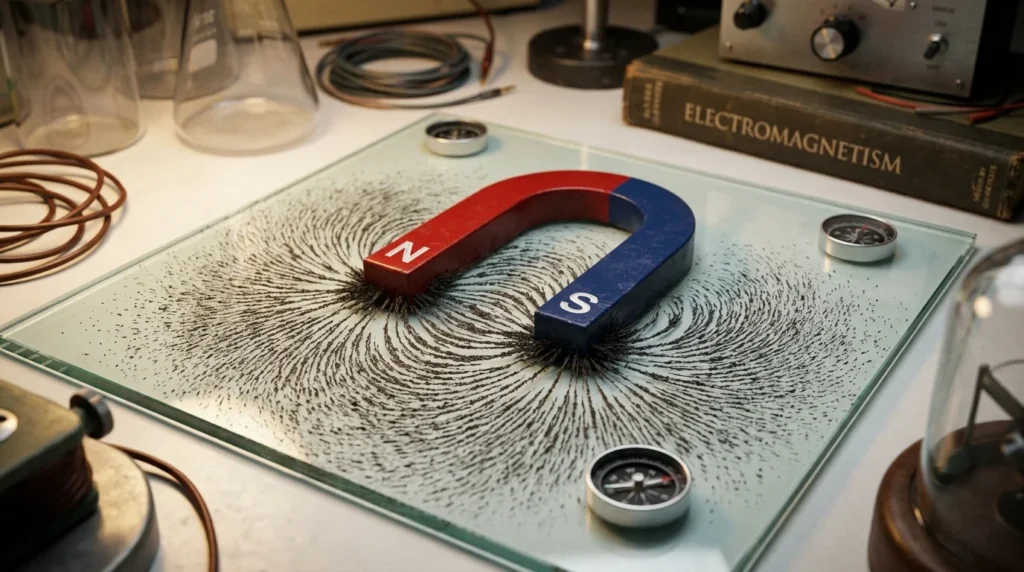
A Permanent Magnetic Field is a magnetic field produced by a permanent magnet without requiring any external electrical power. It is created by the alignment of magnetic domains within magnetic materials such as iron, cobalt, nickel, or their alloys. Once magnetized, these materials continuously generate a stable magnetic field that remains present unless affected by strong heat, mechanical shock, or an opposing magnetic field. Permanent magnetic fields have fixed north and south poles and exert attractive or repulsive forces on magnetic materials and other magnets. They are widely used in electrical and electronic devices such as permanent magnet motors, generators, loudspeakers, measuring instruments, magnetic sensors, relays, and magnetic separators. Because they do not consume electrical energy to produce magnetism, permanent magnetic fields provide an efficient, reliable, and maintenance-free source of magnetic force in many industrial and commercial applications.
- Produced by permanent magnets
- Constant and stable
Example: Bar magnet
Electromagnetic Field
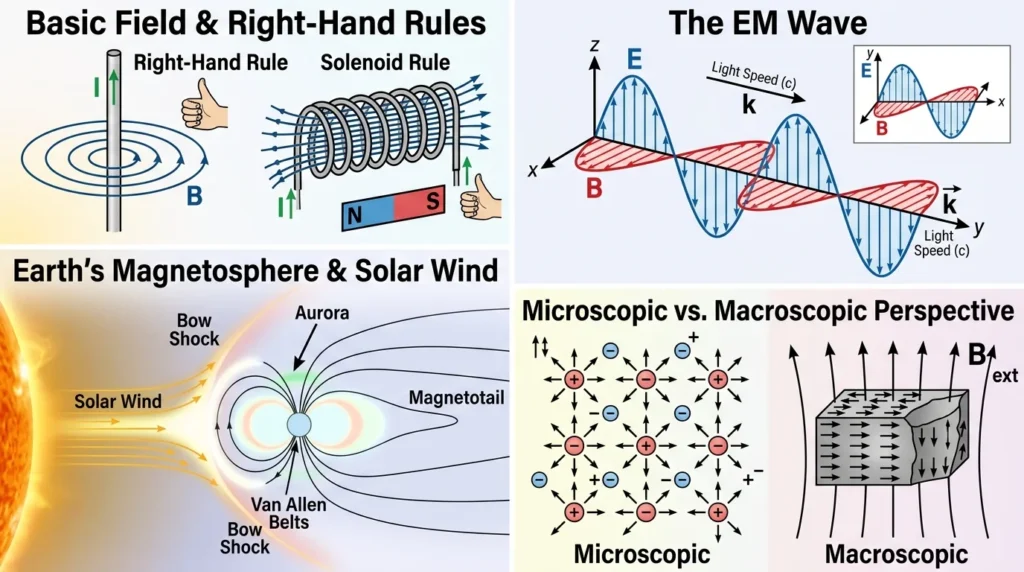
An Electromagnetic Field (EMF) is a magnetic field produced when an electric current flows through a conductor or coil. Unlike a permanent magnetic field, an electromagnetic field exists only while electrical current is flowing and its strength can be controlled by changing the amount of current or the number of turns in the coil. When current passes through the conductor, it creates magnetic lines of force around it, forming a magnetic field that can attract or repel magnetic materials. Electromagnetic fields are widely used in electrical and electronic devices because they can be switched on and off and precisely controlled. Common applications include transformers, electric motors, generators, relays, solenoids, electromagnetic cranes, circuit breakers, and measuring instruments. Their ability to produce adjustable magnetic force makes electromagnetic fields essential for modern power systems, industrial automation, and electrical machinery.
- Produced by electric current
- Can be controlled
Example: Coil with current
Uniform Magnetic Field
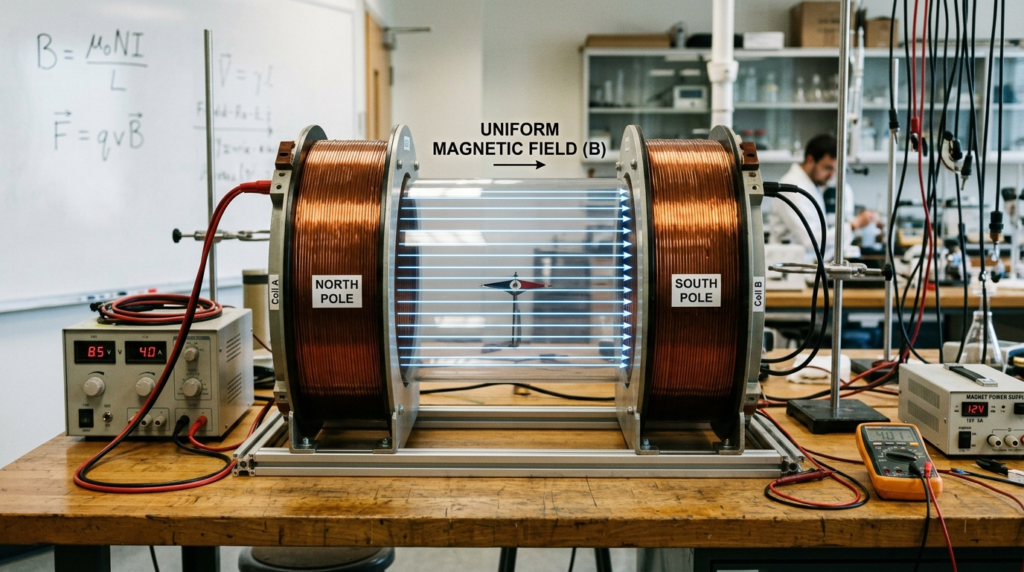
A Uniform Magnetic Field is a magnetic field in which the strength and direction of the magnetic force remain constant at every point within a given region. In this type of field, the magnetic field lines are straight, parallel, and equally spaced, indicating that the magnetic intensity is the same throughout the area. Any charged particle or magnetic material placed within a uniform magnetic field experiences the same magnetic effect regardless of its position. Uniform magnetic fields are commonly produced between the parallel poles of specially designed magnets or inside certain electromagnetic devices. They are widely used in scientific experiments, electrical measuring instruments, particle accelerators, electric motors, generators, and laboratory equipment where consistent and predictable magnetic behavior is required. A uniform magnetic field is essential for accurate measurements and efficient operation of many electrical and electronic systems.
- Field strength is constant
- Lines are parallel
Example: Between poles of magnet
Non-Uniform Magnetic Field
- Field strength varies
- Lines are uneven
Example: Around a single magnet
Earth’s Magnetic Field
- Natural magnetic field of Earth
- Used for navigation
Main Components
Magnetic fields involve several important elements.
Magnetic Source
Magnet or current-carrying conductor.
Function: Creates magnetic field
Magnetic Field Lines
Imaginary lines representing field.
Function: Show direction and strength
Magnetic Flux
Total field passing through area.
Function: Measure of field strength
Magnetic Force
Force acting on objects.
Function: Causes movement or alignment
Medium
Material around field.
Function: Affects field strength
Advantages
Here are the key magnetic field advantages and disadvantages, starting with benefits:
- Enables operation of motors and generators
- Allows wireless energy transfer
- Essential for transformers
- Used in data storage devices
- Supports navigation systems
- Helps in medical imaging
- Enables automation systems
Disadvantages / Limitations
Some limitations include:
- Cannot be seen directly
- Strength decreases with distance
- Requires energy in electromagnets
- Can interfere with electronic devices
- Strong fields may be harmful
Applications
Magnetic fields have wide applications in various areas.
Home Applications
- Electric fans
- Speakers
- Induction cooktops
Industrial Applications
- Motors and generators
- Magnetic lifting devices
- Sensors
Medical Applications
- MRI machines
- Diagnostic equipment
Modern Technology
- Hard drives
- Electric vehicles
- Wireless charging systems
Comparison Section
Difference Between Electric Field and Magnetic Field
| Feature | Electric Field | Magnetic Field |
| Source | Electric charges | Moving charges or magnets |
| Effect | Force on charges | Force on moving charges |
| Unit | N/C | Tesla (T) |
| Direction | Charge-based | Right-hand rule |
| Example | Capacitor | Motor |
Understanding this difference between electric field and magnetic field is important.
Selection Guide
Choosing the right magnetic field application depends on needs.
Tips for Beginners
- Start with basic magnets
- Understand field lines
- Learn right-hand rule
- Practice simple experiments
For Engineers
- Select proper materials
- Control field strength
- Optimize design
- Consider safety factors
Common Problems & Solutions
Why is magnetic field weak?
Low current or distance
Increase current or reduce distance
Why devices interfere with each other?
Magnetic interference
Shielding or spacing
Can magnetic field be blocked?
Partially, using shielding materials
Why motors fail?
Weak magnetic field
Check supply and coils
How to measure magnetic field?
Use gauss meter
Future Trends
Magnetic field technology is advancing rapidly.
Wireless Power Transfer
- Charging without wires
- Efficient energy transfer
Magnetic Levitation
- High-speed trains
- Frictionless motion
Advanced Materials
- Stronger magnets
- Better efficiency
Medical Innovations
- Improved MRI systems
- Non-invasive treatments
Smart Devices
- Magnetic sensors in IoT systems
Conclusion
A magnetic field is a fundamental concept in electrical engineering that explains how forces act around magnets and current-carrying conductors. It plays a key role in the operation of many devices, including motors, transformers, and generators.
Understanding the magnetic field working principle, types, applications, and limitations helps you design and analyze electrical systems effectively. Knowing the difference between electric field and magnetic field further strengthens your understanding.
As you continue learning, focus on practical experiments and real-world applications. Mastering magnetic fields will give you a strong foundation in electrical and electronic engineering.