
When you plug your mobile charger into a wall socket, you are using a type of electrical energy that constantly changes its value and direction. This is known as Alternating Voltage (AC Voltage). It is the backbone of modern power systems and is used to deliver electricity to homes, industries, and cities around the world.
Imagine a ceiling fan running smoothly or an air conditioner cooling your room. All of these depend on alternating voltage supplied through the electrical grid. Without it, long-distance power transmission would be inefficient and expensive.
Understanding what is alternating voltage is essential for electrical students, engineers, and technicians because it forms the foundation of power systems, machines, and electronics. In this article, you will learn its definition, working principle, types, advantages, disadvantages, applications, and how it compares with other forms of voltage. The explanation is simple, practical, and designed for real-world understanding.
What is Alternating Voltage?
Definition
Alternating Voltage (AC Voltage) is a type of electrical voltage that changes its magnitude and polarity (direction) periodically with time.
Simple Explanation
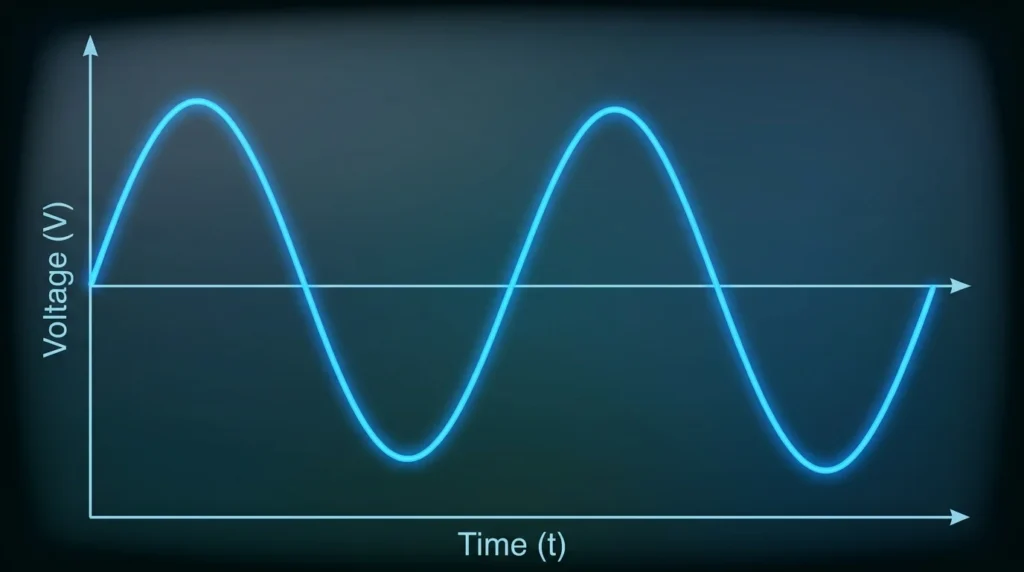
Unlike constant voltage, alternating voltage does not stay fixed. It rises from zero, reaches a peak, then falls back to zero, and reverses direction.
Practical Example
- The electricity coming from your home socket is alternating voltage.
- It changes direction 50 or 60 times per second depending on the country.
Key Idea
Alternating voltage is not steady—it continuously varies in a wave-like pattern, usually in the form of a sine wave.
So, the alternating voltage working principle is based on periodic variation in electrical pressure that drives current in both directions.
Working Principle of Alternating Voltage
Understanding the alternating voltage working principle is very important for beginners in electrical engineering.
Step-by-Step Working
A generator produces electrical energy using rotating magnets.
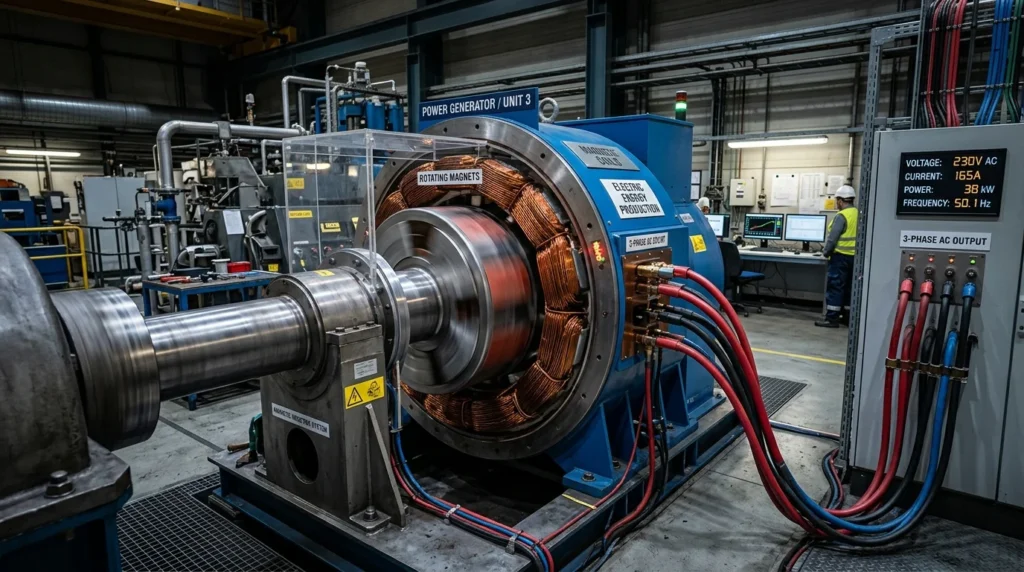
A generator produces electrical energy using rotating magnets by converting mechanical energy into electrical energy through the principle of electromagnetic induction. In a generator, a magnetic field is created using either permanent magnets or electromagnets, and a coil of wire or conductor is rotated within this magnetic field. As the magnets or coil rotate, the magnetic flux linked with the conductors continuously changes, which induces an electromotive force (EMF) according to Faraday’s law of electromagnetic induction. This induced EMF causes electric current to flow in the output circuit. In simple words, when a magnet rotates near a coil, it generates electricity due to the changing magnetic field. The faster the rotation, the greater the induced voltage. Generators are widely used in power plants, wind turbines, hydroelectric systems, and backup power systems to supply electrical energy for homes, industries, and commercial applications. Understanding this principle is important for electrical students and engineers because it explains how mechanical motion is converted into usable electrical power.
As the coil rotates, the magnetic field changes continuously.
This creates a changing electrical pressure (voltage).
The voltage first flows in one direction.
Then it reverses direction as the rotation continues.
This cycle repeats continuously.
Easy Analogy
Think of a swing:
- It moves forward → peak voltage in one direction
- It comes back → voltage decreases to zero
- It moves backward → voltage reverses direction
- Then repeats
Key Characteristics
- Alternates between positive and negative values
- Follows a wave pattern (usually sine wave)
- Has frequency (50Hz or 60Hz)
- Has peak and RMS values
Types / Classification of Alternating Voltage
Alternating voltage can be classified based on waveform and phase.
Single-Phase Alternating Voltage
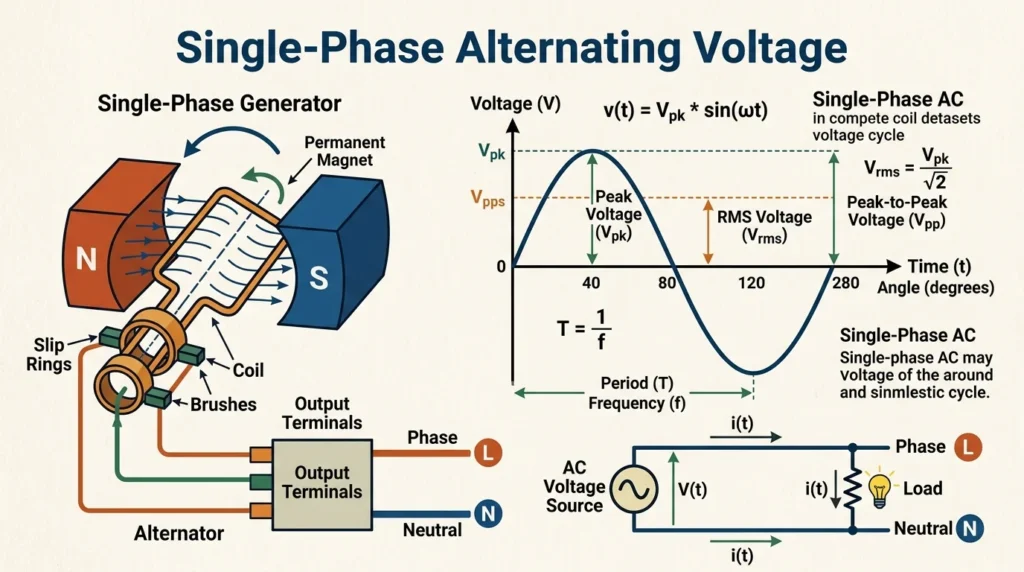
Single-phase alternating voltage is a type of electrical voltage that changes its magnitude and direction periodically over time, following a sinusoidal waveform. In a single-phase system, the electrical power is delivered using one alternating voltage waveform, which alternates between positive and negative cycles. This means the direction of current flow keeps reversing continuously. The voltage rises from zero to a positive peak, then decreases back to zero, and further goes to a negative peak before returning again, completing one full cycle. In simple words, single-phase alternating voltage is a continuously changing electrical supply that powers most household appliances and small electrical devices. It is commonly used in residential lighting systems, fans, televisions, and small machines where the power requirement is relatively low. Understanding single-phase alternating voltage is important for electrical students and technicians because it forms the basic foundation of AC power systems and helps in learning more advanced concepts like three-phase systems and power distribution.
- Has one alternating waveform
- Used in homes and small loads
- Simple and cost-effective
Three-Phase Alternating Voltage
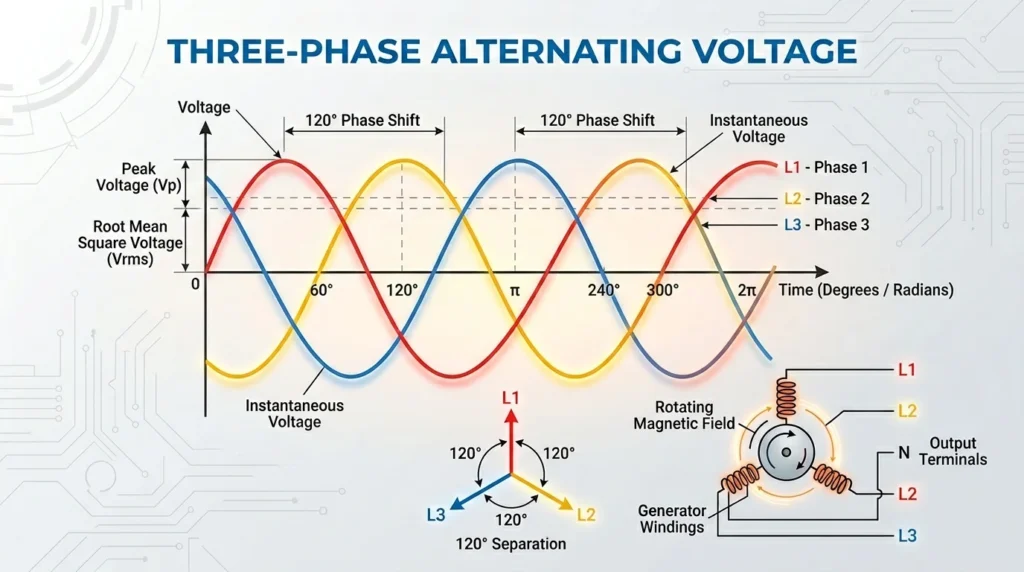
Three-phase alternating voltage is a type of electrical power system in which three alternating voltages of equal magnitude and frequency are generated, but each is phase-shifted by 120 degrees from the others. This means that at any instant, the three voltages are not equal, but together they provide a continuous and balanced supply of electrical power. Each phase follows a sinusoidal waveform, and the combination of all three phases ensures smooth and efficient power delivery. In simple words, three-phase alternating voltage is a system where three AC voltages work together in a timed sequence to provide more stable and powerful electricity. It is widely used in industrial plants, power transmission systems, heavy machinery, motors, and large electrical loads because it offers higher efficiency and better performance compared to single-phase supply. Understanding three-phase alternating voltage is important for electrical students and engineers because it is the backbone of modern power generation, transmission, and industrial electrical systems.
- Has three waveforms separated by 120°
- Used in industries
- More efficient for heavy loads and motors
Sinusoidal Voltage
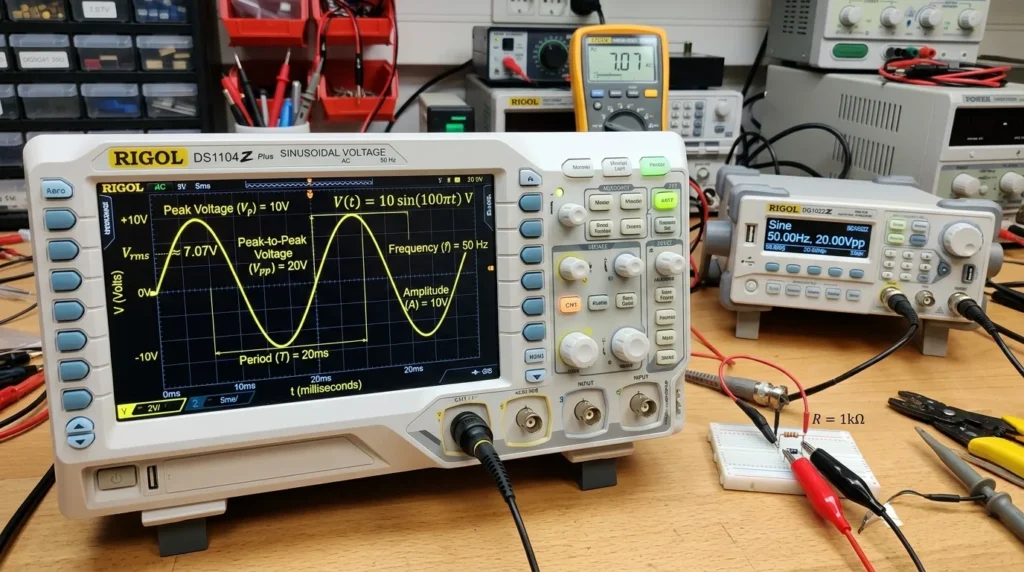
Sinusoidal voltage is an alternating voltage that varies smoothly and continuously with time in the shape of a sine wave. It increases from zero to a positive peak, returns back to zero, then goes to a negative peak, and again returns to zero, completing one full cycle. This pattern repeats continuously in an AC system. In simple words, sinusoidal voltage is a smooth wave-like electrical signal that naturally represents how alternating current behaves in power systems. It is considered the most efficient and stable waveform for transmitting electrical energy because it avoids sudden changes that can cause losses or disturbances in electrical equipment. Sinusoidal voltage is widely used in power generation, transmission lines, transformers, motors, and most electrical and electronic systems. Understanding sinusoidal voltage is important for electrical students and engineers because it forms the foundation of AC circuit analysis, power calculations, and waveform behavior in modern electrical engineering.
- Smooth wave pattern
- Most common type in power systems
- Reduces electrical losses
Non-Sinusoidal Voltage
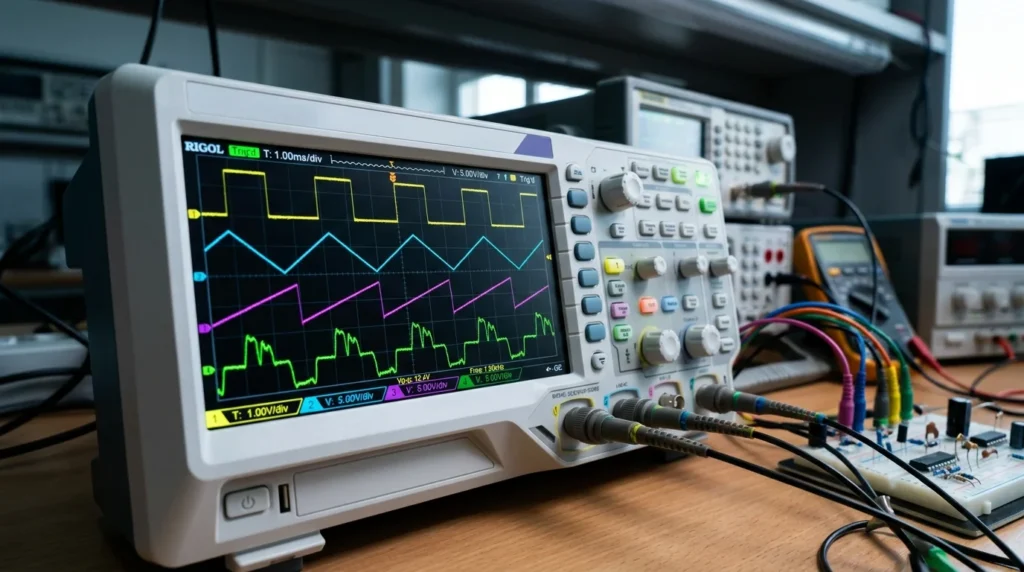
Non-sinusoidal voltage is an alternating voltage that does not follow a smooth sine wave pattern. Instead, it has irregular, distorted, or complex wave shapes such as square waves, triangular waves, sawtooth waves, or other mixed forms. This type of voltage is usually produced by electronic devices, switching circuits, inverters, and power electronic systems where the waveform is intentionally modified for specific applications. In simple words, non-sinusoidal voltage is a type of electrical signal that does not flow smoothly like a sine wave but changes in sharp or uneven patterns. Because of its irregular shape, it contains harmonics, which are unwanted frequency components that can affect the performance of electrical equipment. Non-sinusoidal voltage is commonly found in modern power electronics, variable frequency drives, UPS systems, and digital devices. Understanding non-sinusoidal voltage is important for electrical students and engineers because it helps in analyzing harmonics, power quality issues, and the behavior of advanced electronic systems in real-world applications.
- Irregular waveforms
- Found in electronic circuits
- Requires filtering for smooth output
Main Components Involved in Alternating Voltage Systems
To understand alternating voltage, you must know its system components.
Alternator (Generator)
- Produces alternating voltage
- Converts mechanical energy into electrical energy
Transformer
- Increases or decreases voltage levels
- Helps in efficient power transmission
Transmission Lines
- Carry electricity over long distances
- Made of high-conductivity materials
Circuit Breakers
- Protect the system from overloads
- Automatically disconnect faulty circuits
Loads (Appliances)
- Devices that consume electrical energy
- Example: fans, lights, machines
Each component plays a critical role in maintaining safe and efficient power delivery.
Advantages of Alternating Voltage
The alternating voltage advantages and disadvantages are important for engineering understanding.
Key Advantages
- Easy to transmit over long distances
- Voltage can be stepped up or down using transformers
- Cost-effective power distribution
- Suitable for industrial machines
- Efficient for large-scale power systems
- Easy generation using alternators
Real-World Benefits
- Powers entire cities efficiently
- Reduces energy loss during transmission
- Supports heavy industrial equipment
Disadvantages / Limitations
Despite its advantages, alternating voltage has limitations.
Key Disadvantages
- Not suitable for battery storage
- Can cause inductive losses in some systems
- More complex in terms of waveform analysis
- High voltage AC can be dangerous
- Requires insulation and safety systems
Practical Concern
Electrical shocks from AC can be more harmful due to continuous alternating nature.
Applications of Alternating Voltage
The alternating voltage applications are found everywhere in modern life.
Home Applications
- Lighting systems
- Fans and air conditioners
- Refrigerators
- Washing machines
Industrial Applications
- Heavy motors
- Pumps and compressors
- Manufacturing machines
- Power tools
Modern Technology Applications
- Power grids
- Railway electrification
- Electric heating systems
- Renewable energy systems (after conversion)
Alternating voltage is the foundation of global electricity distribution systems.
Comparison Section: Alternating Voltage vs Direct Voltage
Understanding the difference between alternating voltage and direct voltage is essential.
| Feature | Alternating Voltage | Direct Voltage |
| Direction | Changes continuously | One direction |
| Waveform | Sinusoidal | Straight line |
| Source | Alternators | Batteries |
| Transmission | Efficient over long distance | Less efficient |
| Conversion | Easy using transformers | Requires electronic circuits |
| Usage | Power systems | Electronics |
This comparison clearly shows how both types serve different purposes in electrical engineering.
Selection Guide – When to Use Alternating Voltage
Choosing between voltage types depends on application needs.
Use Alternating Voltage When:
- You need long-distance power transmission
- You are powering household appliances
- You are working with industrial machines
- You are designing power distribution systems
Beginner Tips:
- Always assume home electricity is AC
- Learn waveform basics first
- Understand frequency (50Hz/60Hz)
- Focus on safety when dealing with high voltage
Common Problems & Solutions (FAQ Style)
Why does alternating voltage change direction?
Because of rotating magnetic fields in generators.
Why is it used in homes?
Because it is easy to transmit and convert to different voltage levels.
Can alternating voltage be stored?
No, it must be converted to DC for storage in batteries.
Why is frequency important?
It determines how fast the voltage changes direction.
What happens if frequency is unstable?
Devices may malfunction or get damaged.
Future Trends in Alternating Voltage Systems
Electrical systems are evolving rapidly.
Smart Grids
- Intelligent control of power flow
- Better efficiency and monitoring
Renewable Energy Integration
- Solar and wind systems connect through AC grids
- Requires power electronics for conversion
High Voltage AC Transmission
- Used for long-distance power transfer
- Reduces energy losses
Hybrid AC-DC Systems
- Combining both technologies for efficiency
- Used in modern smart cities
The future of alternating voltage systems is focused on efficiency, automation, and sustainability.
Conclusion
Alternating voltage is one of the most important concepts in electrical engineering. It is the foundation of how electricity is generated, transmitted, and used in everyday life. From homes to industries, almost all electrical systems depend on it.
By understanding what is alternating voltage, its working principle, types, advantages, disadvantages, and applications, you build a strong foundation for advanced electrical studies and real-world engineering work.
Whether you are a student or a professional, mastering this topic helps you understand power systems, machines, and modern electrical networks more effectively. It is not just theory—it is the backbone of the entire electrical world.