
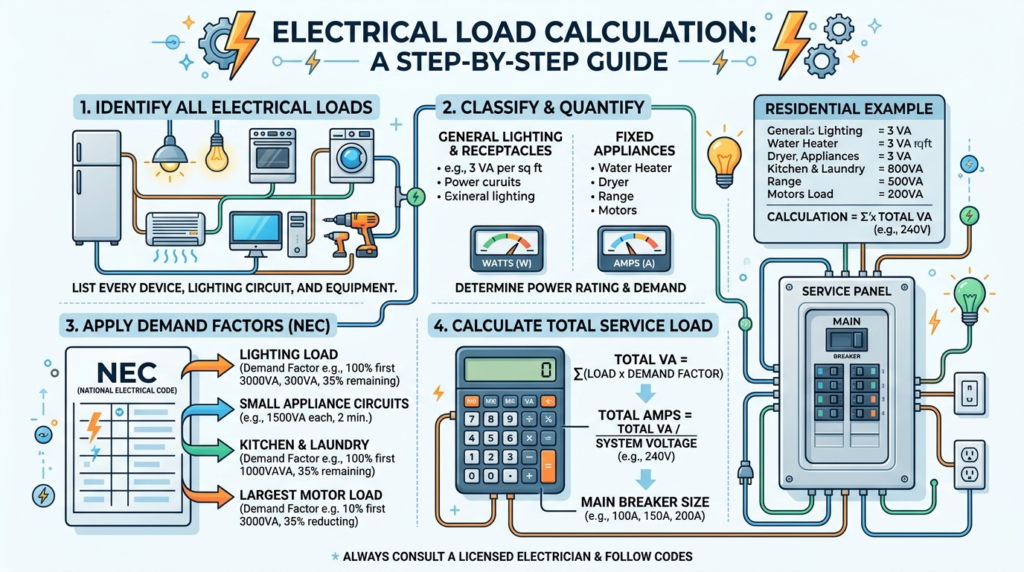

Imagine installing a new air conditioner in your home, only to find that your circuit breaker trips every time you turn it on. This is a common problem caused by improper planning of electrical demand. Without knowing how much load your system can handle, even simple upgrades can lead to failures, overheating, or safety risks.
This is where electrical load calculation becomes essential. It helps you determine how much electrical power is required and whether your system can safely support it. For engineers, technicians, and even beginners, understanding this concept is critical for designing safe and efficient electrical systems.
In this article, you will learn what electrical load calculation is, how it works, its types, key components, advantages and disadvantages, and real-world applications. By the end, you will clearly understand how to calculate electrical loads and make better decisions in both residential and industrial settings.
What is Electrical Load Calculation?
Electrical load calculation is the process of determining the total amount of electrical power required by all devices in a system.
Simple Explanation
Every electrical device—like lights, fans, motors, and computers—consumes power. When you add all these together, you get the total electrical load.
Practical Example
In a house:
- Lights = 500 watts
- Fans = 300 watts
- Air conditioner = 1500 watts
Total load = 2300 watts
This total helps you choose the right wiring, circuit breakers, and power supply.
Working Principle
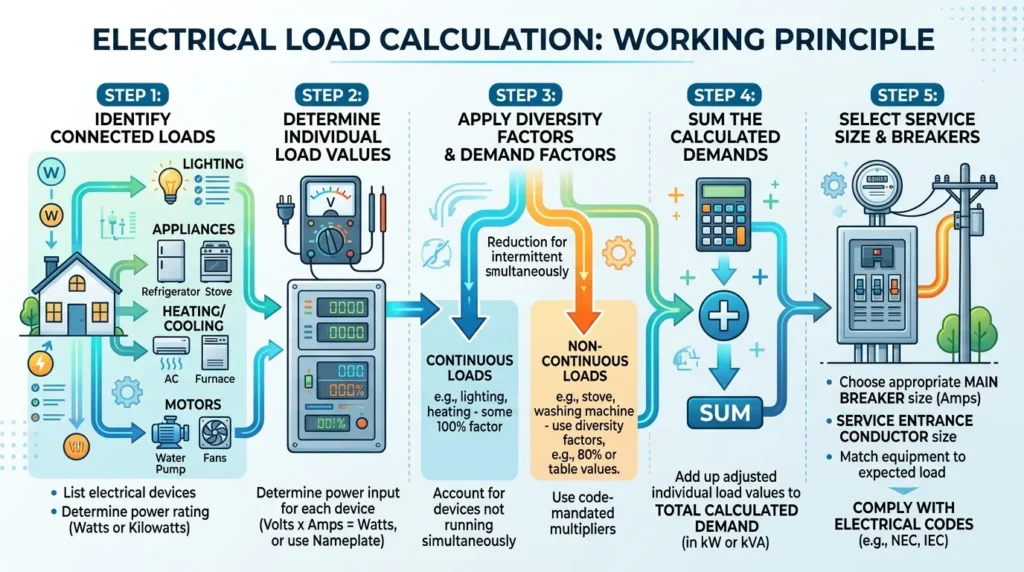
The electrical load calculation working principle is based on summing the power consumption of all connected devices and applying safety factors.Electrical load calculation is the process of determining the total electrical power required by an electrical system, building, or facility. It is performed by adding the power ratings of all electrical appliances, lighting, motors, and other equipment that may operate in the system. The total load is then used to calculate the required current, cable size, circuit breaker rating, transformer capacity, and power supply requirements. Proper electrical load calculation ensures the safe, efficient, and reliable operation of the electrical system by preventing overloading, reducing energy losses, improving power distribution, and allowing for future expansion when additional electrical loads are added.
Step-by-Step Process
- List all electrical devices
- Note their power ratings (in watts or kilowatts)
- Add all loads together
- Apply demand factor (not all devices run at once)
- Add safety margin
Basic Formula
Power (P) = Voltage (V) × Current (I)
Easy Analogy
Think of a water tank system:
- Each tap = electrical device
- Water flow = power consumption
- Total flow = total load
If too many taps are open, pressure drops—similar to overload in electrical systems.
Types / Classification
Residential Load Calculation

Residential load calculation is the process of determining the total electrical power required for a house or residential building. It involves adding the power ratings of all electrical appliances, lighting fixtures, fans, air conditioners, water heaters, and other equipment that may operate in the home. The calculated load helps in selecting the correct size of wires, circuit breakers, distribution boards, and the main power supply. An accurate residential load calculation ensures the electrical system operates safely, efficiently, and without overloading. It also helps reduce energy wastage, improves system reliability, and supports future electrical expansion if additional appliances are installed.
Used in homes and apartments.
- Lighting load
- Appliance load
- HVAC systems
- Kitchen equipment
Focus is on safety and comfort.
Commercial Load Calculation

Commercial load calculation is the process of determining the total electrical power required for a commercial building, such as an office, shopping mall, hotel, hospital, or school. It involves calculating the power consumption of lighting systems, air conditioning units, elevators, computers, machinery, and other electrical equipment used in the building. The calculated load helps engineers select the correct size of transformers, cables, circuit breakers, distribution panels, and backup power systems. Accurate commercial load calculation ensures the electrical system operates safely, efficiently, and reliably while preventing overloading, reducing energy wastage, and allowing for future expansion.
Used in offices, malls, and buildings.
- Lighting systems
- Elevators and escalators
- Office equipment
- Air conditioning
Requires higher accuracy due to larger systems.
Industrial Load Calculation
Industrial load calculation is the process of determining the total electrical power required for an industrial facility or factory. It involves calculating the power consumption of motors, machines, lighting systems, compressors, pumps, conveyors, heating equipment, and other electrical loads used in the industry. The calculated load helps engineers select the correct size of transformers, generators, cables, switchgear, circuit breakers, and distribution systems. Accurate industrial load calculation ensures the electrical system operates safely, efficiently, and reliably while preventing overloading, reducing energy losses, improving productivity, and allowing for future expansion of the facility.

Used in factories and plants.
- Heavy machinery
- Motors and drives
- Welding equipment
- Automation systems
More complex due to high power and continuous operation.
Demand Load Calculation

Demand load calculation is the process of determining the maximum electrical load that is expected to operate at the same time in a building or facility. Since not all electrical appliances and equipment run simultaneously, the demand load is usually lower than the total connected load. This calculation helps engineers select the correct size of transformers, generators, cables, circuit breakers, and other electrical equipment. Accurate demand load calculation improves the efficiency, safety, and reliability of the electrical system, prevents overloading, reduces installation costs, and ensures an adequate power supply for normal operation.
Considers that not all devices run simultaneously.
- Uses demand factor
- Reduces total calculated load
- Improves system efficiency
Main Components
Electrical Devices
All appliances and machines consuming power.
Power Rating
Measured in watts (W) or kilowatts (kW). Indicates energy usage.
Load Factor
Ratio of actual load to maximum load.
Demand Factor
Shows how much load is used at peak time.
Diversity Factor
Indicates that different loads operate at different times.
Circuit Protection Devices
Includes circuit breakers and fuses to handle calculated loads safely.
Advantages
Electrical Load Calculation Advantages and Disadvantages (Advantages)
- Prevents overloading and electrical failures
- Improves system efficiency
- Helps in proper equipment selection
- Ensures safety and compliance with standards
- Reduces energy waste
- Supports future expansion planning
Disadvantages / Limitations
Electrical Load Calculation Limitations
- Requires accurate data for correct results
- Time-consuming for large systems
- Errors can lead to under or over design
- Demand factors may vary in real conditions
- Needs technical knowledge
Applications
Electrical Load Calculation Applications
Home Applications
- Wiring design
- Circuit breaker selection
- Solar system sizing
Industrial Applications
- Power distribution planning
- Machine load management
- Backup generator sizing
Commercial Applications
- Building electrical design
- HVAC system planning
- Energy management
Modern Technology
- Smart homes
- Renewable energy systems
- Electric vehicle charging stations
Comparison Section
Difference Between Connected Load and Demand Load
| Feature | Connected Load | Demand Load |
| Definition | Total installed load | Actual load used |
| Accuracy | Less practical | More realistic |
| Usage | Initial design | Final design |
| Value | Higher | Lower |
| Efficiency | Not optimized | Optimized |
Selection Guide
Choosing the right approach for electrical load calculation depends on your project.
For Beginners
- Start with connected load
- Use simple addition
- Add safety margin (20–25%)
For Professionals
- Use demand and diversity factors
- Follow electrical standards
- Use software tools for accuracy
Key Tips
- Always consider future expansion
- Avoid underestimating load
- Choose proper cable size
- Ensure protection devices match load
Common Problems & Solutions
Why is my circuit breaker tripping?
: Load exceeds calculated capacity. Reduce load or upgrade system.
How to calculate load for a house?
Add all appliance wattages and apply demand factor.
What is the difference between connected load and demand load?
: Connected load is total installed; demand load is actual usage.
Can I ignore small devices in calculation?
No, small loads add up and affect total.
Why add safety margin?
To handle unexpected load increases.
Future Trends
Electrical systems are becoming smarter and more efficient.
Key Trends
- Smart meters for real-time load monitoring
- AI-based load prediction
- Integration with renewable energy
- Energy-efficient building design
- IoT-enabled load management
These advancements will make electrical load calculation more accurate and automated.
Conclusion
Electrical load calculation is a fundamental skill for designing safe and efficient electrical systems. It helps you understand how much power is needed and ensures that your system can handle it without failure.
We covered the electrical load calculation working principle, types, components, advantages and disadvantages, and applications. Understanding the difference between connected load and demand load also helps in making better design decisions.
Whether you are a student or a professional, mastering this concept will improve your technical skills and prevent costly mistakes. Keep practicing real-world calculations to build confidence and expertise.