
Imagine you are running a small workshop with several electric motors. Your electricity bill is higher than expected, even though your machines seem to be working normally. You consult an experienced technician, and the first thing they check is the power factor of your system.
This real-life situation highlights why understanding what is power factor is so important. Power factor directly affects how efficiently electrical power is used. A poor power factor means wasted energy, higher electricity bills, and unnecessary stress on equipment.
For electrical students, engineers, and technicians, power factor is not just a theory—it is a practical concept used daily in system design, maintenance, and troubleshooting.
In this article, you will learn power factor in a simple and clear way. We will cover its definition, working principle, types, applications, advantages and disadvantages, and how to improve it. By the end, you will be able to understand, calculate, and apply power factor concepts in real-world electrical systems.
What is Power Factor?
Definition
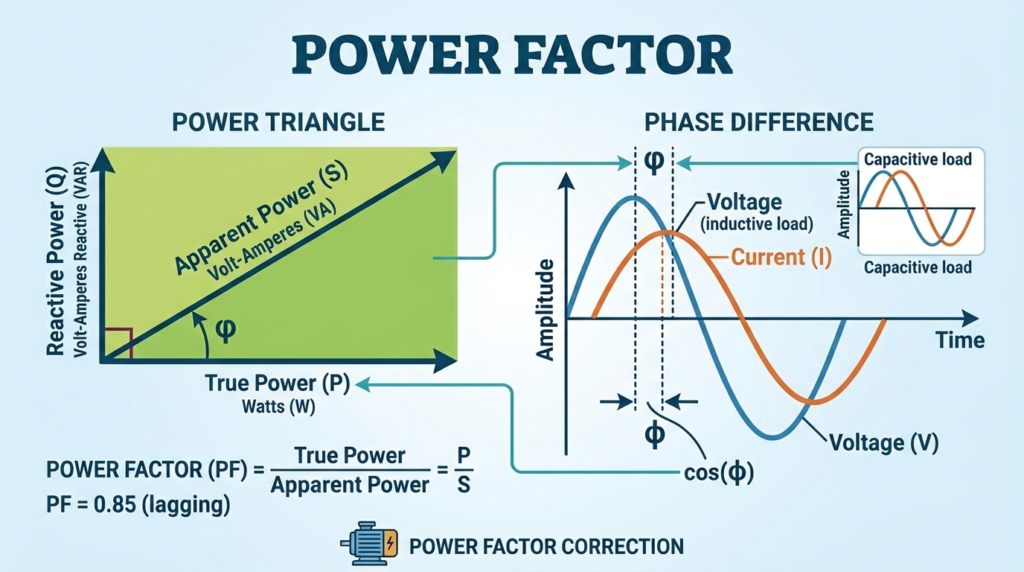
Power factor is the ratio of real power (useful power) to apparent power (total power supplied in a circuit).
It is expressed as a value between 0 and 1.
Simple Explanation
Power factor tells us how efficiently electrical power is being used.
- A power factor of 1 (unity) means all power is used effectively
- A lower power factor means some power is wasted
Formula
Power Factor (PF) = Real Power (kW) / Apparent Power (kVA)
Practical Example
If a system uses 80 kW of real power and receives 100 kVA of apparent power:
PF = 80 / 100 = 0.8
This means only 80% of the supplied power is being used effectively.
Working Principle
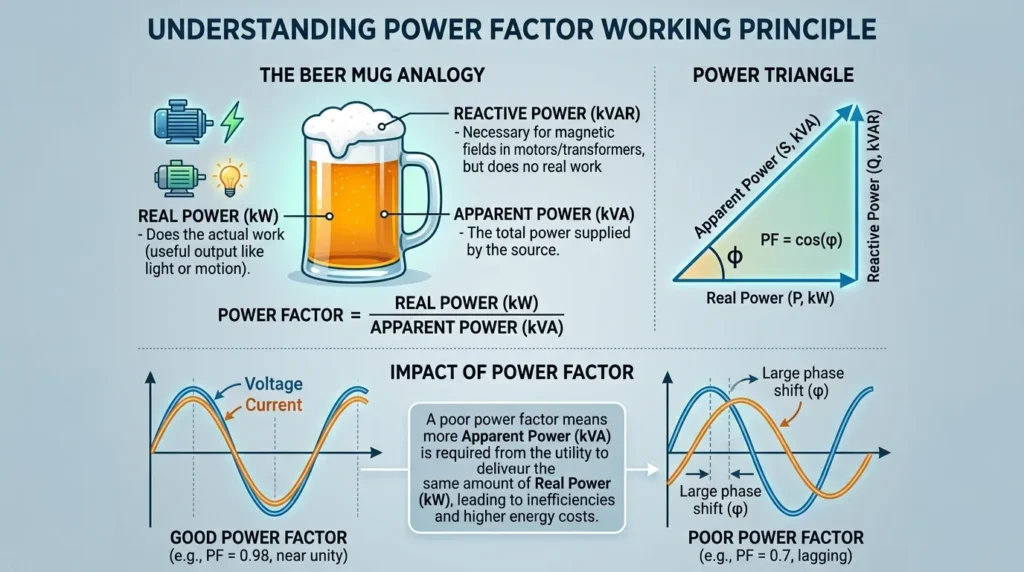
Power factor is the ratio of active power (real power) to apparent power in an AC electrical circuit. It indicates how efficiently electrical power is being converted into useful work. In purely resistive loads, such as electric heaters and incandescent lamps, the voltage and current are in phase, giving a power factor of 1 (unity). However, in inductive loads such as motors and transformers, the current lags behind the voltage, resulting in a lower power factor. A low power factor increases current, causes higher power losses, and reduces system efficiency. Power factor can be improved by using capacitor banks or power factor correction devices, which reduce the phase difference between voltage and current and improve the overall efficiency of the electrical system.
The power factor working principle is based on the relationship between voltage and current in an AC circuit.
Step-by-Step Explanation
In AC systems, voltage and current may not be in sync
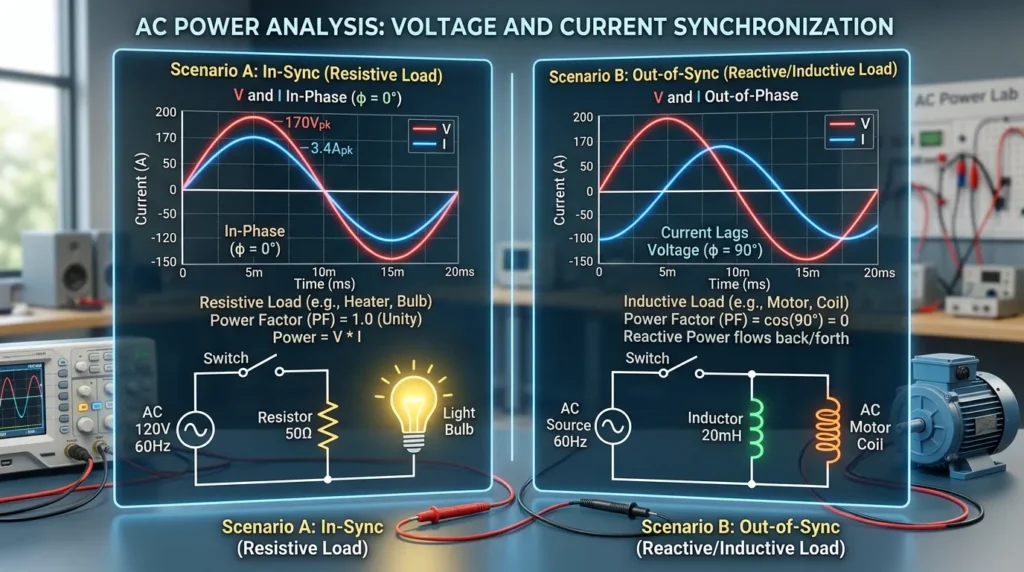
In AC (Alternating Current) systems, the voltage and current are not always in sync because some electrical loads, such as motors, transformers, and inductors, cause the current to either lag behind or lead the voltage. This difference in timing is called the phase difference. When voltage and current are perfectly in phase, the power factor is 1 (unity), and electrical power is used most efficiently. However, when they are out of phase, the power factor decreases, resulting in higher current, increased power losses, and lower system efficiency. Power factor correction devices, such as capacitors, are used to reduce the phase difference and improve the efficiency of AC power systems.
Some loads (like motors) cause current to lag behind voltage
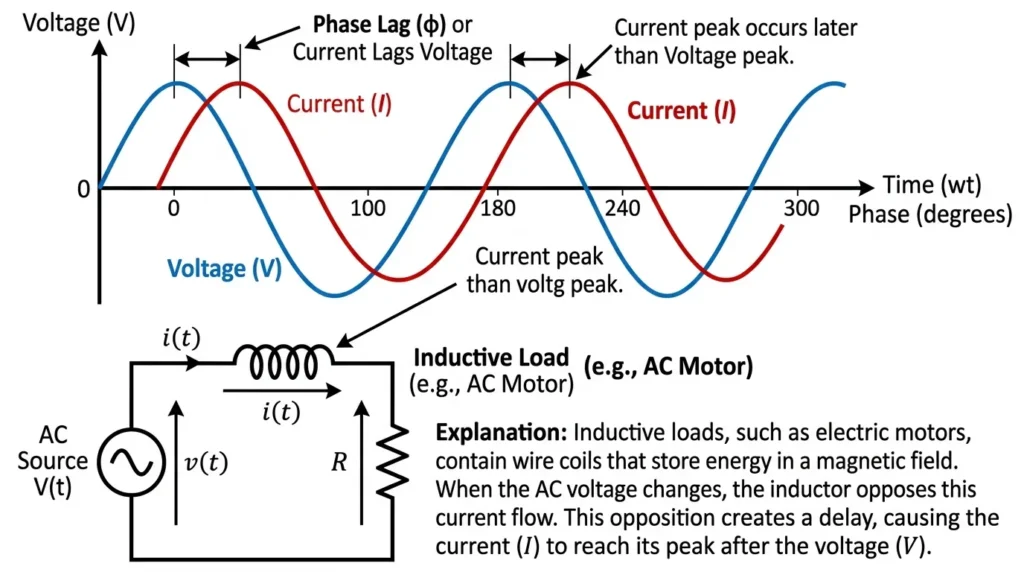
Some electrical loads, such as induction motors, transformers, and other inductive devices, cause the current to lag behind the voltage in an AC circuit. This happens because these devices require a magnetic field for operation, and time is needed to build and collapse the magnetic field. As a result, the current reaches its maximum value after the voltage, creating a phase difference between them. This lagging current lowers the power factor, increases the current drawn from the supply, and causes higher power losses. To improve efficiency and reduce the phase difference, capacitor banks or other power factor correction devices are commonly used.
This phase difference reduces efficiency
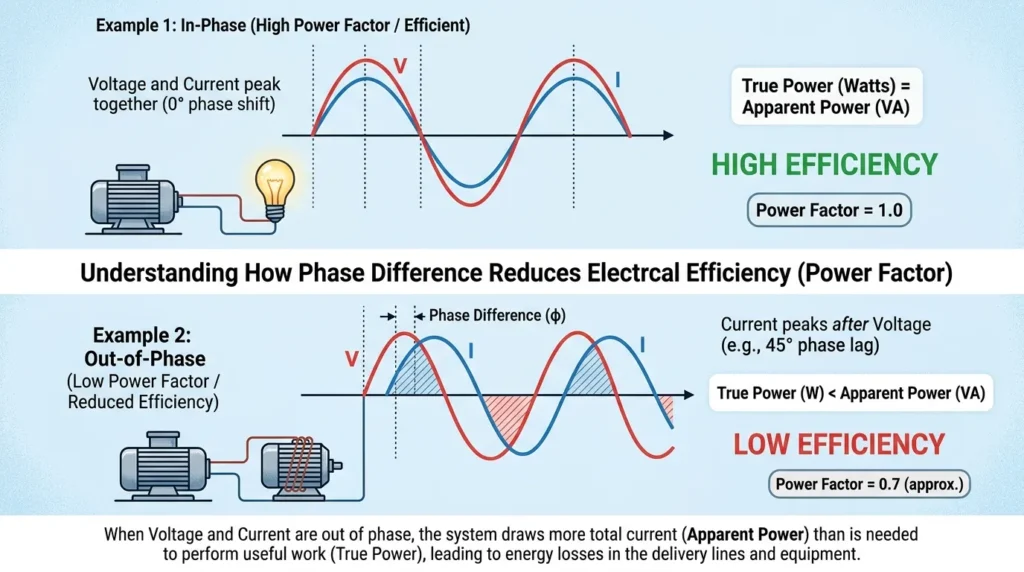
When there is a phase difference between voltage and current in an AC circuit, not all of the supplied electrical power is converted into useful work. As the phase difference increases, the power factor decreases, causing the system to draw more current for the same amount of useful power. This leads to higher power losses in cables and equipment, increased voltage drop, overheating, and reduced overall efficiency. By reducing the phase difference through power factor correction methods, such as using capacitor banks, the electrical system operates more efficiently, consumes less current, and minimizes energy losses.
Real power performs useful work
Reactive power does not perform useful work but is necessary
The combination of both gives apparent power
Power factor shows how much of the total power is useful
Easy Analogy
Think of a glass of juice with foam:
- Juice = useful power (real power)
- Foam = useless part (reactive power)
- Total glass = apparent power
Power factor tells how much “juice” you actually have.
Key Points
- Power factor depends on load type
- Inductive loads reduce power factor
- Capacitive elements can improve it
Types / Classification
Types of Power Factor
Lagging Power Factor

A lagging power factor occurs when the current in an AC circuit lags behind the voltage. This condition is mainly caused by inductive loads such as induction motors, transformers, reactors, and fluorescent lighting. These devices require magnetic fields for operation, causing the current to reach its maximum value after the voltage. A lagging power factor increases the current drawn from the power supply, resulting in higher power losses, greater voltage drop, overheating of equipment, and reduced system efficiency. The lagging power factor can be improved by installing capacitor banks or other power factor correction devices, which reduce the phase difference between voltage and current and improve the overall efficiency of the electrical system.
- Current lags behind voltage
- Common in inductive loads (motors, transformers)
- Most common in industries
Leading Power Factor
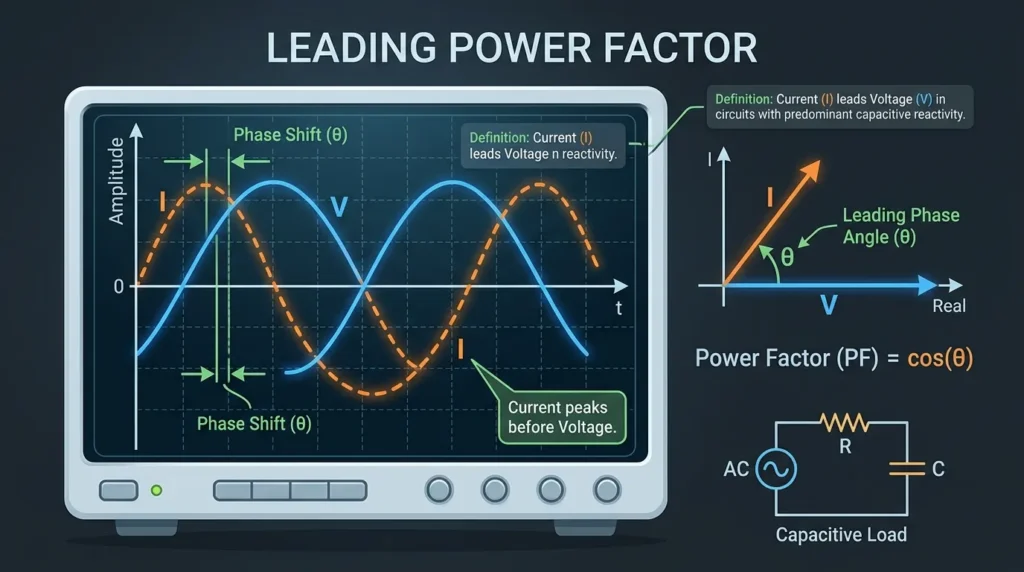
A leading power factor occurs when the current in an AC circuit leads the voltage. This condition is mainly caused by capacitive loads, such as capacitor banks, synchronous condensers, and long underground cables. Capacitive devices store electrical energy in an electric field, causing the current to reach its maximum value before the voltage. A leading power factor can help compensate for the lagging power factor caused by inductive loads and improve the overall efficiency of the electrical system. However, an excessive leading power factor may result in voltage rise, unstable system operation, and equipment problems. Therefore, power factor correction should be carefully controlled to maintain efficient and reliable operation.
- Current leads voltage
- Caused by capacitive loads
- Less common but used for correction
Unity Power Factor
A unity power factor occurs when the voltage and current in an AC circuit are perfectly in phase, meaning there is no phase difference between them. In this condition, the power factor is equal to 1 (100%), and all the electrical power supplied by the source is converted into useful work. Unity power factor is usually found in purely resistive loads, such as electric heaters, incandescent lamps, and electric ovens. It provides maximum system efficiency, minimizes current flow, reduces power losses, improves voltage regulation, and eliminates the need for power factor correction. Maintaining a unity power factor helps ensure the safe, efficient, and economical operation of electrical systems.
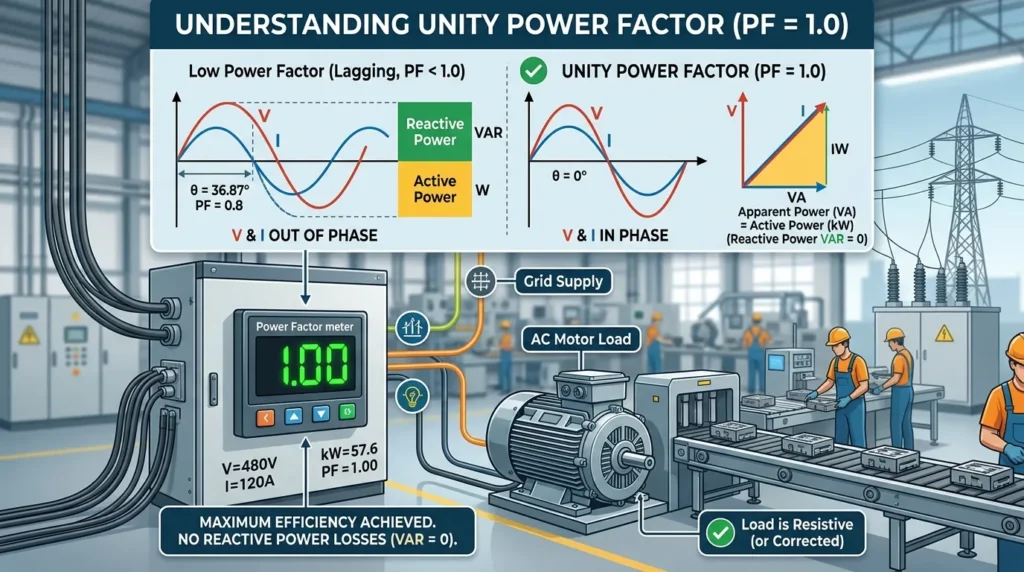
- Voltage and current are in perfect sync
- Maximum efficiency
- Ideal condition
Main Components
To understand and control power factor, you should know these components:
Load Devices
- Motors, transformers, lighting
- Determine power factor behavior
Capacitors
- Improve power factor
- Reduce reactive power
Inductors
- Cause lagging power factor
- Store energy in magnetic fields
Power Source
- Supplies voltage and current
Power Factor Correction Equipment
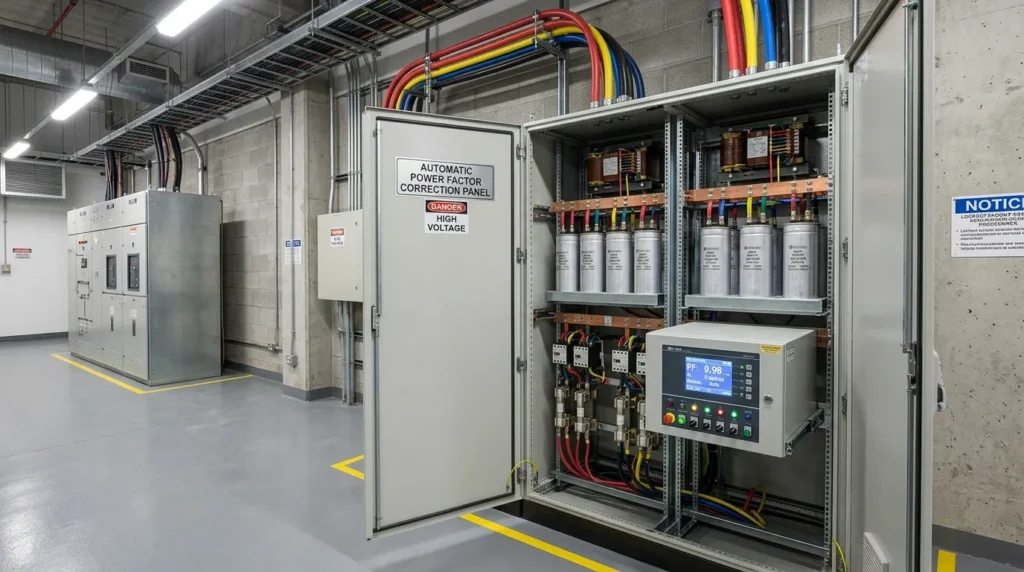
Power factor correction equipment is used to improve the power factor of an AC electrical system by reducing the phase difference between voltage and current. These devices supply reactive power to offset the reactive power consumed by inductive loads such as motors and transformers. Common power factor correction equipment includes capacitor banks, synchronous condensers, and automatic power factor correction (APFC) panels. By improving the power factor, these devices reduce current flow, minimize power losses, improve voltage regulation, increase system efficiency, and lower electricity costs. Power factor correction equipment is widely used in residential, commercial, and industrial electrical installations to ensure efficient and reliable operation of the power system.
- Capacitor banks
- Automatic controllers
Function
These components work together to control and maintain an efficient power factor in electrical systems.
Advantages
Power Factor Advantages
- Reduces electricity bills
- Improves system efficiency
- Decreases power losses
- Increases equipment life
- Reduces load on generators and transformers
- Improves voltage regulation
- Allows better use of electrical capacity
Disadvantages / Limitations
Power Factor Disadvantages
- Requires additional equipment for correction
- Improper correction can cause overvoltage
- Maintenance cost of capacitor banks
- Complex calculation for large systems
- Not always easy to maintain unity power factor
Applications
Power Factor Applications
Home Applications
- Efficient use of appliances
- Reducing electricity bills
Industrial Applications
- Motor-driven systems
- Large manufacturing plants
- Power distribution systems
Modern Technology
- Renewable energy systems
- Smart grids
- Data centers
- Electric vehicle charging systems
Power factor is critical wherever AC power is used.
Comparison Section
Difference Between Power Factor and Efficiency
| Feature | Power Factor | Efficiency |
| Definition | Ratio of useful to total power | Ratio of output to input energy |
| Focus | Power usage quality | Energy conversion performance |
| Unit | No unit (0 to 1) | Percentage (%) |
| Applies To | AC systems | All systems |
| Example | 0.8 PF | 90% efficiency |
This table explains the difference between power factor and efficiency, which are often confused but serve different purposes.
Selection Guide
Choosing and maintaining the right power factor is essential.
Use High Power Factor when:
- Running industrial systems
- Operating heavy machinery
- Managing large loads
Improve Power Factor by:
- Installing capacitor banks
- Using power factor correction devices
- Reducing inductive loads
Tips for Beginners
- Monitor power factor regularly
- Keep PF close to unity
- Use automatic correction systems
- Avoid overcorrection
Common Problems & Solutions
Why is my power factor low?
Problem: Inductive loads like motors
Solution: Add capacitors for correction
What happens with low power factor?
Problem: Higher electricity bills and losses
Solution: Improve PF using correction devices
Can power factor be greater than 1?
Answer: No, it ranges between 0 and 1
How to measure power factor?
Solution: Use a power factor meter or digital analyzer
Future Trends
Power factor management is evolving with modern electrical systems.
- Smart power factor correction systems
- AI-based energy optimization
- Integration with smart grids
- Advanced capacitor technologies
- Renewable energy systems requiring PF control
Future systems aim for better efficiency and automatic control.
Conclusion
Understanding what is power factor is essential for efficient electrical system operation. It shows how effectively electrical power is being used and helps reduce energy waste.
Maintaining a good power factor improves system performance, lowers costs, and extends equipment life. While achieving perfect unity power factor is challenging, proper correction methods can bring systems close to optimal performance.
As a student or professional, mastering power factor concepts will significantly improve your ability to design and manage electrical systems. Keep practicing and applying these principles in real-world situations.