
Imagine you are at home using multiple appliances—an air conditioner, refrigerator, and electric heater—at the same time. Suddenly, there is a short circuit, and sparks appear from a socket. Within milliseconds, the power supply shuts off automatically. That quick action prevents fire, equipment damage, and possible injury. This safety is made possible by electrical protection devices.
Electrical systems are powerful but can also be dangerous if not properly controlled. Faults like overload, short circuit, and leakage current can occur at any time. Without protection devices, these faults can damage expensive equipment and pose serious safety risks.
This topic is important for electrical students, engineers, and technicians because protection devices are the backbone of safe electrical design. Every system—from a small home to a large power plant—relies on them.
In this article, you will learn about the types of electrical protection devices, their working principle, components, advantages and disadvantages, applications, and how to choose the right one. By the end, you will have a strong practical understanding of how these devices keep electrical systems safe.
What is Types of Electrical Protection Devices?
Types of electrical protection devices refer to various devices used to protect electrical systems from faults such as overload, short circuit, and earth leakage.
Simple Explanation
These devices act like safety guards. When something goes wrong in a circuit, they automatically stop the flow of electricity to prevent damage or danger.
Practical Example
If too many appliances are connected to one circuit:
- The current increases beyond safe limit
- A circuit breaker trips and cuts off power
- This prevents overheating and fire
Working Principle
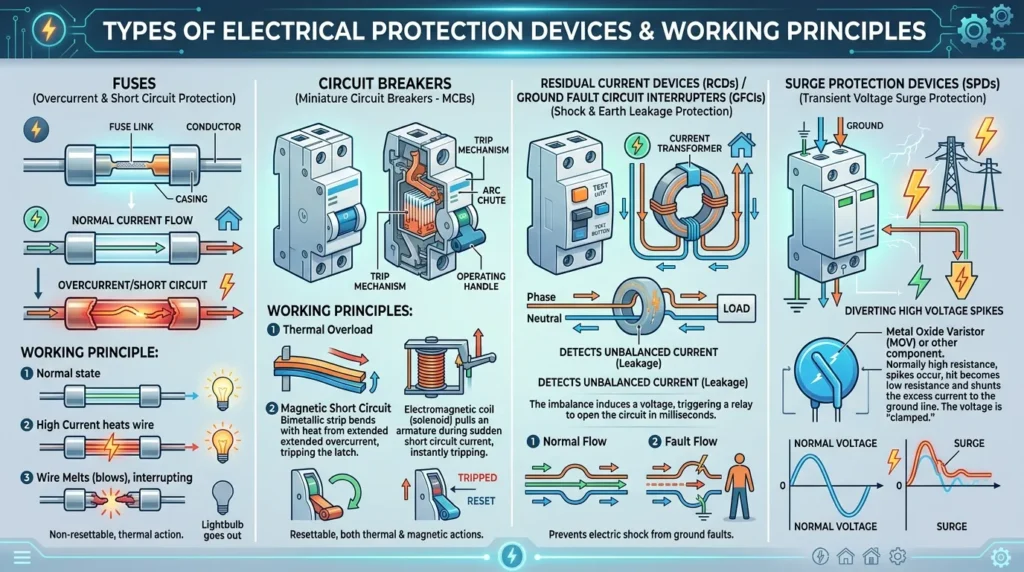
The types of electrical protection devices working principle is based on detecting abnormal conditions and interrupting the electrical supply.Electrical protection devices are safety components used to protect electrical circuits, equipment, and people from faults such as overload, short circuit, earth leakage, and overvoltage. They continuously monitor the flow of current and voltage in the electrical system. When an abnormal condition or fault occurs, the protection device automatically disconnects the power supply to prevent damage to equipment, fire hazards, and electric shock. Common electrical protection devices include fuses, circuit breakers (MCB, MCCB), residual current devices (RCD/RCCB), earth leakage circuit breakers (ELCB), surge protection devices (SPD), and protective relays. These devices ensure the safe, reliable, and efficient operation of residential, commercial, and industrial electrical systems.
Step-by-Step Explanation
Normal operation
- Current flows within safe limits
Fault occurs
- Overload, short circuit, or leakage
Detection
- Device senses abnormal current or voltage
Activation
- Protection device operates
Disconnection
- Circuit is automatically cut off
Easy Analogy
Think of it like a safety valve in a water system:
- Normal pressure = normal flow
- High pressure = danger
- Valve opens to release pressure
Similarly, protection devices stop dangerous current flow.
Key Points
- Fast response is critical
- Devices must be reliable
- Must reset or replace after operation
Types / Classification
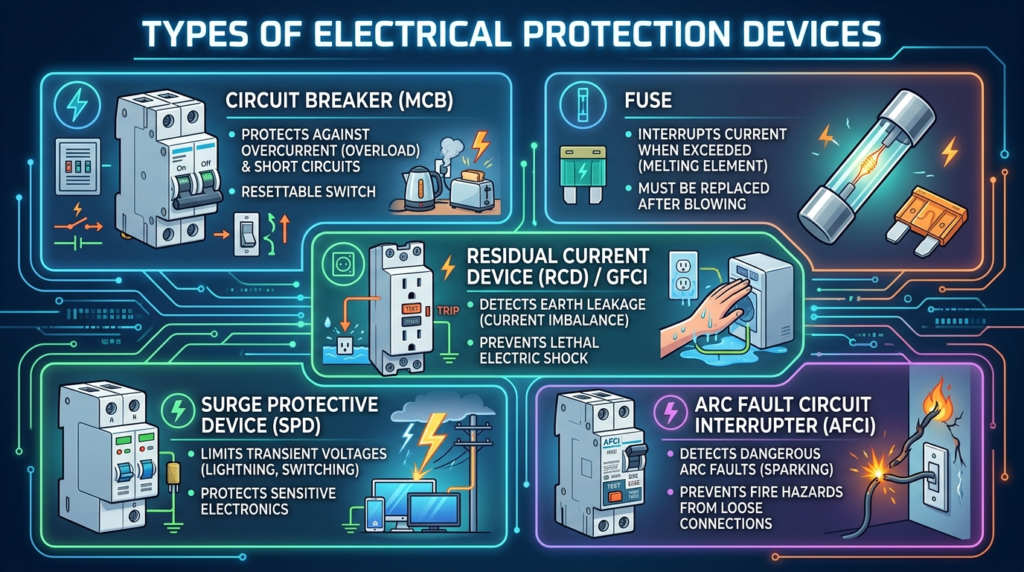
There are several types of electrical protection devices, each designed for specific faults.
Fuse
A fuse is the simplest protection device.
- Contains a thin metal wire
- Melts when current exceeds limit
- Breaks the circuit
Use: Homes, small circuits
Miniature Circuit Breaker (MCB)
A Miniature Circuit Breaker (MCB) is an automatic electrical protection device used to protect electrical circuits from overload and short-circuit faults. It continuously monitors the current flowing through the circuit. When the current exceeds the safe limit due to an overload, the thermal mechanism inside the MCB trips and disconnects the power supply. In the event of a short circuit, the magnetic mechanism operates instantly to interrupt the fault current. Unlike a fuse, an MCB can be reset and reused after the fault has been cleared. MCBs are widely used in residential, commercial, and industrial electrical installations to provide safe, reliable, and efficient circuit protection.
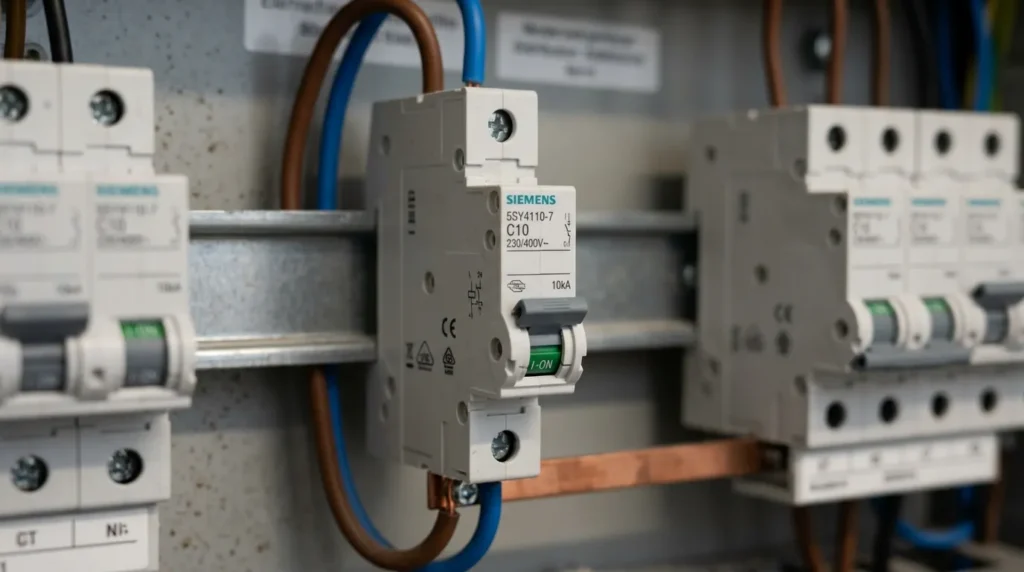
MCB is widely used in modern homes.
- Automatically trips during overload
- Can be reset after operation
Use: Residential and commercial buildings
Molded Case Circuit Breaker (MCCB)
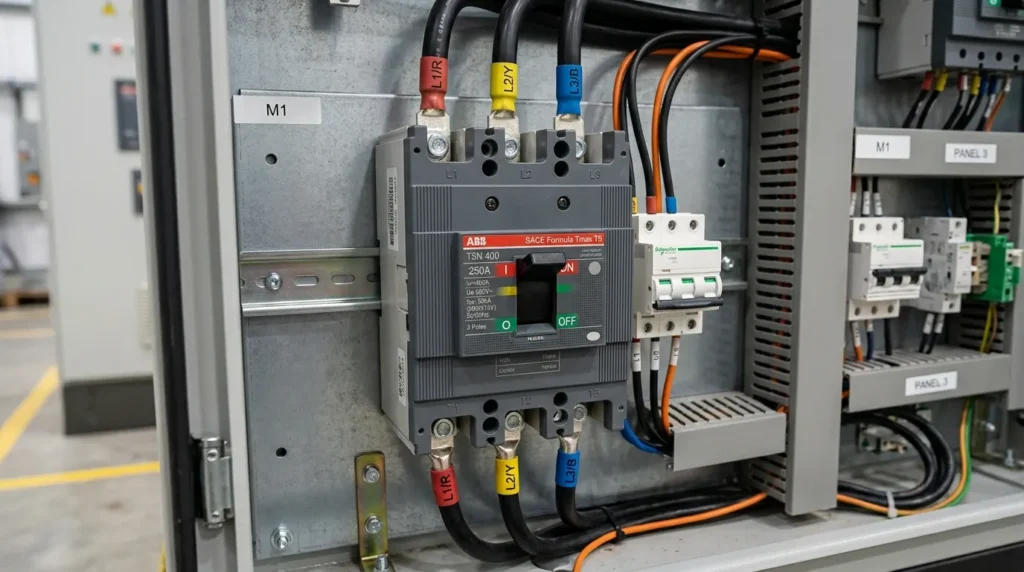
A Molded Case Circuit Breaker (MCCB) is an electrical protection device designed to protect electrical circuits from overload, short circuit, and, in some models, ground fault conditions. It continuously monitors the current flowing through the circuit and automatically disconnects the power supply when the current exceeds the preset safe limit. MCCBs have a higher current rating and breaking capacity than Miniature Circuit Breakers (MCBs), making them suitable for commercial and industrial applications. Many MCCBs feature adjustable trip settings, allowing users to customize protection according to the load requirements. They are widely used in distribution panels, motor control centers, generators, and industrial power systems to ensure safe, reliable, and efficient electrical operation.
Used for higher current ratings.
- Adjustable trip settings
- Handles large loads
Use: Industrial systems
Residual Current Device (RCD) / RCCB
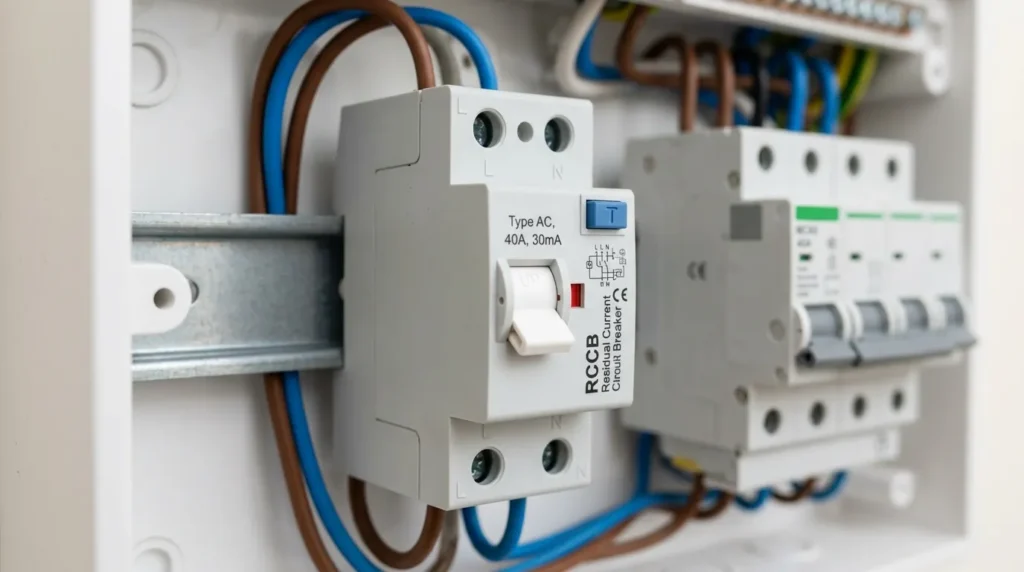
A Residual Current Device (RCD), also known as a Residual Current Circuit Breaker (RCCB), is an electrical protection device designed to protect people from electric shock and prevent electrical fires caused by earth leakage currents. It continuously compares the current flowing through the live (phase) wire with the current returning through the neutral wire. Under normal conditions, these currents are equal. If a leakage current flows to earth due to insulation failure or accidental contact, the RCD/RCCB detects the imbalance and automatically disconnects the power supply within milliseconds. Unlike an MCB, an RCD/RCCB does not provide overload or short-circuit protection; it is specifically used for earth leakage protection. RCDs/RCCBs are widely installed in residential, commercial, and industrial electrical systems to improve electrical safety and protect human life.
Protects against electric shock.
- Detects leakage current
- Trips instantly
Use: Bathrooms, kitchens, sensitive areas
Earth Leakage Circuit Breaker (ELCB)
Older version of leakage protection.
- Detects earth faults
- Less sensitive than RCCB
Overload Relay
Used with motors.
- Protects against overheating
- Works with contactors
Surge Protection Device (SPD)
Protects from voltage spikes.
- Absorbs sudden high voltage
- Protects electronic devices
Circuit Breaker (Air, Oil, SF6, Vacuum)
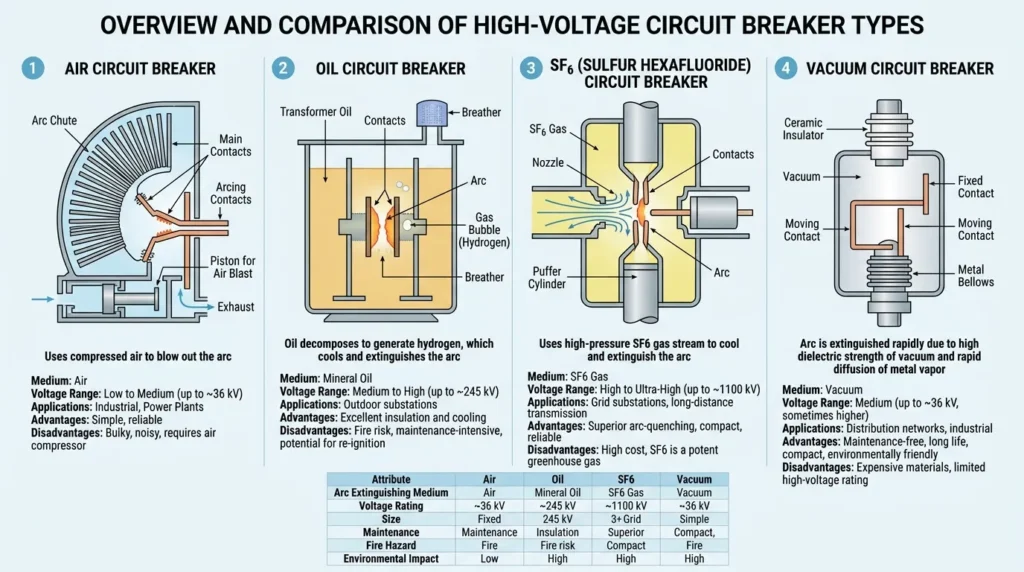
A circuit breaker is an electrical switching and protection device used to protect power systems from overload, short circuit, and other electrical faults. It automatically interrupts the flow of current when a fault is detected, preventing damage to electrical equipment and ensuring system safety. Different types of circuit breakers use different arc-extinguishing media. Air Circuit Breakers (ACB) use air to extinguish the electric arc and are commonly used in low-voltage systems. Oil Circuit Breakers (OCB) use insulating oil to cool and extinguish the arc and are mainly used in medium-voltage applications. SF₆ Circuit Breakers use sulfur hexafluoride (SF₆) gas, which has excellent insulating and arc-quenching properties, making them suitable for high-voltage power systems. Vacuum Circuit Breakers (VCB) extinguish the arc in a vacuum, providing fast operation, low maintenance, and long service life. These circuit breakers are widely used in residential, commercial, industrial, and power transmission systems to ensure safe, reliable, and efficient electrical operation.
Used in power systems.
- Handles very high voltage
- Used in substations
Main Components
Electrical protection devices include several key components.
Sensing Element
Detects abnormal conditions.
Function: Identify fault
Tripping Mechanism
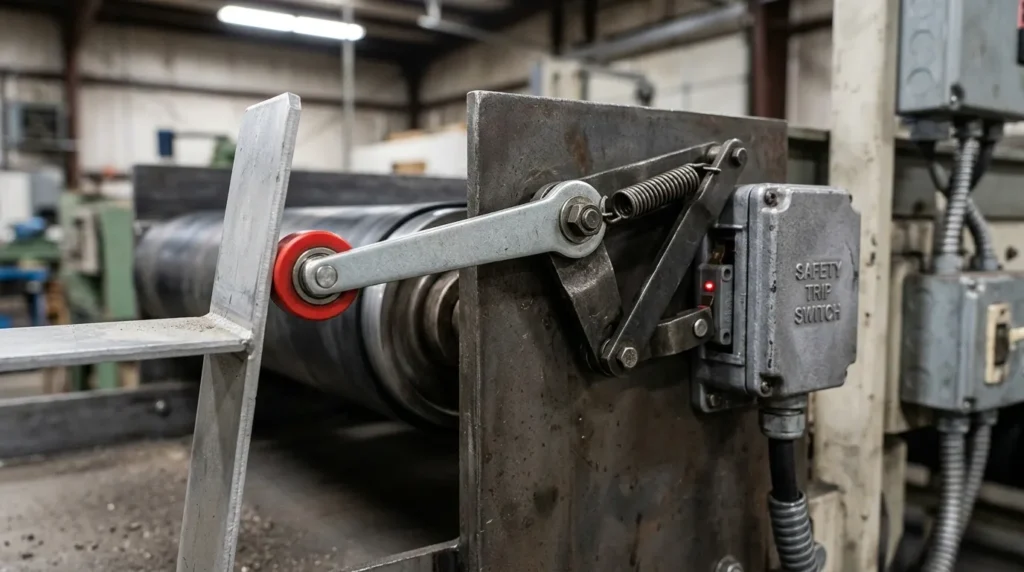
A tripping mechanism is the operating system inside a circuit breaker that automatically disconnects the electrical circuit when a fault is detected. It continuously monitors the electrical current and responds to abnormal conditions such as overload, short circuit, or earth fault. When the current exceeds the preset safe limit, the tripping mechanism activates the breaker, causing its contacts to open and interrupt the flow of electricity. Depending on the type of circuit breaker, the tripping mechanism may operate using thermal, magnetic, electronic, or relay-based protection. This automatic operation protects electrical equipment, prevents fire hazards, and ensures the safe and reliable operation of the electrical system.
Disconnects the circuit.
Function: Stop current flow
Contacts
Open and close the circuit.
Function: Control electricity
Arc Extinguishing System
An arc extinguishing system is a protective mechanism used in circuit breakers to safely interrupt the electric arc that forms when the breaker contacts separate during a fault. When a circuit carrying current is opened, a high-temperature electric arc is produced between the contacts. The arc extinguishing system quickly cools, lengthens, or deionizes the arc using a suitable medium such as air, oil, vacuum, or SF₆ gas, causing it to extinguish safely. This process prevents damage to the circuit breaker contacts, reduces the risk of fire, and ensures the reliable interruption of fault current. Arc extinguishing systems are essential for the safe and efficient operation of low-, medium-, and high-voltage electrical power systems.
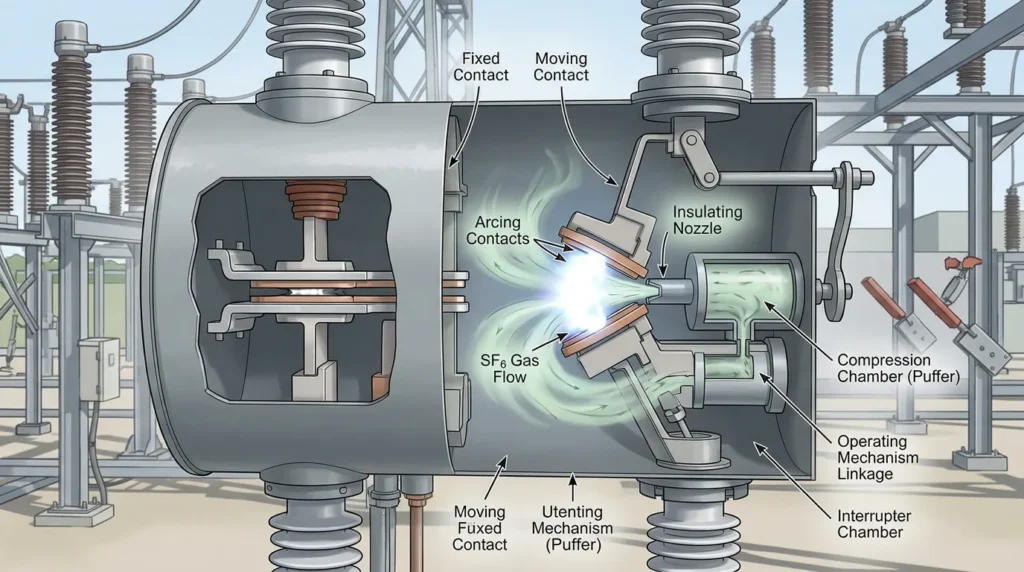
Stops electric arc during switching.
Function: Prevent damage
Housing
Protective outer body.
Function: Ensure safety and durability
Advantages
Here are the key types of electrical protection devices advantages and disadvantages, starting with benefits:
- Protects against electrical hazards
- Prevents fire accidents
- Saves expensive equipment
- Improves system reliability
- Provides automatic operation
- Reduces maintenance costs
- Enhances safety for users
Disadvantages / Limitations
Some limitations include:
- Initial installation cost
- Requires proper selection
- Regular maintenance needed
- Incorrect settings may cause nuisance tripping
- Some devices are complex to operate
Applications
The types of electrical protection devices applications are found everywhere.
Home Applications
- Distribution boards
- Appliance protection
- Leakage protection
Industrial Applications
- Motor protection
- Machinery safety
- Power distribution
Commercial Applications
- Office buildings
- Shopping malls
- Hospitals
Modern Technology
- Data centers
- Renewable energy systems
- Electric vehicle charging stations
Comparison Section
Difference Between Fuse and Circuit Breaker
| Feature | Fuse | Circuit Breaker |
| Operation | Melts | Trips automatically |
| Reusability | One-time use | Reusable |
| Response Time | Very fast | Fast |
| Cost | Low | Higher |
| Maintenance | Replace required | Reset only |
Understanding this difference between fuse and circuit breaker is important.
Selection Guide
Choosing the right protection device is critical.
Tips for Beginners
- Identify type of load
- Check current rating
- Choose correct device type
- Ensure proper installation
- Follow safety standards
For Engineers
- Analyze fault levels
- Select coordination between devices
- Consider environment conditions
- Use standard guidelines
- Plan for future expansion
Common Problems & Solutions
Why does my MCB trip frequently?
Overload or short circuit
Reduce load or check wiring
Why fuse blows again and again?
Fault in circuit
Identify and fix fault
What is nuisance tripping?
Unnecessary tripping
Adjust settings or replace device
Why is RCCB important?
Prevents electric shock
How to test protection devices?
Use testing equipment regularly
Future Trends
Electrical protection devices are evolving rapidly.
Smart Protection Devices
- Remote monitoring
- Real-time fault detection
IoT Integration
- Connected systems
- Automatic alerts
AI-Based Protection
- Predict faults before occurrence
- Improve reliability
Renewable Energy Protection
- Specialized devices for solar and wind
Advanced Circuit Breakers
- Faster and more efficient
- Compact designs
Conclusion
Electrical protection devices are essential for safe and reliable operation of electrical systems. They protect people, equipment, and buildings from faults like overload, short circuit, and leakage currents. Without them, even a small fault could lead to serious damage or danger.
Understanding the types of electrical protection devices, their working principle, applications, and limitations helps in selecting the right device for each situation. Knowing the difference between fuse and circuit breaker also improves practical knowledge.
As a future engineer or technician, always prioritize protection in your designs. A well-protected system is not just efficient—it is safe and dependable.