
Imagine you are running an air conditioner at home. You pay for the electricity consumed, but not all the supplied power is actually used to produce cooling. Some part does useful work, while another part circulates in the system without doing real work. This hidden behavior of power is explained using the power triangle.
In AC electrical systems, power is not as simple as in DC circuits. There are three types of power working together—real power, reactive power, and apparent power. Understanding their relationship is very important for improving efficiency and reducing energy losses.
That’s why learning Power Triangle Explained is essential for electrical students, engineers, and technicians. It helps in understanding power factor, optimizing electrical systems, and reducing electricity costs.
In this article, you will learn the complete power triangle explained working principle, components, types, applications, advantages and disadvantages, and practical troubleshooting. By the end, you will clearly understand how power behaves in AC circuits and how to manage it effectively.
2. What is Power Triangle Explained?
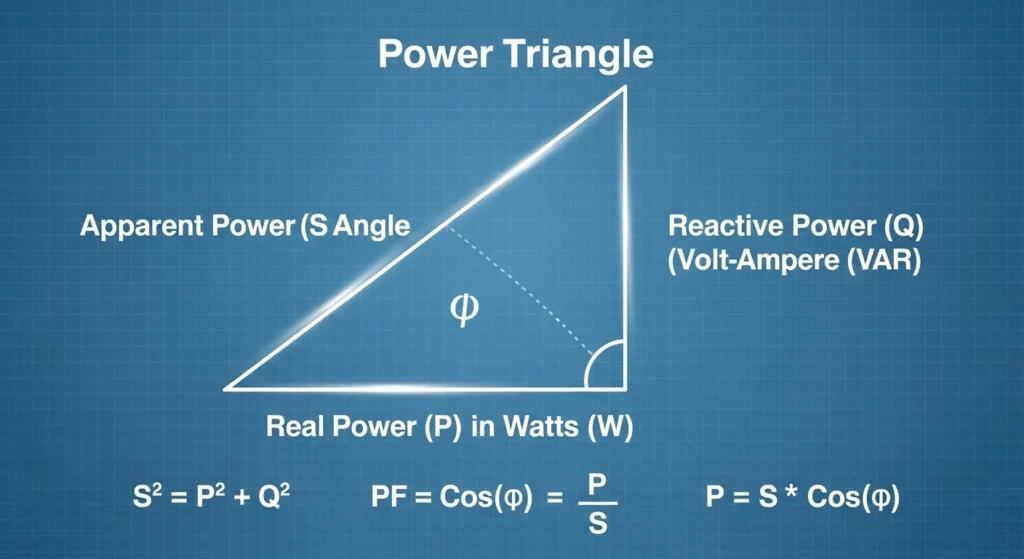
The power triangle is a graphical representation of the relationship between three types of power in an AC circuit:
- Real Power (P)
- Reactive Power (Q)
- Apparent Power (S)
Simple Explanation
It is a right-angled triangle where:
- Base = Real Power
- Perpendicular = Reactive Power
- Hypotenuse = Apparent Power
Practical Example
In a motor:
- Real power runs the motor
- Reactive power supports magnetic field
- Apparent power is total supplied power
3. Working Principle
The power triangle explained working principle is based on how power flows in AC circuits with phase difference.
Step-by-Step Explanation
- AC voltage is applied to a load
- Current flows with a phase difference
- Power splits into:
- Real power (useful work)
- Reactive power (energy storage)
- These combine to form apparent power
- The relationship is shown as a triangle
Mathematical Relationship
S^2 = P^2 + Q^2
Power Factor Formula
\cos(\phi) = \frac{P}{S}
Easy Analogy
Think of a glass of juice:
- Real power = juice (useful part)
- Reactive power = foam (not useful)
- Apparent power = total drink
Key Points
- Real power does actual work
- Reactive power supports system
- Apparent power is total demand
4. Types / Classification
Real Power (Active Power)
- Measured in watts (W)
- Performs useful work
Reactive Power
- Measured in VAR
- Does not perform real work
- Supports magnetic and electric fields
Apparent Power
- Measured in VA
- Total power supplied
5. Main Components
Resistive Load
- Uses real power
- Example: Heaters
Inductive Load
- Uses reactive power
- Example: Motors
Capacitive Load
- Supplies reactive power
- Used for power factor correction
Power Source
- Provides apparent power
Measuring Instruments
- Wattmeter (real power)
- VAR meter (reactive power)
- Power meter (apparent power)
6. Advantages
Power Triangle Explained Advantages
- Helps understand power flow
- Improves power factor correction
- Reduces energy losses
- Enhances system efficiency
- Assists in system design
- Supports better load management
7. Disadvantages / Limitations
Power Triangle Explained Disadvantages
- Complex for beginners
- Requires proper measurement tools
- Reactive power causes inefficiency
- Needs correction equipment
- Not directly visible in system
8. Applications
Power Triangle Explained Applications
Home Applications
- Power factor improvement
- Efficient appliance usage
Industrial Applications
- Motor performance analysis
- Power system optimization
- Energy cost reduction
Modern Technology
- Smart grids
- Renewable energy systems
- Electric vehicle charging
- Power electronics
Power triangle is essential in all AC power systems.
9. Comparison Section
Difference Between Real Power and Reactive Power
| Feature | Real Power | Reactive Power |
| Definition | Useful power | Supporting power |
| Unit | Watt (W) | VAR |
| Function | Performs work | Maintains fields |
| Consumption | Consumed | Not consumed |
| Example | Heating, lighting | Motors, transformers |
10. Selection Guide
Managing power triangle is key for efficiency.
Tips for Beginners
- Maintain power factor close to 1
- Use capacitors for correction
- Avoid excessive reactive power
Key Factors to Consider
- Load type
- Power factor
- System efficiency
- Cost of energy
- Equipment rating
Practical Advice
- Regularly monitor power factor
- Install capacitor banks
- Optimize load distribution
11. Common Problems & Solutions
Why is power factor low?
High reactive power.
Use capacitor banks.
Why electricity bill is high?
Poor power factor.
Improve efficiency.
Why motors consume more power?
Lagging power factor.
Use correction methods.
What happens if reactive power is high?
System becomes inefficient.
How to improve power triangle performance?
- Use capacitors
- Reduce losses
- Maintain proper load
12. Future Trends
Power systems are evolving with new technologies.
Key Trends
- Smart Power Factor Controllers
- AI-Based Energy Optimization
- IoT Monitoring Systems
- Renewable Energy Integration
- Advanced Power Electronics
Future systems aim for better efficiency and minimal losses.
13. Conclusion
Understanding Power Triangle Explained is essential for analyzing AC power systems. It shows the relationship between real, reactive, and apparent power, helping engineers improve efficiency and reduce losses.
By learning the power triangle explained working principle, components, and applications, you can design better electrical systems and solve real-world problems. While reactive power cannot be eliminated, it can be controlled to improve performance.
As technology advances, managing power efficiently will become even more important. Focus on practical understanding and regular analysis to build strong expertise in electrical power systems.