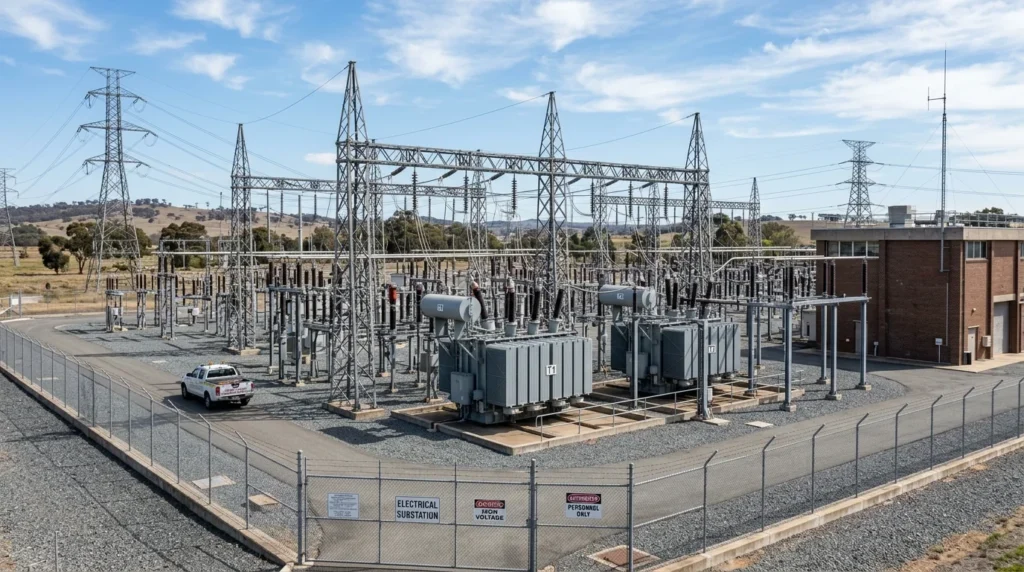

Imagine a large city suddenly losing electricity because the power from a generating station could not be properly controlled or distributed. Homes would go dark, factories would stop operating, hospitals would face emergencies, and communication systems could fail. Behind the stable electrical supply we use every day, an important system works silently in the background — the electrical substation.
Electrical substations are one of the most important parts of a power system. They help transmit electrical energy safely and efficiently from generating stations to homes, industries, and commercial areas. Without substations, long-distance electricity transmission would not be practical or reliable.
For electrical students, technicians, engineers, and beginners, understanding substations is essential because they are the backbone of modern electrical power networks. A strong knowledge of substation operation also helps in understanding power transmission, protection systems, voltage control, and electrical safety.
In this article, you will learn the electrical substation working principle, types, components, applications, advantages and disadvantages, troubleshooting methods, and future technologies in simple and easy English. The explanations are practical and designed to help junior learners understand real-world electrical systems confidently.
What is an Electrical Substation?
An electrical substation is a part of the power system where electrical voltage is transformed, controlled, protected, and distributed.
In simple words, a substation acts like a traffic control center for electricity. It manages the flow of electrical power between generating stations, transmission lines, and distribution systems.
Electrical substations mainly perform the following tasks:
- Increase voltage for transmission
- Reduce voltage for distribution
- Control power flow
- Protect electrical equipment
- Isolate faulty sections
For example, electricity generated at a power plant may be around 11 kV. A substation increases this voltage to 132 kV or higher for efficient long-distance transmission. Near residential areas, another substation reduces the voltage to safer levels for homes and businesses.
Electrical substations are installed in cities, industrial areas, power plants, and renewable energy systems.
Electrical Substation Working Principle
The electrical substation working principle is based on voltage transformation, switching, protection, and power distribution.
Simple Analogy
Think of a water supply system:
- Large pipelines carry water over long distances.
- Smaller pipes distribute water to homes safely.
Similarly:
- High voltage lines carry electrical power efficiently.
- Substations control and distribute the power safely.
Step-by-Step Working Principle
Power Arrives from the Generating Station
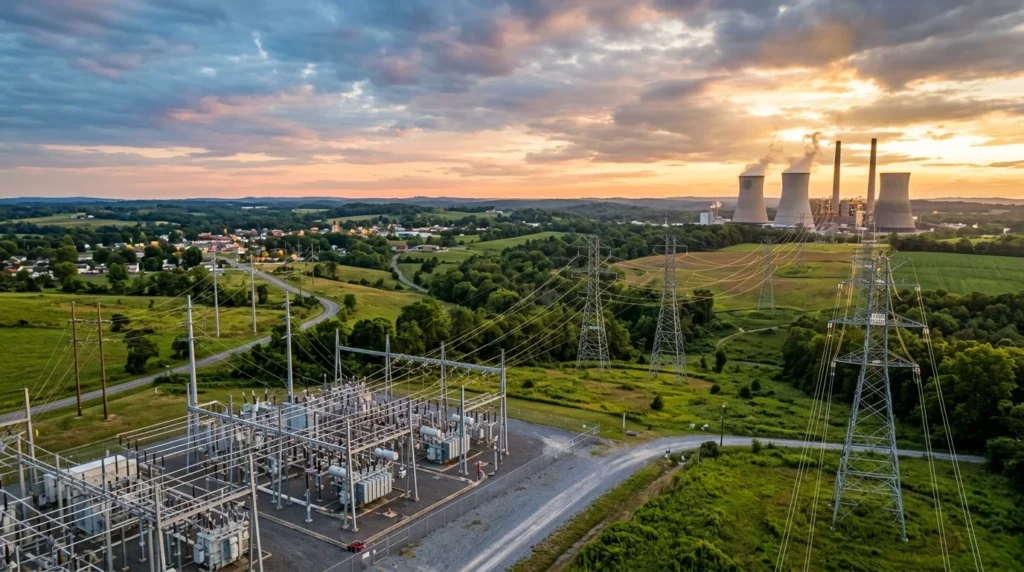
Power arrives from the generating station through high-voltage transmission lines. These lines carry electricity over long distances to substations, where the voltage is reduced to a safer level. From the substations, electricity travels through distribution lines and finally reaches homes, schools, offices, and factories. This system ensures that electrical power is delivered safely, efficiently, and continuously to consumers.
Electricity enters the substation through transmission lines.
Voltage Transformation Occurs
Power transformers increase or decrease voltage levels as required.
Transformer operation follows the voltage ratio principle:
\frac{V_1}{V_2}=\frac{N_1}{N_2}
Where:
- (V_1) = Primary voltage
- (V_2) = Secondary voltage
- (N_1) = Primary turns
- (N_2) = Secondary turns
Switching Operations are Performed
Circuit breakers and isolators control electrical connections.
Protection Systems Monitor Faults
Protective relays detect abnormal conditions such as:
- Short circuits
- Overloads
- Earth faults
Electricity is Distributed
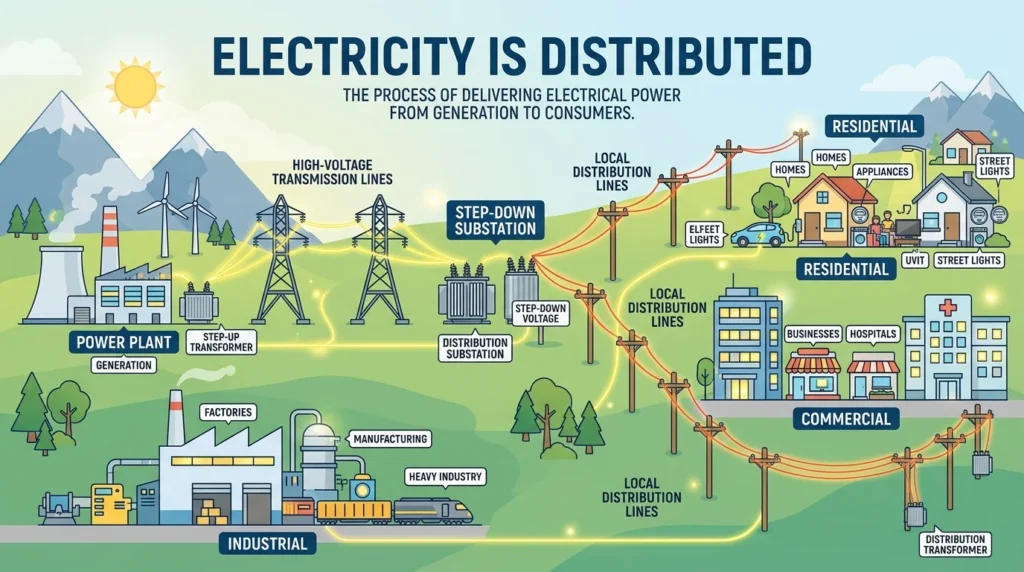
Electricity is distributed from power stations to homes, schools, offices, and factories through a network of transmission and distribution lines. First, electricity is generated at power plants and sent over high-voltage transmission lines to substations. At the substations, the voltage is reduced to a safer level. Finally, it is delivered through local distribution lines to consumers, where it is used to power lights, appliances, machines, and other electrical devices safely and efficiently.
The substation sends power to distribution feeders and consumers.
Key Functions of an Electrical Substation
- Voltage transformation
- System protection
- Power control
- Load distribution
- Fault isolation
Types / Classification of Electrical Substations
Electrical substations are classified based on function, construction, and application.
Step-Up Substation
A step-up substation increases voltage levels.
Working
- Installed near generating stations
- Uses step-up transformers
Applications
- Long-distance power transmission
Advantages
- Reduces transmission losses
Step-Down Substation
A step-down substation reduces voltage levels.
Working
- Installed near consumer areas
- Uses step-down transformers
Applications
- Residential supply
- Commercial distribution
Distribution Substation
A distribution substation is a facility where high-voltage electricity from transmission lines is reduced to a lower voltage before being supplied to consumers. It contains transformers, circuit breakers, and other equipment that help control and protect the electrical system. From the distribution substation, electricity is sent through local distribution lines to homes, schools, offices, and industries. It plays an important role in ensuring a safe, reliable, and efficient supply of electricity.
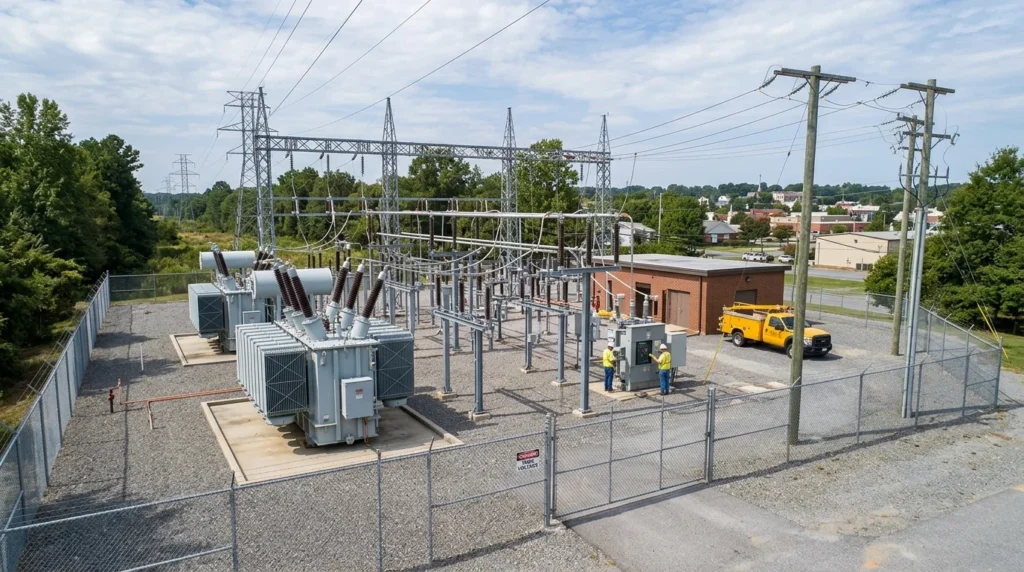
Distribution substations supply electricity directly to local areas.
Features
- Lower voltage operation
- Feeds homes and offices
Applications
- Urban and rural distribution systems
Transmission Substation
Transmission substations connect transmission networks.
Features
- Operates at very high voltage
- Controls bulk power transfer
Applications
- National grid systems
Indoor Substation
Indoor substations are installed inside buildings.
Advantages
- Better environmental protection
- Improved safety
Applications
- Industrial plants
- Commercial buildings
Outdoor Substation
Outdoor substations are installed in open areas.
Advantages
- Lower installation cost
- Easy expansion
Applications
- Large power systems
Gas Insulated Substation (GIS)
GIS substations use gas insulation instead of air.
Features
- Compact size
- High reliability
Applications
- Urban areas
- Space-limited locations
Main Components of an Electrical Substation
Understanding substation components is important for practical electrical engineering knowledge.
Power Transformer
The transformer is the heart of the substation.
Function
- Changes voltage levels
Circuit Breaker
Circuit breakers interrupt fault currents.
Function
- Protect equipment from damage
Isolator
An isolator disconnects equipment for maintenance.
Function
- Provides safe isolation
Busbar
A busbar is a metallic conductor that distributes power.
Function
- Transfers electrical energy within the substation
Protective Relay
Relays detect abnormal electrical conditions.
Function
- Sends trip signals to circuit breakers
Current Transformer (CT)
CTs reduce current for measurement and protection.
Function
- Provides safe current sensing
Potential Transformer (PT)
PTs reduce voltage for metering purposes.
Function
- Provides voltage measurement signals
Lightning Arrester
Protects equipment from high-voltage surges.
Function
- Diverts lightning energy safely to ground
Advantages
Understanding electrical substation advantages and disadvantages helps engineers evaluate system performance.
Advantages of Electrical Substations
- Efficient power transmission
- Reduced transmission losses
- Improved system protection
- Reliable electricity distribution
- Better voltage regulation
- Easier fault isolation
- Supports large electrical networks
- Enhances electrical safety
Real-World Benefits
Stable Power Supply
Substations help maintain continuous electricity for homes and industries.
Improved Grid Reliability
Faults can be isolated quickly without shutting down the entire system.
Better Energy Management
Load distribution becomes more efficient.
Disadvantages / Limitations
Despite their importance, substations also have limitations.
Disadvantages of Electrical Substations
- High installation cost
- Large land requirement
- Regular maintenance needed
- Risk of equipment failure
- Complex protection systems
- Noise from transformers
Practical Limitations
Environmental Concerns
Large substations may affect nearby areas due to electromagnetic fields and noise.
Skilled Workforce Requirement
Operation and maintenance require trained personnel.
Applications
Electrical substation applications are found throughout modern power systems.
Residential Applications
- Power distribution to homes
- Voltage regulation
Industrial Applications
- Factory power supply
- Motor control systems
- Heavy machinery operation
Commercial Applications
- Shopping malls
- Office buildings
- Hospitals
Renewable Energy Applications
- Solar power integration
- Wind farm connections
- Hydroelectric systems
Transportation Applications
- Railway electrification
- Metro systems
- Electric vehicle charging infrastructure
Electrical substation applications continue growing with expanding electrical infrastructure.
Comparison Section
Difference Between AIS and GIS Substations
| Feature | AIS (Air Insulated Substation) | GIS (Gas Insulated Substation) |
| Insulation Medium | Air | SF6 Gas |
| Space Requirement | Large | Compact |
| Installation Cost | Lower | Higher |
| Maintenance | Higher | Lower |
| Reliability | Moderate | Very high |
| Environmental Protection | Lower | Better |
| Applications | Rural/open areas | Urban areas |
| Expansion | Easier | More complex |
Understanding the difference between AIS and GIS substations helps engineers choose suitable systems for different environments.
Selection Guide
Choosing the right electrical substation depends on several engineering factors.
Voltage Level
Select based on transmission or distribution requirements.
Examples:
- 11 kV distribution
- 132 kV transmission
Load Requirement
Calculate expected power demand carefully.
Available Space
- GIS for limited space
- AIS for large open areas
Environmental Conditions
Consider:
- Temperature
- Humidity
- Pollution
- Lightning risk
Budget
Balance installation cost with maintenance and reliability.
Tips for Beginners
- Understand single-line diagrams
- Learn transformer basics
- Study protection systems
- Follow electrical safety rules
- Practice reading substation layouts
Common Problems & Solutions
Transformer Overheating
Causes
- Overloading
- Poor cooling
Solution
- Reduce load
- Improve cooling systems
Circuit Breaker Failure
Causes
- Mechanical wear
- Fault current damage
Solution
- Regular inspection
- Replace damaged components
Busbar Faults
Causes
- Insulation failure
- Loose connections
Solution
- Tighten joints
- Improve insulation
Relay Malfunction
Causes
- Incorrect settings
- Electrical interference
Solution
- Calibrate relays properly
Voltage Fluctuation
Causes
- Sudden load changes
- Transformer tap issues
Solution
- Use automatic voltage regulation
Future Trends
Electrical substations are rapidly evolving with modern technology.
Smart Substations
Modern substations now use:
- Digital communication
- Intelligent monitoring
- Automated control systems
Benefits
- Faster fault detection
- Remote operation
- Better reliability
IoT Integration
Sensors continuously monitor:
- Temperature
- Voltage
- Equipment condition
This supports predictive maintenance.
Renewable Energy Integration
Future substations will handle:
- Solar power systems
- Wind energy networks
- Battery storage systems
Eco-Friendly Technologies
New substations aim to reduce environmental impact by:
- Using biodegradable transformer oils
- Reducing SF6 gas usage
- Improving energy efficiency
AI-Based Grid Management
Artificial intelligence is helping utilities optimize:
- Load management
- Fault prediction
- Power quality control
The future of electrical substation applications is closely linked with smart grid development and sustainable power systems.
Conclusion
Electrical substations are one of the most important parts of modern electrical power systems. They help transform voltage levels, control power flow, protect equipment, and distribute electricity safely and efficiently to consumers. Without substations, reliable electrical transmission and distribution would not be possible.
This article explained the electrical substation working principle, types, components, applications, advantages and disadvantages, troubleshooting methods, and future developments in simple and practical language. You also learned the difference between AIS and GIS substations and how engineers select suitable systems for different environments.
For electrical students, technicians, engineers, and beginners, understanding substations is essential because they form the foundation of power transmission and distribution networks. As smart grids and renewable energy systems continue expanding, electrical substations will become even more advanced and important in future electrical engineering.


Pingback: Types of Electrical Substations: Full Classification