
Imagine a large city where thousands of homes, schools, hospitals, and factories need electricity every second. Electricity is generated at power plants and transmitted over long distances at very high voltages to reduce power losses. However, this high-voltage electricity cannot be supplied directly to homes or industries because it would be dangerous and would damage electrical equipment.
This is where a Step-Down Grid Station plays a vital role. It safely reduces the high transmission voltage to lower voltage levels that are suitable for distribution and practical use. Without step-down grid stations, the modern power system would not be able to deliver electricity safely and efficiently.
Whether you are an electrical engineering student, technician, engineer, or beginner, understanding how a step-down grid station works is essential. In this article, you will learn the Step-Down Grid Station working principle, its types, major components, advantages, disadvantages, applications, troubleshooting methods, and future developments in simple and easy English.
What is a Step-Down Grid Station (2026)
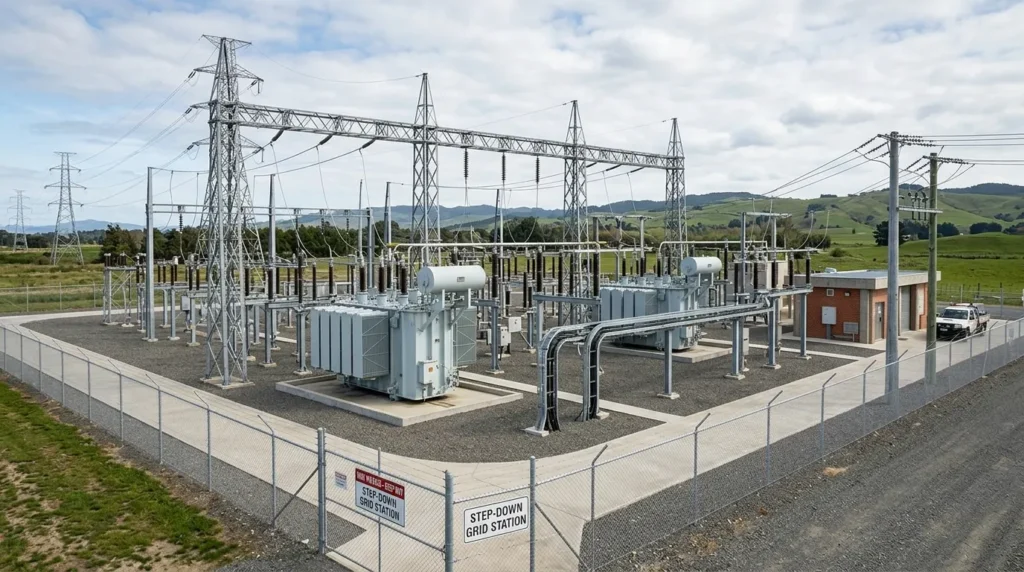
A Step-Down Grid Station is an electrical substation that receives electricity at a high transmission voltage and reduces it to a lower voltage before supplying it to distribution networks or large industrial consumers.
The main purpose of a step-down grid station is to make electrical power safe and suitable for homes, commercial buildings, industries, and public facilities.
Simply put, it acts like a pressure control valve in a water supply system. Just as high water pressure is reduced before entering homes, electrical voltage is reduced before reaching consumers.
Practical Example
Electricity may leave a power station at 220 kV and travel through transmission lines. At a step-down grid station, the voltage may be reduced to 132 kV, 66 kV, 33 kV, or 11 kV, depending on the distribution requirements. Finally, distribution transformers reduce it further to 400 V or 230 V for homes and businesses.
Step-Down Grid Station Working Principle (2026)
The working principle of a Step-Down Grid Station is based on the principle of electromagnetic induction, which enables a power transformer to convert high transmission voltage into a lower distribution voltage without changing the frequency of the electrical supply. The process ensures that electrical energy is transmitted efficiently over long distances at high voltage and then delivered safely to consumers at lower voltage levels suitable for residential, commercial, and industrial applications.
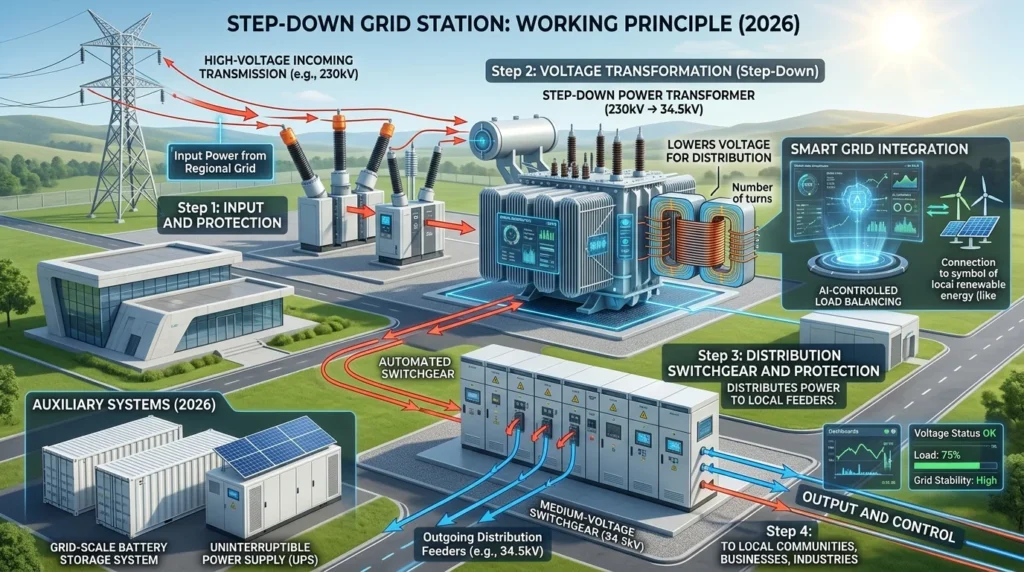
According to the principle of power transmission, electrical power remains nearly constant during voltage transformation (ignoring small system losses). Therefore, when the transformer reduces the voltage, the current increases proportionally. This allows electricity to be distributed safely while maintaining the required power for consumers.
The entire operation of a step-down grid station involves voltage transformation, protection, switching, monitoring, and controlled distribution of electrical energy. Each component works together to ensure reliable, efficient, and uninterrupted power delivery.
Principle of Electromagnetic Induction
A power transformer operates on Faraday’s Law of Electromagnetic Induction. When alternating current (AC) flows through the primary winding of the transformer, it produces a changing magnetic field inside the transformer core. This varying magnetic flux induces a voltage in the secondary winding.
If the secondary winding has fewer turns than the primary winding, the output voltage is reduced while the output current increases proportionally. This process is known as step-down voltage transformation.
Key Characteristics:
- Voltage decreases at the secondary side.
- Current increases proportionally.
- Frequency remains unchanged.
- Power remains nearly constant except for minor efficiency losses.
Step-by-Step Working Process
The operation of a step-down grid station follows a systematic sequence that ensures safe voltage transformation and reliable power distribution.
High-Voltage Power Reception
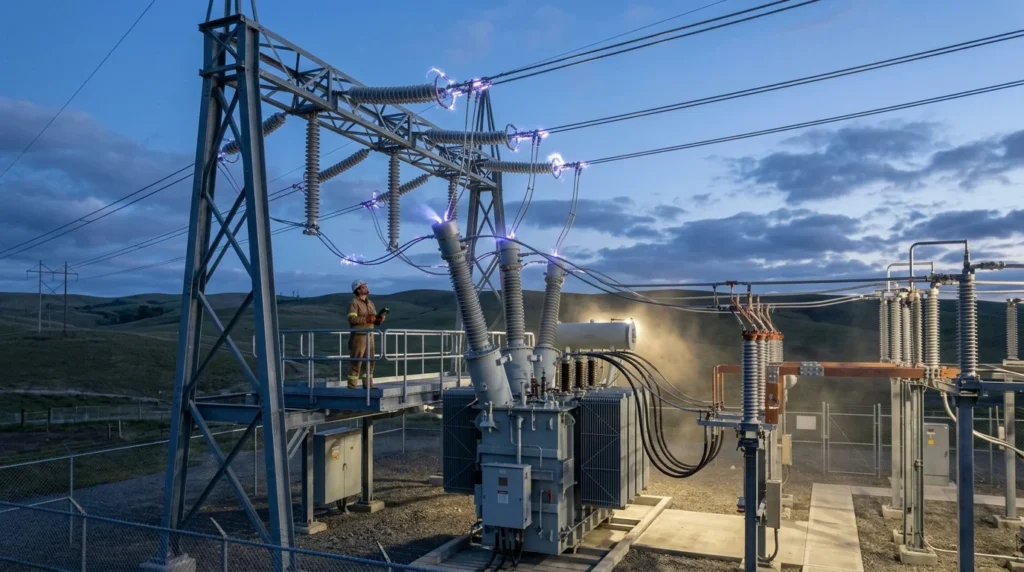
High-voltage power reception is the first stage in the operation of a step-down grid station. Electrical energy generated at power plants is transmitted over long distances through high-voltage transmission lines, typically operating at voltage levels such as 500 kV, 220 kV, or 132 kV. Using high transmission voltages significantly reduces current flow, minimizes transmission losses, and improves the overall efficiency of the power system. When the electricity reaches the grid station, it enters through incoming transmission lines where it is received by the station’s switching equipment. Before the power is supplied to the transformer, it passes through protective devices such as lightning arresters, circuit breakers, isolators, and measuring instruments to ensure safe and reliable operation. This stage serves as the entry point of the substation, providing a continuous supply of bulk electrical power for further voltage transformation and distribution to industrial, commercial, and residential consumers.
Purpose:
- Receive bulk electrical power.
- Enable efficient long-distance transmission.
- Minimize transmission losses.
Surge Protection
Before entering the main equipment, the incoming electrical supply passes through lightning arresters (surge arresters). These devices protect transformers and switchgear from lightning strikes and switching surges by safely diverting excessive voltage to the ground.
Purpose:
- Protect electrical equipment from overvoltage.
- Improve equipment lifespan.
- Reduce the risk of insulation failure.
Switching and Protection
The incoming electrical supply is controlled by circuit breakers and isolators.
- Circuit breakers automatically disconnect the circuit during overloads, short circuits, or earth faults.
- Isolators provide safe electrical isolation during maintenance after the circuit has been de-energized.
Purpose:
- Ensure safe operation.
- Protect equipment from electrical faults.
- Facilitate maintenance activities.
Measurement and Monitoring
Current Transformers (CTs) and Voltage Transformers (VTs/PTs) continuously measure electrical parameters such as current and voltage. These measurements are supplied to protection relays, metering equipment, and monitoring systems.
Purpose:
- Monitor system performance.
- Provide accurate electrical measurements.
- Support protection and control systems.
Voltage Transformation
The power transformer, which is the heart of the step-down grid station, reduces the incoming high transmission voltage to the required distribution voltage using electromagnetic induction.
For example:
- 220 kV → 132 kV
- 132 kV → 66 kV
- 66 kV → 11 kV
- 11 kV → 400/230 V
Purpose:
- Convert high voltage into safe distribution voltage.
- Improve distribution efficiency.
- Supply electricity suitable for consumers.
Protection Relay Operation
Modern protection relays continuously analyze electrical conditions such as current, voltage, frequency, impedance, and fault levels. If abnormal conditions are detected, the relay immediately sends a trip command to the circuit breaker.
Purpose:
- Detect electrical faults rapidly.
- Prevent equipment damage.
- Maintain system reliability.
Distribution Through Outgoing Feeders
After voltage transformation, electrical power flows through busbars and outgoing feeders, which distribute electricity to different regions, industries, commercial facilities, and residential areas.
Purpose:
- Supply electricity to multiple distribution circuits.
- Maintain balanced electrical loads.
- Improve distribution flexibility.
Delivery to End Consumers
Finally, electricity is transmitted through local distribution networks to homes, offices, hospitals, schools, shopping centers, factories, and other consumers. Additional distribution transformers further reduce the voltage where necessary before final consumption.
Purpose:
- Provide safe and reliable electricity.
- Meet residential, commercial, and industrial demand.
- Ensure continuous power supply.
Simplified Working Flow
The overall working process of a step-down grid station can be summarized as follows:
Power Generation → High-Voltage Transmission Lines → Surge Arresters → Circuit Breakers & Isolators → CTs & VTs → Power Transformer (Voltage Reduction) → Protection Relays → Busbars → Outgoing Feeders → Distribution Network → Consumers
This sequence ensures efficient voltage transformation, effective protection, and reliable electricity distribution.
Easy Analogy
A step-down grid station can be understood through the example of a water supply system.
Imagine a tall water tank that stores water at very high pressure. The large pipeline carrying water from the tank represents the high-voltage transmission line, which transports electricity efficiently over long distances.
Before the water reaches homes, it passes through a pressure regulator that reduces the water pressure to a safe level. Similarly, the power transformer reduces high transmission voltage to a lower and safer distribution voltage.
Finally, smaller water pipes distribute water safely to houses and buildings, just as the distribution network delivers electricity to residential, commercial, and industrial consumers.
Although the pressure is reduced, every home still receives the required amount of water. Likewise, although the transformer lowers the voltage, electrical power is delivered safely and efficiently to end users.
Types of Step-Down Grid Stations (2026)
Step-down grid stations are designed in different configurations to meet the diverse requirements of electrical power systems. The selection of a particular type depends on several factors, including operating voltage, load demand, available land, environmental conditions, installation cost, maintenance requirements, and future expansion plans. Each type of step-down grid station has its own advantages, limitations, and areas of application. Understanding these types enables engineers to select the most suitable substation for efficient and reliable power distribution.
Indoor Step-Down Grid Station
An Indoor Step-Down Grid Station is installed inside a building or enclosed structure to protect electrical equipment from environmental conditions such as rain, dust, pollution, humidity, and extreme temperatures. These substations are commonly used in densely populated urban areas where land availability is limited and equipment protection is a priority.
Key Features:
- Installed inside specially designed buildings.
- Provides excellent protection from weather and environmental pollution.
- Improves operational safety and equipment security.
- Suitable for urban and commercial areas.
- Requires less exposure to external environmental conditions.
Advantages:
- Better equipment protection.
- Increased operational reliability.
- Reduced environmental impact.
- Lower risk of accidental contact.
- Easier inspection and maintenance in controlled conditions.
Limitations:
- Higher construction and installation cost.
- Requires adequate building ventilation and cooling.
- Limited space for future expansion.
Typical Applications:
- Metropolitan cities
- Commercial complexes
- Hospitals
- Shopping malls
- Underground utility systems
Outdoor Step-Down Grid Station
The Outdoor Step-Down Grid Station is the most widely used type of substation. Electrical equipment is installed in open areas and designed to withstand varying weather conditions. These substations are suitable for medium- and high-voltage power systems.
Key Features:
- Installed in open outdoor environments.
- Suitable for high-voltage transmission and distribution.
- Easy access for maintenance and equipment replacement.
- Supports future system expansion.
Advantages:
- Lower construction cost.
- Simple installation process.
- Easy addition of transformers and feeders.
- Better cooling due to natural air circulation.
Limitations:
- Equipment is exposed to weather conditions.
- Requires regular inspection and maintenance.
- Increased risk of contamination from dust and pollution.
Typical Applications:
- Transmission substations
- Utility distribution networks
- Industrial power systems
- Rural and suburban electrical networks
Pole-Mounted Step-Down Grid Station
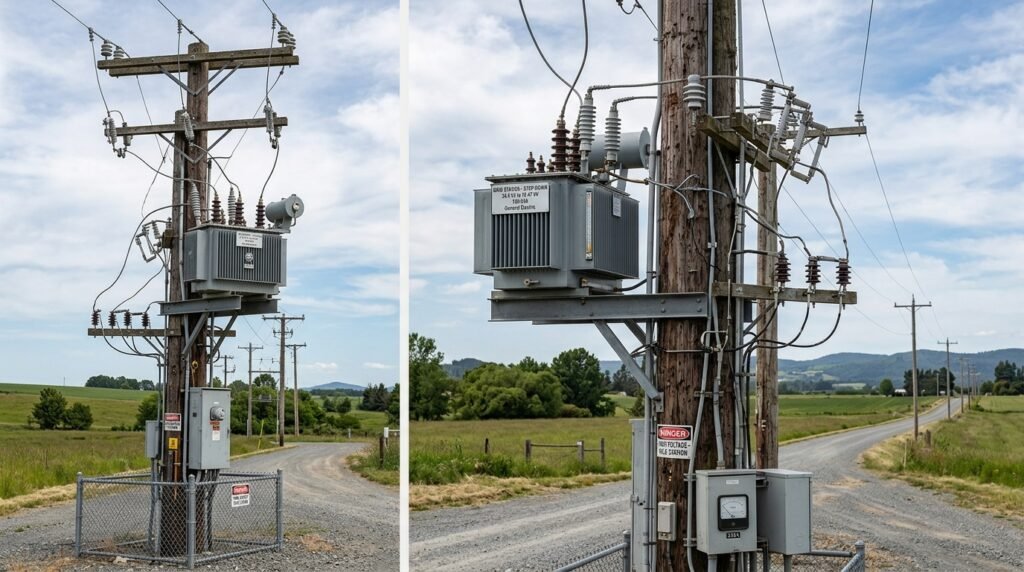
A Pole-Mounted Step-Down Grid Station is a compact distribution substation installed on reinforced utility poles instead of being constructed on the ground. It is primarily designed for supplying electricity to rural areas, villages, agricultural fields, and small residential communities where the electrical load demand is relatively low. The substation typically consists of a distribution transformer, lightning arresters, drop-out fuses, isolating switches, and other protective equipment mounted on the pole. High-voltage electricity received from the distribution feeder is stepped down to a lower voltage suitable for local consumers. Pole-mounted substations are widely preferred because they require very little land, have a low installation cost, and can be installed quickly compared to conventional substations. Although they are economical and easy to maintain, they are generally suitable only for light-load applications and are not recommended for supplying large industrial or commercial facilities with high power demands.
Key Features:
- Mounted on reinforced utility poles.
- Compact and economical design.
- Suitable for low-capacity distribution.
- Requires minimal land area.
Advantages:
- Low installation and maintenance cost.
- Quick installation.
- Ideal for remote locations.
- Simple construction.
Limitations:
- Limited transformer capacity.
- Not suitable for heavy industrial loads.
- Maintenance at height requires additional safety measures.
Typical Applications:
- Villages
- Agricultural areas
- Small residential communities
- Rural electrification projects
Gas-Insulated Step-Down Grid Station (GIS)
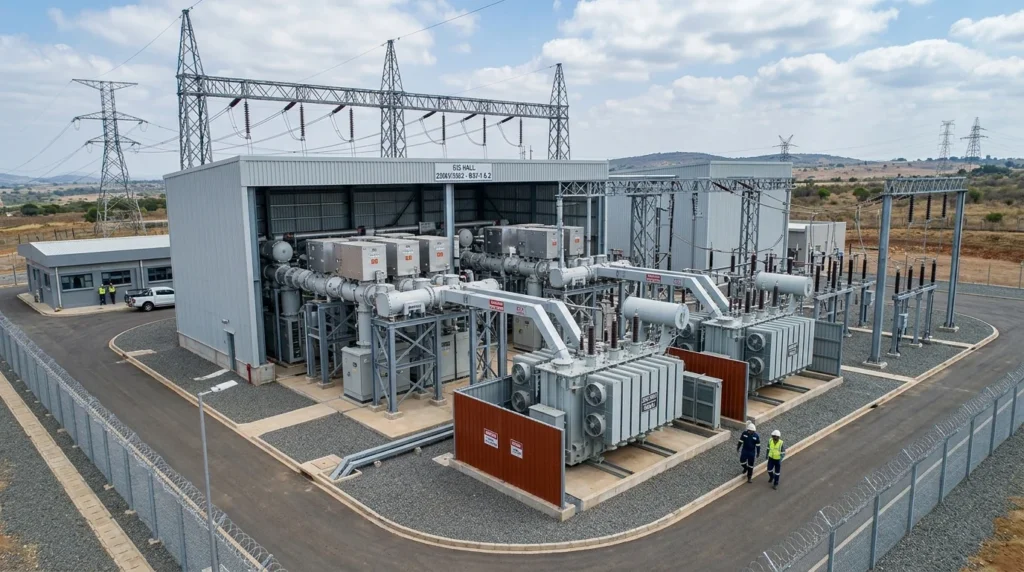
A Gas-Insulated Step-Down Grid Station (GIS) is a modern type of substation in which major electrical components such as circuit breakers, disconnectors, busbars, current transformers, and voltage transformers are enclosed within sealed metal compartments filled with sulfur hexafluoride (SF₆) gas. SF₆ gas has excellent insulating and arc-quenching properties, allowing the equipment to be installed much closer together than in conventional air-insulated substations. As a result, GIS substations require significantly less land and are ideal for densely populated urban areas, industrial zones, underground installations, and locations where space is limited. In addition to their compact design, GIS substations provide high operational reliability, excellent protection against dust, moisture, pollution, and harsh weather conditions, while requiring relatively low maintenance. Although the initial installation cost of a GIS is higher than that of an Air-Insulated Substation (AIS), its superior reliability, long service life, enhanced safety, and efficient use of space make it an excellent choice for modern electrical power systems.
Key Features:
- Uses SF₆ gas for electrical insulation.
- Compact and enclosed design.
- Highly reliable operation.
- Suitable for high-voltage applications.
Advantages:
- Requires significantly less land.
- Excellent protection against dust, moisture, and pollution.
- High operational reliability.
- Minimal maintenance requirements.
- Long service life.
Limitations:
- High initial investment.
- Specialized maintenance procedures.
- SF₆ gas requires careful environmental handling.
Typical Applications:
- Urban cities
- Underground substations
- Airports
- Industrial facilities
- Offshore installations
Air-Insulated Step-Down Grid Station (AIS)
An Air-Insulated Step-Down Grid Station (AIS) uses atmospheric air as the insulating medium between energized electrical components. AIS is one of the most commonly used substation types because of its simple design and lower equipment cost.
Key Features:
- Uses air for insulation.
- Open and accessible equipment layout.
- Simple construction and operation.
- Suitable for medium- and high-voltage systems.
Advantages:
- Lower equipment cost.
- Easier inspection and maintenance.
- Simple installation.
- Well-established technology.
Limitations:
- Requires a large installation area.
- Equipment is exposed to weather and pollution.
- Higher maintenance requirements than GIS.
Typical Applications:
- Utility substations
- Industrial power systems
- Regional distribution networks
- Areas where sufficient land is available
Main Components of a Step-Down Grid Station (2026)
A step-down grid station consists of several interconnected electrical components that work together to ensure the safe, reliable, and efficient transmission and distribution of electrical power. Each component performs a specific function in voltage transformation, system protection, monitoring, switching, and fault isolation. The proper selection, installation, and maintenance of these components are essential for maintaining grid stability, minimizing power interruptions, and ensuring the long-term performance of the electrical network.
Power Transformer
The power transformer is the most important component of a step-down grid station and is often referred to as the heart of the substation. Its primary function is to reduce high transmission voltage to a lower distribution voltage suitable for industrial, commercial, and residential consumers.
Functions:
- Reduces high transmission voltage to distribution voltage.
- Supplies stable and reliable electrical power.
- Improves transmission efficiency by minimizing power losses.
- Maintains voltage levels according to system requirements.
- Supports continuous operation of the distribution network.
Importance:
- Essential for voltage transformation.
- Increases overall power system efficiency.
- Ensures safe electricity delivery to end users.
Circuit Breaker (CB)
A circuit breaker is a protective switching device that automatically interrupts the flow of electrical current whenever abnormal operating conditions such as short circuits, overloads, or earth faults occur.
Functions:
- Disconnects faulty sections automatically.
- Protects transformers, cables, and switchgear.
- Prevents equipment damage during electrical faults.
- Enables safe restoration of the power system.
- Supports automatic protection coordination.
Importance:
- Improves system reliability.
- Minimizes outage duration.
- Enhances electrical safety.
Isolator (Disconnect Switch)
An isolator is a mechanical switching device used to disconnect electrical equipment from the power system during maintenance. Unlike a circuit breaker, it is operated only when there is no current flowing through the circuit.
Functions:
- Provides complete electrical isolation.
- Ensures safe maintenance conditions.
- Separates faulty equipment from healthy sections.
- Improves operational safety.
Importance:
- Protects maintenance personnel.
- Prevents accidental energization.
- Simplifies maintenance procedures.
Busbar
A busbar is a metallic conductor that collects electrical power from incoming feeders and distributes it to outgoing feeders within the substation.
Functions:
- Connects incoming and outgoing transmission lines.
- Distributes electrical power efficiently.
- Supports multiple feeder connections.
- Provides operational flexibility.
Importance:
- Simplifies substation layout.
- Improves system reliability.
- Facilitates future expansion.
Current Transformer (CT)
A Current Transformer (CT) safely converts high current into a lower measurable value that can be used by meters and protection relays.
Functions:
- Measures high electrical current safely.
- Supplies current signals to protection relays.
- Provides input for energy metering.
- Supports fault detection systems.
Importance:
- Enables accurate current measurement.
- Protects monitoring equipment.
- Improves protection system performance.
Voltage Transformer (VT/PT)
A Voltage Transformer (VT) or Potential Transformer (PT) reduces high system voltage to a safe level for measurement and protection purposes.
Functions:
- Measures system voltage accurately.
- Supplies voltage signals to protective relays.
- Supports voltage monitoring equipment.
- Assists in synchronization and control operations.
Importance:
- Ensures accurate voltage measurement.
- Improves protection reliability.
- Supports safe system operation.
Protection Relay
A protection relay continuously monitors electrical parameters such as current, voltage, frequency, and impedance. When abnormal conditions are detected, it sends a trip signal to the circuit breaker to isolate the fault.
Functions:
- Detects electrical faults quickly.
- Initiates automatic circuit breaker tripping.
- Protects transformers and other equipment.
- Monitors abnormal operating conditions.
- Coordinates with other protection devices.
Importance:
- Reduces equipment damage.
- Improves power system stability.
- Enhances operational safety.
Lightning Arrester
A lightning arrester protects substation equipment from high-voltage surges caused by lightning strikes and switching operations by safely diverting surge currents to the ground.
Functions:
- Protects electrical equipment from overvoltage.
- Diverts surge current safely to earth.
- Prevents insulation breakdown.
- Improves system reliability during storms.
Importance:
- Extends equipment lifespan.
- Minimizes outage risks.
- Enhances substation safety.
Earthing (Grounding) System
The earthing system provides a low-resistance path for fault current to flow safely into the ground. It protects both electrical equipment and personnel from dangerous touch and step voltages.
Functions:
- Safely dissipates fault current.
- Protects transformers and switchgear.
- Prevents electric shock hazards.
- Stabilizes system voltage during faults.
- Supports effective operation of protection devices.
Importance:
- Ensures personnel safety.
- Protects valuable equipment.
- Meets electrical safety standards.
Control and Monitoring System
Modern step-down grid stations include advanced control and monitoring systems that supervise substation operations in real time. These systems often integrate SCADA (Supervisory Control and Data Acquisition) technology for remote monitoring and control.
Functions:
- Monitors equipment status continuously.
- Records operational data and alarms.
- Enables remote control of substation equipment.
- Assists in fault diagnosis and preventive maintenance.
Importance:
- Improves operational efficiency.
- Reduces response time during faults.
- Supports smart grid automation.
Step-Down Grid Station Advantages and Limitations (2026)
Step-down grid stations are one of the most important components of modern electrical power systems. They safely reduce high transmission voltages to lower distribution voltages, ensuring that electricity can be delivered efficiently to residential, commercial, and industrial consumers. In addition to improving power quality and system reliability, these substations enhance electrical safety and support the continuous operation of the power grid. However, despite their numerous advantages, step-down grid stations also have certain limitations related to installation costs, maintenance, and operational complexity. Understanding both the benefits and limitations is essential for engineers, utility companies, and power system planners when designing, operating, and expanding electrical networks.
Advantages of Step-Down Grid Stations
Step-down grid stations provide several technical, operational, and economic benefits that contribute to the efficient operation of modern power systems.
Safe Reduction of Transmission Voltage
The primary function of a step-down grid station is to reduce high transmission voltages to lower and safer distribution voltages. This process allows electricity to be supplied safely to homes, commercial buildings, and industries while protecting electrical equipment and consumers from excessive voltage.
Efficient Power Distribution
By converting transmission voltage into distribution voltage, step-down grid stations enable efficient delivery of electricity over local distribution networks. Proper voltage transformation minimizes power losses and improves the overall efficiency of the electrical system.
Improved System Reliability
Modern substations include advanced protection, monitoring, and automation systems that improve grid reliability. These systems quickly detect faults and isolate affected sections, helping maintain uninterrupted electricity supply to unaffected areas.
Protection of Expensive Equipment
Step-down grid stations use protective relays, circuit breakers, surge arresters, and grounding systems to safeguard transformers, switchgear, transmission lines, and other valuable electrical equipment against overloads, short circuits, and lightning surges.
Reduction of Transmission and Distribution Losses
Efficient voltage transformation and well-designed distribution systems reduce electrical losses during power transmission and distribution. This improves energy efficiency and lowers overall operating costs.
Support for Industrial Power Supply
Large industries require stable and continuous electrical power for manufacturing processes and heavy machinery. Step-down grid stations provide reliable voltage levels that improve industrial productivity and reduce equipment downtime.
Simplified Maintenance Operations
Properly designed substations include isolation switches, monitoring systems, and maintenance facilities that allow equipment inspection and servicing without significantly disrupting the electrical network.
Improved Fault Isolation
Advanced protection systems can quickly identify and isolate faulty sections of the power system. This minimizes the impact of electrical faults, reduces outage duration, and improves overall grid stability.
Effective Voltage Regulation
Many step-down transformers are equipped with tap changers that help maintain constant output voltage despite variations in system load. Stable voltage improves the performance and lifespan of connected electrical equipment.
Continuous and Reliable Power Supply
Step-down grid stations support uninterrupted electricity delivery through redundant equipment, automatic protection systems, and backup operational arrangements, ensuring dependable service for consumers.
Compatibility with Smart Grid Technologies
Modern substations support digital communication, SCADA systems, Intelligent Electronic Devices (IEDs), and IoT-based monitoring, enabling remote operation, predictive maintenance, and improved operational efficiency.
Step-Down Grid Station Limitations (2026)
Although step-down grid stations provide numerous advantages, they also present certain technical and economic challenges that should be considered during planning, installation, and operation.
High Installation Cost
Constructing a step-down grid station requires a significant initial investment. Costs include transformers, switchgear, protection systems, civil works, transmission connections, land acquisition, and installation of control and communication equipment.
Regular Maintenance Requirements
Transformers, circuit breakers, relays, batteries, cooling systems, and other electrical equipment require scheduled inspection, testing, and preventive maintenance to ensure reliable operation and prevent unexpected failures.
Large Land Requirement (AIS)
Air Insulated Substations (AIS) require substantial land area because sufficient spacing must be maintained between energized components for electrical safety. This can increase construction costs, particularly in densely populated urban areas.
Transformer Oil Monitoring
Oil-filled transformers require regular monitoring of oil level, oil quality, moisture content, insulation condition, and dissolved gas analysis (DGA) to maintain safe and efficient operation.
Equipment Failures May Interrupt Power Supply
Failure of major equipment such as transformers, circuit breakers, or protection systems can cause temporary power interruptions until repairs or replacements are completed.
Requirement for Skilled Personnel
The operation, maintenance, testing, and troubleshooting of modern substations require trained engineers and qualified technical staff. Inadequate expertise may increase operational risks and maintenance costs.
Increased Cost of Protection Systems
Modern numerical relays, communication systems, automation equipment, and cybersecurity infrastructure improve reliability but also increase the overall capital and maintenance costs of the grid station.
Environmental and Weather Effects
Outdoor substations are exposed to rain, dust, humidity, extreme temperatures, pollution, lightning, and storms. These environmental conditions may affect equipment performance and increase maintenance requirements.
Expansion Challenges
Expanding an existing grid station may require additional land, upgraded transformers, new feeders, and modifications to protection and control systems, making future upgrades complex and expensive.
Cybersecurity Risks
As substations become increasingly digital and connected through SCADA and smart grid technologies, they face cybersecurity threats that require continuous monitoring, secure communication protocols, and regular software updates.
Step-Down Grid Station Applications (2026)
Step-down grid stations are an essential part of modern electrical power systems. Their primary function is to reduce high transmission voltages to lower distribution voltages, allowing electricity to be delivered safely and efficiently to various types of consumers. These grid stations support reliable power distribution across residential, commercial, industrial, and utility sectors while also facilitating the integration of renewable energy sources. As power demand continues to grow, step-down grid stations play an increasingly important role in maintaining grid stability, improving energy efficiency, and ensuring an uninterrupted electricity supply.
Residential Applications
Step-down grid stations provide the electrical power required for homes and residential communities. They convert high-voltage electricity into safe distribution voltages that can be supplied to households through local distribution networks.
Major Residential Applications:
- Home electricity supply
- Apartment buildings
- Housing societies
- Residential colonies
- Street lighting systems
- Community facilities and public services
Benefits:
- Reliable and continuous power supply
- Improved voltage stability
- Enhanced electrical safety
- Reduced transmission losses
Commercial Applications
Commercial buildings require a stable and uninterrupted electricity supply to support business operations, lighting, air conditioning, elevators, communication systems, and security equipment. Step-down grid stations ensure that commercial consumers receive quality electrical power.
Major Commercial Applications:
- Shopping malls
- Office complexes
- Hospitals and healthcare facilities
- Educational institutions
- Hotels and restaurants
- Airports and transportation terminals
Benefits:
- Continuous business operations
- Improved power quality
- Reduced risk of equipment failure
- Reliable operation of critical services
Industrial Applications
Industries consume large amounts of electrical energy to operate heavy machinery, production lines, and automated manufacturing systems. Step-down grid stations provide stable voltage levels and high-capacity power required for industrial operations.
Major Industrial Applications:
- Manufacturing plants
- Cement factories
- Steel industries
- Textile mills
- Chemical processing plants
- Food and beverage industries
- Oil and gas facilities
- Mining operations
Benefits:
- Stable voltage for heavy equipment
- Increased production efficiency
- Reduced equipment downtime
- Enhanced operational reliability
Utility and Distribution Networks
Electric utility companies rely on step-down grid stations to distribute electricity from high-voltage transmission systems to regional and local distribution networks. These substations serve as the connection between transmission infrastructure and end users.
Major Utility Applications:
- Regional distribution systems
- Urban electricity supply
- Rural electrification projects
- Municipal distribution networks
- Public infrastructure
- Emergency power distribution
Benefits:
- Efficient power distribution
- Reduced transmission losses
- Improved grid reliability
- Better load management
Renewable Energy Integration
The increasing use of renewable energy sources requires advanced grid infrastructure. Step-down grid stations enable efficient integration of renewable energy into the electrical grid while maintaining voltage stability and system reliability.
Major Renewable Energy Applications:
- Solar photovoltaic (PV) farms
- Wind power plants
- Hydroelectric generation systems
- Battery Energy Storage Systems (BESS)
- Hybrid renewable energy projects
- Microgrid systems
Benefits:
- Efficient renewable energy integration
- Improved grid stability
- Better voltage regulation
- Support for sustainable energy development
Public Infrastructure Applications
Government and public infrastructure projects require dependable electrical power for continuous operation. Step-down grid stations provide reliable electricity to support essential public services.
Major Public Infrastructure Applications:
- Railway stations
- Metro systems
- Water treatment plants
- Wastewater treatment facilities
- Government offices
- Communication and broadcasting centers
Benefits:
- Reliable operation of public services
- Improved infrastructure efficiency
- Enhanced public safety
- Continuous emergency service support
Smart Grid and Digital Infrastructure
Modern electrical grids increasingly rely on automation and digital technologies. Step-down grid stations equipped with smart monitoring and control systems improve operational efficiency and support intelligent power management.
Major Smart Grid Applications:
- SCADA-based monitoring systems
- Smart distribution networks
- Intelligent Electronic Devices (IEDs)
- IoT-enabled monitoring
- Predictive maintenance systems
- Automated fault detection and isolation
Benefits:
- Real-time system monitoring
- Faster fault identification
- Reduced maintenance costs
- Improved operational efficiency
Comparison Between Step-Down Grid Station and Distribution Substation (2026)
| Feature | Step-Down Grid Station | Distribution Substation |
| Main Purpose | Reduces transmission voltage | Supplies local consumers |
| Voltage Level | High to medium voltage | Medium to low voltage |
| Transformer Rating | Large | Smaller |
| Service Area | Large region | Local neighborhood |
| Consumers | Utilities and industries | Homes and businesses |
| Installation Cost | Higher | Lower |
| Equipment Size | Larger | Smaller |
Understanding the difference between Step-Down Grid Station and Distribution Substation helps engineers design reliable electrical distribution systems.
Selection Guide (2026)
Selecting the appropriate step-down grid station is one of the most important decisions in power system planning and design. A properly designed and selected grid station ensures reliable electricity distribution, improves system efficiency, reduces operational costs, and provides flexibility for future expansion. Engineers must evaluate several technical, economic, environmental, and operational factors before selecting the most suitable type and configuration of a step-down grid station.
Voltage Level Selection
The first consideration is the operating voltage level of the electrical network. The transformer and associated equipment should be selected according to the transmission voltage and the required distribution voltage. Choosing the correct voltage ratio ensures efficient power transfer, minimizes transmission losses, and maintains stable voltage levels for consumers.
Key Considerations:
- Match transformer ratings with the transmission network.
- Select suitable voltage ratios (e.g., 220/132 kV, 132/66 kV, or 66/11 kV).
- Ensure compliance with national grid standards and utility requirements.
- Consider future voltage upgrades where applicable.
Load Demand Assessment
Accurate estimation of electrical load is essential for selecting transformer capacity and substation equipment. Both current electricity demand and future load growth should be considered to avoid transformer overloading and costly upgrades.
Key Considerations:
- Analyze present peak and average load demand.
- Forecast future residential, commercial, and industrial growth.
- Include reserve capacity for emergency situations.
- Avoid oversizing, which increases installation costs and reduces efficiency.
Site Location and Environmental Conditions
The location of the grid station significantly affects construction cost, equipment selection, safety, and long-term operation. Environmental conditions such as temperature, humidity, pollution, flooding, and available land should be carefully evaluated.
Key Considerations:
- Choose between Indoor, Outdoor, AIS (Air Insulated Substation), or GIS (Gas Insulated Substation) based on available space.
- Consider accessibility for maintenance and emergency services.
- Ensure compliance with environmental and safety regulations.
- Select equipment suitable for local weather conditions.
Protection and Safety Requirements
An effective protection system safeguards transformers, switchgear, transmission lines, and personnel from electrical faults. Modern substations require fast, accurate, and coordinated protection systems to ensure uninterrupted power supply.
Key Considerations:
- Install high-quality numerical protection relays.
- Select reliable circuit breakers with appropriate interrupting capacity.
- Design an effective grounding (earthing) system.
- Include lightning protection and surge arresters.
- Ensure proper coordination between all protection devices.
Budget and Cost Analysis
Economic evaluation is essential when selecting a step-down grid station. While minimizing initial investment is important, engineers should also consider long-term operating and maintenance costs throughout the station’s service life.
Key Considerations:
- Evaluate initial construction and equipment costs.
- Compare operating and maintenance expenses.
- Consider equipment life expectancy and energy efficiency.
- Perform life-cycle cost analysis before final selection.
Future Expansion Capability
Electricity demand continues to increase due to urbanization, industrial development, and renewable energy integration. Therefore, every grid station should be designed with sufficient space and capacity for future expansion.
Key Considerations:
- Reserve land for additional transformers and feeders.
- Design expandable busbar arrangements.
- Allow installation of future protection and automation equipment.
- Plan for integration of renewable energy and smart grid technologies.
Maintenance and Reliability
Reliable equipment with simple maintenance procedures helps reduce downtime and operating costs. Equipment should be selected based on its durability, availability of spare parts, and ease of inspection.
Key Considerations:
- Choose equipment from reputable manufacturers.
- Ensure spare parts are readily available.
- Prefer equipment requiring minimal maintenance.
- Schedule periodic inspections and preventive maintenance.
- Implement condition monitoring for critical assets.
Energy Efficiency and Environmental Considerations
Modern grid stations should focus on energy efficiency and environmental sustainability. Selecting efficient transformers and environmentally friendly insulation materials reduces power losses and environmental impact.
Key Considerations:
- Use high-efficiency transformers with low losses.
- Select biodegradable insulating oils where appropriate.
- Minimize greenhouse gas emissions.
- Improve overall energy utilization and sustainability.
Automation and Smart Grid Compatibility
With the increasing adoption of digital technologies, grid stations should support automation and intelligent monitoring systems. Smart substations improve operational efficiency and enable predictive maintenance.
Key Considerations:
Incorporate cybersecurity measures for digital infrastructure.
Ensure compatibility with SCADA systems.
Integrate Intelligent Electronic Devices (IEDs).
Enable remote monitoring and control.
Support IoT-based sensors and predictive maintenance.
Common Problems & Solutions (2026)
Step-down grid stations play a vital role in ensuring a continuous and reliable electricity supply. However, due to continuous operation, environmental conditions, and increasing power demand, several technical problems may arise. Understanding these issues and applying the appropriate corrective measures helps improve system reliability, reduce downtime, and extend the life of electrical equipment.
Transformer Overheating
Common Causes:
- Overloading beyond the transformer’s rated capacity
- Failure of the cooling system (fans, pumps, or radiators)
- Low transformer oil level or poor oil quality
- Blocked cooling ducts or poor ventilation
- High ambient temperature
Recommended Solutions:
- Reduce the transformer load to within its rated capacity.
- Inspect and repair cooling fans, oil pumps, and radiators.
- Check transformer oil level and maintain the required oil quality.
- Clean cooling equipment and ensure proper ventilation.
- Monitor transformer temperature continuously using protection and monitoring systems.
Repeated Circuit Breaker Tripping
Common Causes:
- Short circuits
- Earth (ground) faults
- Overcurrent conditions
- Equipment malfunction
- Incorrect protection relay settings
Recommended Solutions:
- Locate and eliminate the fault before re-energizing the circuit.
- Test circuit breakers and protective relays.
- Inspect cables, transformers, and switchgear for insulation damage.
- Verify relay coordination and protection settings.
- Replace defective electrical components if required.
Low Output Voltage
Common Causes:
- Transformer overload
- Poor voltage regulation
- Faulty on-load tap changer (OLTC)
- Excessive feeder voltage drop
- Loose electrical connections
Recommended Solutions:
- Reduce connected load where necessary.
- Inspect and adjust transformer tap changer settings.
- Tighten loose electrical connections.
- Check feeder conditions and minimize voltage drops.
- Perform routine transformer maintenance and testing.
Frequent Operation of Protection Relays.
Common Causes:
- Incorrect relay settings
- Cable insulation failure
- Transformer internal faults
- CT/PT measurement errors
- Power quality disturbances
Recommended Solutions:
- Calibrate and test protection relays periodically.
- Inspect cables and replace damaged insulation.
- Perform transformer diagnostic testing.
- Verify CT and PT accuracy.
- Review protection coordination studies and update relay settings where necessary.
Unusual Transformer Noise
Common Causes:
- Loose transformer core laminations
- Mechanical vibration
- Overloading
- Loose mounting bolts
- Internal winding displacement
Recommended Solutions:
- Inspect transformer mounting and tighten loose components.
- Check for excessive vibration and structural issues.
- Reduce transformer loading if necessary.
- Perform internal inspection during scheduled maintenance.
- Conduct vibration and acoustic testing when required.
Future Trends in Step-Down Grid Stations (2026)
The electrical power industry is rapidly evolving with the adoption of advanced digital technologies, automation, and renewable energy integration. Modern step-down grid stations are transforming into intelligent substations capable of monitoring, analyzing, and controlling electrical systems with minimal human intervention. These developments improve operational efficiency, enhance system reliability, and support sustainable energy goals.
Some of the major future trends include:
Smart Digital Substations
Modern substations use intelligent electronic devices (IEDs), digital communication networks, and advanced automation systems to improve monitoring, control, and fault management while reducing maintenance requirements.
Remote Monitoring and SCADA Systems
Supervisory Control and Data Acquisition (SCADA) systems enable engineers to monitor equipment performance, control operations remotely, and respond quickly to faults, reducing outage duration and operational costs.
Artificial Intelligence (AI) for Predictive Maintenance
AI-based systems analyze operational data to detect early signs of equipment failure. Predictive maintenance reduces unexpected outages, improves asset reliability, and extends equipment life.
Internet of Things (IoT) Integration
IoT-enabled sensors continuously monitor transformer temperature, oil level, vibration, humidity, and electrical parameters, providing real-time data for improved decision-making and preventive maintenance.
Advanced Protection and Automation
Modern numerical relays provide faster and more accurate fault detection, self-diagnostics, communication capabilities, and automatic restoration functions, significantly improving power system protection.
Environment-Friendly Insulation Technologies
Utilities are increasingly adopting biodegradable insulating oils and environmentally friendly insulating materials to reduce environmental impact while maintaining high operational performance.
Cybersecurity Enhancement
As substations become more digitally connected, robust cybersecurity measures such as secure communication protocols, network segmentation, intrusion detection systems, and encryption are essential for protecting critical infrastructure.
Renewable Energy Integration
Future grid stations will efficiently integrate solar, wind, and other renewable energy sources into the power system while maintaining voltage stability and power quality.
Battery Energy Storage Systems (BESS)
Battery energy storage systems will support load balancing, voltage regulation, peak shaving, frequency control, and improved reliability during renewable energy fluctuations.
Fully Automated Grid Stations
Automation technologies will enable self-monitoring, automatic fault isolation, self-healing networks, and remote operation with minimal human intervention, improving safety and reducing operational costs.
Conclusion
A Step-Down Grid Station is one of the most important parts of an electrical power system. It safely converts high transmission voltages into lower voltages suitable for distribution to homes, commercial buildings, and industries. Understanding the Step-Down Grid Station working principle, major components, types, applications, and maintenance practices helps electrical students and professionals build a strong foundation in power engineering. Although installation and maintenance require significant investment, the benefits of safe, reliable, and efficient electricity distribution far outweigh the challenges. As electrical networks continue to modernize with digital technologies, automation, and renewable energy integration, step-down grid stations will remain essential for delivering dependable electrical power. Building a clear understanding of their operation today will prepare you for future developments in the evolving power industry.