
Imagine buying a new air conditioner for your home. You look at the label and see terms like volts, amps, and watts. Many people use electrical devices every day but do not fully understand what these electrical units mean. However, these units are extremely important because they help us understand how electricity works, how much power devices consume, and how electrical systems are designed safely.
For electrical students, engineers, technicians, and beginners, learning electrical units explained (Volt, Amp, Watt) is one of the most important foundations in electrical engineering. Without understanding these units, it becomes difficult to calculate power consumption, troubleshoot circuits, choose proper equipment, or work safely with electricity.
These units are used everywhere — in homes, industries, solar systems, electric vehicles, mobile chargers, and large power plants. Whether you are checking battery voltage, measuring motor current, or calculating energy usage, these units play a critical role.
In this article, you will learn the electrical units working principle, definitions, types, applications, advantages and disadvantages, comparison tables, practical examples, troubleshooting tips, and future trends in simple and clear language.
What are Electrical Units (Volt, Amp, Watt)?
Electrical units are measurement terms used to describe different properties of electricity. The three most important electrical units are:
- Volt (Voltage)
- Ampere or Amp (Current)
- Watt (Power)
These units help engineers and technicians understand how electricity behaves inside a circuit.
What is Volt?
A Volt measures electrical pressure or force that pushes current through a circuit.
Simple Explanation
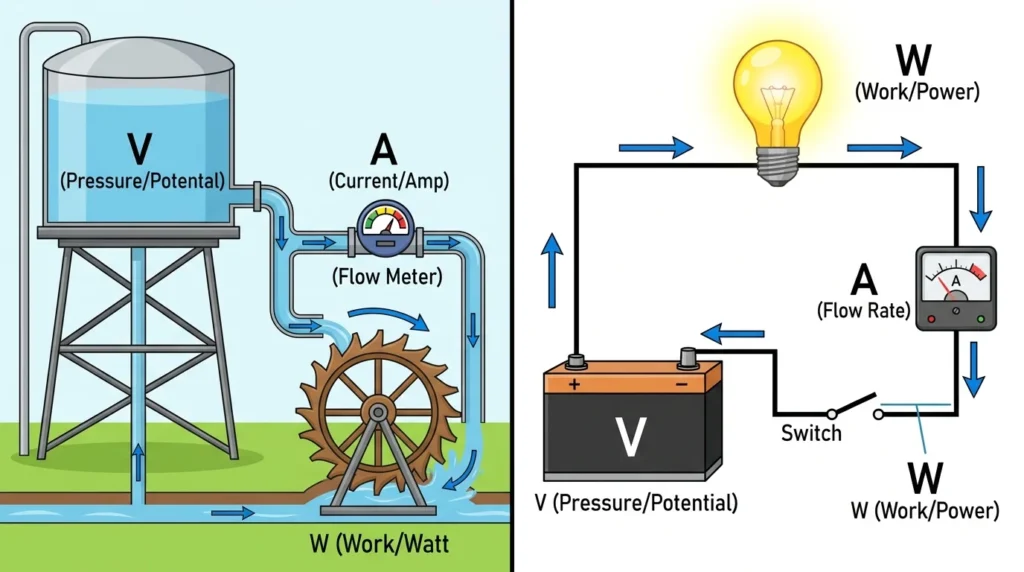
Voltage is like water pressure inside a pipe. Higher pressure pushes more water through the pipe.
Practical Example
- A mobile battery may have 3.7 volts
- Household supply may be 220V or 120V depending on the country
Important Formula
genui{“math_block_widget_always_prefetch_v2”:{“content”:”V=IR”}}
This formula shows that voltage depends on current and resistance.
What is Ampere (Amp)?
An Ampere measures the flow of electric current.
Simple Explanation
Current is similar to the amount of water flowing through a pipe.
Practical Example
- A phone charger may supply 2 amps
- Industrial motors may require hundreds of amps
What is Watt?
A Watt measures electrical power.
Simple Explanation
Power tells us how much electrical work is being done.
Practical Example
- A 10W LED bulb consumes less power
- A 1500W electric heater consumes much more electricity
Important Formula
P=VI
This formula explains the relationship between power, voltage, and current.
Electrical Units Working Principle
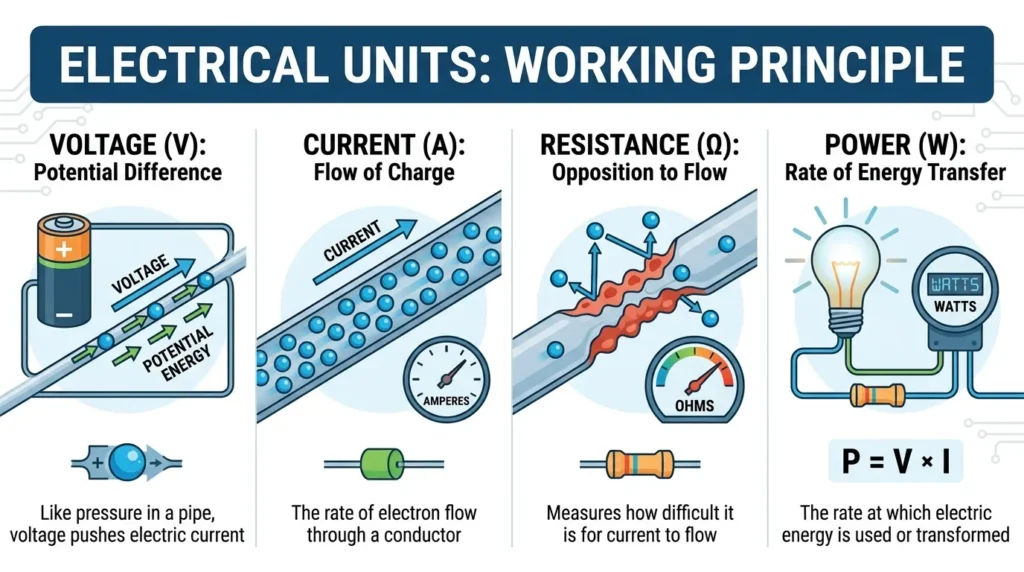
Electrical units are standard measurements used to quantify electrical quantities such as voltage, current, resistance, power, and energy. These units are based on the International System of Units (SI) and help engineers and technicians measure, analyze, and compare electrical parameters accurately. Electrical measuring instruments work by detecting an electrical quantity and converting it into a readable value. For example, a voltmeter measures voltage in volts (V), an ammeter measures current in amperes (A), an ohmmeter measures resistance in ohms (Ω), a wattmeter measures power in watts (W), and an energy meter measures electrical energy in kilowatt-hours (kWh). Accurate measurement of these electrical units ensures the safe, efficient, and reliable operation of electrical systems.
Understanding the electrical units working principle becomes easier with simple analogies.
Step-by-Step Explanation
Voltage Creates Pressure
Voltage acts like pressure that pushes electrons through a conductor.
Without voltage, current cannot flow.
Current Starts Flowing
When a circuit is connected, electrons begin moving through the wire. This movement is called current.
The amount of current depends on:
- Voltage level
- Resistance in the circuit
Power is Produced
When voltage and current work together, electrical power is generated.
Devices convert this electrical power into:
- Light
- Heat
- Motion
- Sound
Water Pipe Analogy
Electrical systems can be compared with water systems:
| Electrical Unit | Water System Analogy |
| Voltage (Volt) | Water pressure |
| Current (Amp) | Water flow rate |
| Power (Watt) | Total work done by water |
This analogy helps beginners understand electrical behavior easily.
Types / Classification
Types of Voltage
Voltage is mainly classified into two types:
Direct Current (DC) Voltage – DC voltage has a constant magnitude and flows in only one direction. It is supplied by sources such as batteries, solar cells, and DC power supplies. DC voltage is commonly used in electronic devices, mobile phones, computers, and electric vehicles.
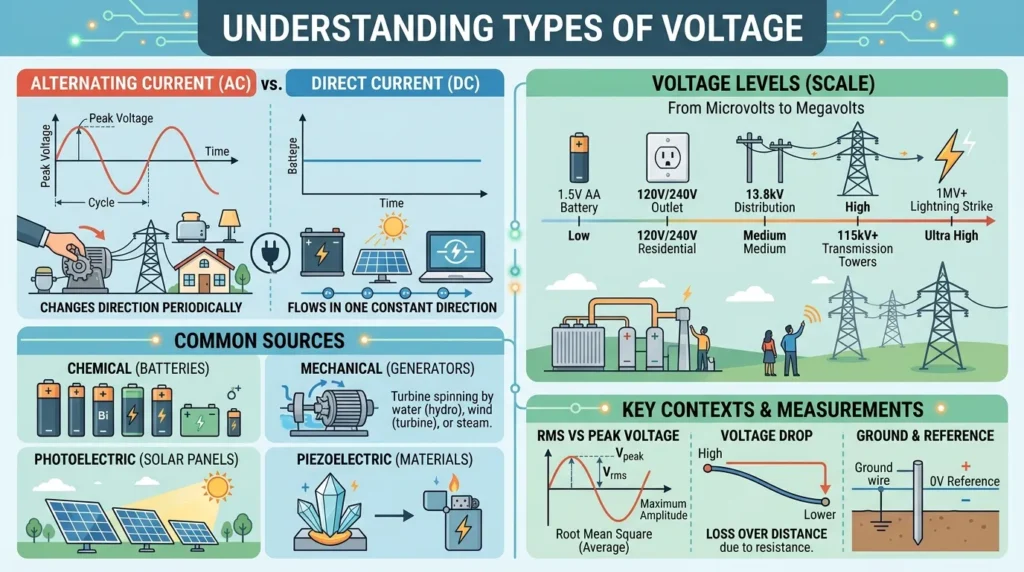
Alternating Current (AC) Voltage – AC voltage continuously changes its magnitude and reverses its direction at regular intervals. It is generated by alternators in power stations and is used for transmitting and distributing electrical power. AC voltage is commonly used in homes, industries, and commercial buildings because it can be easily transformed to different voltage levels using transformers.
AC Voltage
Alternating Current voltage changes direction continuously.
Applications
- Home electricity
- Industrial power systems
- Transmission networks
DC Voltage
Direct Current voltage flows in one direction only.
Applications
- Batteries
- Solar systems
- Electronic devices
Types of Current
Current is mainly classified into two types:
Direct Current (DC) Current – DC current flows in only one direction and has a constant magnitude. It is supplied by sources such as batteries, solar cells, and DC power supplies. DC current is widely used in electronic devices, mobile phones, computers, and electric vehicles.
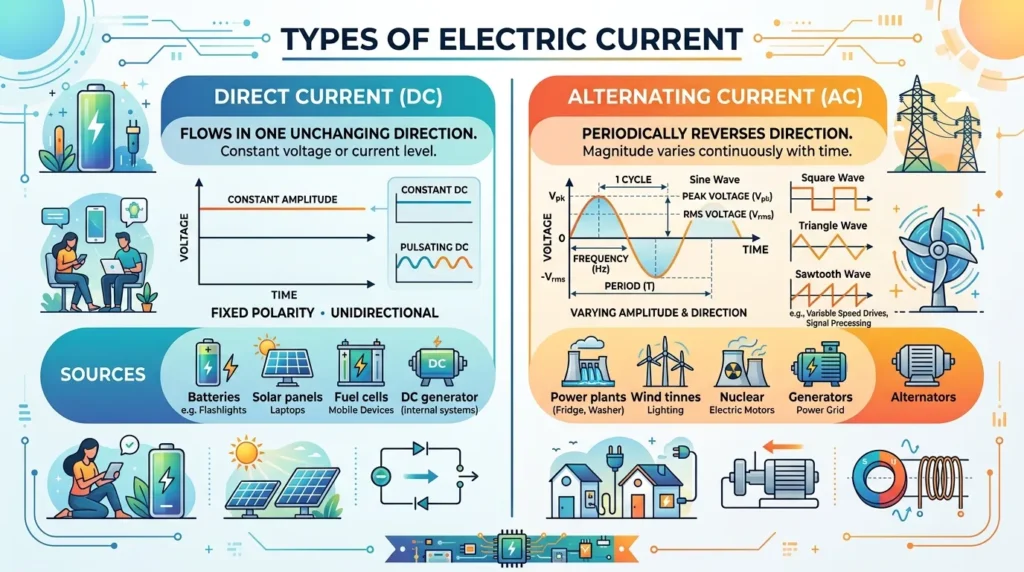
Alternating Current (AC) Current – AC current continuously changes its magnitude and reverses its direction at regular intervals. It is generated by alternators in power stations and is commonly used for transmitting and distributing electrical power. AC current is widely used in homes, industries, and commercial buildings because it can be transmitted efficiently over long distances.
Alternating Current (AC)
Current reverses direction periodically.
Features
- Used in power transmission
- Efficient for long distances
Direct Current (DC)
Current flows steadily in one direction.
Features
- Stable supply
- Suitable for electronics
Types of Power
Electrical power is mainly classified into three types in AC circuits:
Active Power (Real Power) – Active power is the actual power that performs useful work in an electrical circuit, such as operating motors, heaters, and lamps. It is measured in watts (W).
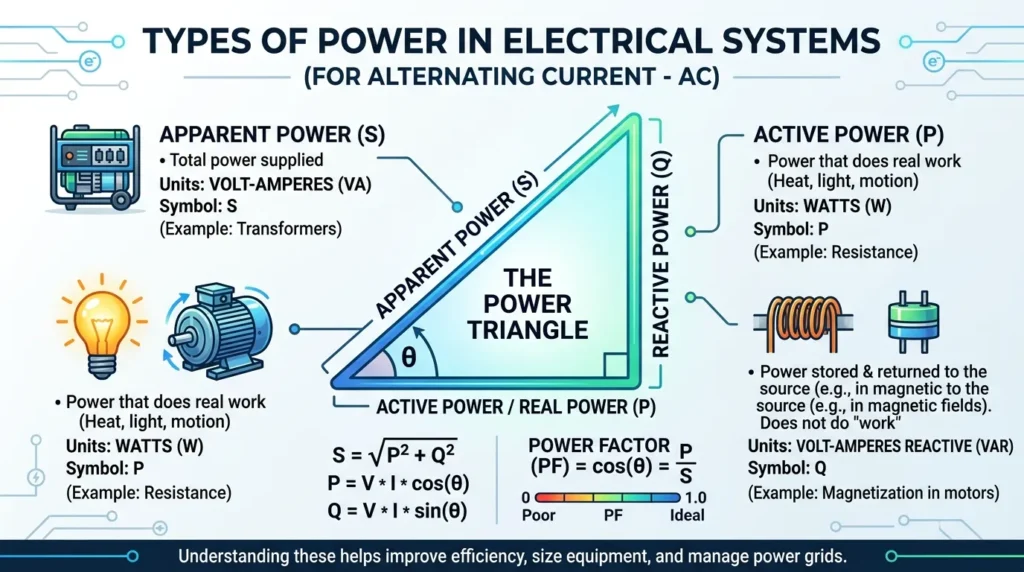
Reactive Power – Reactive power is the power that flows back and forth between the source and reactive components such as inductors and capacitors. It does not perform useful work but is necessary for creating magnetic and electric fields. It is measured in volt-amperes reactive (VAR).
Apparent Power – Apparent power is the total power supplied by the source. It is the combination of active power and reactive power and is measured in volt-amperes (VA). Apparent power represents the total electrical power required by an AC circuit.
Active Power
Actual usable power consumed by devices.
Measured in Watts (W).
Reactive Power
Power stored temporarily in inductive and capacitive components.
Measured in VAR.
Apparent Power
Combination of active and reactive power.
Measured in VA.
Main Components
Several electrical components directly affect voltage, current, and power.
Power Source
The power source generates voltage.
Examples
- Batteries
- Generators
- Solar panels
Function
Provides energy for the circuit.
Conductors
Conductors allow current flow.
Examples
- Copper wires
- Aluminum cables
Function
Carry electricity from source to load.
Load
A load consumes electrical power.
Examples
- Fans
- Motors
- Lights
- Heaters
Function
Converts electrical energy into useful work.
Resistance
Resistance opposes current flow.
Function
Controls current levels and protects circuits.
Measuring Instruments
Voltmeter
Measures voltage.
Ammeter
Measures current.
Wattmeter
Measures electrical power.
Advantages
Advantages of Understanding Electrical Units
Better Electrical Safety
Knowing voltage and current ratings helps prevent electrical accidents.
Correct Equipment Selection
Electrical units help in selecting:
- Proper cables
- Correct circuit breakers
- Suitable transformers
Improved Troubleshooting
Technicians can quickly identify faults using electrical measurements.
Energy Savings
Understanding watts helps reduce electricity consumption.
Essential for Engineering Design
Electrical calculations are impossible without volts, amps, and watts.
Supports Renewable Energy Systems
Solar systems and battery storage require accurate electrical measurements.
Disadvantages / Limitations
Limitations of Electrical Measurements
Measurement Errors
Incorrect instrument use may give wrong readings.
Complex Calculations in Large Systems
Industrial systems may involve:
- Power factor
- Harmonics
- Reactive power
These require advanced calculations.
Confusion for Beginners
Many beginners mix voltage, current, and power concepts.
Electrical Losses Affect Readings
Heat losses and cable resistance can change measured values.
AC Systems are More Complicated
AC calculations involve frequency and phase angle considerations.
Electrical Units Applications
Home Applications
Electrical units are used daily in homes.
Examples
- Checking appliance wattage
- Selecting extension cables
- Calculating electricity bills
- Charging mobile devices
Industrial Applications
Industries use electrical measurements for:
- Motor control
- Power distribution
- Machine protection
- Energy management
Renewable Energy Systems
Solar systems rely heavily on:
- DC voltage
- Battery current
- Inverter power ratings
Electric Vehicles
EV systems use electrical units for:
- Battery voltage
- Charging current
- Motor power
Electronics and Communication
Electronic circuits require accurate current and voltage control.
Examples
- Computers
- Mobile phones
- Data centers
- Networking equipment
Comparison Section
Difference Between Volt, Amp, and Watt
| Feature | Volt | Amp | Watt |
| Measures | Electrical pressure | Current flow | Electrical power |
| Symbol | V | A | W |
| Function | Pushes electrons | Indicates electron flow | Measures work done |
| Water Analogy | Water pressure | Water flow | Total water power |
| Measuring Device | Voltmeter | Ammeter | Wattmeter |
| Formula | V = IR | I = V/R | P = VI |
| Common Example | 220V supply | 5A charger | 100W bulb |
Selection Guide
How to Choose the Right Electrical Ratings
Selecting proper voltage, current, and power ratings is extremely important for safety and efficiency.
Choose Correct Voltage
Tips
- Match equipment voltage with supply voltage
- Incorrect voltage can damage devices
Example
A 120V appliance should not be connected to 220V supply.
Choose Correct Current Rating
Tips
- Use proper wire size
- Ensure breakers handle expected current
Example
High-current motors require thick cables.
Choose Proper Power Rating
Tips
- Select equipment with sufficient watt capacity
- Avoid overloading circuits
Example
Using a low-watt inverter for a large load may cause failure.
Beginner Tips
Learn Basic Formulas
The most important electrical formulas are:
P=VI
genui{“math_block_widget_always_prefetch_v2”:{“content”:”I=\frac{V}{R}”}}
Use Measuring Instruments Carefully
Always:
- Check meter settings
- Use insulated probes
- Follow safety procedures
Common Problems & Solutions
Why Does a Circuit Breaker Trip Frequently?
Problem
Excessive current draw overloads the circuit.
Solution
- Reduce connected load
- Use proper breaker rating
- Check wiring condition
Why Does Voltage Drop Occur?
Problem
Long cables or overloaded circuits cause voltage drop.
Solution
- Use thicker cables
- Reduce cable length
- Improve power distribution
Why Do Devices Overheat?
Problem
High current flow increases heat generation.
Solution
- Check ventilation
- Inspect wiring
- Reduce overload conditions
Why Is Electricity Bill Very High?
Problem
High-wattage appliances consume more energy.
Solution
- Use energy-efficient devices
- Turn off unused equipment
- Replace old appliances
Why Do Batteries Drain Quickly?
Problem
Excessive current consumption shortens battery life.
Solution
- Reduce load
- Use proper charging systems
- Replace weak batteries
Future Trends
Smart Energy Monitoring
Modern homes and industries now use smart meters for real-time monitoring of:
- Voltage
- Current
- Power consumption
Renewable Energy Growth
Solar and battery technologies are increasing demand for advanced electrical measurement systems.
Electric Vehicle Expansion
EV charging infrastructure requires accurate voltage and current management.
AI-Based Power Management
Future systems will automatically optimize power usage using intelligent monitoring technologies.
Advanced Digital Measuring Instruments
Traditional analog meters are being replaced by:
- Digital multimeters
- Smart analyzers
- Wireless monitoring systems
Conclusion
Understanding electrical units explained (Volt, Amp, Watt) is essential for anyone involved in electrical work, whether beginner or professional. Voltage provides the electrical pressure, current represents the flow of electricity, and power measures the actual work performed by electrical devices. Together, these units form the foundation of every electrical system.
From household appliances to industrial machines and renewable energy systems, volts, amps, and watts are used everywhere. Learning their working principles, applications, and differences improves troubleshooting skills, equipment selection, energy efficiency, and electrical safety.
As technology advances through smart grids, electric vehicles, and renewable energy systems, the importance of electrical measurements will continue to grow. A strong understanding of these basic electrical units creates the foundation for advanced electrical engineering knowledge and practical field experience.