
Imagine a large industrial motor suddenly stopping during factory production. Machines shut down, conveyor belts stop moving, and production losses begin within minutes. In many cases, the problem is caused by electrical machine faults such as overheating, insulation failure, bearing damage, or short circuits. These faults can reduce efficiency, damage equipment, and even create dangerous safety conditions.
Electrical machines are widely used in homes, industries, transportation systems, and power plants. Motors, generators, and transformers are essential parts of modern electrical systems. Understanding faults in electrical machines is important for electrical students, engineers, technicians, and beginners because proper fault detection and maintenance improve safety, reliability, and equipment life.
In this article, you will learn about the faults in electrical machines working principle, common fault types, causes, main components involved, applications, troubleshooting methods, advantages and disadvantages of fault detection systems, and future trends in machine protection technology. The explanations are practical, beginner-friendly, and written like a senior electrical engineer teaching junior technicians.
What are Faults in Electrical Machines?
Faults in electrical machines are abnormal conditions that affect the normal operation of motors, generators, transformers, or other electrical equipment.
These faults may be electrical, mechanical, thermal, or environmental. They can reduce machine performance, cause overheating, increase power losses, or completely stop operation.
Simple Explanation
When an electrical machine does not work properly because of damage, overload, or abnormal conditions, it is called a machine fault.
Practical Example
If a motor winding insulation breaks down, the winding may short-circuit and the motor can burn out. This is a common electrical machine fault.
Faults in Electrical Machines Working Principle
The faults in electrical machines working principle is based on how abnormal conditions disturb the normal electrical and mechanical operation of machines.
Step-by-Step Fault Process
Normal Machine Operation
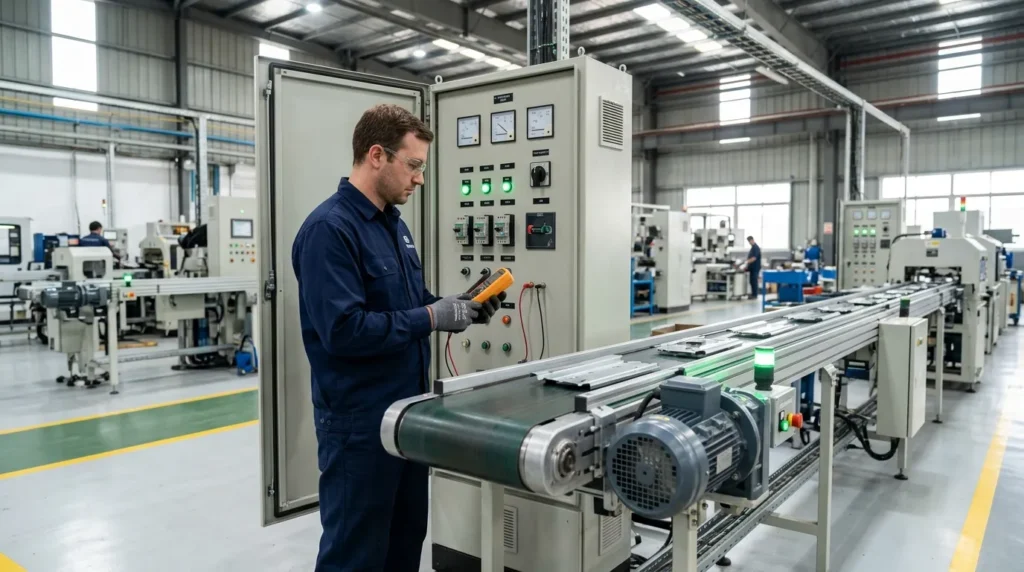
Normal machine operation refers to the condition in which an electrical machine works safely and efficiently under its rated voltage, current, and load. During normal operation, all electrical and mechanical parts function properly without overheating, excessive vibration, or unusual noise. The machine delivers the required output with high efficiency while consuming the correct amount of electrical power. Regular maintenance, proper lubrication, and protection devices help ensure smooth operation, increase the machine’s lifespan, and prevent unexpected faults or breakdowns.
The machine operates under rated voltage, current, and load conditions.
Abnormal Condition Develops
Problems such as overload, overheating, moisture, vibration, or insulation failure occur.
Machine Parameters Change
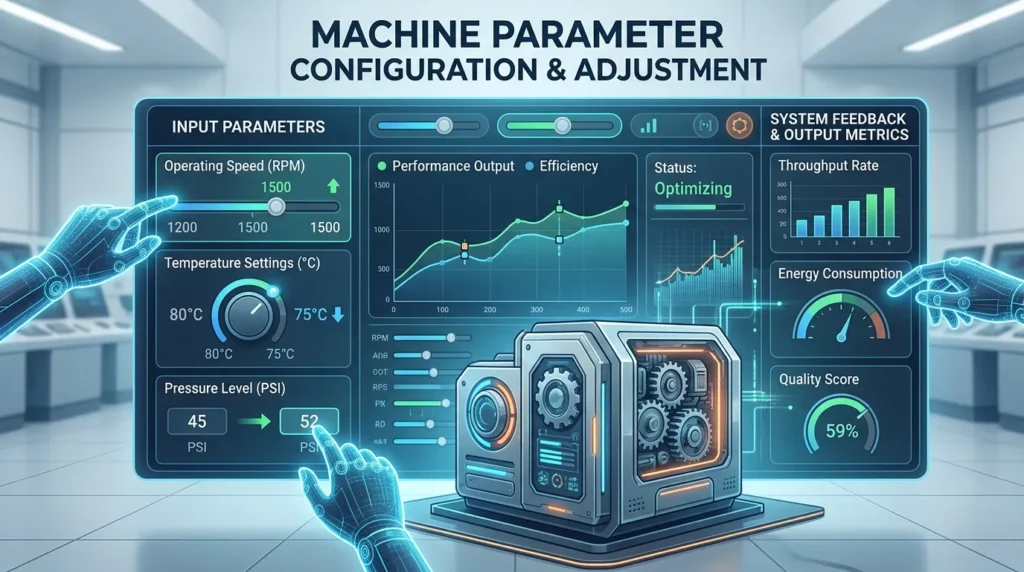
Machine parameter change refers to the variation in the electrical or mechanical characteristics of a machine during operation. These parameters include resistance, inductance, speed, voltage, current, torque, and temperature. Changes may occur due to load variations, heating, aging of components, or changes in the power supply. Such variations can affect the performance, efficiency, and stability of the machine. Therefore, regular monitoring and proper maintenance are important to keep the machine operating safely and efficiently.
Current, voltage, temperature, speed, or vibration values become abnormal.
Fault Begins
Electrical or mechanical damage starts affecting machine operation.
Protection System Activates
Protective relays, circuit breakers, or sensors detect the fault and disconnect the machine.
Simple Analogy
Think of the human body developing a fever during illness. Similarly, electrical machines show warning signs like overheating, noise, or vibration when faults occur.
Overcurrent Relationship
The overcurrent relationship describes the connection between the amount of current flowing in an electrical machine and its operating condition. When the current exceeds the machine’s rated value, it is called overcurrent. Overcurrent can occur due to overload, short circuits, or equipment faults. Excessive current increases heat in the windings, reduces efficiency, damages insulation, and may lead to machine failure. To protect the machine, overcurrent protection devices such as fuses, circuit breakers, and overcurrent relays are used to detect and interrupt excessive current before damage occurs.
Fault current usually increases beyond normal operating limits.
I_f > I_n
Where:
- (I_f) = Fault current
- (I_n) = Normal current
Types of Faults in Electrical Machines
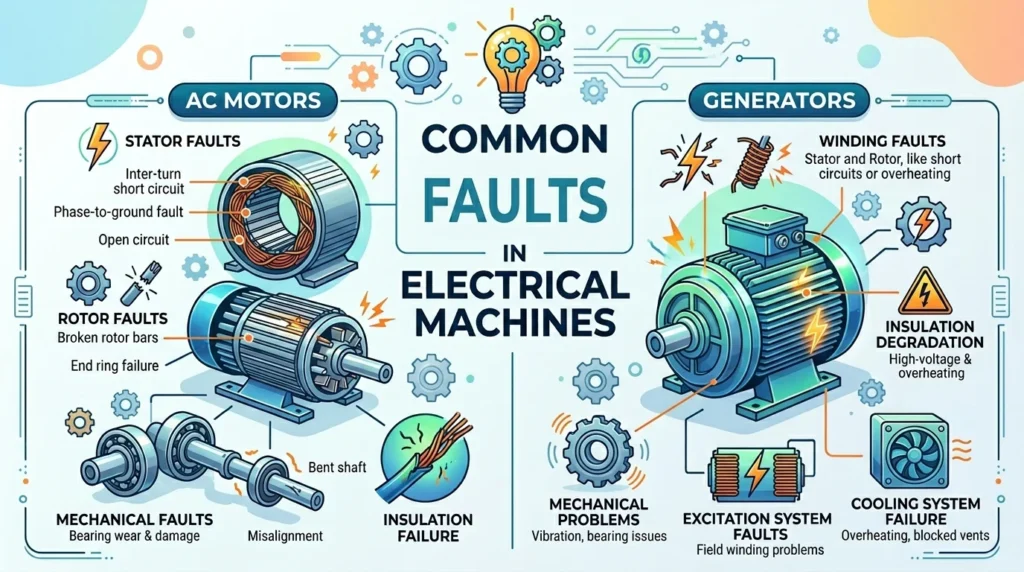
Electrical Faults in Motors
Electrical faults are among the most common problems that can affect the performance, efficiency, and safety of an electric motor. These faults can develop in the motor windings, insulation, terminals, cables, or other electrical connections. If an electrical fault is not identified and corrected quickly, it can cause excessive current, overheating, winding damage, unexpected machine shutdown, or even a complete motor failure.
Common Electrical Faults in Motors
Common electrical faults in motors include short circuits, open circuits, earth faults, insulation failure, loose connections, and winding faults. These problems may occur because of excessive current, voltage imbalance, moisture, heat, aging insulation, mechanical vibration, poor installation, or inadequate maintenance.
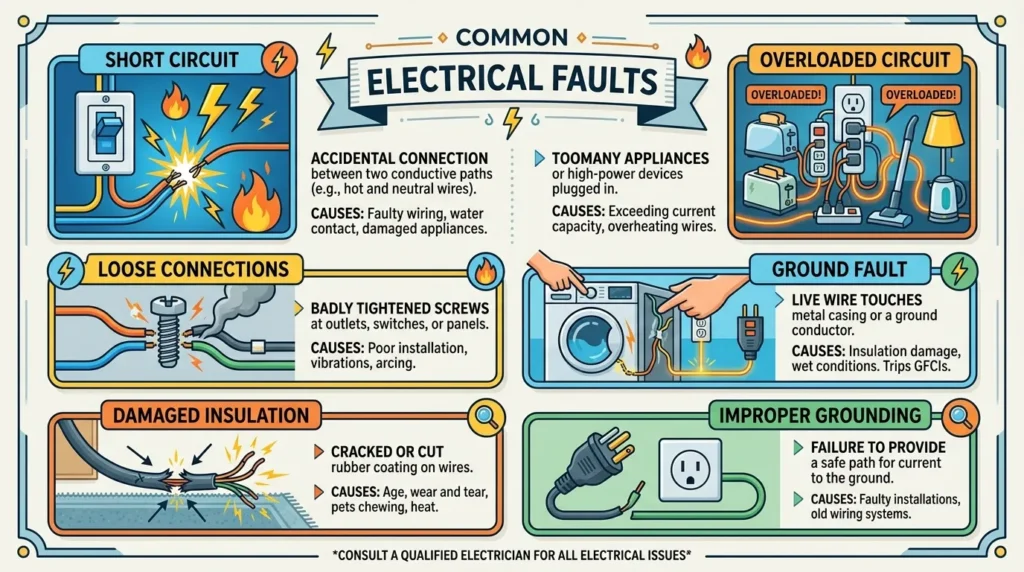
Some common electrical faults include:
- Short circuit: A short circuit occurs when current finds an unintended low-resistance path. It can produce very high current and may quickly damage motor windings.
- Open circuit: An open circuit occurs when the normal electrical path is broken because of a damaged wire, loose terminal, or broken winding connection.
- Earth fault: An earth fault occurs when electrical current flows from a live part of the motor to its grounded body or frame. This can create a serious electric shock and equipment safety risk.
- Insulation failure: Damaged or deteriorated insulation can allow current to leak between windings or from a winding to the motor frame.
- Loose electrical connections: Loose terminals and cable connections can increase resistance, generate heat, cause voltage drops, and lead to motor failure.
- Winding fault: Motor windings can develop shorted turns, phase-to-phase faults, or other winding problems that affect motor current and performance.
Effects of Electrical Faults
Electrical faults can have several harmful effects on a motor and the electrical system connected to it. The severity depends on the type of fault, the motor rating, and how quickly the problem is detected.
Common effects include:
- Overheating of motor windings
- High current flow
- Excessive power consumption
- Voltage imbalance
- Reduced motor efficiency
- Insulation damage
- Winding failure
- Unexpected machine shutdown
- Tripping of circuit breakers or overload relays
- Burning smell or visible damage
- Reduced motor service life
- Complete motor failure
How to Prevent Electrical Faults
Regular inspection and proper electrical maintenance can help reduce the risk of motor electrical faults. Technicians should regularly check motor terminals, cables, insulation condition, current consumption, and protective devices.
Using correctly rated fuses, circuit breakers, overload relays, and earth-fault protection can also help protect motors from serious electrical damage. Keeping electrical connections tight and clean, maintaining proper ventilation, and avoiding continuous operation under excessive load are important preventive measures.
Early detection is especially important because a small electrical problem can become a major winding or insulation failure if the motor continues operating under abnormal conditions.
Mechanical Faults in Motors
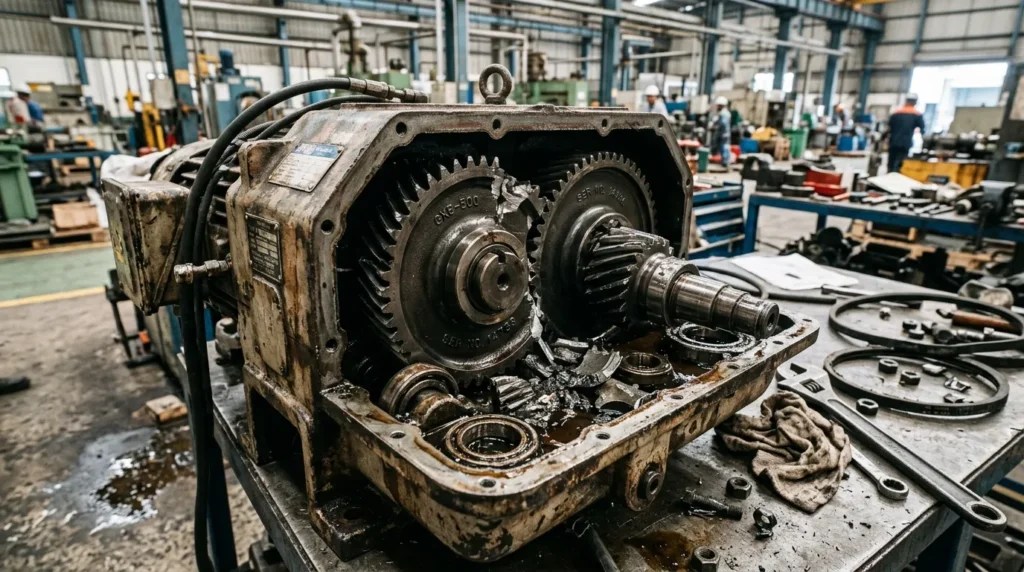
Mechanical faults are common problems that occur in the moving and physical parts of electric motors and machines. These faults can affect components such as bearings, shafts, rotors, couplings, gears, and other rotating parts. Mechanical problems may develop because of continuous operation, excessive load, poor lubrication, improper installation, misalignment, or normal wear and tear.
If mechanical faults are not detected and repaired in time, they can reduce motor efficiency, increase vibration and noise, damage other components, and eventually cause unexpected machine breakdowns. Regular inspection, proper lubrication, correct alignment, and preventive maintenance can help identify mechanical problems early and improve the reliability and service life of the motor.
Common Mechanical Faults in Motors
Common mechanical faults in motors include bearing failure, shaft misalignment, rotor imbalance, coupling damage, loose components, excessive wear, and insufficient lubrication. These problems can gradually become worse if a motor continues operating without proper maintenance.
Some common mechanical faults include:
- Bearing failure: Bearings support the rotating shaft and allow smooth movement. Worn, damaged, or poorly lubricated bearings can produce noise, heat, and excessive vibration.
- Shaft misalignment: Shaft misalignment occurs when connected shafts are not correctly aligned. It can place additional stress on bearings, couplings, and other rotating components.
- Rotor imbalance: An unbalanced rotor can cause uneven rotation and excessive vibration. Rotor imbalance may result from uneven wear, damaged components, or improper balancing.
- Coupling damage: A damaged or worn coupling can affect power transmission between the motor and driven equipment. It may also increase vibration and mechanical stress.
- Loose components: Loose bolts, mounting parts, or mechanical connections can create vibration and unusual noise during motor operation.
- Lack of lubrication: Insufficient or incorrect lubrication increases friction between moving parts and can cause overheating, wear, and premature bearing failure.
Effects of Mechanical Faults
Mechanical faults can negatively affect motor performance and the overall operation of machinery. Even a small mechanical problem can become serious when the motor continues to operate for long periods.
Common effects include:
- Excessive vibration
- Unusual mechanical noise
- Bearing overheating
- Increased friction
- Reduced motor efficiency
- Higher energy consumption
- Shaft and coupling wear
- Damage to rotating components
- Frequent machine shutdowns
- Increased maintenance costs
- Reduced motor service life
- Unexpected equipment breakdown
How to Prevent Mechanical Faults
Proper preventive maintenance is one of the best ways to reduce mechanical faults in motors. Technicians should regularly inspect bearings, shafts, couplings, mounting bolts, and other moving components for signs of wear or damage.
Correct lubrication should be provided according to the motor manufacturer’s recommendations. Shaft and coupling alignment should also be checked during installation and maintenance. Excessive vibration, unusual noise, overheating, or changes in motor performance should not be ignored because these can be early signs of a mechanical problem.
Regular inspection, proper alignment, timely bearing replacement, correct lubrication, and preventive maintenance can help reduce mechanical faults in motors, improve operating efficiency, and extend the overall service life of electrical machines.
Thermal Faults in Motors
Thermal faults are common problems in electric motors that occur when the motor operates at a temperature higher than its normal operating limit. Excessive heat can develop in the motor windings, bearings, insulation, or other internal components. If the heat is not removed properly, it can gradually damage the motor and reduce its performance and service life.
Thermal faults in motors can be caused by electrical overload, poor ventilation, blocked cooling passages, high ambient temperature, frequent starting, voltage problems, or continuous operation under heavy load. Regular temperature monitoring and proper maintenance can help detect excessive heating before it causes permanent damage.
Common Causes of Thermal Faults
Several operating and maintenance conditions can cause excessive heating in electric motors. The most common causes include:
- Motor overload: Operating a motor above its rated load increases current and generates additional heat in the windings.
- Poor cooling: Blocked ventilation openings, damaged cooling fans, or dirty surfaces can prevent heat from leaving the motor.
- Continuous operation: Running a motor continuously for long periods, especially under heavy load, can increase its operating temperature.
- High ambient temperature: A motor operating in a hot environment may have difficulty releasing the heat produced during operation.
- Frequent starting and stopping: Repeated motor starts can cause high starting current and increase winding temperature.
- Voltage imbalance: Unequal voltage between phases can cause unbalanced current and additional heating in a three-phase motor.
- Poor maintenance: Dust, dirt, blocked ventilation, and damaged cooling components can reduce the motor’s ability to dissipate heat.
Effects of Thermal Faults
Excessive temperature can seriously affect the electrical and mechanical components of a motor. Continuous overheating can gradually weaken insulation and increase the possibility of winding failure.
Common effects include:
- Insulation damage
- Winding overheating
- Reduced motor life
- Loss of motor efficiency
- Increased energy consumption
- Bearing damage
- Motor overheating
- Frequent thermal overload trips
- Winding failure
- Unexpected machine shutdown
- Permanent motor damage
How to Prevent Thermal Faults
Proper cooling and regular preventive maintenance are important for preventing thermal faults in motors. The motor should always be operated within its rated load and temperature limits. Cooling fans and ventilation openings should be kept clean and free from dust or other obstructions.
Technicians should also regularly check motor current, operating temperature, ventilation, and overload protection. If a motor starts running hotter than normal, the cause should be investigated instead of continuing operation without inspection.
Using correctly rated overload protection, maintaining proper ventilation, avoiding excessive loading, and performing regular maintenance can help control motor temperature and prevent serious thermal damage.
Early detection of overheating can significantly reduce repair costs and help extend the service life of electric motors.
Magnetic Faults in Motors
Magnetic faults are problems that affect the magnetic circuit, magnetic field, or flux distribution inside an electric motor. The magnetic field is essential for producing the torque required to rotate the motor. If the magnetic flux becomes uneven or the magnetic circuit does not operate correctly, the motor may develop vibration, unusual noise, overheating, and reduced operating efficiency.
Magnetic faults can occur because of air-gap irregularities, damaged or loose core parts, incorrect winding conditions, core saturation, or an imbalance in the magnetic flux between different parts of the motor. These faults can be difficult to identify because their symptoms may be similar to electrical or mechanical problems.
Regular inspection, proper motor alignment, correct winding design, and suitable operating conditions can help reduce the possibility of magnetic faults and improve motor reliability.
Common Magnetic Faults in Motors
Common magnetic faults include air-gap irregularities, core saturation, flux imbalance, damaged magnetic cores, and uneven magnetic fields. These faults can affect the normal electromagnetic operation of the motor.
Some common magnetic faults include:
- Air-gap irregularities: An uneven air gap between the stator and rotor can cause an unbalanced magnetic field. It may also produce vibration, noise, and additional mechanical stress.
- Core saturation: Core saturation occurs when the magnetic core reaches a point where it cannot effectively handle additional magnetic flux. This can increase magnetizing current and cause excessive heating.
- Flux imbalance: Flux imbalance occurs when magnetic flux is not distributed evenly throughout the motor. It can result from winding problems, air-gap variations, or other magnetic circuit issues.
- Damaged magnetic core: Damage to the stator or rotor core can disturb the normal magnetic path and reduce the motor’s electromagnetic performance.
- Uneven magnetic field: An uneven magnetic field can produce unwanted forces inside the motor, leading to vibration, noise, and reduced efficiency.
Effects of Magnetic Faults
Magnetic faults can affect both the electrical and mechanical performance of an electric motor. If these faults remain undetected, they may cause additional stress on windings, bearings, and other components.
Common effects include:
- Excessive vibration
- Unusual motor noise
- Reduced efficiency
- Increased energy consumption
- Uneven torque production
- Additional winding heating
- Increased mechanical stress
- Reduced motor performance
- Bearing and rotor stress
- Shorter motor service life
How to Prevent Magnetic Faults
Preventive maintenance and proper motor installation can help reduce magnetic faults. Technicians should ensure that the motor is correctly assembled and that the rotor and stator maintain the required air gap.
The motor should also be operated within its rated voltage and load conditions. Regular inspection can help identify unusual vibration, noise, temperature rise, or changes in current consumption that may indicate a developing magnetic problem.
Proper winding maintenance, correct alignment, clean cooling passages, and timely repair of damaged motor components can help maintain a balanced magnetic field and improve the reliability and efficiency of the motor.
Early detection of magnetic faults in motors can prevent further damage and reduce the risk of unexpected machine downtime.
Environmental Faults in Motors
Environmental conditions can have a major effect on the performance, insulation, cooling, and service life of electric motors. Dust, moisture, corrosion, high temperature, chemicals, and poor ventilation can gradually damage motor components and increase the risk of failure.
Common Causes of Environmental Faults
- Dust: Dust can collect on motor surfaces and cooling passages, restricting airflow and causing overheating.
- Moisture: Moisture can reduce insulation resistance and increase the risk of electrical leakage or short circuits.
- Corrosion: Corrosion can damage metal components, terminals, connections, and motor housings.
- High temperature: Excessive ambient temperature can make it difficult for the motor to remove heat during operation.
Effects of Environmental Faults
Environmental faults can gradually reduce motor performance and reliability. Common effects include:
- Insulation weakening
- Rust formation
- Cooling problems
- Motor overheating
- Electrical leakage
- Corrosion of terminals
- Reduced motor efficiency
- Shorter motor service life
How to Prevent Environmental Faults
Regular cleaning and proper environmental protection can help prevent damage to electric motors. Motors should be installed in suitable locations with adequate ventilation and protection from excessive dust and moisture.
Where motors operate in harsh environments, suitable enclosures and protective measures should be used. Regular inspection can also help identify corrosion, dirt accumulation, moisture, and cooling problems before they cause serious motor damage.
Main Components
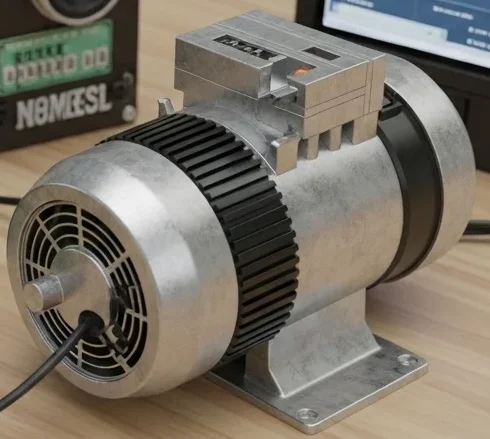
Electric machines and motors are made up of several important components that work together to convert electrical energy into mechanical energy. The main components include the stator, rotor, bearings, and shaft. Each component has a specific function, and a fault in any one of them can affect the overall performance and reliability of the machine.
Stator
The stator is the stationary part of an electric motor. It surrounds the rotor and contains the windings that produce the magnetic field required for motor operation. The stator remains fixed while the rotor rotates inside it.
Function
- Produces magnetic field: The stator windings create a magnetic field when electrical current flows through them. This magnetic field interacts with the rotor and produces rotation.
- Contains windings: The stator contains insulated copper or aluminum windings that carry electrical current and play an important role in generating the motor’s magnetic field.
Common Faults
- Insulation failure: Damaged insulation can allow current to leak between windings or to the motor frame, potentially causing short circuits and overheating.
- Winding short circuit: A short circuit between winding turns or phases can cause excessive current and serious damage to the motor.
Rotor
The rotor is the rotating part of an electric motor. It is positioned inside the stator and rotates when it interacts with the magnetic field produced by the stator. The rotor transfers the developed torque to the motor shaft.
Function
- Produces rotation: The rotor responds to the stator’s magnetic field and rotates to produce mechanical movement and torque.
- Transfers torque: The rotating rotor transfers mechanical power through the shaft to the connected equipment.
Common Faults
- Rotor bar damage: In induction motors, damaged or broken rotor bars can cause uneven current distribution, vibration, overheating, and reduced motor performance.
- Rotor imbalance: An unbalanced rotor does not rotate smoothly and can produce excessive vibration, noise, and additional stress on bearings.
Bearings
Bearings support the motor shaft and allow it to rotate smoothly with minimum friction. They are important for maintaining correct shaft position and alignment during motor operation.
Function
- Reduce friction: Bearings reduce friction between the rotating shaft and stationary parts, allowing the motor to operate smoothly.
- Maintain alignment: They help keep the shaft correctly positioned and prevent unwanted movement during rotation.
Common Faults
- Wear: Continuous operation, excessive load, contamination, or poor maintenance can cause bearing surfaces to wear over time, resulting in noise and vibration.
- Lubrication failure: Insufficient, incorrect, or contaminated lubricant can increase friction and temperature, eventually leading to bearing damage.
Shaft
The shaft is a rotating mechanical component that transfers the torque produced by the motor to the driven equipment. It connects the rotor to external machinery such as pumps, fans, compressors, or gear systems.
Function
- Transfers mechanical power: The shaft carries the rotational force from the rotor to the connected machine.
- Maintains rotation: A properly aligned shaft ensures smooth and stable power transmission during operation.
Common Faults
- Bending: A bent shaft can cause uneven rotation, vibration, and additional stress on bearings and couplings.
- Misalignment: Shaft misalignment occurs when the motor shaft and driven equipment are not correctly aligned. It can increase vibration, bearing wear, and mechanical stress.
Insulation System
Insulation separates electrical conductors safely.
Common Faults
- Cracking
- Moisture damage
Cooling System
Cooling systems remove excess heat.
Common Faults
- Fan failure
- Blocked ventilation
Advantages of Fault Detection Systems
Fault Detection Advantages
- Improves machine safety
- Prevents severe damage
- Reduces downtime
- Increases machine life
- Improves maintenance planning
- Saves repair costs
- Enhances system reliability
- Protects operators and equipment
Real-World Benefits
Early fault detection prevents expensive industrial shutdowns and improves production efficiency.
Disadvantages / Limitations
Fault Detection Disadvantages
- Protection systems increase cost
- Sensors require maintenance
- False alarms may occur
- Complex systems need skilled technicians
- Continuous monitoring may be required
Practical Limitation
Small faults are sometimes difficult to detect before serious damage occurs.
Faults in Electrical Machines Applications
Fault monitoring and protection systems are widely used in modern electrical engineering.
Industrial Applications
Manufacturing Plants
Motor condition monitoring is widely used in manufacturing plants to monitor motors, pumps, fans, compressors, and other production machinery. It helps detect electrical and mechanical problems early and reduces unexpected machine breakdowns.
Conveyor Systems
Conveyor systems depend on motors that often operate for long hours. Monitoring motor current, temperature, vibration, and load helps identify overload conditions, overheating, bearing problems, and other faults before they cause production interruptions.
Pumps and Compressors
Pumps and compressors use electric motors that can develop bearing, winding, vibration, or overload problems. Regular condition monitoring helps identify abnormal operating conditions and supports preventive maintenance.
Power System Applications
Power Plants
Power plants use condition monitoring to protect generators, motors, transformers, and auxiliary equipment. Monitoring temperature, vibration, current, and other operating parameters helps detect faults before serious equipment damage occurs.
Substations
Electrical equipment in substations must operate reliably for continuous power distribution. Condition monitoring helps technicians identify overheating, insulation problems, abnormal current, and other equipment issues at an early stage.
Renewable Energy Systems
Renewable energy systems also require reliable electrical equipment monitoring. In wind turbines, monitoring helps protect generators and drive systems, while solar power systems can use monitoring to identify inverter overheating, abnormal current, and other electrical problems.
Transportation Applications
Electric Vehicles
Electric vehicles use electric motors that require continuous monitoring for safe and efficient operation. Motor temperature, current, voltage, and operating conditions can be monitored to help prevent overheating and motor damage.
Railway Systems
Railway systems use powerful traction motors to move trains. Monitoring these motors helps detect overheating, excessive vibration, electrical faults, and other abnormal conditions before they lead to costly failures or service interruptions.
Home Applications
Air Conditioners
Air conditioners use compressor motors that can experience overload, overheating, voltage problems, and other faults. Motor protection devices and monitoring systems help protect the compressor and improve the reliability of the air-conditioning system.
Washing Machines
Washing machines use electric motors for drum rotation and washing operations. Motor protection helps prevent damage caused by overload, overheating, abnormal current, or other operating problems, improving motor life and appliance reliability.
Difference Between Electrical Faults and Mechanical Faults
Understanding the difference between electrical faults and mechanical faults is important for troubleshooting.
| Feature | Electrical Faults | Mechanical Faults |
| Main Cause | Electrical issues | Physical damage |
| Common Examples | Short circuit, insulation failure | Bearing wear, misalignment |
| Symptoms | Overcurrent, overheating | Noise, vibration |
| Detection Method | Electrical testing | Mechanical inspection |
| Damage Type | Winding damage | Structural damage |
| Repair Method | Rewinding, insulation repair | Part replacement |
Selection Guide
Choosing the right fault protection system depends on machine type and operating conditions.
Choose Thermal Protection When
- Machines operate continuously
- Overheating risk exists
- Heavy load conditions occur
Choose Vibration Monitoring When
- Rotating machinery is used
- Bearings require monitoring
- Industrial motors operate at high speed
Choose Current Protection When
- Short-circuit risk exists
- Overload conditions are common
Tips for Beginners
- Regularly inspect machine temperature
- Listen for unusual sounds
- Monitor vibration levels
- Keep machines clean and dry
- Follow maintenance schedules properly
Common Problems & Solutions
Why Is the Motor Overheating?
Causes
- Overload: Operating the motor above its rated load can cause excessive current and heat.
- Poor ventilation: Blocked cooling openings can prevent heat from escaping.
- Low voltage: Low supply voltage can increase motor current and cause overheating.
Solutions
- Reduce the motor load to its rated capacity.
- Clean the cooling system and ventilation openings.
- Verify that the supply voltage is within the motor’s rated range.
Why Is the Machine Producing Excessive Noise?
Causes
- Bearing wear: Worn or damaged bearings can produce grinding or unusual sounds.
- Rotor imbalance: An unbalanced rotor can create noise and vibration during operation.
- Loose mounting: Loose bolts or mounting parts can cause abnormal noise.
Solutions
- Replace worn or damaged bearings.
- Check and balance the rotor correctly.
- Tighten all mounting bolts and mechanical connections.
Why Does the Circuit Breaker Trip Frequently?
Causes
- Short circuit: A short circuit can create a sudden and excessive current.
- Ground fault: Current flowing to ground can activate protective devices.
- Excessive current: Continuous overcurrent may occur because of motor overload or other electrical problems.
Solutions
- Inspect the wiring for short circuits or damaged conductors.
- Check the insulation condition and look for ground faults.
- Measure the motor current and compare it with the rated current.
Why Is the Machine Vibrating?
Causes
- Misalignment: Incorrect shaft alignment can produce excessive vibration.
- Damaged bearings: Faulty bearings can cause uneven rotation and vibration.
- Uneven load: An unbalanced or uneven mechanical load can increase vibration.
Solutions
- Align the motor and driven equipment correctly.
- Replace damaged or worn bearings.
- Check and balance the mechanical load.
Why Does Insulation Fail?
Causes
- Heat: Excessive temperature can weaken and damage motor insulation.
- Moisture: Water or humidity can reduce insulation resistance and cause electrical leakage.
- Aging: Insulation naturally deteriorates after long-term operation.
Solutions
- Improve motor cooling and ventilation.
- Keep the machine protected from moisture and water.
- Test and replace damaged or severely aged insulation when necessary.
Future Trends
The future of fault detection in electrical machines is becoming smarter, faster, and more automated. Modern monitoring technologies can continuously collect machine data and identify abnormal operating conditions before they develop into serious failures.
Smart Monitoring Systems
Modern electrical machines increasingly use sensors and connected monitoring devices to track their operating condition.
Common technologies include:
- Temperature sensors: Monitor motor and bearing temperature.
- Vibration sensors: Detect abnormal vibration caused by mechanical problems.
- IoT monitoring devices: Send machine data to centralized monitoring systems.
- Wireless diagnostics: Allow technicians to monitor equipment without traditional wired connections.
Artificial Intelligence in Fault Detection
Artificial intelligence (AI) is being used in advanced fault detection systems to analyze large amounts of machine data. These systems can identify unusual patterns and help predict possible failures before major damage occurs.
Benefits
- Reduced machine downtime
- Better maintenance planning
- Improved equipment reliability
- Earlier detection of developing faults
Predictive Maintenance
Industries are gradually moving from traditional maintenance toward predictive maintenance. Instead of waiting for a machine to fail, monitoring systems use real-time data to identify when maintenance may be required.
Features
- Real-time monitoring: Continuously tracks important machine parameters.
- Data analysis: Examines temperature, vibration, current, and other operating data.
- Early fault warning: Alerts maintenance teams when abnormal conditions are detected.
Smart Factories
Smart factories integrate electrical machines, sensors, automation systems, and centralized monitoring platforms. This allows maintenance teams to monitor machine health from a central location and respond quickly when faults are detected.
High-Efficiency Machines
Modern electrical machines are being designed to provide better performance, lower energy consumption, and improved reliability.
Important developments include:
- Better insulation materials
- Improved cooling systems
- Lower vibration levels
- Advanced protection system
Conclusion
Understanding faults in electrical machines is essential for students, technicians, and engineers working with electrical systems. Faults can occur due to electrical, mechanical, thermal, magnetic, or environmental problems, and they can seriously affect machine performance and safety. Proper fault detection and maintenance improve equipment reliability, reduce downtime, and extend machine life.
By learning the faults in electrical machines working principle, types, troubleshooting methods, and protection systems, beginners can develop strong practical knowledge for real-world electrical applications. Modern industries now use smart monitoring and predictive maintenance technologies to detect faults early and prevent major failures.
As electrical systems continue becoming more advanced and automated, understanding machine faults and protection methods will remain one of the most important skills in electrical engineering.