
Imagine pressing the starter button of a car and hearing the engine start instantly. Behind this simple action, an important electrical device called a solenoid is working. Solenoids are used in cars, industrial machines, door locks, relays, automation systems, and many electrical control circuits. Even though they are small devices, they play a major role in converting electrical energy into mechanical movement.
Understanding the working of solenoid is important for electrical students, engineers, technicians, and beginners because solenoids are widely used in modern electrical and automation systems. They help control switches, valves, locks, and mechanical operations automatically and efficiently.
In this article, you will learn what a solenoid is, the solenoid working principle, different types of solenoids, main components, advantages and disadvantages, applications, troubleshooting methods, and future technologies. The explanations are written in simple and practical language so beginners can easily understand how solenoids work in real-world electrical systems.
What is a Solenoid?
A solenoid is an electromagnetic device that converts electrical energy into linear mechanical motion.
In simple words, when electric current flows through a coil of wire, it creates a magnetic field. This magnetic field pulls or pushes a metal rod called a plunger, creating movement.
Simple Explanation
A solenoid acts like an electrically controlled magnet. When power is supplied, the solenoid produces motion automatically.
Practical Example
An electric door lock uses a solenoid. When electricity flows through the coil, the plunger moves and unlocks the door.
Solenoid Working Principle
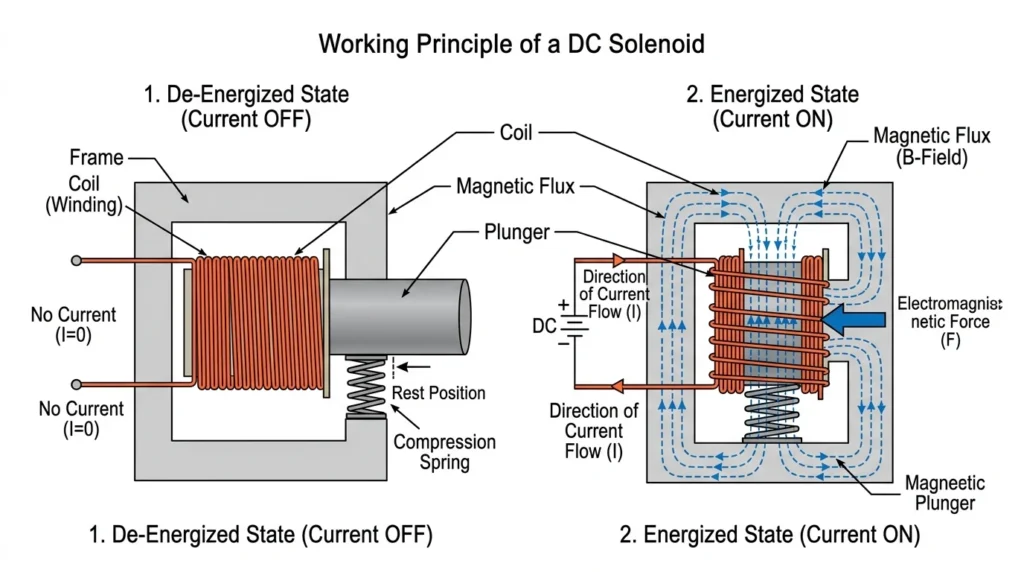
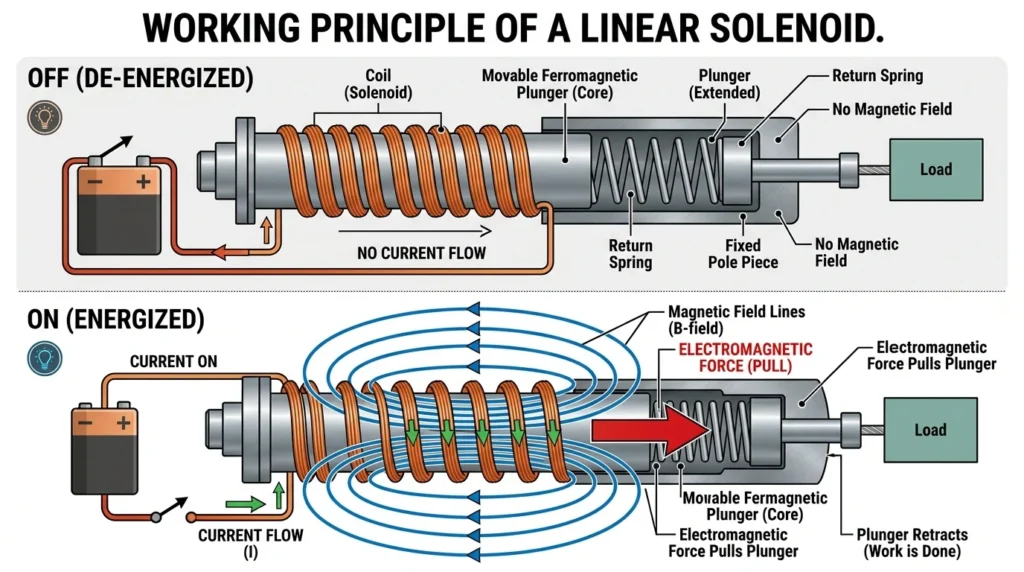
The working of solenoid is based on the principle of electromagnetism.The solenoid working principle is based on the conversion of electrical energy into mechanical motion through the use of electromagnetism. When an electric current flows through the coil of wire wound around the solenoid, it creates a magnetic field. This magnetic field attracts a movable iron plunger or armature located inside the coil. As the plunger moves, it produces a linear mechanical motion that can be used to operate switches, valves, locks, relays, and other mechanical devices. When the electrical supply is removed, a spring or external force returns the plunger to its original position. In simple words, a solenoid acts like an electrically controlled magnet that creates movement when energized. Solenoids are widely used in industrial automation, automotive systems, door locking mechanisms, hydraulic and pneumatic controls, and household appliances. Understanding the solenoid working principle is important for electrical students and technicians because it forms the basis of many electromechanical control systems used in modern technology.
When electric current passes through a wire coil, a magnetic field is produced around the coil. This magnetic field attracts a movable iron core or plunger.
Step-by-Step Solenoid Working Principle
Power Supply Connection
Electrical current is supplied to the solenoid coil.
Magnetic Field Generation
The coil creates a magnetic field around itself.
Plunger Attraction
The magnetic field attracts the iron plunger toward the center of the coil.
Mechanical Movement
The plunger movement performs a mechanical action such as opening a valve or switching a relay.
Power Removal
When power is removed, the magnetic field disappears.
Return Spring Action
A spring pushes the plunger back to its original position.
Simple Analogy
Think of a magnet pulling a metal nail toward itself. A solenoid works in a similar way, but the magnetism is created electrically.
Electromagnetic Force Formula
The magnetic force in a solenoid depends on current, number of turns, and magnetic field strength.
F \propto NI
Where:
- (F) = Magnetic force
- (N) = Number of coil turns
- (I) = Current through the coil
Types / Classification
Types of Solenoids
Linear Solenoid
A linear solenoid produces straight-line movement.
Features
- Simple construction
- Fast operation
- Commonly used in locking systems
Applications
- Door locks
- Relays
- Valves
Rotary Solenoid
A rotary solenoid produces rotational movement instead of linear movement.
Features
- Controlled angular motion
- Compact design
Applications
- Camera systems
- Industrial automation
- Robotics
DC Solenoid
This solenoid operates using direct current supply.
Features
- Stable operation
- Smooth movement
- Lower noise
Applications
- Automotive systems
- Battery-operated devices
AC Solenoid
This solenoid works with alternating current supply.
Features
- Strong starting force
- Common in industrial systems
Applications
- Contactors
- Industrial valves
- Electrical machinery
Push-Type Solenoid
The plunger moves outward when energized.
Applications
- Eject systems
- Mechanical pushing mechanisms
Pull-Type Solenoid
The plunger moves inward toward the coil.
Applications
- Locking systems
- Switch mechanisms
Main Components
Coil
The coil is made of insulated copper wire wound around a frame.
Function
- Produces magnetic field when energized
Plunger
The plunger is a movable iron rod inside the coil.
Function
- Converts magnetic force into movement
Spring
The spring returns the plunger to its original position.
Function
- Maintains normal position after power removal
Frame or Housing
The housing supports all components.
Function
- Protects internal parts
- Provides structural support
Core
The magnetic core strengthens the magnetic field.
Function
- Improves efficiency and pulling force
Electrical Terminals
Used for electrical connections.
Function
- Connect power supply to the coil
Advantages of Solenoid
Solenoid Advantages
- Simple construction
- Fast operation
- Reliable performance
- Easy automatic control
- Low maintenance
- Compact design
- Quick response time
- Suitable for remote operation
Real-World Benefits
Solenoids make automation systems faster and more efficient by reducing manual operation.
Disadvantages / Limitations
Solenoid Disadvantages
- Generates heat during continuous operation
- Limited movement distance
- Coil may burn due to overload
- Magnetic force decreases with distance
- AC solenoids may produce humming noise
- Requires proper voltage supply
Practical Limitation
Continuous energizing may overheat the coil and reduce lifespan.
Solenoid Applications
Solenoid applications are found in homes, industries, automobiles, and modern technology systems.
Home Applications
Electric Door Locks
Used for automatic locking and unlocking systems.
Washing Machines
Control water valves automatically.
Printers
Operate paper feeding mechanisms.
Industrial Applications
Pneumatic and Hydraulic Valves
Control fluid and air movement.
Industrial Automation
Used in robotic systems and machinery control.
Contactors and Relays
Operate electrical switching systems.
Automotive Applications
Car Starter Systems
Solenoids engage the starter motor.
Fuel Injection Systems
Control fuel flow in engines.
Automatic Transmission Systems
Operate gear control mechanisms.
Modern Technology Applications
Robotics
Used for precise movement control.
Medical Equipment
Operate automated medical devices.
Smart Security Systems
Used in electronic locking systems.
Difference Between Solenoid and Electromagnet
The difference between solenoid and electromagnet is important in electrical engineering.
| Feature | Solenoid | Electromagnet |
| Main Purpose | Produces motion | Produces magnetic field |
| Movement | Mechanical movement occurs | Usually no movement |
| Components | Coil and plunger | Coil and core |
| Applications | Valves, locks, relays | Cranes, magnetic lifting |
| Output | Linear or rotary motion | Magnetic attraction |
| Control | Electrical switching | Magnetic holding |
Selection Guide
Choosing the right solenoid depends on application requirements.
Choose Linear Solenoid When
- Straight movement is needed
- Locking systems are used
- Fast switching is required
Choose Rotary Solenoid When
- Rotational movement is needed
- Compact automation systems are used
Choose AC Solenoid When
- Industrial AC supply is available
- Strong pulling force is needed
Choose DC Solenoid When
- Battery systems are used
- Silent operation is important
Tips for Beginners
- Check voltage rating carefully
- Verify stroke length requirements
- Choose proper duty cycle
- Consider operating temperature
- Select suitable mounting method
Common Problems & Solutions
Why is the Solenoid Not Working?
Causes
- No power supply
- Broken coil
- Loose wiring
Solution
- Check voltage supply
- Test coil continuity
- Tighten electrical connections
Why Does the Solenoid Overheat?
Causes
- Continuous operation
- Incorrect voltage
- Coil overload
Solution
- Use correct duty cycle
- Verify voltage rating
- Improve ventilation
Why is the Plunger Sticking?
Causes
- Dirt accumulation
- Rust formation
- Mechanical damage
Solution
- Clean moving parts
- Lubricate plunger
- Replace damaged components
Why is the Solenoid Producing Noise?
Causes
- Loose mounting
- AC vibration
- Worn components
Solution
- Tighten mounting hardware
- Inspect internal parts
- Replace damaged spring
Weak Pulling Force Problem
Causes
- Low voltage
- Damaged coil
- Weak magnetic field
Solution
- Check power supply
- Replace faulty coil
- Inspect magnetic core
Future Trends
The future of solenoid technology is connected with automation and smart control systems.
Smart Solenoid Systems
Modern solenoids now include:
- Electronic controllers
- Sensor integration
- Remote monitoring systems
Miniature Solenoids
Compact solenoids are becoming popular in:
- Medical devices
- Smartphones
- Robotics
- Micro-automation systems
Energy-Efficient Designs
Manufacturers are developing low-power solenoids to reduce energy consumption and heat generation.
Industrial Automation Growth
Solenoids are increasingly used in:
- Smart factories
- IoT systems
- Automated production lines
- Intelligent machinery
Electric Vehicle Technology
Modern EV systems use solenoids in:
- Charging systems
- Battery controls
- Electronic braking systems
Conclusion
Understanding the working of solenoid is essential for anyone learning electrical and automation systems. A solenoid converts electrical energy into mechanical movement using electromagnetic force. Its simple design, fast operation, and reliable performance make it one of the most widely used devices in electrical engineering.
From door locks and relays to industrial automation and automotive systems, solenoids play a critical role in modern technology. Although solenoids have some limitations such as heating and limited movement range, their advantages make them highly useful in automatic control applications.
By learning the solenoid working principle, types, applications, and troubleshooting methods, students and technicians can better understand how modern electrical systems operate efficiently and safely.