
Imagine touching a copper wire connected to a battery and seeing a bulb glow instantly. Now imagine replacing that copper wire with a rubber strip. The bulb will not light up. Why does electricity flow easily through copper but not through rubber? The answer lies in two important electrical properties: conductivity and resistivity.
These concepts are fundamental in electrical engineering because they explain how different materials behave when electricity passes through them. Engineers use conductivity and resistivity to design cables, motors, transformers, electronic circuits, transmission lines, and insulation systems. Without understanding these properties, it becomes difficult to select the right material for electrical applications.
For electrical students, technicians, beginners, and engineers, learning conductivity and resistivity is essential because these properties directly affect efficiency, heat generation, energy loss, and safety. Materials with high conductivity are used as conductors, while materials with high resistivity are used as insulators.
In this article, you will learn the conductivity and resistivity working principle, definitions, formulas, types, applications, advantages and disadvantages, comparison tables, practical examples, troubleshooting methods, and future industry trends in simple and easy English.
What is Conductivity and Resistivity?
What is Conductivity?
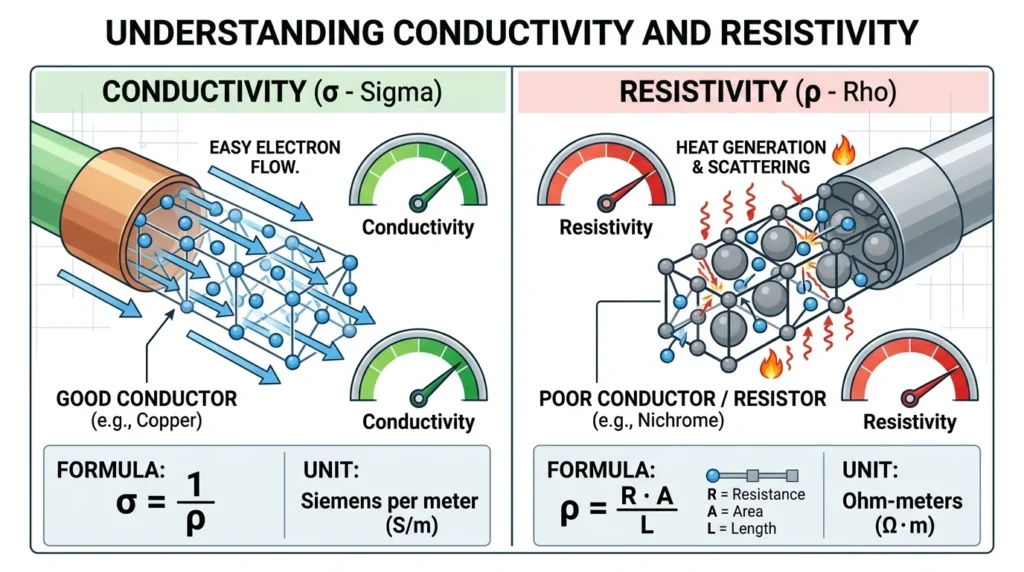
Conductivity is the ability of a material to allow electric current to flow through it easily.
A material with high conductivity allows electrons to move freely with very little resistance.
Simple Explanation
Conductivity tells us how well a material carries electricity.
Practical Example
Copper and aluminum are highly conductive materials, which is why they are widely used in electrical wiring.
Conductivity Formula
\sigma=\frac{1}{\rho}
Where:
- σ = Conductivity
- ρ = Resistivity
What is Resistivity?
Resistivity is the property of a material that opposes the flow of electric current.
A material with high resistivity restricts electron movement.
Simple Explanation
Resistivity tells us how strongly a material resists electricity.
Practical Example
Rubber, glass, and plastic have high resistivity, so they are used as insulating materials.
Resistivity Formula
\rho=R\frac{A}{L}
Where:
- ρ = Resistivity
- R = Resistance
- A = Cross-sectional area
- L = Length of conductor
Conductivity and Resistivity Working Principle
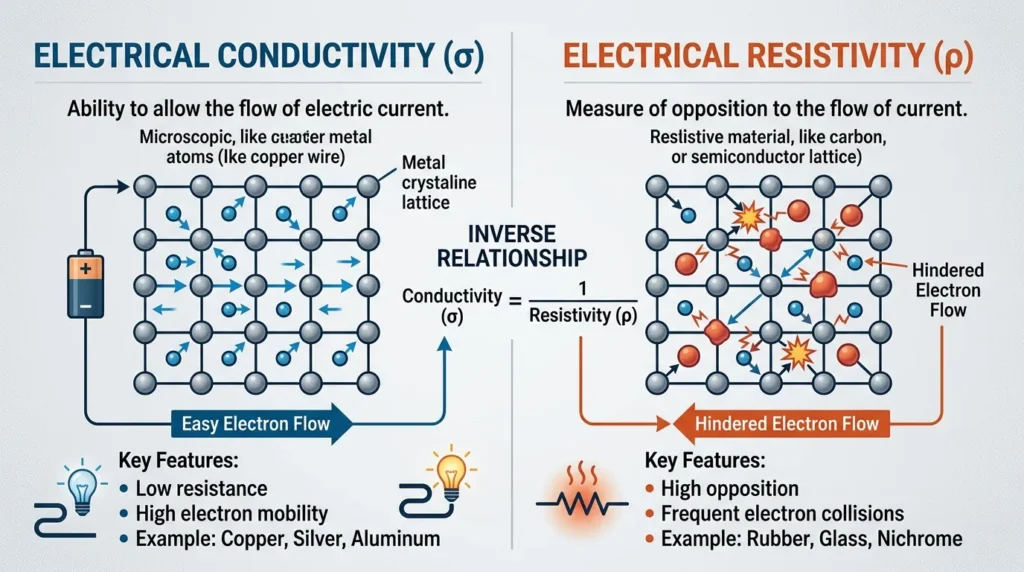
Conductivity and resistivity are electrical properties that determine how easily a material allows electric current to flow. Conductivity is the ability of a material to conduct electricity. Materials with high conductivity, such as copper and aluminum, have many free electrons, allowing current to flow easily. Resistivity is the property of a material that opposes the flow of electric current. Materials with high resistivity, such as nichrome and manganin, resist the movement of electrons and reduce the flow of current. Conductivity and resistivity are inversely related—when conductivity is high, resistivity is low, and vice versa. These properties are important in selecting suitable materials for electrical wiring, resistors, heating elements, and electronic circuits.
Understanding the conductivity and resistivity working principle becomes easier when we study electron movement inside materials.
Step-by-Step Explanation
Atoms Contain Electrons
Every material contains atoms with electrons.
Some materials allow electrons to move easily, while others restrict movement.
Voltage Applies Force
When voltage is applied:
- Electrons begin moving
- Electric current starts flowing
Material Controls Electron Flow
The internal structure of the material determines:
- How freely electrons move
- How much resistance occurs
Conductive Materials Support Current Flow
Conductive materials are substances that allow electric current to flow easily because they contain a large number of free electrons. When a voltage is applied across a conductor, these free electrons move through the material, creating an electric current. Metals such as copper, aluminum, silver, and gold are excellent conductors due to their low electrical resistance. Conductive materials are widely used in electrical wiring, cables, motors, generators, and electronic circuits because they provide efficient and reliable transmission of electrical energy.
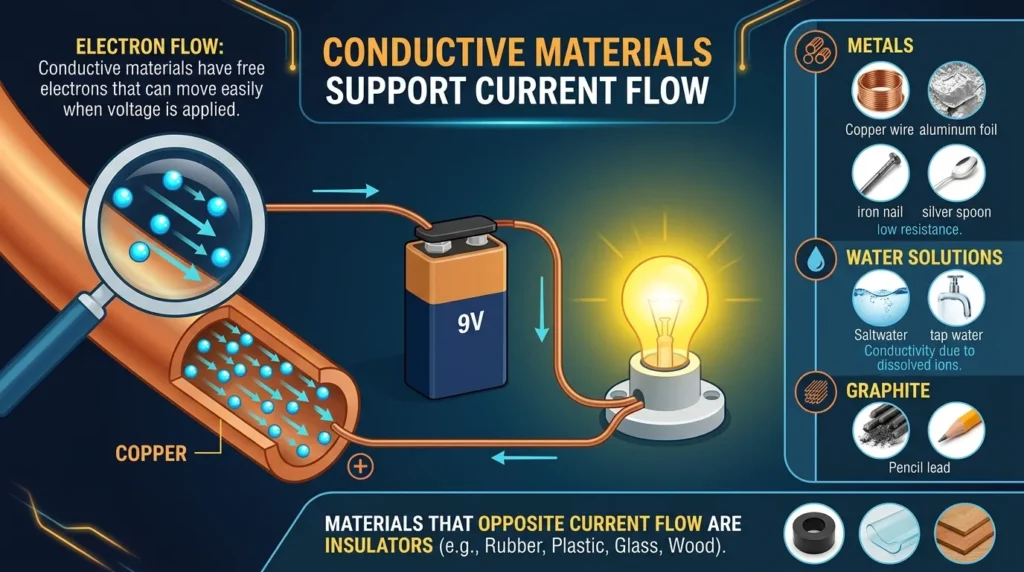
Materials with many free electrons have:
- High conductivity
- Low resistivity
Examples:
- Copper
- Silver
- Gold
Resistive Materials Oppose Current
Materials with tightly bound electrons have:
- High resistivity
- Low conductivity
Examples:
- Rubber
- Wood
- Plastic
Water Pipe Analogy
A simple analogy helps beginners understand conductivity and resistivity.
Conductivity
Imagine a wide, smooth water pipe. Water flows easily with little restriction.
This represents high conductivity.
Resistivity
Now imagine a narrow pipe filled with obstacles. Water struggles to move through it.
This represents high resistivity.
Types / Classification
Types of Conductive Materials
Conductive materials are mainly classified into two types:
Good Conductors – Good conductors have very low electrical resistance and allow electric current to flow easily. They contain a large number of free electrons, making them highly efficient for carrying electricity. Examples include silver, copper, gold, and aluminum. These materials are commonly used in electrical wiring, cables, motors, and electronic circuits.
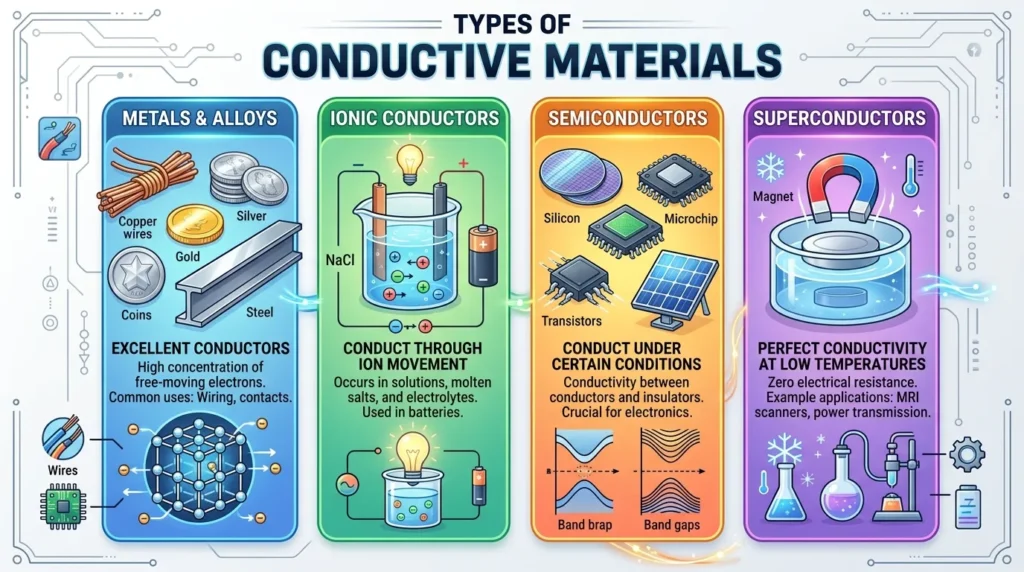
Poor Conductors – Poor conductors have higher electrical resistance and allow only a limited amount of electric current to flow. Although they can conduct electricity, they are much less efficient than good conductors. Examples include iron, steel, lead, and mercury. These materials are used in applications where high conductivity is not the primary requirement.
Good Conductors
These materials allow electricity to flow easily.
Examples
- Silver
- Copper
- Aluminum
- Gold
Features
- Very low resistance
- High efficiency
- Widely used in wiring
Semiconductors
Semiconductors have moderate conductivity.
Examples
- Silicon
- Germanium
Features
- Conductivity changes with temperature
- Used in electronics
Superconductors
Superconductors have almost zero resistance at extremely low temperatures.
Features
- No power loss
- Very high efficiency
Applications
- MRI machines
- High-speed trains
- Scientific research
Types of Resistive Materials
High Resistive Materials – High resistive materials have high electrical resistance and greatly oppose the flow of electric current. They are commonly used in heating elements and electrical resistors because they can withstand high temperatures. Examples include Nichrome, Manganin, Constantan, and Kanthal.
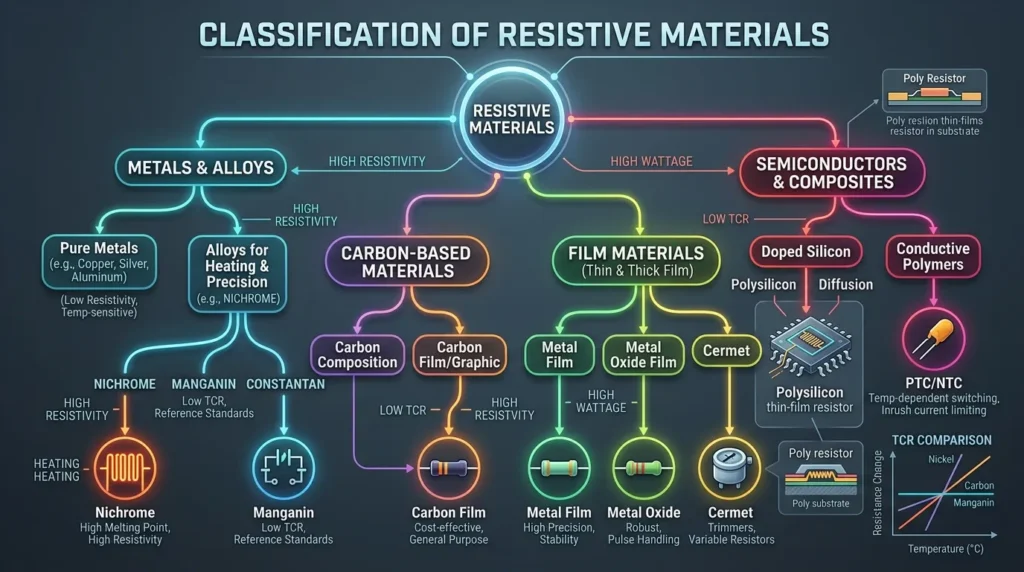
Low Resistive Materials – Low resistive materials have lower electrical resistance compared to high resistive materials but still offer more resistance than good conductors. They are used where controlled resistance is required in electrical and electronic circuits. Examples include Carbon, Graphite, and certain metal alloys.
Resistive materials are widely used in resistors, heating elements, electric heaters, toasters, irons, and other electrical devices where controlling the flow of current is important.
Insulators
Insulators strongly oppose electric current.
Examples
- Rubber
- Plastic
- Glass
- Ceramic
Features
- Very high resistivity
- Used for electrical safety
Resistive Alloys
These materials intentionally provide controlled resistance.
Examples
- Nichrome
- Constantan
Applications
- Heating elements
- Resistors
Main Components
Several factors affect conductivity and resistivity.
Material Structure
The atomic arrangement directly affects electron movement.
Function
Determines how easily current flows.
Free Electrons
Conductive materials contain many free electrons.
Function
Support electric current flow.
Temperature
Temperature significantly affects conductivity and resistivity.
Function
- Higher temperature increases resistance in metals
- Higher temperature improves semiconductor conductivity
Length of Material
Longer conductors usually have higher resistance.
Function
Affects current flow efficiency.
Cross-Sectional Area
Thicker conductors provide lower resistance.
Function
Improves current carrying capacity.
Advantages
Advantages of High Conductivity
Efficient Power Transmission
Conductive materials reduce energy losses.
Lower Heat Generation
Good conductors minimize unwanted heating.
Improved Electrical Performance
High conductivity supports stable current flow.
Better Energy Efficiency
Less resistance means lower power wastage.
Essential for Modern Electronics
Electronic circuits require controlled conductivity.
Advantages of High Resistivity
Improved Electrical Safety
Insulators protect users from electric shock.
Better Circuit Protection
Resistive materials help control current.
Heat Generation Applications
High-resistance materials are useful in heaters and furnaces.
Disadvantages / Limitations
Disadvantages of High Conductivity
Expensive Materials
Silver and gold are highly conductive but costly.
Corrosion Issues
Some conductive materials degrade over time.
Difficult Insulation
Highly conductive materials require proper insulation for safety.
Disadvantages of High Resistivity
Energy Losses
Resistive materials waste energy as heat.
Reduced Efficiency
Excessive resistance lowers system performance.
Voltage Drop Problems
High resistance can reduce voltage in long cables.
Conductivity and Resistivity Applications
Home Applications
Electrical Wiring
Copper wires are used because of excellent conductivity.
Appliance Insulation
Plastic and rubber prevent electric shock.
Heating Appliances
Electric heaters use resistive materials to generate heat.
Industrial Applications
Power Transmission
Aluminum conductors carry electricity over long distances.
Motor Windings
Copper improves motor efficiency.
Electronic Manufacturing
Semiconductors are essential for:
- Computers
- Mobile phones
- Control systems
Modern Technology Applications
Electric Vehicles
Conductive materials improve battery and motor performance.
Renewable Energy Systems
Solar systems depend on efficient conductors and semiconductors.
High-Speed Communication
Modern communication systems use conductive materials for signal transmission.
Comparison Section
Difference Between Conductivity and Resistivity
| Feature | Conductivity | Resistivity |
| Definition | Ability to conduct electricity | Opposition to electric current |
| Symbol | σ | ρ |
| Unit | Siemens/meter | Ohm-meter |
| Current Flow | Supports current | Restricts current |
| High Value Means | Better conduction | Greater resistance |
| Common Materials | Copper, silver | Rubber, glass |
| Relationship | Inverse of resistivity | Inverse of conductivity |
| Applications | Wires and circuits | Insulation and heaters |
Selection Guide
How to Choose the Right Material
Choosing the correct material depends on the electrical application.
Choose High Conductivity Materials When
Applications
- Power cables
- Transformer windings
- Motor coils
- Electronic circuits
Recommended Materials
- Copper
- Aluminum
- Silver
Choose High Resistivity Materials When
Applications
- Electrical insulation
- Heating systems
- Circuit protection
Recommended Materials
- Rubber
- Plastic
- Nichrome
Tips for Beginners
Understand Application Requirements
Always determine whether the material should:
- Conduct electricity
- Resist electricity
Consider Temperature Effects
Temperature changes electrical behavior significantly.
Check Cost and Efficiency
Some materials provide excellent performance but are expensive.
Common Problems & Solutions
Why Do Electrical Wires Overheat?
High resistance causes excessive heat generation.
- Use thicker conductors
- Improve connections
- Reduce overload conditions
Why Does Voltage Drop Happen?
Long cables increase resistance.
- Use low-resistance conductors
- Increase cable size
- Reduce cable length
Why Do Conductors Corrode?
Environmental exposure damages conductive surfaces.
- Use protective coatings
- Perform regular maintenance
- Choose corrosion-resistant materials
Why Do Electronic Components Fail?
Incorrect conductivity properties affect circuit operation.
- Use proper semiconductor materials
- Ensure correct operating temperature
Why Are Insulators Damaged?
Excessive heat or moisture reduces resistivity.
- Replace damaged insulation
- Maintain dry operating conditions
Future Trends
Advanced Conductive Materials
Researchers are developing materials with:
- Higher efficiency
- Lower losses
- Improved durability
Superconductivity Development
Future superconductors may revolutionize:
- Power transmission
- Transportation
- Medical systems
Nanotechnology Applications
Nano-materials are improving conductivity in:
- Electronics
- Batteries
- Communication systems
Smart Grid Technology
Modern smart grids require advanced conductive materials for efficient energy distribution.
Electric Vehicle Growth
Electric vehicles are increasing demand for:
- Lightweight conductors
- High-performance semiconductors
- Advanced insulation materials
Conclusion
Understanding what is conductivity and resistivity is essential for electrical engineering and modern technology. Conductivity explains how easily electricity flows through a material, while resistivity describes how strongly a material opposes current flow. These two properties directly affect efficiency, safety, energy loss, and electrical performance.
Highly conductive materials like copper and aluminum are used in wires, motors, and transmission systems, while high-resistivity materials like rubber and plastic provide insulation and protection. Engineers carefully select materials based on their conductivity and resistivity to ensure safe and efficient operation.
As technology continues advancing through electric vehicles, renewable energy, superconductors, and smart grids, the importance of conductivity and resistivity will continue growing. A strong understanding of these concepts creates a solid foundation for anyone entering the electrical field.