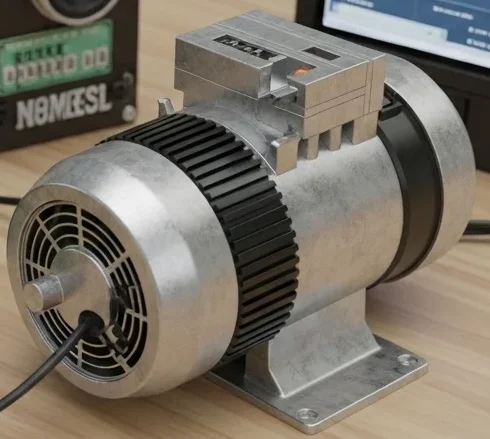

Imagine switching on a water pump, ceiling fan, air conditioner, or industrial conveyor system. In most cases, the machine starts rotating instantly and performs its task smoothly. Behind this reliable operation is one of the most important electrical machines ever developed — the induction motor.
Induction motors are widely used because they are simple, durable, efficient, and economical. In fact, industries around the world depend heavily on induction motors for running machinery, pumps, compressors, elevators, and manufacturing systems. Even many household appliances use induction motors daily without people realizing it.
Understanding the working principle of induction motor is essential for electrical students, engineers, technicians, and beginners because it forms the foundation of electrical machine technology. Once you understand how an induction motor works, it becomes easier to troubleshoot motor problems, select the correct motor type, improve efficiency, and understand industrial automation systems.
In this article, you will learn the induction motor working principle, types, components, advantages and disadvantages, applications, troubleshooting methods, comparison tables, and future trends. The explanations are written in simple and practical language, just like a senior engineer teaching a junior technician.
What is an Induction Motor?
An induction motor is an AC electric motor that converts electrical energy into mechanical energy using electromagnetic induction.
Unlike some other motors, the rotor of an induction motor does not receive direct electrical power. Instead, current is induced in the rotor by the magnetic field created by the stator.
Simple Explanation
An induction motor works because a rotating magnetic field created in the stator induces current in the rotor. This induced current creates torque, causing the rotor to rotate.
Practical Example
Induction motors are commonly used in:
- Ceiling fans
- Water pumps
- Air compressors
- Industrial conveyors
- Washing machines
- HVAC systems
These motors are popular because they require less maintenance and provide reliable operation.
Working Principle of Induction Motor
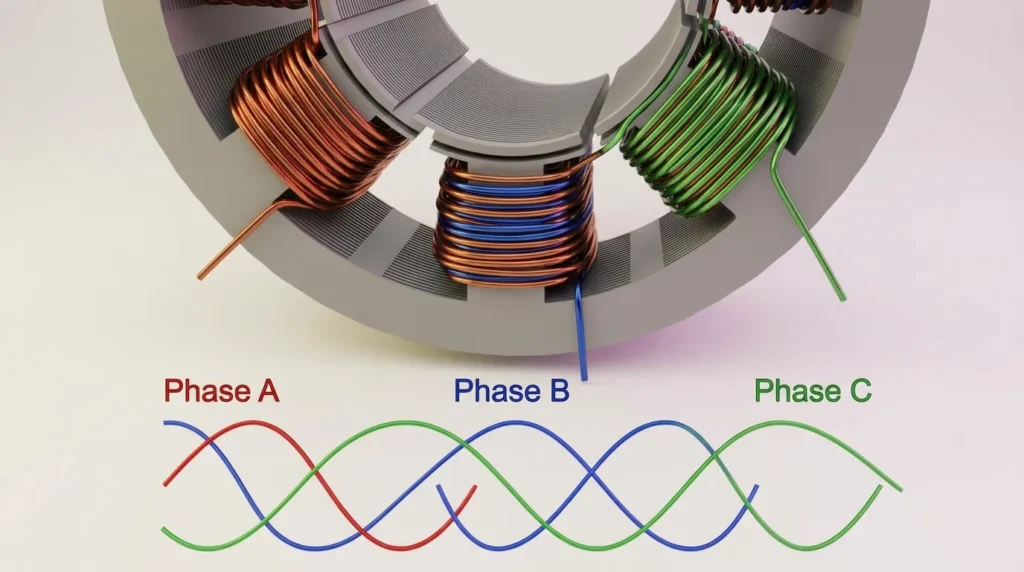
An induction motor works on the principle of electromagnetic induction. When an AC supply is applied to the stator winding, it produces a rotating magnetic field. This rotating magnetic field cuts the rotor conductors and induces an electric current in the rotor. The induced current creates its own magnetic field, which interacts with the stator’s rotating magnetic field to produce torque. As a result, the rotor starts rotating in the same direction as the rotating magnetic field. The rotor always rotates at a speed slightly lower than the synchronous speed, and this difference in speed is called slip, which is necessary for continuous induction of current and torque production.
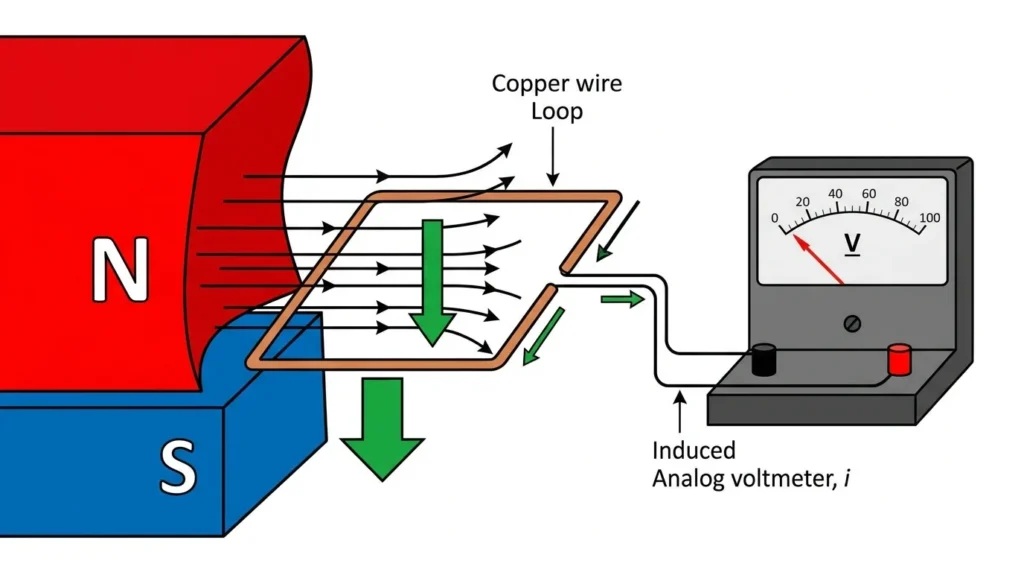
The working principle of induction motor is based on Faraday’s Law of Electromagnetic Induction.
When alternating current flows through the stator winding, it produces a rotating magnetic field. This rotating field cuts the rotor conductors and induces current in them. The interaction between magnetic fields creates torque, causing the rotor to rotate.
Basic Formula
The synchronous speed of an induction motor is:
N_s=\frac{120f}{P}
Where:
- Ns = Synchronous speed
- f = Supply frequency
- P = Number of poles
Step-by-Step Working Process
AC Supply is Applied to the Stator
When an AC supply is applied to the stator winding of an induction motor, an alternating current flows through the winding and produces a magnetic field. In a three-phase induction motor, the three-phase AC supply creates a rotating magnetic field around the stator. This rotating magnetic field is the first step in the operation of the induction motor, as it induces current in the rotor and produces the torque required to rotate the motor. The speed of the rotating magnetic field is called the synchronous speed, which depends on the supply frequency and the number of stator poles.
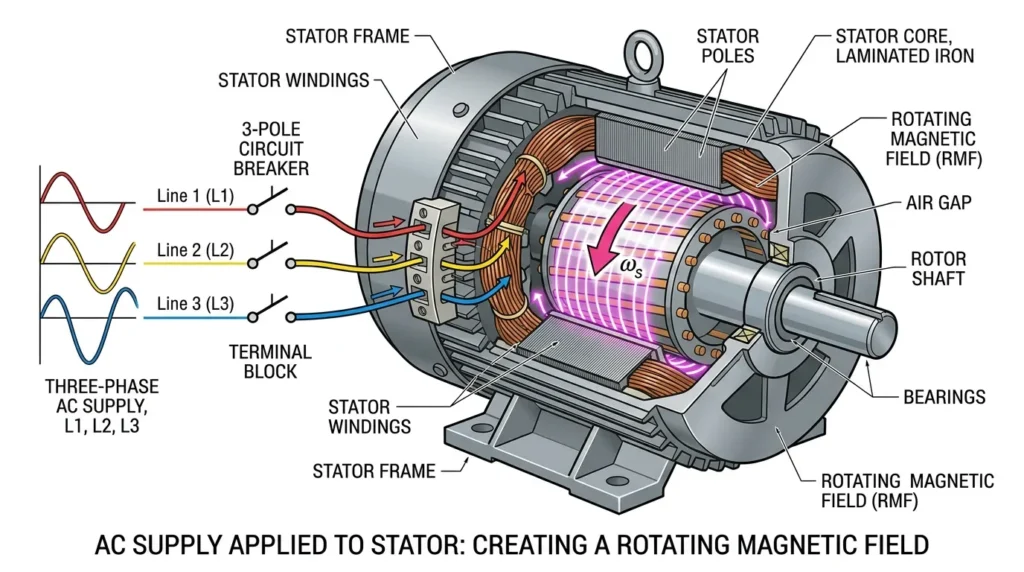
When AC voltage is applied:
- Current flows through stator windings
- Magnetic fields are generated
Rotating Magnetic Field is Produced
The stator windings create a rotating magnetic field.
This field rotates at synchronous speed.
Rotor Conductors are Cut by Magnetic Flux
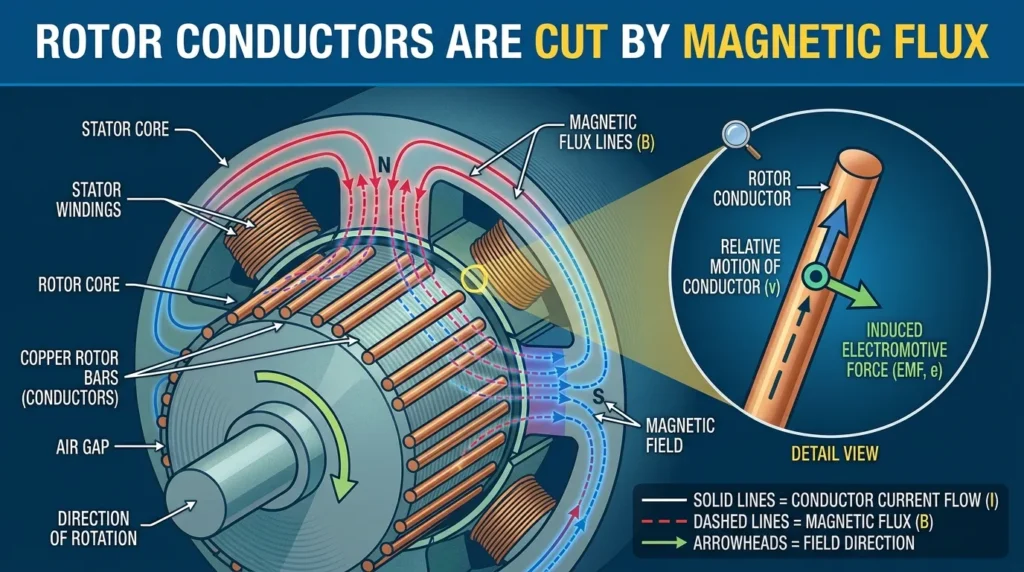
The rotating magnetic field produced by the stator moves across the rotor conductors, causing the magnetic flux to cut the rotor bars. According to Faraday’s Law of Electromagnetic Induction, this changing magnetic flux induces an electromotive force (EMF) and current in the rotor conductors. The induced current creates its own magnetic field, which interacts with the stator’s rotating magnetic field to produce torque. As a result, the rotor begins to rotate in the same direction as the rotating magnetic field.
The rotating magnetic field passes across the rotor conductors.
According to electromagnetic induction:
- Voltage is induced
- Rotor current starts flowing
Rotor Magnetic Field is Generated
The induced rotor current creates its own magnetic field.
Interaction Produces Torque
The stator magnetic field and rotor magnetic field interact.
This interaction creates mechanical torque, causing the rotor to rotate.
Rotor Rotates Below Synchronous Speed
The rotor never reaches synchronous speed.
The speed difference is called slip.
Slip Formula
s=\frac{N_s-N_r}{N_s}\times100
Where:
- s = Slip
- Ns = Synchronous speed
- Nr = Rotor speed
Easy Analogy
Imagine trying to catch a moving train while running behind it.
You must remain slightly slower than the train to keep moving forward.
Similarly, the rotor must rotate slightly slower than the magnetic field for induction to continue.
Types / Classification
Types of Induction Motors
nduction motors are mainly classified into two types based on the type of power supply:
Single-Phase Induction Motor – Operates on a single-phase AC supply and is commonly used in household appliances such as fans, washing machines, refrigerators, and water pumps. It requires a starting method, such as a capacitor or shaded pole, to produce starting torque.
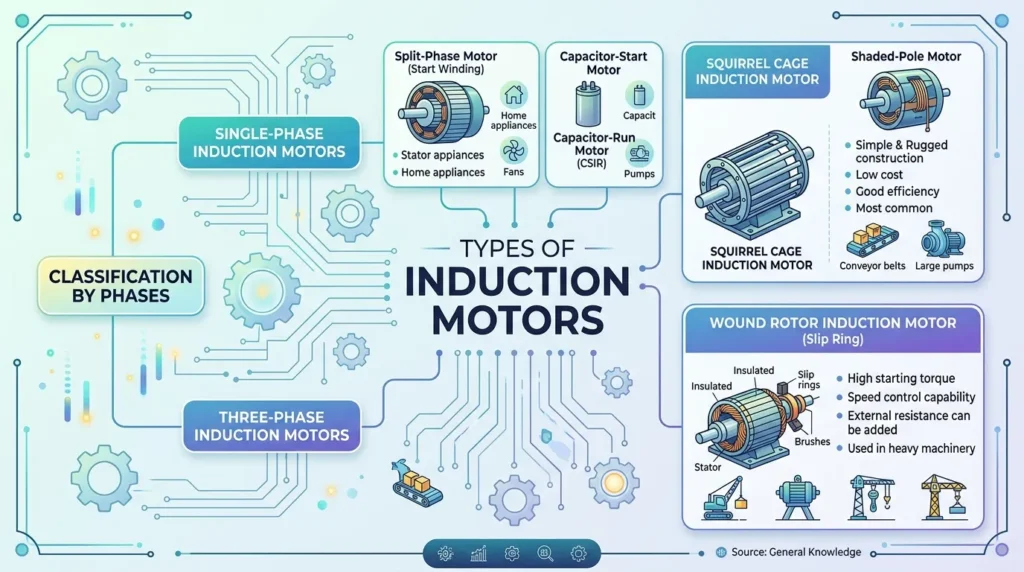
Three-Phase Induction Motor – Operates on a three-phase AC supply and is widely used in industrial applications because it is self-starting, highly efficient, and provides high starting torque. It is commonly used in pumps, compressors, conveyors, machine tools, and other industrial machinery.
Based on rotor construction, three-phase induction motors are further classified into:
- Squirrel Cage Induction Motor
- Slip Ring (Wound Rotor) Induction Motor
Induction motors are mainly classified into two categories.
Single-Phase Induction Motor
Single-phase motors operate using single-phase AC supply.
Features
- Simple design
- Used for low-power applications
- Common in homes
Applications
- Ceiling fans
- Washing machines
- Small pumps
- Air coolers
Three-Phase Induction Motor
Three-phase motors use three-phase AC supply.
Features
- High efficiency
- Self-starting
- Smooth operation
Applications
- Industrial machinery
- Compressors
- Conveyors
- Cranes
Types Based on Rotor Construction
Squirrel Cage Induction Motor
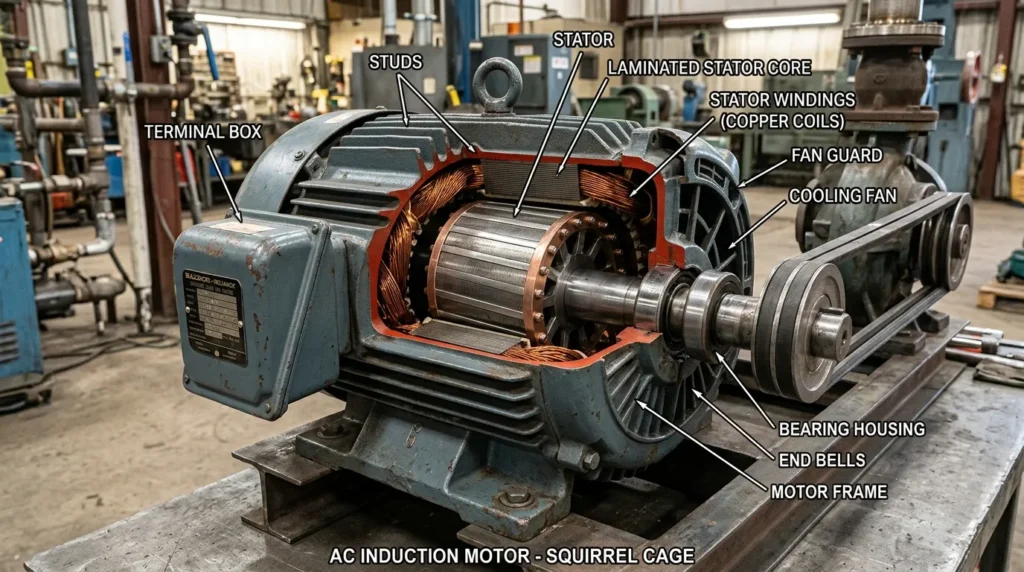
A squirrel cage induction motor is the most common type of three-phase induction motor. Its rotor consists of aluminum or copper bars placed in slots and permanently short-circuited at both ends by end rings, forming a structure similar to a squirrel cage. When the stator is supplied with three-phase AC, it produces a rotating magnetic field that induces current in the rotor bars. The interaction between the induced current and the rotating magnetic field produces torque, causing the rotor to rotate. Squirrel cage induction motors are simple in construction, rugged, reliable, low in cost, and require very little maintenance. They are widely used in pumps, fans, compressors, conveyors, machine tools, and other industrial applications.
The rotor resembles a squirrel cage structure.
Features
- Rugged design
- Low maintenance
- Most widely used
Slip Ring Induction Motor
This motor uses external rotor resistance through slip rings.
Features
- High starting torque
- Speed control capability
Applications
- Cranes
- Elevators
- Heavy machinery
Main Components
Stator
The stator is the stationary outer part of the motor.
Function
- Produces rotating magnetic field
- Contains stator windings
Rotor
The rotor is the rotating part inside the stator.
Function
- Receives induced current
- Produces mechanical rotation
Air Gap
The small space between stator and rotor.
Function
Allows magnetic flux interaction.
Shaft
Connected to the rotor.
Function
Transfers mechanical power to the load.
Bearings
Support smooth rotor rotation.
Function
Reduce friction and vibration.
Cooling Fan
Helps maintain motor temperature.
Function
Prevents overheating.
Advantages
Advantages of Induction Motor
Simple Construction
Induction motors have fewer moving parts.
Low Maintenance
No brushes or commutators are required.
High Reliability
These motors operate efficiently for long periods.
Cost Effective
Manufacturing and maintenance costs are low.
Self-Starting Capability
Three-phase induction motors start automatically.
Good Efficiency
Suitable for continuous industrial operation.
Rugged Design
Can operate in harsh environments.
Disadvantages / Limitations
Disadvantages of Induction Motor
Speed Control is Difficult
Basic induction motors have limited speed control.
High Starting Current
Starting current can be several times higher than rated current.
Lower Starting Torque in Some Types
Squirrel cage motors may have lower starting torque.
Slip Causes Energy Loss
Rotor slip reduces efficiency slightly.
Poor Power Factor at Light Load
Efficiency decreases under low-load conditions.
Induction Motor Applications
Home Applications
Induction motors are widely used in household equipment.
- Fans
- Refrigerators
- Washing machines
- Water pumps
Industrial Applications
Industries rely heavily on induction motors.
- Conveyor belts
- Compressors
- Crushers
- Drilling machines
Commercial Applications
Used in:
- Elevators
- Escalators
- HVAC systems
- Air handling units
Modern Technology Applications
Electric Vehicles
Some EV systems use advanced induction motors.
Automation Systems
Factories use induction motors in automated production lines.
Renewable Energy Systems
Wind energy systems may use induction generators and motors.
Comparison Section
Difference Between Induction Motor and Synchronous Motor
| Feature | Induction Motor | Synchronous Motor |
| Rotor Speed | Less than synchronous speed | Equal to synchronous speed |
| Starting | Self-starting | Requires separate starting |
| Construction | Simple | More complex |
| Maintenance | Low | Higher |
| Cost | Lower | Higher |
| Slip | Present | Zero |
| Efficiency | Good | Very high |
| Applications | General industrial use | Precise speed applications |
Selection Guide
How to Choose the Right Induction Motor
Choosing the correct motor depends on load, speed, environment, and power requirements.
Choose Single-Phase Motor When
Applications
- Home appliances
- Small pumps
- Low-power devices
Advantages
- Easy installation
- Low cost
Choose Three-Phase Motor When
Applications
- Industrial machinery
- Heavy loads
- Continuous operation
Advantages
- Better efficiency
- High reliability
Tips for Beginners
Check Power Rating
Select motor power according to load requirement.
Understand Starting Torque
Heavy loads require high starting torque motors.
Consider Operating Environment
Dusty or wet environments require protected motors.
Check Efficiency
Energy-efficient motors reduce electricity costs.
Common Problems & Solutions
Why Does an Induction Motor Overheat?
Overloading or poor ventilation causes overheating.
- Reduce load
- Clean cooling fan
- Improve ventilation
Why Does the Motor Fail to Start?
Possible causes include:
- Low voltage
- Faulty capacitor
- Damaged winding
- Check power supply
- Test capacitor
- Inspect winding resistance
Why Does the Motor Produce Noise?
Bearing wear or mechanical imbalance.
- Replace bearings
- Align shaft properly
- Tighten mounting bolts
Why Does Motor Speed Drop Under Load?
Excessive load increases slip.
- Reduce load
- Select higher-rated motor
Why Does the Circuit Breaker Trip?
Short circuit or excessive current draw.
- Inspect wiring
- Check insulation
- Measure motor current
Future Trends
Smart Induction Motors
Modern motors now include:
- Sensors
- Remote monitoring
- Predictive maintenance systems
Energy-Efficient Motors
Industries are shifting toward high-efficiency motors to reduce energy consumption.
Variable Frequency Drives (VFDs)
VFD technology improves:
- Speed control
- Energy savings
- Motor performance
Electric Vehicle Applications
Advanced induction motors are becoming important in electric transportation systems.
Industrial Automation Growth
Automation systems increasingly depend on intelligent motor control technologies.
Conclusion
Understanding the working principle of induction motor is essential for electrical students, technicians, engineers, and beginners. Induction motors operate using electromagnetic induction, where the stator creates a rotating magnetic field that induces current in the rotor, producing torque and rotation.
These motors are popular because they are reliable, economical, rugged, and easy to maintain. From household appliances to large industrial machines, induction motors play a major role in modern life. Their advantages and disadvantages help engineers select the correct motor for specific applications.
As industries move toward automation, energy efficiency, and electric transportation, induction motor technology will continue evolving. A strong understanding of induction motor working principles creates a solid foundation for learning advanced electrical machines and industrial systems.