
Every electrical device you own runs on one of two types of current: AC (alternating current) or DC (direct current). Your home sockets supply AC, while your phone battery supplies DC. Understanding the difference between AC and DC is the foundation of all electrical knowledge — and one of the most asked questions by students and beginners.
This guide explains both types in simple language, shows how their waveforms differ, where each is used, and gives you a complete 15-point comparison table. (If you want the transmission-line angle specifically, see our dedicated guide on AC vs DC transmission.)
What Is AC (Alternating Current)?
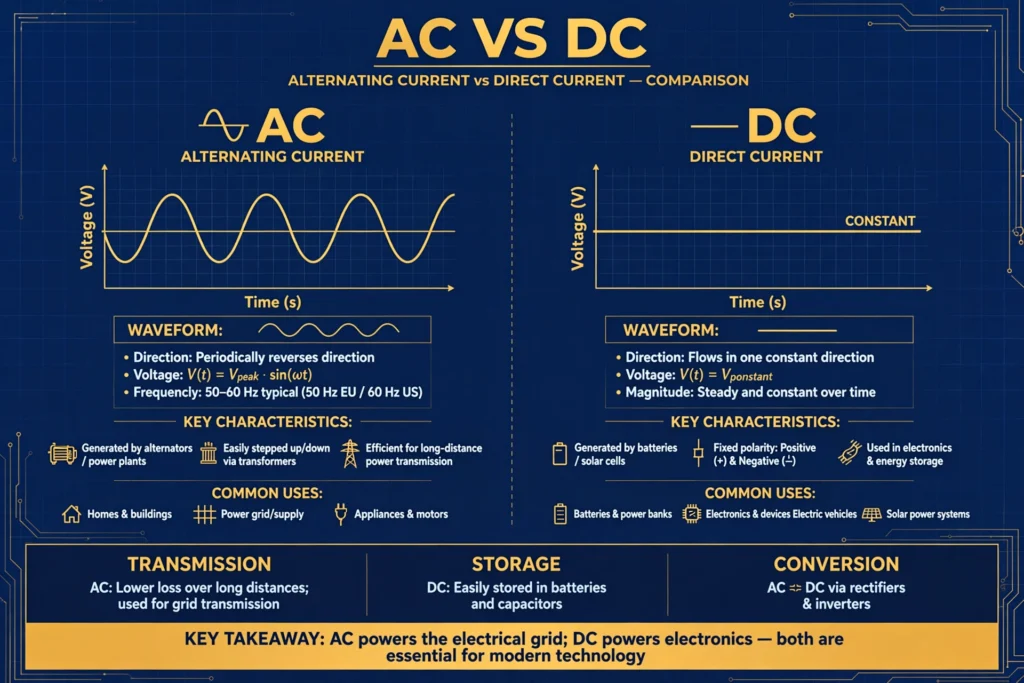
AC is electric current that changes direction many times per second. Imagine water flowing back and forth in a pipe instead of one way — that is what AC does in a wire. In most countries, it reverses direction 50 times per second (50 Hz); in the USA, 60 times per second.
On a graph, AC looks like a smooth wave going up and down — the famous sine wave. Learn to read it in our electrical waveform guide. Because AC voltage keeps changing, we describe it with special values like RMS — explained simply in our RMS value guide. Your wall socket, typically 230 V AC, is the most familiar example.
What Is DC (Direct Current)?
DC is electric current that flows in one direction only, steadily. Think of water flowing one way down a river. Batteries, solar panels, and phone chargers all supply DC. On a graph, pure DC is a flat, straight horizontal line — constant voltage, constant direction.
DC is simple and stable, which is why all electronics — phones, laptops, LED lights — ultimately run on it. Even though your home receives AC, every charger brick converts it to DC first. See how in our AC to DC converter guide.
How Each Is Generated
AC is naturally produced by rotating machines. An alternator in a power station spins magnets past coils, and the rotation itself creates the back-and-forth wave. This is why almost all grid electricity in the world is AC — it is what generators make most easily and cheaply.
DC comes from chemical or light energy: batteries (chemical reactions), solar panels (sunlight), and fuel cells. DC can also be made from AC using a rectifier, and AC can be made from DC using an inverter — the two directions of conversion behind every UPS and solar system.
Where Each Is Used
AC runs the big stuff: home wiring, factories, motors, air conditioners, and the entire power grid. It dominates because it is easy to generate in bulk and its voltage can be raised or lowered cheaply with transformers.
DC runs the small and the modern: phones, laptops, electric vehicles, LED lighting, solar systems, and data centers. Electronics need steady, one-direction current, so DC rules the digital world. Electric cars are a great example — the battery stores DC and the motor controller shapes it as needed.
The 15 Differences at a Glance
| # | Point | AC (Alternating Current) | DC (Direct Current) |
|---|---|---|---|
| 1 | Direction of flow | Reverses direction 50/60 times per second | Flows in one direction only |
| 2 | Waveform | Sine wave (up and down) | Straight flat line |
| 3 | Frequency | 50 Hz or 60 Hz | 0 Hz (no frequency) |
| 4 | Main sources | Alternators, power stations, wall sockets | Batteries, solar panels, fuel cells |
| 5 | Voltage conversion | Easy and cheap with transformers | Needs electronic converters (harder) |
| 6 | Transmission over distance | Efficient for long-distance bulk power | Losses are higher over long AC-style lines |
| 7 | Typical uses | Homes, factories, large motors, grid | Electronics, EVs, mobiles, solar systems |
| 8 | Storage | Cannot be stored directly | Can be stored in batteries |
| 9 | Skin effect | Current crowds to the wire surface | No skin effect (uniform flow) |
| 10 | Safety profile | More dangerous at the same voltage (let-go effect) | Safer at low voltages, still dangerous at high voltage |
| 11 | Power loss in wires | Extra losses from skin effect and reactance | Only simple resistance losses |
| 12 | Motors | AC motors are simple, rugged, cheap | DC motors give easy speed control |
| 13 | Measurement | Needs RMS meters for true readings | Simple average reading is enough |
| 14 | Interruption (switching) | Arc extinguishes at zero crossing — easier | Arc persists — harder to switch off |
| 15 | Future trend | Still dominates grids and homes | Growing fast: EVs, solar, data centers |
Why Do We Use Both?
History decided it: AC won the “war of currents” in the 1890s because transformers made long-distance power cheap, and the grid has been AC ever since. But the digital age runs on DC — every chip, battery, and solar panel speaks DC. So the modern world converts constantly: grid AC becomes device DC through chargers, and solar DC becomes grid AC through inverters.
Neither is “better” in general. AC wins for generation, transmission, and big motors; DC wins for storage, electronics, and steady control. Compare the machines themselves in our AC motor vs DC motor guide, and the supplies behind them in AC power supply and DC power supply.
FAQs
Which is more dangerous, AC or DC?
At the same voltage, AC is generally more dangerous because its alternating nature can cause muscles to grip (the “let-go” effect) and it affects the heart more easily. Both can kill at high voltage — treat every live wire with respect.
Why is our home supply AC and not DC?
Because AC voltage can be stepped up for efficient long-distance transmission and stepped down for safe home use, all with simple, cheap transformers. Doing the same with DC needs expensive electronics.
Can DC be converted to AC?
Yes — a device called an inverter converts DC to AC. Solar systems and UPS units use inverters to feed AC loads from DC sources.
Do phones use AC or DC?
Phones run on DC. The charger brick converts wall-socket AC into the low-voltage DC the battery and circuits need.
What does 50 Hz mean in AC supply?
It means the current completes 50 full back-and-forth cycles every second. The USA uses 60 Hz. Appliances are designed for one or the other.
Will the future be AC or DC?
Both. Grids and homes will stay AC for decades, but DC is growing fast with electric vehicles, solar power, and data centers — many engineers expect more DC microgrids in the future.
Conclusion
AC flows back and forth in a wave; DC flows one way in a steady stream. AC powers our homes and grid because it is easy to generate and transform; DC powers our devices and batteries because electronics need stability. Knowing these 15 differences gives you a solid foundation for everything else in electrical engineering — from waveforms to machines to power systems.
See the Wikipedia article on alternating current.