
Imagine plugging your laptop charger into a wall socket. Your home supplies Alternating Current (AC), but your laptop, smartphone, and many other electronic devices operate on Direct Current (DC). So, how does the electricity from your wall outlet become suitable for your electronic devices? The answer is an AC-DC Converter.
An AC-DC Converter is one of the most widely used power electronic devices in modern electrical and electronic systems. It converts alternating current into direct current, providing stable and reliable power for everything from mobile phone chargers to industrial automation equipment. Without AC-DC converters, many of the devices we use every day simply would not function.
Understanding the AC-DC Converter working principle is important for electrical students, engineers, technicians, and beginners because it forms the foundation of power electronics. Whether you are learning about power supplies, designing electrical circuits, or troubleshooting industrial equipment, knowing how an AC-DC converter works is an essential skill.
In this article, you will learn what an AC-DC Converter is, how it works, its types, components, advantages, disadvantages, applications, comparison with DC-AC converters, selection tips, troubleshooting methods, and future trends in power conversion technology.
What is an AC-DC Converter?
An AC-DC Converter is an electronic device that converts Alternating Current (AC) into Direct Current (DC). This conversion allows electronic devices and electrical equipment to receive a steady DC voltage required for proper operation.
AC electricity changes direction many times every second, while DC electricity flows in only one direction. Since most electronic circuits require a stable DC supply, an AC-DC converter performs this essential conversion.
Simple Explanation
Think of AC power as water flowing back and forth in a pipe, while DC power is like water flowing smoothly in one direction. An AC-DC converter changes the back-and-forth flow into a continuous flow that electronic devices can use.
Practical Example
A mobile phone charger is one of the best examples of an AC-DC converter. It receives 230V AC (or 120V AC in some countries) from the wall socket and converts it into a low-voltage DC output, such as 5V DC, to safely charge your phone.
AC-DC Converter Working Principle
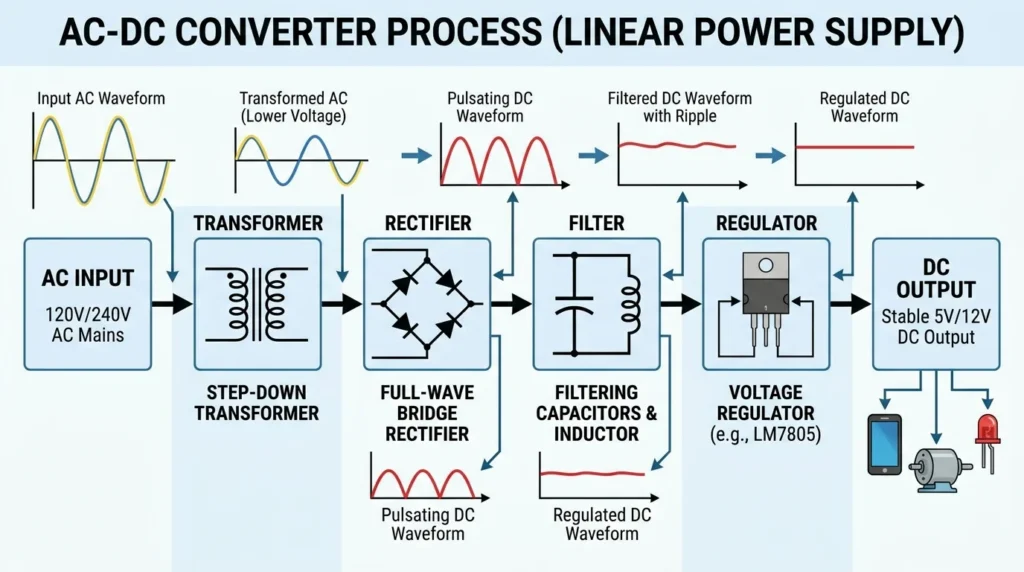
The AC-DC Converter working principle involves converting alternating current into direct current through several stages. These stages ensure that the output voltage is smooth, stable, and suitable for connected equipment.
Step-by-Step Working Principle
AC Input
The converter receives AC voltage from the mains power supply.
Depending on the country, this may be:
- 120V AC
- 230V AC
- 400V AC (industrial systems)
Transformer (Optional)
Many AC-DC converters use a transformer to:
- Increase voltage
- Decrease voltage
- Provide electrical isolation
Modern switching power supplies often use high-frequency transformers after the initial conversion stage.
Rectification
A rectifier, usually made of diodes, converts AC into pulsating DC.
Common rectifier types include:
- Half-wave rectifier
- Full-wave rectifier
- Bridge rectifier
During this stage, current flows in only one direction.
Filtering
The pulsating DC still contains ripples.
A filter, typically using capacitors and sometimes inductors, smooths these ripples to produce a more stable DC output.
Voltage Regulation
A voltage regulator maintains a constant output voltage even if the input voltage or load changes.
This ensures safe operation of connected devices.
DC Output
The converter supplies clean and stable DC voltage to the load.
Examples include:
- 5V DC
- 12V DC
- 24V DC
- 48V DC
Easy Analogy
Imagine filling a water tank from a pump that delivers water in bursts. The filter acts like the tank, smoothing the flow, while the regulator acts like a pressure controller that keeps the water pressure constant regardless of demand.
Types of AC-DC Converter
Different applications require different types of AC-DC converters.
Half-Wave Rectifier Converter
This converter uses only one half of the AC waveform.
Features
- Simple design
- Low cost
- Low efficiency
- High ripple
Applications
- Educational circuits
- Low-power electronics
Full-Wave Rectifier Converter
This type uses both halves of the AC waveform.
Features
- Better efficiency
- Lower ripple
- Higher output power
Applications
- Small power supplies
- Electronic equipment
Bridge Rectifier Converter
A bridge rectifier uses four diodes arranged in a bridge configuration.
Features
- No center-tapped transformer required
- High efficiency
- Widely used
Applications
- Battery chargers
- Consumer electronics
- Industrial power supplies
Linear AC-DC Converter
This converter uses a linear voltage regulator after rectification.
Features
- Low electrical noise
- Simple circuit
- Stable output
- Lower efficiency due to heat dissipation
Applications
- Audio equipment
- Laboratory power supplies
- Precision electronic circuits
Switching AC-DC Converter (SMPS)
A Switching Mode Power Supply (SMPS) converts AC to DC using high-frequency switching.
Features
- High efficiency
- Compact size
- Lightweight
- Wide input voltage range
Applications
- Laptop chargers
- Desktop computers
- LED lighting
- Industrial automation
- Telecommunication equipment
Main Components
An AC-DC converter contains several components that work together to provide a stable DC output.
Input Filter
- Reduces electrical noise
- Protects against electromagnetic interference (EMI)
Transformer
- Changes voltage level
- Provides electrical isolation when required
Rectifier
- Converts AC into pulsating DC
- Usually consists of diodes
Filter Capacitor
- Smooths pulsating DC
- Reduces voltage ripple
Inductor (Optional)
- Further reduces ripple
- Improves output quality
Voltage Regulator
- Maintains constant DC voltage
- Protects connected devices from voltage variations
Heat Sink
- Dissipates heat
- Protects power components
Protection Circuit
- Prevents overload
- Protects against short circuits
- Guards against overvoltage and overheating
AC-DC Converter Advantages
Understanding the AC-DC Converter advantages and disadvantages helps users choose the right converter for different applications.
Advantages
- Converts AC into usable DC power
- High efficiency, especially in switching converters
- Stable output voltage
- Compact and lightweight designs available
- Supports a wide range of input voltages
- Improves device reliability
- Provides electrical isolation in many designs
- Reduces voltage fluctuations
- Available in various power ratings
- Suitable for home, commercial, and industrial applications
- Long service life with proper maintenance
- Built-in protection against overload and short circuits
AC-DC Converter Disadvantages / Limitations
Despite their many advantages, AC-DC converters also have some limitations.
- Initial cost can be higher for advanced models.
- Linear converters generate significant heat.
- Switching converters may produce electrical noise.
- Poor-quality converters have lower efficiency.
- Cooling may be required for high-power applications.
- Harmonics can affect the power supply if filtering is inadequate.
- Components age over time, especially electrolytic capacitors.
- Repairs can be difficult in compact switching power supplies.
AC-DC Converter Applications
The wide range of AC-DC Converter applications makes these devices essential in modern electrical and electronic systems.
Home Applications
- Mobile phone chargers
- Laptop adapters
- LED lighting
- Television power supplies
- Wi-Fi routers
- Smart home devices
Commercial Applications
- Office equipment
- Security systems
- POS terminals
- Network switches
- Printers
Industrial Applications
- PLC control panels
- Industrial automation
- CNC machines
- Robotics
- Motor control systems
- Process control equipment
Medical Applications
- Patient monitoring equipment
- Diagnostic machines
- Laboratory instruments
Renewable Energy
- Solar inverter auxiliary power
- Battery charging systems
- Energy storage equipment
Modern Technology
- Electric vehicle charging systems
- Data centers
- Telecommunication equipment
- IoT devices
- Smart grids
- Consumer electronics
Comparison: AC-DC Converter vs DC-AC Converter
Understanding the difference between AC-DC Converter and DC-AC Converter is important because both perform opposite functions.
| Feature | AC-DC Converter | DC-AC Converter (Inverter) |
| Input | Alternating Current | Direct Current |
| Output | Direct Current | Alternating Current |
| Main Function | Converts AC to DC | Converts DC to AC |
| Common Devices | Phone chargers, power supplies | Solar inverters, UPS systems |
| Output Voltage | Fixed DC levels | AC voltage at required frequency |
| Applications | Electronic equipment | Home backup, renewable energy |
Selection Guide
Choosing the right AC-DC converter depends on the application and electrical requirements.
Determine Output Voltage
Select the required DC output, such as:
- 5V
- 12V
- 24V
- 48V
Calculate Current Requirement
Ensure the converter can supply more current than the connected load requires.
Check Power Rating
Power (Watts) = Voltage × Current
Choose a converter with sufficient power capacity and a safety margin.
Consider Efficiency
- Heat generation
- Energy losses
- Electricity costs
Protection Features
- Overvoltage protection
- Overcurrent protection
- Short-circuit protection
- Thermal protection
Installation Environment
- Indoor or outdoor use
- Temperature
- Humidity
- Dust levels
- Ventilation
Certifications and Quality
Choose products that comply with recognized electrical safety standards and are manufactured by reputable suppliers for reliable long-term performance.
Common Problems & Solutions
Why is there no DC output?
causes:
- Blown fuse
- Faulty rectifier
- Damaged transformer
Solution:
Inspect the input supply, replace damaged components, and verify continuity.
Why is the output voltage low?
causes:
- Overloaded converter
- Aging capacitors
- Faulty regulator
Solution:
Reduce the load, test the capacitors, and replace defective regulators.
Why is the converter overheating?
causes:
- Poor ventilation
- Excessive load
- Cooling fan failure
Solution:
Improve airflow, reduce loading, and inspect cooling components.
Why is the output unstable?
causes:
- Filter capacitor failure
- Loose wiring
- Input voltage fluctuations
Solution:
Replace faulty capacitors, tighten connections, and verify the AC input.
Why is there electrical noise?
causes:
- Switching interference
- Poor grounding
- Inadequate filtering
Solution:
Improve grounding, check EMI filters, and ensure proper cable routing.
Future Trends
Power conversion technology continues to improve as industries demand greater efficiency and smarter power management.
Future developments include:
- Gallium Nitride (GaN) and Silicon Carbide (SiC) semiconductor devices for higher efficiency
- Smaller and lighter high-power converters
- Digital power management with programmable control
- Intelligent fault diagnostics
- Higher power density designs
- Improved electromagnetic compatibility
- Integration with renewable energy systems
- Fast-charging solutions for electric vehicles
- Smart monitoring through IoT connectivity
- More energy-efficient power supplies meeting stricter environmental standards
These innovations will make AC-DC converters more compact, reliable, and capable of supporting the growing demands of modern electrical and electronic systems.
Conclusion
An AC-DC Converter is a fundamental device in power electronics, converting alternating current into stable direct current required by modern electrical and electronic equipment. Understanding the AC-DC Converter working principle helps students and professionals build a strong foundation in electrical engineering, from simple rectifier circuits to advanced switching power supplies. With various types available, including bridge rectifiers, linear converters, and switching mode power supplies, users can select the most suitable option based on efficiency, voltage requirements, and application. Although AC-DC converters have limitations such as heat generation and electrical noise in some designs, their advantages far outweigh these challenges. As technology advances, newer converter designs will continue to improve energy efficiency, reliability, and performance, making them indispensable in homes, industries, renewable energy systems, and future smart electrical networks.