
ImaWhat Is a SCADA System? Working Principle, Components, Types, Applications, and More
Imagine a power distribution company supplying electricity to thousands of homes and industries across a large city. Instead of sending engineers to every substation to check equipment, operators can monitor the electrical network from a central control room. They can view real-time information, receive alarms, identify abnormal conditions, and send control commands to remote equipment. This is made possible by a SCADA System.
A SCADA System stands for Supervisory Control and Data Acquisition. It is a computerized system used to collect information from field equipment, transmit that information to a central control location, display operating conditions, and support supervisory control over industrial processes and geographically distributed assets. SCADA is widely associated with electrical utilities, water systems, pipelines, transportation, manufacturing, and other industrial applications.
Understanding the SCADA System working principle is important for electrical students, engineers, technicians, automation professionals, and beginners because SCADA connects field devices with centralized monitoring and control.
In this guide, you will learn what a SCADA System is, how it works, its main components, types and architectures, advantages and disadvantages, applications, SCADA vs PLC, cybersecurity, troubleshooting, selection factors, and future trends in simple English.
What Is a SCADA System?
A SCADA System is a computerized industrial control system used to collect, process, display, and supervise data from equipment and processes. It allows operators to monitor and control systems from a central location, even when field equipment is located many kilometers away.
The term SCADA means:
- Supervisory – provides high-level monitoring and control.
- Control – allows authorized operators or control logic to send commands.
- Data – collects information from sensors, meters, PLCs, RTUs, and other devices.
- Acquisition – gathers field information and transfers it to the control system.
In a typical SCADA architecture, a control center contains components such as a SCADA/control server, HMI, communication equipment, engineering workstations, and a data historian. Remote field sites may contain RTUs, PLCs, sensors, actuators, and intelligent electronic devices.
Simple Example of a SCADA System
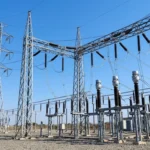
Consider an electrical substation located several kilometers from a utility control center.
The substation may have:
- Voltage sensors
- Current transformers
- Circuit breakers
- Protection relays
- Transformers
- RTUs or PLCs
- Communication equipment
The SCADA System collects important information from the substation and makes it available to operators at the control center.
If a circuit breaker changes state or an abnormal electrical condition occurs, the system can generate an alarm. Depending on the system design and permissions, an operator may also send a command to operate remote equipment.
This allows operators to supervise geographically distributed equipment without physically visiting every location.
SCADA System Working Principle
The SCADA System working principle is based on a continuous cycle of data collection, communication, processing, visualization, alarm generation, and supervisory control.
The basic process can be understood in the following steps.
Field Devices Measure Operating Conditions
The process begins with sensors, meters, instruments, and other field devices.
They can measure parameters such as:
- Voltage
- Current
- Temperature
- Pressure
- Flow rate
- Water level
- Speed
- Equipment status
The measured information is provided to local control devices such as PLCs, RTUs, or intelligent electronic devices.
RTU or PLC Processes Field Information
A Remote Terminal Unit (RTU) or Programmable Logic Controller (PLC) receives information from connected field equipment.
The device may process inputs, execute local control logic, communicate data, and operate connected equipment.
A PLC is commonly used for local machine or process control, while an RTU is frequently used in geographically distributed applications where remote monitoring and communication are important.
RTUs and PLCs can also perform local control without requiring every individual action to be performed directly by the central SCADA operator.
Data Transmission
The processed information is transferred between field locations and the control center through a communication network.
Depending on the application, communication may use:
- Ethernet
- Fiber-optic communication
- Radio
- Cellular networks
- Microwave links
- Telephone or leased lines
- Other wired and wireless communication technologies
SCADA systems are designed to work with communication networks that may connect geographically distributed locations.
SCADA Server Processes the Information
The SCADA server or control server receives information from field devices through the communication network.
It can process incoming information and make it available to operator interfaces. It may also support centralized alarms, trends, reporting, and historical data functions.
In modern SCADA architectures, the control server communicates with lower-level devices such as RTUs and PLCs over an operational technology network.
Human Machine Interface Displays Data
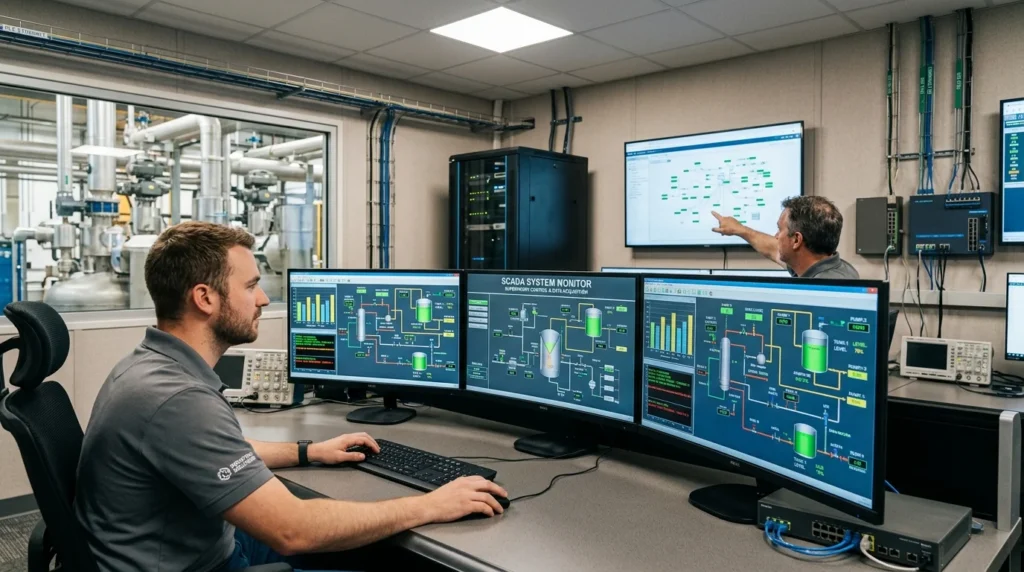
The Human Machine Interface (HMI) provides the graphical interface used by operators.
An HMI can display:
- Equipment status
- Electrical measurements
- Alarms
- Trends
- Graphs
- Process conditions
- Historical information
- Control options
Instead of examining every field device individually, operators can view important system conditions from the control room.
Alarm Generation
When a monitored value moves outside a defined operating range or an abnormal event occurs, the SCADA System can generate an alarm.
For example:
- High transformer temperature
- Low water level
- Excessive pressure
- Breaker status change
- Communication failure
- Equipment fault
Alarms help operators identify abnormal conditions and take appropriate action.
Remote Supervisory Control
Depending on the system design, authorized operators can send commands from the control center to remote equipment.
Examples include:
- Opening or closing a circuit breaker
- Starting or stopping a pump
- Opening or closing a valve
- Changing an operating setpoint
The command travels through the communication network to the appropriate RTU, PLC, or other control device, which then performs the local control action.
SCADA therefore provides centralized supervisory monitoring and control while local control devices continue to perform process-level functions.
Simple SCADA Analogy
Think of a SCADA System as the central control room of a large industrial operation.
Sensors and field devices provide information, RTUs and PLCs handle local inputs and control, the communication network carries information, the SCADA server manages supervisory functions, and the HMI allows operators to see what is happening and issue authorized commands.
Types and Architectures of SCADA Systems
SCADA technology has developed through different system architectures. The following categories help explain how SCADA systems have evolved.
Monolithic SCADA System
Early SCADA systems often used centralized computer architectures with limited networking capabilities.
Main Features
- Centralized processing
- Limited communication
- Standalone architecture
- Less flexible than modern networked systems
These systems are mainly associated with older industrial installations.
Distributed SCADA System
Distributed SCADA systems divide processing and system functions across multiple connected computers.
Main Features
- Distributed processing
- Improved reliability
- Better communication
- Greater flexibility
- Easier expansion
Distributed architectures became useful as industrial networks and computer technology developed.
Networked SCADA System
Modern SCADA systems commonly use network-based communication to connect control centers with remote field sites.
They may use LAN, WAN, fiber, radio, cellular, or other communication technologies.
Main Features
- Remote monitoring
- Network-based communication
- Centralized data collection
- Improved scalability
- Support for geographically distributed equipment
Modern SCADA With IIoT and Cloud Integration
Modern industrial environments may integrate SCADA with Industrial Internet of Things (IIoT) technologies, advanced analytics, edge computing, and cloud services.
These technologies can support:
- Remote access
- Advanced data analysis
- Predictive maintenance
- Mobile monitoring
- Asset management
- Integration with other enterprise systems
However, these technologies should be integrated carefully because connecting industrial control environments to additional networks can introduce new security and reliability considerations. NIST treats SCADA as part of the broader operational technology environment where performance, reliability, and safety are important requirements.
Main Components of a SCADA System
A SCADA System consists of hardware, software, communication equipment, and field devices working together.
Human Machine Interface (HMI)
The HMI is the operator interface.
Main Functions
- Displays real-time information
- Shows alarms
- Displays trends and graphs
- Provides equipment status
- Allows authorized supervisory commands
- Helps operators understand process conditions
SCADA Server or Control Server
The SCADA server manages important supervisory functions.
Main Functions
- Receives field information
- Communicates with RTUs and PLCs
- Processes system information
- Supports alarms
- Provides data to operator interfaces
- Supports historical and reporting functions
NIST describes the control server as a server that hosts control software and communicates with lower-level devices such as RTUs and PLCs.
Programmable Logic Controller (PLC)
A PLC is a programmable industrial controller used primarily for local machine and process control.
Main Functions
- Reads input signals
- Executes programmed logic
- Controls outputs
- Operates connected equipment
- Communicates with higher-level systems
A PLC may operate independently for local control while also exchanging information with a SCADA System.
Remote Terminal Unit (RTU)
An RTU is a field device commonly used to collect information and communicate with a central SCADA system.
Main Functions
- Collects field information
- Processes inputs
- Communicates with the control center
- Controls connected field equipment where designed to do so
- Supports remote monitoring
RTUs are particularly useful in geographically distributed applications such as electrical utilities, pipelines, and water systems.
Sensors and Field Devices
Sensors and instruments provide information about physical conditions.
Examples include:
- Temperature sensors
- Pressure sensors
- Flow meters
- Level sensors
- Voltage measurement devices
- Current measurement devices
- Position sensors
Actuators and Controlled Equipment
Actuators receive control commands and cause physical actions.
Examples include:
- Motors
- Pumps
- Valves
- Circuit breakers
- Switches
- Control devices
Communication Network
The communication network connects field sites with the control center.
It may include:
- Ethernet
- Fiber optics
- Radio
- Cellular communication
- Microwave
- WAN connections
- Other industrial communication technologies
Data Historian and Database
A data historian stores historical process information.
Historical data can help engineers and operators:
- Analyze trends
- Investigate previous events
- Compare operating conditions
- Prepare reports
- Support maintenance decisions
Modern SCADA control centers commonly include data historians along with HMI and control server components.
Intelligent Electronic Devices
In electrical applications, Intelligent Electronic Devices (IEDs) such as protection relays can communicate information directly to SCADA systems.
They may provide measurements, equipment status, protection information, and other operational data.
SCADA System Advantages
The main SCADA System advantages include:
- Real-time monitoring
- Remote supervisory control
- Faster detection of abnormal conditions
- Centralized information
- Historical data storage
- Improved operational visibility
- Reduced need for routine physical inspection
- Better process monitoring
- Automated alarm generation
- Improved maintenance planning
- Support for large and geographically distributed systems
- Better decision-making using historical and real-time data
SCADA is especially useful when equipment is distributed across large geographic areas because operators can monitor many field locations from centralized control facilities.
SCADA System Disadvantages and Limitations
Despite its advantages, a SCADA System also has limitations.
High Initial Cost
Large SCADA installations may require servers, communication equipment, software licenses, field devices, engineering, and cybersecurity measures.
System Complexity
Large systems can become complex because many devices, networks, databases, and software components must work together.
Communication Dependence
If communication links fail, the control center may temporarily lose access to remote data or supervisory control.
Cybersecurity Risks
SCADA systems can face cybersecurity risks when networks, remote access, or connected devices are not properly secured.
Skilled Personnel Required
Installation, programming, troubleshooting, maintenance, and cybersecurity may require trained technical personnel.
Maintenance Requirements
Servers, network equipment, field devices, software, and databases require regular maintenance to maintain reliable operation.
SCADA System Applications
The wide range of SCADA System applications makes it important in many industrial and infrastructure sectors.
Electrical Power Systems
SCADA is widely used for:
- Power generation monitoring
- Transmission systems
- Distribution networks
- Electrical substations
- Load management
- Remote equipment monitoring
SCADA is particularly suitable for electrical systems where equipment is distributed over large geographic areas.
Manufacturing Industry
Applications include:
- Production line monitoring
- Machine supervision
- Process control
- Equipment status monitoring
- Production data collection
Water and Wastewater Treatment
SCADA can monitor and control:
- Water pumps
- Reservoir levels
- Flow rates
- Pressure
- Treatment processes
- Wastewater systems
Water distribution and wastewater systems are established SCADA application areas.
Oil and Gas Industry
SCADA can be used for:
- Pipeline monitoring
- Pump stations
- Compressor stations
- Storage facilities
- Remote equipment
Renewable Energy
SCADA systems can monitor:
- Solar power plants
- Wind farms
- Battery energy storage
- Renewable energy substations
- Power generation parameters
Building Automation
SCADA or related supervisory systems may monitor:
- HVAC systems
- Energy consumption
- Pumps
- Lighting
- Building equipment
Transportation
SCADA technology can support monitoring and control in:
- Railway systems
- Transportation infrastructure
- Tunnel systems
- Traffic-related infrastructure
NIST identifies transportation systems among the areas where SCADA and related industrial control technologies can be used.
SCADA System vs PLC
Understanding the difference between SCADA System and PLC is important because they often work together rather than being direct replacements for each other.
| Feature | SCADA System | PLC |
|---|---|---|
| Main Purpose | Supervisory monitoring and control | Local machine or process control |
| Data Collection | Centralized monitoring and historical collection | Local real-time input processing |
| User Interface | Usually provides or connects to HMI | May have no operator interface |
| Remote Monitoring | Yes | Usually requires an additional supervisory system |
| Data Storage | Can maintain extensive historical data | Primarily handles local process data |
| Alarm Management | Centralized and advanced | Local/basic depending on configuration |
| Multiple Sites | Can monitor multiple sites | Usually controls a local machine or process |
| Control Level | Supervisory | Local/control level |
| Typical Application | Plant-wide or geographically distributed systems | Machine and process automation |
A simple way to remember the difference is:
PLC = local control
SCADA = supervisory monitoring and control
In many industrial systems, the PLC and SCADA System work together. The PLC handles local control while SCADA provides centralized visualization, alarms, data collection, historical information, and supervisory commands.
SCADA System Cybersecurity
Cybersecurity is an important consideration when designing and operating modern SCADA systems.
Because SCADA is part of the broader operational technology environment, security must consider not only computers and networks but also the reliability, safety, and physical processes being controlled. NIST’s OT security guidance specifically addresses threats, vulnerabilities, and security measures for industrial control environments.
Important security practices may include:
- Strong user authentication
- Role-based access control
- Network segmentation
- Secure remote access
- Regular software updates
- Backup and recovery procedures
- Network monitoring
- Secure communication
- Protection of engineering workstations
- Controlled access to field devices
Cybersecurity should be planned as part of the SCADA architecture rather than treated as an afterthought.
How to Choose a SCADA System
Choosing the right SCADA System depends on the application, number of devices, communication requirements, and future expansion.
Define the System Size
Consider:
- Number of field devices
- Number of PLCs and RTUs
- Number of locations
- Number of operators
- Expected future expansion
Check Communication Compatibility
Make sure the SCADA platform can communicate with the PLCs, RTUs, meters, IEDs, and other equipment used in the project.
Consider Scalability
Choose a system that can expand as the number of machines, sensors, and remote sites increases.
Evaluate HMI Usability
The operator interface should make important information easy to understand.
Look for:
- Clear graphics
- Easy navigation
- Alarm displays
- Trend screens
- Useful reports
Check Security Features
Important security capabilities may include:
- User authentication
- Access control
- Secure remote access
- Network security features
- Audit logging
Consider Reliability and Redundancy
Critical applications may require redundant servers, communication paths, power supplies, or other system components to reduce the effect of equipment failures.
Evaluate Technical Support
Good documentation, training, maintenance support, and software updates can be important for long-term SCADA operation.
Common SCADA Problems and Solutions
Why Is the SCADA System Not Receiving Data?
Possible causes include:
- Communication failure
- RTU or PLC offline
- Network problem
- Damaged communication cable
- Incorrect communication settings
Solution: Check the communication network, field device status, network equipment, and communication configuration.
Why Are SCADA Alarms Not Appearing?
Possible causes include:
- Incorrect alarm configuration
- Alarm service problem
- Communication failure
- Database or software issue
Solution: Check alarm configuration, communication status, software services, and event records.
Why Is SCADA Data Updating Slowly?
Possible causes include:
- Network congestion
- High server load
- Communication delays
- Incorrect polling configuration
- Excessive system traffic
Solution: Check network performance, server resources, communication settings, and polling configuration.
Why Can Operators Not Control Equipment Remotely?
Possible causes include:
- Insufficient user permissions
- PLC or RTU communication failure
- Equipment interlock
- Output device problem
- Local control mode enabled
Solution: Check operator permissions, device communication, equipment status, interlocks, and local/remote control settings.
Why Is Historical SCADA Data Missing?
Possible causes include:
- Database problem
- Storage capacity issue
- Historian service failure
- Backup problem
- Incorrect data logging configuration
Solution: Check database health, storage capacity, historian services, logging configuration, and backup systems.
Frequently Asked Questions About SCADA Systems
What does SCADA stand for?
SCADA stands for Supervisory Control and Data Acquisition. It is a computerized system used for centralized monitoring, data collection, and supervisory control of industrial processes and geographically distributed equipment.
What is the main function of a SCADA System?
The main function of a SCADA System is to collect field data, display operating conditions, generate alarms, store historical information, and provide supervisory monitoring and control from a central location.
What are the main components of SCADA?
Common SCADA components include the HMI, SCADA/control server, PLCs, RTUs, communication networks, sensors, actuators, databases, data historians, and other field devices.
Is SCADA the same as a PLC?
No. A PLC is primarily used for local machine or process control, while SCADA provides supervisory monitoring, centralized data collection, visualization, alarms, historical information, and supervisory control. They commonly work together.
Where are SCADA Systems used?
SCADA systems are used in electrical power, water and wastewater, oil and gas, manufacturing, transportation, renewable energy, and other industrial and infrastructure applications.
Can SCADA control equipment remotely?
Yes. Depending on the system design, communication network, permissions, and safety controls, SCADA can allow authorized operators to send supervisory commands to remote PLCs, RTUs, breakers, pumps, valves, and other equipment.
What is the difference between SCADA and HMI?
An HMI is the operator interface used to visualize and interact with a process. SCADA is the broader supervisory system that can include the HMI, control server, communication infrastructure, data collection, alarms, historical data, and other components.
What is an RTU in a SCADA System?
An RTU, or Remote Terminal Unit, is a field device that collects information from remote equipment and communicates with a central SCADA system. It can also perform local control functions depending on its configuration.
Future Trends in SCADA Systems
SCADA technology continues to develop as industrial systems become more connected and data-driven.
Important trends include:
- Industrial Internet of Things (IIoT) integration
- Edge computing
- Cloud-connected industrial applications
- Advanced data analytics
- Digital twin technologies
- Predictive maintenance
- Mobile monitoring
- Stronger cybersecurity
- Renewable energy integration
- Smart grid automation
- Improved interoperability between industrial systems
Modern SCADA development is increasingly connected with broader operational technology, IIoT, and industrial cybersecurity practices.
Why Is a SCADA System Important?
A SCADA System provides a centralized way to understand and supervise complex industrial processes.
Instead of relying only on physical inspections, operators can use real-time information, alarms, trends, historical records, and supervisory controls to manage equipment more effectively.
This is especially valuable for systems that cover large geographic areas, such as electrical distribution networks, pipelines, water systems, and transportation infrastructure.
Conclusion
A SCADA System is the backbone of modern industrial monitoring and supervisory control. By understanding the SCADA System working principle, students and professionals can appreciate how real-time data collection, remote monitoring, and centralized control improve the safety, efficiency, and reliability of electrical and industrial systems. From power plants and substations to manufacturing facilities, water treatment plants, and smart cities, SCADA has become an essential technology for managing complex operations. Although it requires careful planning, secure communication, and skilled maintenance, the benefits of improved productivity, reduced downtime, and better operational control far outweigh its limitations. As industries continue moving toward digital automation and connected infrastructure, learning SCADA concepts will provide a strong foundation for anyone pursuing a career in electrical engineering, industrial automation, or control systems.