
Imagine a power station located hundreds of kilometers away from your city. Yet, when you switch on a light at home, electricity is instantly available. Have you ever wondered how electrical power travels such long distances efficiently?
This is where AC vs DC transmission becomes important. Transmission systems are the backbone of modern power networks. Choosing between alternating current (AC) and direct current (DC) for power transmission affects efficiency, cost, stability, and reliability.
As an electrical student or junior engineer, you must clearly understand the difference between AC and DC transmission. This knowledge is essential for power system design, grid planning, renewable energy integration, and high-voltage systems.
In this article, I will explain the AC vs DC transmission working principle, types, components, advantages and disadvantages, applications, and a detailed comparison. By the end, you will confidently understand when to use AC transmission and when DC transmission is the better choice.
AC vs DC Power Transmission (2026 Edition)
Electrical power generated at power plants must be transmitted efficiently and reliably to industries, commercial facilities, and residential consumers. Two fundamental methods are used for transmitting electrical energy: Alternating Current (AC) transmission and Direct Current (DC) transmission. Both technologies have unique operating principles, advantages, and applications. While AC transmission has been the backbone of electrical power systems for more than a century, modern High Voltage Direct Current (HVDC) technology has become increasingly important for long-distance and renewable energy transmission. Understanding the differences between these two systems is essential for students, engineers, and professionals working in electrical power engineering.
Definition of AC vs DC Transmission
AC vs DC transmission refers to two different methods of transmitting electrical power from generating stations to substations and ultimately to consumers.
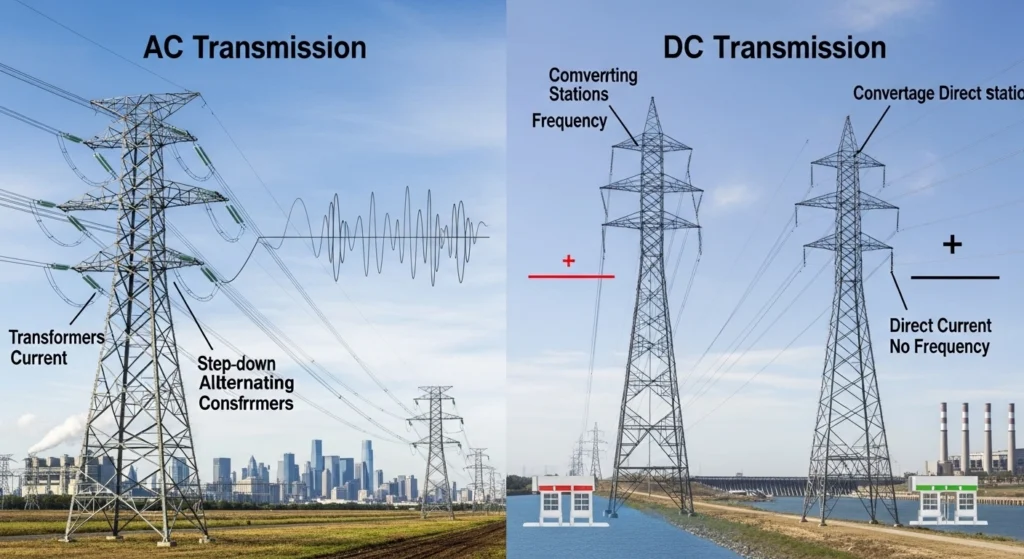
- AC (Alternating Current) Transmission uses alternating current, where the direction and magnitude of current continuously change with time according to a specific frequency (typically 50 Hz or 60 Hz depending on the country’s power system). AC transmission is the most widely used method for national and regional electricity networks because voltage can be easily transformed using transformers.
- DC (Direct Current) Transmission uses direct current, where electrical current flows continuously in a single direction. Modern DC transmission generally employs High Voltage Direct Current (HVDC) technology, which provides high efficiency, lower transmission losses, and superior performance for long-distance power transfer and renewable energy integration.
Simple Explanation
The basic difference between AC and DC transmission lies in the way electrical current flows through the transmission system.
AC Transmission
In an AC transmission system:
- Electrical current changes its direction periodically.
- Voltage and current vary continuously with time.
- Voltage can be easily increased or decreased using transformers.
- High-voltage transmission reduces current and minimizes power losses.
- AC systems are economical for short- and medium-distance transmission.
- Most national electricity grids operate using three-phase AC transmission.
DC Transmission
In a DC transmission system:
- Electrical current flows in only one direction.
- Voltage remains essentially constant during transmission.
- AC generated at power stations is converted into DC using rectifier stations and converted back into AC at the receiving end using inverter stations.
- DC transmission eliminates reactive power flow and reduces line losses.
- HVDC technology is highly efficient for long-distance, high-capacity, and submarine cable applications.
Practical Example
A practical example can be observed in modern power systems around the world. Most national electricity grids use AC transmission because it allows efficient voltage transformation, economical distribution, and easy integration of existing infrastructure. Electricity generated at power plants is transmitted at high AC voltages, stepped down at substations, and finally delivered to homes, businesses, and industries.
In contrast, High Voltage Direct Current (HVDC) transmission is commonly used for:
- Very long-distance bulk power transmission.
- Submarine and underground cable systems.
- Offshore wind farm connections.
- Large hydroelectric projects located far from load centers.
- Cross-border interconnection of asynchronous power grids.
- Long-distance transmission of renewable energy from remote solar and wind farms.
For example, electricity generated by offshore wind farms is often transmitted to the mainland through HVDC submarine cables, where lower transmission losses and improved system stability make DC transmission the preferred solution.
Importance of AC and DC Transmission in Modern Power Systems
As global electricity demand continues to increase in 2026 and beyond, both AC and DC transmission systems play complementary roles in modern power networks. AC transmission remains the preferred choice for conventional transmission and distribution because of its lower infrastructure cost and widespread compatibility. At the same time, HVDC technology is becoming increasingly important for improving transmission efficiency, supporting renewable energy integration, strengthening international power interconnections, and developing future smart grids.
AC vs DC Transmission Working Principle
Understanding the AC vs DC transmission working principle helps you analyz power systems correctly.
AC Transmission Working Principle
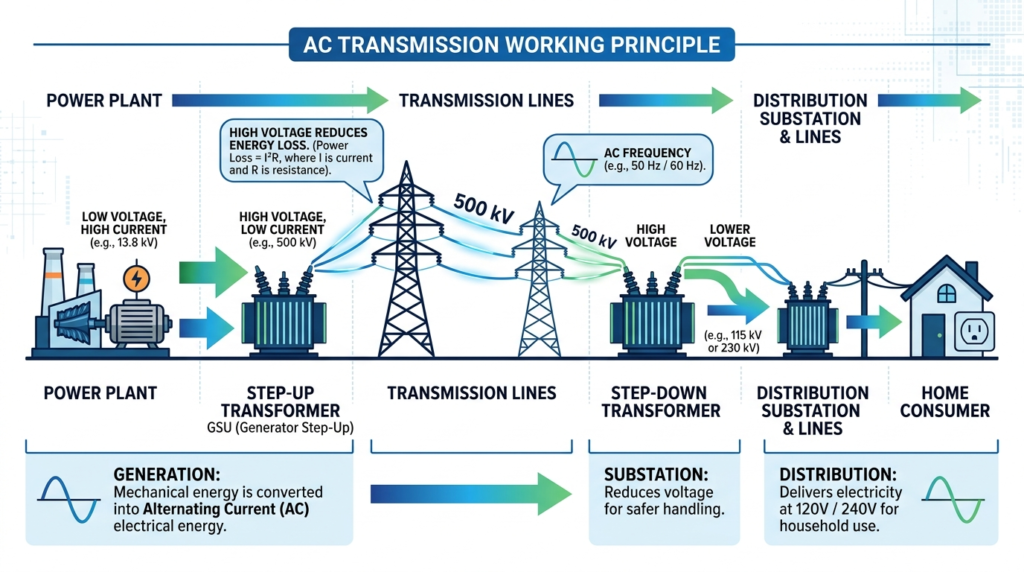
AC transmission working principle is based on the transfer of alternating current electrical power from generating stations to consumers through transmission lines. In this system, electrical energy produced at power plants is converted to high voltage using transformers before transmission. High voltage reduces current flow and minimizes power losses over long distances. The alternating current continuously changes direction and frequency, which allows transformers to easily increase or decrease voltage levels according to system requirements. During transmission, substations reduce the voltage step-by-step for safe distribution to homes, industries, and commercial areas. AC transmission systems are widely used worldwide because they are economical, efficient for long-distance power transfer, and easy to integrate with electrical grids and distribution networks.
Step-by-step explanation:
- Power is generated as AC in generators.
- Voltage is increased using step-up transformer.
- High-voltage AC travels through transmission lines.
- Voltage is reduced using step-down transformer.
- Power is distributed to consumers.
Key idea:
Higher voltage → Lower current → Reduced power loss.
DC Transmission Working Principle
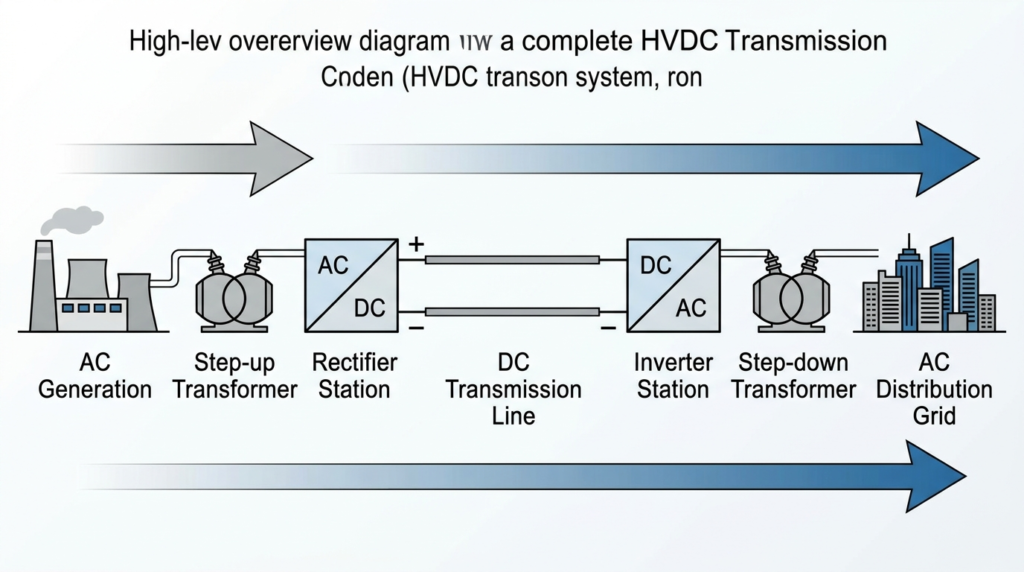
DC transmission working principle is based on the transfer of electrical power using direct current, where the current flows continuously in one direction. In a DC transmission system, alternating current generated at the power station is first converted into direct current using rectifier systems. The high-voltage DC power is then transmitted through transmission lines over long distances with lower power losses and better efficiency. At the receiving end, the DC power is converted back into AC using inverters for distribution and consumer use. DC transmission is especially useful for very long-distance power transfer, underwater cables, and connecting different power grids because it reduces transmission losses, improves stability, and allows better control of power flow. High Voltage Direct Current (HVDC) systems are commonly used in modern renewable energy and international power transmission projects.
Step-by-step explanation:
- AC power is generated.
- Converted into DC using rectifier station.
- High-voltage DC transmitted through lines.
- At receiving end, DC converted back to AC using inverter.
- Power supplied to gr/
Easy Analogy
Think of transporting water:
- AC transmission = water flowing back and forth but controlled easily with valves (transformers).
- DC transmission = water flowing in one direction with strong pressure for long-distance transport.
Types and Classification of AC and DC Power Transmission Systems (2026 Edition)
Power transmission systems are classified according to the type of current used, the transmission configuration, and the method of power delivery. Understanding these classifications helps engineers select the most suitable transmission system based on factors such as transmission distance, power capacity, reliability, installation cost, and operational efficiency. In 2026, both AC and DC transmission technologies continue to play important roles in modern electrical power systems, with each offering different configurations for specific applications.
Types of AC Transmission Systems
AC (Alternating Current) transmission systems are generally classified into single-phase and three-phase systems. Among these, three-phase transmission is the global standard for electrical power transmission because of its superior efficiency and power-handling capability.
Single-Phase AC Transmission
Single-phase AC transmission uses one phase conductor and one neutral conductor to transmit electrical power. This system is simple in design and relatively inexpensive for low-power applications, but it is not suitable for transmitting large amounts of electricity over long distances.
Characteristics
- Uses a single alternating voltage waveform.
- Simple construction and lower installation cost.
- Suitable for light electrical loads.
- Lower transmission efficiency compared to three-phase systems.
- Limited power transfer capability.
Applications
- Residential power supply for small loads.
- Rural electrification in limited-capacity networks.
- Small commercial buildings.
- Lighting circuits and household appliances.
- Low-capacity distribution systems.
Although single-phase transmission remains useful for small-scale applications, it is rarely used for long-distance power transmission because of its lower efficiency and higher conductor requirements.
Three-Phase AC Transmission
Three-phase AC transmission is the most widely used transmission system throughout the world. It uses three conductors carrying alternating voltages that are separated by 120 electrical degrees, providing continuous and balanced power delivery.
Characteristics
- High transmission efficiency.
- Greater power transfer capability.
- Reduced conductor material for the same amount of transmitted power.
- Smooth and continuous power delivery.
- Better voltage regulation and system stability.
- Economical for medium- and long-distance transmission.
Applications
- National power transmission grids.
- Regional electricity networks.
- Industrial power systems.
- Commercial power distribution.
- Large manufacturing plants.
- Renewable energy integration into the AC grid.
Because of its excellent efficiency, reliability, and economic advantages, three-phase AC transmission remains the standard choice for modern electrical power systems worldwide.
Types of DC Transmission Systems
High Voltage Direct Current (HVDC) transmission systems are classified according to the arrangement of their conductors and return paths. Each configuration offers different advantages depending on reliability requirements, installation cost, and operating conditions.
Monopolar HVDC System
A monopolar HVDC system uses a single high-voltage conductor, while the return current flows through the earth or sea using a ground electrode. In some installations, a metallic return conductor may also be used instead of ground return.
Characteristics
- Uses one high-voltage conductor.
- Lower installation cost than bipolar systems.
- Simpler converter station configuration.
- Suitable for lower-capacity HVDC projects.
- Ground return operation may create environmental and corrosion concerns.
Applications
- Pilot HVDC projects.
- Remote power transmission.
- Temporary HVDC installations.
- Small-capacity transmission links.
Although monopolar systems are relatively economical, they are less reliable because a conductor fault can interrupt the entire transmission system.
Bipolar HVDC System
The bipolar HVDC system is the most common and widely adopted HVDC configuration. It consists of two conductors carrying equal positive and negative voltages with respect to ground.
Characteristics
- Uses both positive and negative conductors.
- Higher transmission reliability.
- Improved operational flexibility.
- Lower transmission losses.
- Can continue operating at reduced capacity if one pole is out of service.
- Better voltage stability and fault performance.
Applications
- Long-distance bulk power transmission.
- Cross-border electricity interconnections.
- Offshore wind farm connections.
- Large hydroelectric transmission projects.
- Renewable energy integration into national grids.
Because of its high reliability, operational flexibility, and efficiency, the bipolar HVDC system is considered the preferred configuration for modern long-distance power transmission.
Homopolar HVDC System
A homopolar HVDC system uses two or more conductors operating with the same polarity, while the return current flows through the earth or a metallic return path. Although this configuration was investigated for certain applications, it is rarely used in modern power systems.
Characteristics
- Conductors operate with the same voltage polarity.
- Ground or metallic return path is required.
- Lower insulation requirements.
- Limited practical applications.
- Environmental concerns associated with earth-return current.
Applications
- Experimental transmission systems.
- Specialized research projects.
- Limited industrial installations.
Due to environmental considerations, operational limitations, and the availability of more efficient bipolar systems, homopolar HVDC transmission has become uncommon in modern electrical networks.
Comparison of AC and DC Transmission Classifications
| Transmission Type | Configuration | Main Characteristics | Typical Applications |
|---|---|---|---|
| Single-Phase AC | One phase and neutral | Simple, economical, low power capacity | Residential and small loads |
| Three-Phase AC | Three phase conductors | High efficiency, balanced power, large capacity | National grids, industries, commercial networks |
| Monopolar HVDC | One conductor with ground/metallic return | Low cost, simple design, lower reliability | Small HVDC projects and remote transmission |
| Bipolar HVDC | Positive and negative conductors | Highly reliable, efficient, flexible operation | Long-distance transmission, renewable integration, international interconnections |
| Homopolar HVDC | Two conductors of the same polarity | Rarely used, specialized configuration | Experimental and limited applications |
Main Components of AC and DC Power Transmission Systems (2026 Edition)
The performance, efficiency, and reliability of any power transmission system depend on the proper functioning of its major components. Although AC (Alternating Current) and DC (Direct Current) transmission systems share the common objective of delivering electrical energy from generating stations to consumers, the equipment used in each system differs significantly. AC transmission primarily relies on transformers and substations, whereas DC transmission depends on advanced converter stations and power electronic devices. The following sections explain the major components of both transmission systems in detail.
Main Components of an AC Transmission System
An AC transmission system consists of several interconnected components that generate, transform, transmit, protect, and distribute electrical energy efficiently.
Alternator (Generator)
The alternator is the primary source of electrical energy in an AC power system. It converts mechanical energy from turbines driven by steam, water, wind, or gas into alternating current electricity. Modern power plants use large three-phase synchronous generators capable of producing electricity at high efficiency and stable frequency.
Step-up Transformer
A step-up transformer increases the voltage generated by the alternator to very high transmission levels while reducing current. This process significantly minimizes I²R transmission losses, allowing electricity to be transmitted economically over long distances. Step-up transformers are among the most important components of an AC transmission network.
High-Voltage Transmission Lines
Transmission lines carry electrical energy from generating stations to substations across cities, regions, and countries. These lines are constructed using aluminum or aluminum-alloy conductors supported by steel lattice towers. High-voltage transmission reduces energy losses and increases the efficiency of power delivery.
Substations
Substations serve as control and distribution centers within the transmission network. They regulate voltage levels, monitor power flow, isolate faulty equipment, and distribute electricity to different transmission and distribution circuits. Modern substations also include digital monitoring, automation, and protection systems.
Step-down Transformer
After electricity reaches a receiving substation, step-down transformers reduce the high transmission voltage to safer levels suitable for industrial, commercial, and residential distribution. Multiple stages of voltage reduction may occur before electricity reaches the final consumer.
Circuit Breakers
Circuit breakers protect the transmission system by automatically interrupting current during faults such as short circuits, overloads, or equipment failures. High-voltage circuit breakers help maintain system reliability and prevent damage to expensive electrical equipment.
Protection and Monitoring Equipment
Modern AC transmission systems include protective relays, current transformers (CTs), potential transformers (PTs), surge arresters, communication systems, and Supervisory Control and Data Acquisition (SCADA) equipment. These devices continuously monitor system conditions, detect faults, and improve overall grid reliability.
Transformers remain the key components of AC transmission systems because they enable efficient voltage transformation, reduce transmission losses, and support economical power distribution.
Main Components of a DC Transmission System
A DC transmission system, particularly an HVDC (High Voltage Direct Current) system, uses specialized power electronic equipment to convert and transmit electrical energy efficiently over very long distances.
Rectifier Station
The rectifier station is located at the sending end of the transmission system. It converts alternating current generated by power plants into direct current using advanced semiconductor-based converters. This conversion allows efficient long-distance transmission with reduced losses.
Converter Transformers
Converter transformers provide electrical isolation, voltage matching, and proper voltage regulation between the AC network and converter equipment. They are specially designed to withstand harmonic currents and the unique operating conditions of HVDC systems.
DC Transmission Lines
DC transmission lines carry high-voltage direct current between converter stations. Since DC transmission has no reactive power flow and lower line losses, these lines are highly efficient for long-distance overhead transmission as well as submarine and underground cable systems.
Inverter Station
Located at the receiving end, the inverter station converts direct current back into alternating current before supplying electricity to the AC power grid. Modern inverter stations use sophisticated control systems to ensure stable and efficient power conversion.
Harmonic Filters
Power electronic converters generate harmonics that can affect power quality and system performance. Harmonic filters remove unwanted frequency components, improve waveform quality, reduce electromagnetic interference, and protect connected equipment.
Smoothing Reactors
Smoothing reactors reduce ripple currents in the DC transmission line, stabilize the DC current, limit fault currents, and improve the overall performance of the HVDC system. They are essential for maintaining reliable and efficient power transmission.
Control and Protection Systems
Modern HVDC installations include advanced digital controllers, communication networks, protection relays, sensors, and automation systems. These technologies continuously monitor converter performance, regulate power flow, detect faults, and maintain system stability under varying operating conditions.
Converter stations are considered the heart of DC transmission systems because they perform the essential conversion between AC and DC while controlling power flow, voltage, and system stability.
Advantages, Limitations, Applications, and Comparison of AC vs DC Power Transmission (2026 Edition)
The selection of AC (Alternating Current) or DC (Direct Current) transmission depends on several engineering factors, including transmission distance, installation cost, power capacity, system stability, and efficiency. While AC transmission remains the standard for most national electricity networks, DC transmission—particularly High Voltage Direct Current (HVDC)—has become increasingly important for long-distance and renewable energy applications. The following sections explain the advantages, disadvantages, applications, and major differences between AC and DC transmission systems.
Advantages of AC Transmission
AC transmission has been the backbone of electrical power systems for more than a century because it is economical, reliable, and easy to integrate into existing infrastructure. Its major advantages include:
- Easy Voltage Transformation: AC voltage can be increased or decreased efficiently using transformers, allowing high-voltage transmission with reduced losses and safe low-voltage distribution to consumers.
- Simple System Design: AC transmission equipment, including generators, transformers, and switchgear, has a comparatively simple design and is widely available.
- Lower Converter Cost: Unlike DC systems, AC transmission does not require expensive converter stations for normal operation, reducing initial installation costs.
- Well-Established Technology: AC transmission is supported by mature engineering standards, experienced operators, and extensive global infrastructure.
- Suitable for Short and Medium Distances: AC systems provide an economical solution for regional and national electricity transmission where transmission distances are moderate.
- Easy Grid Expansion: New substations and transmission lines can be integrated into existing AC networks with relatively simple modifications.
Advantages of DC Transmission
DC transmission, especially HVDC technology, offers several significant benefits for modern high-capacity power systems and renewable energy integration.
- Lower Transmission Losses: DC transmission experiences lower line losses over long distances because there is no reactive power flow.
- No Reactive Power Problems: The absence of reactive power improves transmission efficiency and voltage regulation.
- Ideal for Underwater and Underground Cables: HVDC is the preferred technology for submarine and underground cable projects due to lower charging current and better performance.
- Improved Stability Control: Advanced converter technology allows precise control of power flow, improving overall grid stability.
- Interconnection of Asynchronous Grids: HVDC links can connect power systems operating at different frequencies without synchronization.
- Higher Power Transfer Capability: More electrical power can be transmitted through a single corridor compared to conventional AC systems.
- Highly Efficient Beyond 600–800 km: For transmission distances greater than approximately 600–800 km, HVDC generally becomes more economical and energy-efficient than AC transmission because reduced line losses offset the higher converter station costs.
Limitations of AC and DC Transmission
Although both technologies offer important benefits, each also has practical limitations that engineers must consider during system planning and design.
AC Transmission Disadvantages
- Reactive power causes additional transmission losses and voltage drops.
- Skin effect increases the effective resistance of conductors at higher frequencies.
- Long transmission lines may experience voltage stability and power angle stability problems.
- Corona discharge becomes more significant at very high voltages, increasing energy losses and radio interference.
- Transmission efficiency decreases as line length increases because of charging current and reactive power requirements.
DC Transmission Disadvantages
- Converter stations require expensive power electronic equipment, making initial investment costs higher.
- Control and protection systems are more complex than conventional AC systems.
- Electrical power must be converted from AC to DC at the sending end and from DC back to AC at the receiving end.
- Maintenance of converters, cooling systems, and semiconductor devices requires specialized technical expertise.
- HVDC projects are generally economical only for long-distance or high-capacity transmission applications.
Applications of AC and DC Transmission
The choice between AC and DC transmission depends on the intended application, transmission distance, and system requirements.
AC Transmission Applications
AC transmission continues to dominate conventional electricity networks because of its flexibility and widespread infrastructure.
- National power transmission grids
- Regional electricity distribution systems
- Industrial power supply networks
- Urban and metropolitan electricity systems
- Commercial and residential distribution networks
- Conventional thermal, hydroelectric, and nuclear power plants
DC Transmission Applications
HVDC technology is increasingly used where high efficiency and long-distance transmission are required.
- Long-distance bulk power transmission
- Submarine and underground cable systems
- Cross-border and international grid interconnections
- Offshore wind farm integration
- Large-scale solar power transmission from desert regions
- Remote hydroelectric power projects
- Integration of renewable energy into modern smart grids
Modern transmission projects around the world increasingly rely on HVDC technology for efficient bulk power transfer because of its superior long-distance performance, reduced losses, and enhanced grid controllability.
Comparison Between AC and DC Transmission (2026)
| Feature | AC Transmission | DC Transmission |
|---|---|---|
| Current Type | Alternating Current (AC) | Direct Current (DC) |
| Voltage Conversion | Easily performed using transformers | Requires converter stations |
| Transmission Losses | Higher over very long distances due to reactive power | Lower over long distances |
| Initial Installation Cost | Lower | Higher because of converter equipment |
| Reactive Power | Present | Absent |
| Power Flow Control | Limited | Highly controllable |
| Suitable Distance | Short to medium distances | Very long-distance transmission |
| Underwater Cable Performance | Less efficient | Highly efficient |
| Grid Interconnection | Requires synchronized systems | Can connect asynchronous grids |
| Main Applications | National grids and regional distribution | HVDC links, offshore wind, renewable integration, submarine cables |
Summary
Both AC and DC transmission systems are essential components of modern power engineering. AC transmission remains the preferred solution for short- and medium-distance electricity distribution because of its lower installation costs, simple voltage transformation, and established infrastructure. In contrast, HVDC transmission provides superior efficiency, lower energy losses, better power flow control, and improved renewable energy integration for long-distance and high-capacity applications. Future electrical networks are expected to combine both technologies in hybrid AC/DC systems to achieve greater reliability, efficiency, and sustainability.
Frequently Asked Questions (FAQs) About AC and DC Power Transmission (2026 Edition)
As power transmission systems continue to evolve with the growth of renewable energy and smart grid technologies, many students and professionals have questions about the differences between AC (Alternating Current) and DC (Direct Current) transmission. The following FAQs provide detailed explanations of the most common concepts based on modern power system practices in 2026.
Why is AC mostly used in power grids?
AC is the most widely used form of electricity transmission because it is easy and economical to change voltage levels using transformers. Electricity can be transmitted at very high voltages to reduce current and minimize transmission losses, and then safely stepped down to lower voltages for industrial, commercial, and residential use. AC generators used in power plants are also relatively simple, reliable, and cost-effective. In addition, the majority of the world’s existing transmission and distribution infrastructure has been built around AC technology, making it the standard choice for national power grids.
Why is DC better for long-distance transmission?
DC transmission, particularly High Voltage Direct Current (HVDC) technology, is highly efficient for transmitting electricity over very long distances. Unlike AC, DC does not experience reactive power flow, which reduces unnecessary energy losses. HVDC systems also have lower line losses, improved voltage regulation, and better power transfer capability over long transmission corridors. These advantages make DC transmission ideal for connecting remote hydroelectric stations, offshore wind farms, solar power plants, and cross-border interconnections.
What is the reactive power problem in AC systems?
Reactive power is an inherent characteristic of AC systems caused by inductive and capacitive components such as transmission lines, transformers, and electric motors. Although reactive power does not perform useful work, it is necessary for maintaining magnetic and electric fields within electrical equipment. Excessive reactive power, however, increases transmission current, causes additional power losses, produces voltage drops, reduces transmission efficiency, and limits the amount of real power that can be delivered. Modern power systems use capacitor banks, reactors, and Flexible AC Transmission Systems (FACTS) to control reactive power and improve voltage stability.
Is DC transmission more modern than AC transmission?
Yes. While AC remains the dominant technology for conventional power distribution, DC transmission represents one of the most advanced developments in modern power engineering. HVDC systems use sophisticated power electronic converters and digital control technologies to transfer large amounts of electricity efficiently over long distances. They are increasingly used to integrate renewable energy sources, connect isolated power systems, and strengthen international electricity networks. As countries invest in clean energy and smart grids, HVDC technology continues to play a growing role in modern transmission infrastructure.
Can AC and DC power grids work together?
Yes. Modern power systems increasingly combine both AC and DC technologies through converter stations that convert electricity between alternating current and direct current. These converter stations enable seamless interconnection between conventional AC grids and HVDC transmission lines. Hybrid AC/DC networks improve system flexibility, increase transmission capacity, enhance grid reliability, and simplify the integration of renewable energy sources. Many countries are adopting these hybrid transmission networks to create more resilient, efficient, and sustainable power systems.
What is the future of AC and DC transmission systems?
Between 2026 and beyond, experts expect future transmission networks to combine the advantages of both AC and DC technologies. AC systems will continue to serve local and regional distribution because of their flexibility and lower infrastructure costs, while HVDC transmission will expand for long-distance, high-capacity, and renewable energy applications. The integration of smart grids, advanced converter stations, energy storage systems, and digital monitoring technologies will further improve transmission efficiency, reduce energy losses, and ensure stable electricity supply for future generations.
Future Trends in Power Transmission Technology (2026
Power transmission technology is undergoing a major transformation as electricity demand continues to grow and power systems become more interconnected 2026 the global energy sector is expected to focus on improving transmission efficiency, increasing grid reliability, and supporting the rapid expansion of renewable energy sources. Modern transmission networks are evolving from conventional AC systems toward intelligent hybrid AC/DC infrastructures capable of delivering electricity over long distances with minimal losses.
Emerging Developments in Power Transmission
Several advanced technologies are shaping the future of power transmission systems:
- Ultra High Voltage Direct Current (UHVDC): UHVDC technology enables the efficient transmission of very large amounts of electrical power over thousands of kilometers with significantly lower transmission losses. It is becoming increasingly important for connecting remote renewable energy plants to major population centers.
- Smart Grid Technology: Smart grids use digital communication, sensors, automation, and real-time monitoring to improve the efficiency, reliability, and security of electricity transmission. These systems can automatically detect faults, optimize power flow, and support demand-side management.
- Renewable Energy Integration: As solar, wind, and other renewable energy sources continue to expand, transmission systems are being redesigned to accommodate variable power generation. Advanced control systems help maintain grid stability while integrating clean energy into existing networks.
- Advanced Converter Stations: Modern converter stations use high-performance power electronic devices to efficiently convert AC power to DC and vice versa. These stations play a vital role in HVDC and UHVDC transmission projects by improving voltage regulation and reducing energy losses.
- Flexible AC Transmission Systems (FACTS): FACTS devices enhance the controllability and flexibility of AC transmission networks. They improve voltage stability, increase transmission capacity, reduce congestion, and enhance overall system performance without constructing new transmission lines.
Growth of Hybrid AC/DC Transmission Networks
One of the most significant trends expected 2026is the widespread adoption of hybrid AC/DC transmission networks. Instead of replacing existing AC infrastructure, utilities are combining AC and DC technologies to take advantage of the strengths of both systems. Hybrid networks provide greater operational flexibility, improved power quality, better renewable energy integration, and enhanced reliability for future smart grids.
Engineering Priorities for the Future
Power system engineers and researchers are concentrating on several important objectives to meet future energy demands:
- Increasing transmission efficiency and reducing overall energy losses.
- Improving voltage regulation and maintaining grid stability under varying load conditions.
- Supporting large-scale integration of renewable and distributed energy resources.
- Enhancing cybersecurity and digital monitoring of transmission infrastructure.
- Developing environmentally sustainable and cost-effective transmission technologies.
- Expanding long-distance interconnections between regional and national power grids.
- Improving system resilience against natural disasters, equipment failures, and cyber threats.
Future Outlook
The future of power transmission is expected to be characterized by highly automated, intelligent, and environmentally sustainable networks. The combination of UHVDC transmission, smart grid technologies, FACTS devices, advanced converter stations, and hybrid AC/DC systems will enable utilities to deliver electricity more efficiently while supporting the global transition toward clean energy. These innovations will play a critical role in building reliable, flexible, and resilient power systems capable of meeting the growing electricity demands of the coming decades.
Conclusion
Understanding AC vs DC transmission is essential for anyone working in power systems. AC transmission is simple, cost-effective, and widely used in national grids. DC transmission is more efficient for very long distances and submarine cables.
We discussed the AC vs DC transmission working principle, types, components, applications, and AC vs DC transmission advantages and disadvantages. You also learned the difference between AC and DC transmission and how to select the right system.
As a junior engineer, always consider distance, cost, efficiency, and stability when designing transmission systems.
Strong fundamentals in transmission technology will help you build a successful career in power engineering.
keep learning and stay .