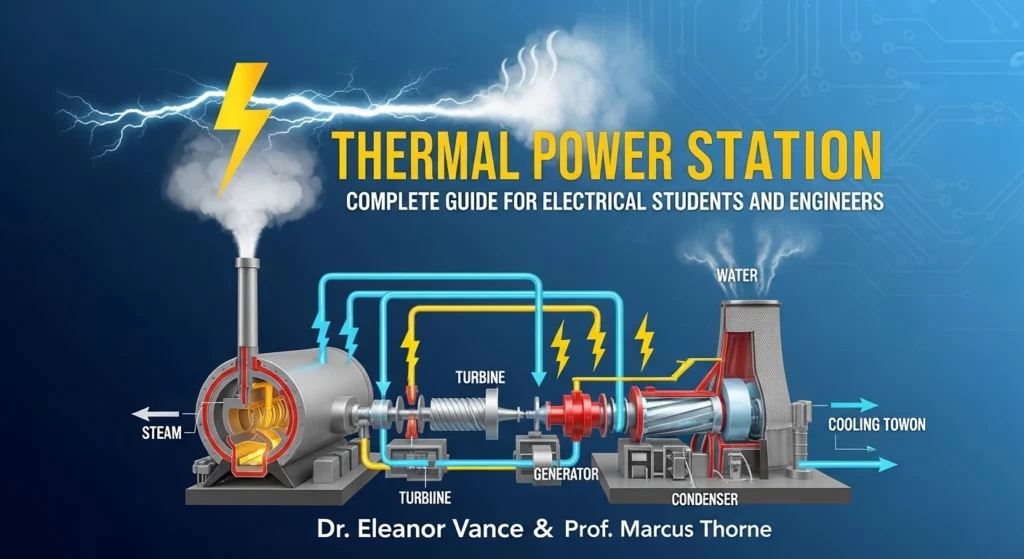

Imagine switching on a light at night. Within a second, your room is bright. Have you ever thought about where that electricity comes from? In many countries, a large portion of electrical power is generated in a thermal power station.
A thermal power station converts heat energy into electrical energy. The heat is usually produced by burning fuel such as coal, oil, or natural gas. This heat creates steam, which rotates a turbine connected to a generator. That generator produces electricity for homes, industries, hospitals, and cities.
Understanding how a thermal power station works is very important for electrical students, engineers, and technicians. It helps you understand power generation, load management, efficiency, and safety.
In this detailed guide, you will learn the thermal power station working principle, types, components, applications, advantages and disadvantages, and future trends in simple and clear language.
Thermal Power Stations (2026 Edition)
A thermal power station is one of the most widely used electricity generation facilities in the world. It generates electrical energy by converting the heat energy obtained from burning fuel into mechanical energy, which is then converted into electrical energy using a generator. Thermal power plants play a vital role in supplying continuous and reliable electricity for residential, commercial, and industrial consumers. Even in 2026, despite the rapid growth of renewable energy sources, thermal power stations continue to contribute significantly to the global electricity supply because of their ability to provide stable base-load power.
Definition
A thermal power station is a power generation plant in which heat energy produced by burning fuels such as coal, natural gas, oil, or biomass is used to convert water into high-pressure steam. The steam drives a steam turbine, which rotates an electrical generator (alternator) to produce electricity. This process is based on the principle of energy conversion, where one form of energy is transformed into another in a controlled and efficient manner.
The primary objective of a thermal power station is to generate a continuous and dependable supply of electrical power while maintaining high efficiency, safety, and environmental compliance.
Simple Explanation of the Working Principle
The operation of a thermal power station follows a sequence of well-defined steps:
Fuel Combustion: Fuel such as coal, natural gas, or oil is burned inside the furnace to produce a large amount of heat energy.
Steam Generation: The heat produced during combustion is transferred to water inside the boiler, converting it into high-pressure, high-temperature steam.
Turbine Rotation: The high-pressure steam flows through the steam turbine, causing the turbine blades and shaft to rotate at high speed.
Electricity Generation: The rotating turbine shaft drives the generator (alternator), which converts mechanical energy into electrical energy using the principle of electromagnetic induction.
Steam Condensation and Recycling: After passing through the turbine, the steam enters the condenser, where it is cooled and converted back into water. The feedwater pump then returns the water to the boiler, allowing the cycle to repeat continuously.
This continuous process enables thermal power stations to generate electricity efficiently for extended periods.
Practical Example
Consider a coal-fired thermal power station as an example. Coal is transported to the boiler furnace and burned under controlled conditions. The combustion process releases a large amount of heat, which is absorbed by water circulating through the boiler tubes. The water is converted into high-pressure steam, which is directed toward the steam turbine.
As the steam expands through the turbine, it rotates the turbine shaft at high speed. The turbine shaft is mechanically connected to an alternator (generator). According to the principle of electromagnetic induction, the generator converts the turbine’s mechanical rotation into electrical energy. The generated electricity is then stepped up to high voltage using transformers and transmitted through the electrical grid to homes, industries, hospitals, schools, and commercial facilities.
After leaving the turbine, the steam is cooled in the condenser, converted back into water, and pumped back into the boiler, completing a continuous Rankine Cycle.
Energy Conversion Process
The operation of a thermal power station is based on a systematic energy conversion process:
Chemical Energy (Fuel) → Heat Energy (Combustion) → Mechanical Energy (Steam Turbine) → Electrical Energy (Generator)
Each stage of this energy conversion process is carefully designed to maximize efficiency while minimizing energy losses. Modern thermal power stations also incorporate advanced technologies such as supercritical boilers, high-efficiency turbines, digital automation, and emission control systems to improve overall performance.
Importance of Thermal Power Stations
Thermal power stations remain essential because they:
Utilize advanced technologies to improve efficiency and reduce environmental impacts.
Provide reliable and continuous base-load electricity.
Support national power grids during periods of high demand.
Supply electricity to residential, commercial, and industrial sectors.
Complement renewable energy sources by ensuring grid stability.
Thermal Power Station Working Principle
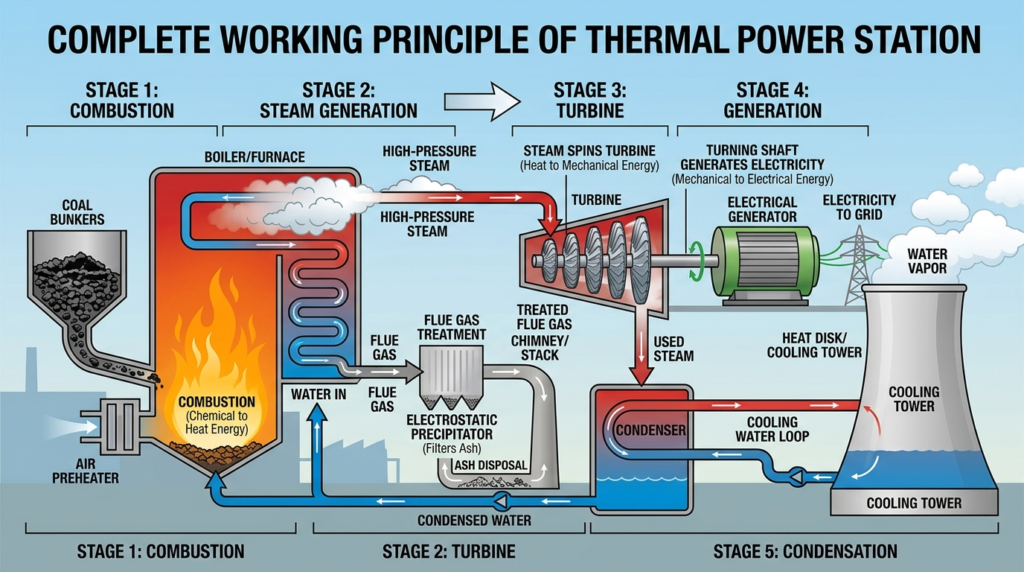
The thermal power station working principle is based on the Rankine cycle, which is a thermodynamic cycle used to convert heat into work.Thermal power station working principle is based on the conversion of heat energy into electrical energy. In a thermal power plant, fuel such as coal, oil, or natural gas is burned in a boiler to produce high-temperature steam. This high-pressure steam flows through a turbine and causes the turbine blades to rotate. The turbine is connected to an electrical generator, which converts the mechanical energy of the rotating turbine into electrical energy through electromagnetic induction. After passing through the turbine, the steam is cooled in a condenser and converted back into water for reuse in the boiler. Thermal power stations are widely used for large-scale electricity generation because they can produce continuous and reliable electrical power for homes, industries, and commercial systems..
Let’s understand it step-by-step using a simple analogy.
Think of it like a pressure cooker connected to a fan:
Fuel Combustion
- Coal or gas burns in a furnace.
- Heat is produced.
Boiler Operation
- Water inside the boiler absorbs heat.
- Water turns into high-pressure steam.
Steam Expansion in Turbine
- Steam flows to the turbine.
- High-pressure steam pushes turbine blades.
- Turbine rotates.
Generator Action
- Turbine shaft is connected to a generator.
- When the turbine rotates, the generator produces electricity.
Condensation
- Used steam goes to a condenser.
- Steam cools down and becomes water again.
Feedwater Pump
- Water is pumped back into the boiler.
- The cycle repeats.
In Simple Points
- Burn fuel
- Produce steam
- Rotate turbine
- Generate electricity
- Condense steam
- Reuse water
This continuous cycle runs 24/7 in large power plants.
Types and Classification of Thermal Power Stations (2026 Edition)
Thermal power stations are classified according to the type of fuel used and the power generation technology employed to produce electricity. Although all thermal power plants generate electrical energy by converting heat into mechanical energy and then into electricity, the source of heat and the operating process vary from one plant to another. Each type offers different advantages in terms of efficiency, fuel consumption, environmental impact, operating cost, and application. In 2026, advancements in cleaner technologies, digital automation, and emission control systems have significantly improved the performance of modern thermal power stations.
Coal-Fired Thermal Power Station
A coal-fired thermal power station uses coal as its primary fuel to generate heat. The heat produced in the boiler converts water into high-pressure steam, which drives a steam turbine connected to an electrical generator.
Characteristics
- Uses coal as the primary energy source.
- One of the most widely used power generation technologies worldwide.
- Suitable for continuous base-load electricity generation.
- Large generating capacity, often ranging from several hundred megawatts (MW) to more than 1,000 MW.
- Equipped with boilers, steam turbines, condensers, and pollution control systems.
Advantages
- Reliable continuous power generation.
- Abundant fuel availability in many countries.
- Well-established and proven technology.
- Suitable for large-scale industrial and national electricity supply.
Limitations
- Produces greenhouse gas emissions and air pollutants.
- Requires ash handling and emission control equipment.
- High fuel transportation and storage requirements.
Modern coal-fired plants increasingly use supercritical and ultra-supercritical boiler technologies to improve efficiency and reduce emissions.
Gas-Fired Power Station
A gas-fired power station uses natural gas as its primary fuel. Natural gas burns more cleanly than coal and produces fewer emissions, making it an attractive option for modern electricity generation.
Characteristics
- Uses natural gas for combustion.
- Lower emissions than conventional coal-fired plants.
- Faster plant start-up and shutdown.
- Compact plant design.
- High operational flexibility.
Advantages
- Cleaner combustion with reduced CO₂, SO₂, and particulate emissions.
- Higher efficiency, particularly in combined-cycle operation.
- Lower maintenance requirements.
- Suitable for meeting peak electricity demand.
Applications
- Urban power generation.
- Industrial power supply.
- Peak-load and intermediate-load power stations.
- Grid balancing alongside renewable energy sources.
Oil-Fired Power Station
An oil-fired power station generates electricity by burning diesel fuel or heavy fuel oil to produce steam for turbine operation.
Characteristics
- Uses diesel or heavy fuel oil.
- Simple fuel handling compared to coal.
- Quick start-up capability.
- Smaller generating capacity than large coal plants.
Advantages
- Fast response during emergency power requirements.
- Reliable operation for standby generation.
- Suitable for isolated or remote areas.
Applications
- Emergency backup power plants.
- Remote industrial facilities.
- Island power systems.
- Temporary electricity generation.
Because of higher fuel costs and environmental concerns, oil-fired power stations are generally used only when continuous operation is not economically practical.
Combined Cycle Power Plant (CCPP)
A Combined Cycle Power Plant (CCPP) combines a gas turbine with a steam turbine to maximize electricity generation efficiency. The hot exhaust gases from the gas turbine are used to produce steam in a Heat Recovery Steam Generator (HRSG), which then drives the steam turbine.
Characteristics
- Uses both gas and steam turbines.
- Recovers waste heat for additional power generation.
- Significantly higher thermal efficiency than conventional thermal plants.
- Lower fuel consumption per unit of electricity generated.
Advantages
- Thermal efficiency often exceeds 60%.
- Lower greenhouse gas emissions.
- Reduced fuel costs.
- Improved environmental performance.
- Faster construction compared to conventional coal-fired stations.
Applications
- Utility-scale electricity generation.
- Industrial cogeneration systems.
- High-efficiency power plants.
- Modern smart grid integration.
Combined-cycle technology has become one of the fastest-growing forms of thermal power generation because of its excellent efficiency and lower environmental impact.
Nuclear Thermal Power Station
A nuclear thermal power station generates heat through controlled nuclear fission reactions instead of burning fossil fuels. The heat produced is used to convert water into steam, which drives a steam turbine connected to an electrical generator.
Characteristics
- Uses uranium or other nuclear fuels.
- Produces heat through nuclear reactions.
- Generates large amounts of continuous electricity.
- Extremely low direct carbon emissions during operation.
- Requires advanced safety and radiation protection systems.
Advantages
- Very high power generation capacity.
- Reliable base-load electricity supply.
- Low greenhouse gas emissions during operation.
- Small fuel requirements compared to fossil-fuel plants.
- Long operating life.
Limitations
- Very high construction cost.
- Complex safety and regulatory requirements.
- Radioactive waste management challenges.
- Longer construction period than conventional thermal plants.
Despite these challenges, nuclear thermal power stations continue to play a major role in providing low-carbon electricity in many countries.
Comparison of Thermal Power Station Types
| Type | Primary Fuel | Efficiency | Environmental Impact | Typical Applications |
|---|---|---|---|---|
| Coal-Fired Power Station | Coal | Moderate | High emissions | Base-load electricity generation |
| Gas-Fired Power Station | Natural Gas | High | Lower emissions than coal | Peak-load and utility power generation |
| Oil-Fired Power Station | Diesel or Heavy Fuel Oil | Moderate | Higher fuel cost and emissions | Backup and emergency power supply |
| Combined Cycle Power Plant | Natural Gas + Waste Heat | Very High | Lower emissions | High-efficiency electricity generation |
| Nuclear Thermal Power Station | Uranium | High | Very low direct carbon emissions | Continuous large-scale base-load power |
Main Components of a Thermal Power Station (2026 Edition)
A thermal power station consists of several interconnected components that work together to convert the chemical energy of fuel into electrical energy. Each component performs a specific function in the power generation cycle, ensuring efficient, reliable, and continuous electricity production. Understanding these components is essential for electrical and mechanical engineers, plant operators, and engineering students because the performance of the entire power plant depends on the proper operation of every unit. The following sections explain the major components of a modern thermal power station based on current engineering practices in 2026.
Boiler
The boiler is the heart of a thermal power station. It converts water into high-pressure, high-temperature steam by transferring heat generated from fuel combustion. Modern boilers are designed to maximize heat transfer efficiency while minimizing fuel consumption and emissions.
Functions
- Converts water into superheated steam.
- Acts as the primary heat exchange unit.
- Supplies high-pressure steam to the steam turbine.
- Improves overall plant efficiency through efficient combustion and heat recovery.
Modern power plants commonly use supercritical and ultra-supercritical boilers to achieve higher thermal efficiency and lower environmental emissions.
Furnace
The furnace is the combustion chamber where fuel such as coal, natural gas, oil, or biomass is burned. The heat produced during combustion is transferred to the boiler tubes to generate steam.
Functions
- Burns fuel to produce thermal energy.
- Maintains the required combustion temperature.
- Supports efficient steam generation.
- Provides continuous heat for boiler operation.
Efficient furnace design reduces fuel consumption and improves combustion performance.
Steam Turbine
The steam turbine converts the thermal energy of high-pressure steam into mechanical energy. As steam expands through multiple turbine stages, it rotates the turbine shaft at high speed.
Functions
- Converts steam energy into rotational mechanical energy.
- Drives the electrical generator.
- Operates at high rotational speeds with excellent efficiency.
- Forms the primary mechanical power source of the power station.
Modern turbines are designed with advanced blade technology to maximize energy conversion efficiency.
Generator (Alternator)
The generator, also known as the alternator, converts the mechanical energy supplied by the steam turbine into electrical energy through the principle of electromagnetic induction.
Functions
- Produces three-phase alternating current (AC).
- Converts mechanical rotation into electrical power.
- Supplies electricity to the transmission network.
- Maintains stable voltage and frequency during operation.
Large thermal power stations use high-capacity synchronous generators capable of producing hundreds of megawatts of electrical power.
Condenser
The condenser receives low-pressure exhaust steam from the steam turbine and converts it back into water by removing latent heat using cooling water.
Functions
- Condenses exhaust steam into water.
- Maintains a high vacuum at the turbine exhaust.
- Improves turbine efficiency.
- Allows recycled water to be reused in the boiler.
A properly functioning condenser significantly increases the overall efficiency of the Rankine cycle.
Cooling Tower
The cooling tower removes excess heat from the circulating cooling water before it returns to the condenser. This process ensures efficient condenser operation and stable plant performance.
Functions
- Dissipates unwanted heat into the atmosphere.
- Cools circulating water for reuse.
- Maintains optimum condenser temperature.
- Improves plant thermal efficiency.
Cooling towers help reduce water consumption by allowing continuous recycling of cooling water.
Feedwater Pump
The feedwater pump delivers condensed water from the condenser back to the boiler at high pressure. It is one of the most important auxiliary components in the steam cycle.
Functions
- Pumps feedwater into the boiler.
- Maintains the required boiler pressure.
- Ensures continuous steam generation.
- Supports stable plant operation.
Modern feedwater pumps are designed for high efficiency and reliable long-term operation.
Chimney (Stack)
The chimney, also known as the stack, safely releases flue gases produced during fuel combustion into the atmosphere after passing through pollution control equipment.
Functions
- Discharges combustion gases safely.
- Maintains proper furnace draft.
- Supports effective air circulation.
- Works with pollution control systems such as electrostatic precipitators (ESPs), scrubbers, and flue gas desulfurization (FGD) units to reduce emissions.
Modern thermal power stations incorporate advanced emission control technologies to comply with environmental regulations.
Auxiliary Equipment
In addition to the major components, thermal power stations include several auxiliary systems that support efficient and safe plant operation.
These include:
- Air preheaters.
- Economizers.
- Superheaters and reheaters.
- Coal handling systems.
- Ash handling systems.
- Water treatment plants.
- Lubrication systems.
- Instrumentation and control systems.
- Fire protection and safety systems.
These auxiliary units enhance efficiency, improve reliability, and reduce operating costs.
Advantages, Limitations, and Applications of Thermal Power Stations (2026 Edition)
Thermal power stations remain one of the world’s primary sources of electricity generation because they provide reliable and continuous power for residential, commercial, and industrial consumers. Despite the rapid growth of renewable energy, thermal power plants continue to play a significant role in maintaining grid stability and meeting base-load electricity demand. Understanding their advantages, limitations, and applications helps students and engineers evaluate where thermal power generation is most suitable in modern energy systems. The following sections provide a detailed explanation based on current industry practices in 2026.
Advantages of Thermal Power Stations
Thermal power plants offer several technical and economic advantages that make them an essential component of many national power systems.
Lower Initial Construction Cost
Compared with hydroelectric and nuclear power plants, thermal power stations generally require a lower initial investment. They can be constructed in a shorter time with comparatively lower civil engineering costs, making them attractive for countries seeking rapid expansion of electricity generation.
Installation Near Load Center
Thermal power plants can be built close to cities, industries, and major load centers, reducing transmission distances and minimizing transmission losses. This also improves the reliability of electricity supply.
Less Dependence on Weather Conditions
Unlike solar and wind power plants, thermal power stations can operate throughout the year regardless of sunlight, rainfall, or wind conditions. This ensures a stable and predictable electricity supply.
Reliable Continuous Power Generation
Thermal power plants are capable of providing continuous base-load electricity, making them highly reliable for supporting national power grids. They can operate for long periods without interruption when adequate fuel is available.
Suitable for Large-Scale Electricity Production
Modern thermal power stations can generate hundreds or even thousands of megawatts of electricity, making them suitable for supplying large industrial zones, metropolitan cities, and interconnected power networks.
Easier Operation Than Nuclear Plants
Although thermal plants require skilled operators, their operation, maintenance, and safety procedures are generally less complex than those of nuclear power plants. This reduces training requirements and simplifies plant management.
Flexible Fuel Options
Many thermal power plants can operate using different fuels such as coal, natural gas, oil, biomass, or a combination of these fuels. This flexibility improves energy security and fuel availability.
Mature and Proven Technology
Thermal power generation has been used for more than a century and is supported by well-established engineering standards, experienced personnel, and readily available equipment.
These advantages continue to make thermal power stations an important source of electricity in many countries, particularly where reliable base-load generation is required.
Limitations of Thermal Power Stations
Although thermal power plants provide dependable electricity, they also have several environmental, technical, and economic limitations.
Air Pollution
Combustion of fossil fuels releases pollutants such as carbon dioxide (CO₂), sulfur dioxide (SO₂), nitrogen oxides (NOₓ), and particulate matter. These emissions contribute to climate change, acid rain, and air quality problems unless advanced pollution control systems are installed.
High Fuel Consumption
Thermal power plants require a continuous supply of coal, natural gas, or oil. Fuel transportation, storage, and handling significantly increase operating costs.
Lower Efficiency Compared with Combined-Cycle Plants
Conventional steam thermal power stations generally have lower thermal efficiency than modern combined-cycle gas turbine (CCGT) plants, which utilize waste heat to generate additional electricity.
Large Cooling Water Requirement
Steam turbines require effective cooling systems to condense exhaust steam. Consequently, thermal power stations consume large quantities of cooling water, making site selection dependent on nearby water resources.
Environmental Impact of Ash Disposal
Coal-fired plants generate fly ash and bottom ash, which require safe collection, transportation, recycling, or disposal. Improper ash management can cause environmental pollution.
high maintenance expenses.
Boilers, turbines, condensers, pumps, and other rotating equipment require regular inspection, servicing, and replacement of worn components, resulting in relatively high maintenance expenses.
Greenhouse Gas Emissions
Thermal power generation remains one of the largest contributors to greenhouse gas emissions worldwide, encouraging governments to invest in cleaner technologies and renewable energy sources.
Because of these challenges, many countries are modernizing existing thermal plants with cleaner technologies while gradually increasing the share of renewable energy in their electricity generation mix.
Applications of Thermal Power Stations (2026 Edition)
Thermal power stations supply electricity to a wide variety of sectors and continue to play a crucial role in supporting modern economies.
Residential Applications
Thermal power plants provide electricity for everyday household activities, including:
- Domestic lighting systems.
- Home appliances such as refrigerators, air conditioners, and washing machines.
- Electric heating and cooling equipment.
- Residential water pumping systems.
- Household electronic devices and communication equipment.
Industrial Applications
Industries require a stable and continuous electricity supply, making thermal power plants an important source of industrial energy.
Common applications include:
- Manufacturing factories.
- Heavy machinery operation.
- Steel production plants.
- Cement manufacturing industries.
- Chemical and fertilizer plants.
- Oil refineries.
- Mining operations.
Commercial Applications
Commercial establishments depend on reliable electricity for uninterrupted operations.
Examples include:
- Shopping malls.
- Office buildings.
- Hospitals and healthcare facilities.
- Educational institutions.
- Hotels and restaurants.
- Airports and railway stations.
- Data centers and communication networks.
Grid Support Applications
Thermal power stations provide essential services for maintaining the stability and reliability of electrical power systems.
These include:
- Continuous base-load power generation.
- Frequency regulation and grid stability support.
- Voltage support through reactive power control.
- Emergency backup generation during periods of high electricity demand.
- Integration support for intermittent renewable energy sources such as wind and solar.
Future Industrial Importance
Although renewable energy continues to expand rapidly, thermal power stations are expected to remain important in many countries because they provide dependable electricity when renewable generation is unavailable. Modern thermal plants equipped with advanced emission control systems, digital automation, and carbon reduction technologies will continue supporting national electricity grids during the transition toward cleaner energy systems.
Comparison Between Thermal and Hydroelectric Power Stations (2026 Edition)
Selecting the most suitable power generation technology requires evaluating several technical, economic, and environmental factors. Among the most widely used electricity generation methods are thermal power stations and hydroelectric power stations. Both play an essential role in meeting global electricity demand, but they differ significantly in terms of energy source, operating cost, environmental impact, installation requirements, and efficiency. The following comparison provides a detailed overview of the key differences between these two types of power plants based on modern engineering practices in 2026.
Difference Between Thermal and Hydroelectric Power Stations
| Feature | Thermal Power Station | Hydroelectric Power Station |
|---|---|---|
| Energy Source | Fossil fuels such as coal, natural gas, or oil | Flowing or stored water from rivers and dams |
| Fuel Cost | High because fuel must be purchased continuously | Very low since water is the primary energy source |
| Environmental Impact | Higher emissions of CO₂, SO₂, NOₓ, and particulate matter | Very low direct emissions during operation |
| Installation Location | Can be built near fuel sources or load centers | Requires suitable rivers, reservoirs, or dams |
| Initial Construction Cost | Moderate | Very high due to dam and civil engineering works |
| Operating Cost | Relatively high because of fuel and maintenance expenses | Low after construction is completed |
| Plant Start-Up Time | Moderate; requires boiler and steam system preparation | Fast; turbines can begin generating quickly |
| Efficiency | Generally 30–45%, depending on plant technology | Often exceeds 85–90% turbine efficiency |
| Maintenance Requirements | Higher because of combustion equipment and moving components | Lower compared to thermal plants, though dam maintenance is essential |
| Service Life | Typically 30–40 years with proper maintenance | Often 50–100 years or more with periodic upgrades |
| Renewable Energy Source | No (uses non-renewable fossil fuels unless biomass is used) | Yes, utilizes renewable water resources |
| Best Applications | Continuous base-load and industrial power generation | Renewable electricity generation and peak-load support |
This comparison helps engineers, planners, and students understand the strengths and limitations of each technology when selecting the most appropriate power generation system for a particular region or project.
Power Plant Selection Guide (2026 Edition)
Choosing the right power plant is one of the most important decisions in power system planning. The selection depends on technical requirements, fuel availability, environmental considerations, economic feasibility, and future electricity demand. A carefully planned power station ensures reliable electricity generation while minimizing long-term operating costs and environmental impacts.
Key Factors to Consider
Before selecting a power generation technology, engineers should carefully evaluate the following factors:
Fuel Availability
The availability and transportation cost of fuel significantly influence plant selection. Regions with abundant coal or natural gas may favor thermal power plants, whereas areas with large rivers and reservoirs are better suited for hydroelectric projects.
Environmental Regulations
Modern environmental laws require power plants to minimize emissions and reduce their ecological impact. Compliance with air quality standards, carbon reduction policies, water management regulations, and waste disposal requirements is essential during project planning.
Land and Water Availability
The amount of available land and water resources affects the feasibility of different power plants. Thermal plants require land for boilers, fuel storage, cooling systems, and ash disposal, while hydroelectric plants require suitable river valleys, reservoirs, and dam construction sites.
Power Demand
The expected electricity demand determines the size and capacity of the power plant. Rapidly growing industrial regions may require large base-load generating stations, whereas smaller communities may benefit from compact or renewable energy facilities.
Budget and Economic Feasibility
Both initial investment and long-term operating expenses should be evaluated. Although hydroelectric plants require substantial construction costs, they generally have lower operating costs. Thermal plants usually require lower initial investment but involve continuous fuel and maintenance expenses.
Grid Connection and Transmission Infrastructure
The selected power plant should be located where electricity can be efficiently connected to the existing transmission network. Adequate substations, transmission lines, and grid stability are essential for reliable power delivery.
Reliability and Future Expansion
Engineers should also consider future electricity demand growth, plant expansion capability, maintenance requirements, and integration with renewable energy and smart grid technologies.
Practical Tips for Beginners in Power Plant Selection
Students and new engineers can improve their understanding of power plant planning by following these practical guidelines:
- Study the expected electrical load and demand profile before selecting a generation technology.
- Calculate both initial investment costs and long-term fuel expenses.
- Evaluate plant efficiency and expected operating performance.
- Consider environmental impacts such as emissions, water consumption, and waste generation.
- Analyze the availability of natural resources, including fuel and water.
- Compare operating and maintenance requirements of different plant types.
- Ensure compatibility with the existing electrical grid and transmission network.
- Consider future energy policies, renewable integration, and sustainability goals.
Importance of Sustainable Power Plant Planning
Modern power engineering emphasizes not only reliable electricity generation but also environmental responsibility and economic sustainability. Engineers must balance efficiency, cost, energy security, and ecological protection when selecting a power plant. Increasingly, projects combine conventional generation with renewable energy technologies, energy storage systems, and digital monitoring to create cleaner and more resilient power systems.
Frequently Asked Questions (FAQs) About Thermal Power Plants (2026 Edition)
Thermal power plants are complex facilities that involve boilers, turbines, generators, condensers, cooling systems, and numerous auxiliary equipment. During operation, engineers and technicians may encounter various technical issues that affect plant efficiency, reliability, and safety. The following Frequently Asked Questions (FAQs) provide detailed explanations of common operational problems, their causes, and practical solutions based on modern thermal power plant practices in 2026.
Why is the efficiency of a thermal power plant relatively low?
The overall efficiency of a thermal power plant is lower than 100% because energy conversion takes place through several stages, and each stage involves unavoidable losses. Heat produced by burning fuel is converted into steam, the steam drives the turbine, and the turbine rotates the generator to produce electricity. During these processes, significant energy is lost in the boiler, turbine, condenser, and other auxiliary equipment due to friction, heat transfer, exhaust steam losses, and mechanical inefficiencies.
Solution
Plant efficiency can be improved by:
- Using superheaters and reheaters to increase steam temperature and reduce moisture content.
- Installing high-efficiency steam turbines with improved blade design.
- Employing supercritical or ultra-supercritical boiler technology.
- Optimizing combustion through advanced burner control systems.
- Performing regular maintenance of boilers, turbines, and heat exchangers.
- Monitoring plant performance using digital automation and AI-based optimization systems.
These measures help increase thermal efficiency, reduce fuel consumption, and lower operating costs.
Why does the condenser vacuum decrease?
The condenser maintains a vacuum to maximize turbine efficiency by reducing the exhaust steam pressure. A reduction in condenser vacuum usually indicates that air or non-condensable gases are entering the system or that the cooling process is not functioning effectively.
Causes
- Air leakage through condenser joints or seals.
- Insufficient cooling water flow.
- Fouled or scaled condenser tubes.
- Cooling tower performance problems.
- Vacuum pump malfunction.
- High cooling water temperature.
Solution
To restore proper condenser vacuum:
- Inspect and repair air leakage points.
- Check condenser seals and gaskets.
- Clean condenser tubes regularly to remove deposits.
- Ensure adequate cooling water circulation.
- Maintain cooling towers and circulating water pumps.
- Test and service vacuum pumps and ejector systems.
Maintaining a proper condenser vacuum improves turbine performance, increases plant efficiency, and reduces fuel consumption.
Why is ash handling important in thermal power plants?
Coal-fired thermal power plants produce large quantities of bottom ash and fly ash during combustion. If ash is not removed efficiently, it can accumulate inside boilers, ducts, and ash collection equipment, reducing heat transfer efficiency, restricting gas flow, increasing maintenance requirements, and causing operational problems.
Importance of Efficient Ash Handling
- Maintains continuous boiler operation.
- Prevents blockage of combustion equipment.
- Improves heat transfer efficiency.
- Reduces environmental pollution.
- Protects plant equipment from excessive wear.
- Supports safe disposal and recycling of ash.
Solution
Modern thermal power plants use advanced ash handling systems, including:
- Hydraulic ash handling systems.
- Pneumatic ash conveying systems.
- Mechanical conveyors.
- Electrostatic precipitators (ESPs) for fly ash collection.
- Automated ash storage and disposal facilities.
Proper ash management ensures reliable plant operation while minimizing environmental impacts.
What causes turbine vibration?
Steam turbines rotate at extremely high speeds, making them highly sensitive to vibration. Excessive vibration can damage bearings, shafts, blades, and couplings if not corrected promptly.
Causes
- Rotor imbalance.
- Shaft misalignment.
- Bearing wear or lubrication problems.
- Blade damage or deposits.
- Foundation looseness.
- Thermal expansion issues.
- Steam flow irregularities.
Solution
To minimize turbine vibration:
- Perform regular rotor balancing.
- Check shaft alignment using precision instruments.
- Monitor bearing temperature and lubrication.
- Inspect turbine blades during scheduled maintenance.
- Tighten foundation bolts and structural supports.
- Use vibration monitoring sensors for continuous condition monitoring.
- Implement predictive maintenance using AI-based diagnostic systems.
Routine inspection and preventive maintenance significantly extend turbine life and improve plant reliability.
How can thermal power plants improve overall performance?
Modern thermal power plants continuously improve operational efficiency through advanced engineering practices and digital technologies.
Some effective methods include:
- Using high-efficiency boilers and turbines.
- Installing automated control and monitoring systems.
- Conducting predictive maintenance with artificial intelligence.
- Optimizing fuel combustion.
- Improving condenser and cooling system performance.
- Reducing auxiliary power consumption.
- Implementing energy management and environmental monitoring systems.
These improvements increase electricity generation efficiency while reducing fuel costs and emissions.
Future Trends in Thermal Power Generation (2026)
The thermal power generation industry is undergoing significant transformation as countries strive to meet growing electricity demand while reducing environmental impacts. 2026 thermal power plants are expected to become cleaner, more efficient, and increasingly integrated with advanced digital technologies and renewable energy systems. Modern engineering innovations are helping thermal power stations improve fuel efficiency, reduce greenhouse gas emissions, enhance operational reliability, and comply with stricter environmental regulations. These developments ensure that thermal power plants continue to play an important role in supporting stable electricity supplies during the global energy transition.
Supercritical and Ultra-Supercritical Boiler Technology
One of the most important advancements in thermal power generation is the adoption of Supercritical (SC) and Ultra–Supercritical (USC) boiler technologies. These systems operate at much higher temperatures and pressures than conventional boilers, allowing them to convert fuel into electricity more efficiently.
Key Benefits
- Higher thermal efficiency compared to conventional coal-fired boilers.
- Lower fuel consumption for the same electricity output.
- Reduced carbon dioxide (CO₂) and pollutant emissions.
- Improved plant reliability and operational performance.
- Lower operating costs over the plant’s lifetime.
- Better compliance with modern environmental standards.
Many newly constructed thermal power plants now utilize supercritical and ultra-supercritical technologies to maximize energy production while minimizing environmental impact.
Carbon Capture, Utilization, and Storage (CCUS)
As governments strengthen climate policies, Carbon Capture, Utilization, and Storage (CCUS) technology is becoming an essential part of future thermal power generation. CCUS systems capture carbon dioxide produced during combustion before it is released into the atmosphere.
Advantages
- Significant reduction in CO₂ emissions.
- Improved environmental performance of fossil-fuel power plants.
- Supports national and international climate goals.
- Enables cleaner utilization of coal and natural gas resources.
- Potential reuse of captured carbon dioxide in industrial processes or long-term geological storage.
Although implementation costs remain high, continuous technological improvements are expected to make CCUS more economical during the coming decade.
Hybrid Thermal and Renewable Energy Systems
Future power plants are increasingly combining conventional thermal generation with renewable energy technologies. Hybrid systems integrate thermal power stations with solar energy, battery storage, and other renewable resources to improve overall plant efficiency and sustainability.
Major Advantages
- Reduced fossil fuel consumption.
- Improved fuel efficiency and lower operating costs.
- Enhanced flexibility during varying electricity demand.
- Better utilization of renewable energy resources.
- Reduced greenhouse gas emissions.
- Increased reliability of power supply through diversified energy sources.
Hybrid power generation is expected to play a major role in supporting energy security while accelerating the transition toward cleaner electricity production.
Automation and Smart Monitoring
Digital transformation is revolutionizing the operation and maintenance of thermal power plants. Modern facilities increasingly use Artificial Intelligence (AI), Industrial Internet of Things (IIoT) devices, cloud computing, and advanced sensors to continuously monitor equipment performance.
Key Features
- AI-based real-time monitoring of plant operations.
- Predictive maintenance to identify equipment problems before failures occur.
- Automated fault detection and diagnostics.
- Improved operational efficiency through intelligent process optimization.
- Reduced maintenance costs and unplanned outages.
- Enhanced worker safety through remote monitoring and automation.
Smart monitoring systems allow plant operators to make data-driven decisions that improve reliability, efficiency, and overall plant performance.
Environmental Sustainability and Cleaner Operations
Future thermal power stations are expected to incorporate advanced pollution control technologies to minimize environmental impacts while maintaining reliable electricity generation.
These improvements include:
- High-efficiency flue gas desulfurization (FGD) systems.
- Advanced nitrogen oxide (NOₓ) reduction technologies.
- Electrostatic precipitators and bag filters for particulate removal.
- Water conservation and wastewater recycling systems.
- Efficient ash handling and waste management practices.
- Increased use of cleaner fuels such as natural gas and biomass co-firing.
These technologies help thermal power plants meet increasingly strict environmental regulations while reducing their ecological footprint.
Digitalization and Future Power Plant Management
The next generation of thermal power plants will rely heavily on digital technologies for plant management and optimization.
Emerging developments include:
- Digital twin technology for virtual plant simulation.
- Machine learning algorithms for performance optimization.
- Remote operation and centralized control centers.
- Cybersecurity systems for protecting critical infrastructure.
- Advanced energy management systems integrated with smart grids.
These innovations will improve operational efficiency, reduce maintenance costs, and increase the overall reliability of future power generation facilities.
Future Outlook
thermal power generation will continue evolving toward cleaner, smarter, and more sustainable operation. While renewable energy will expand rapidly, thermal power plants will remain an important source of reliable base-load electricity in many countries. The combination of supercritical and ultra-supercritical boilers, carbon capture technologies, hybrid renewable integration, AI-based automation, predictive maintenance, and advanced environmental controls will significantly improve the efficiency and sustainability of thermal power stations.
The future of thermal power generation is focused on higher efficiency, lower emissions, greater operational reliability, digital intelligence, and stronger compatibility with renewable energy systems, ensuring that thermal power plants continue to support global electricity demand while contributing to a cleaner energy future.
Conclusion
A thermal power station is one of the most important sources of electricity in the modern world. It converts heat energy into electrical energy using a boiler, turbine, and generator system. Understanding the thermal power station working principle helps engineers design, operate, and maintain power plants effectively.
We discussed types, components, thermal power station applications, and thermal power station advantages and disadvantages. We also compared it with hydroelectric plants and explored future trends.
As a student or junior engineer, mastering this topic builds a strong foundation in power generation. Keep learning about efficiency improvement and clean energy technologies to stay ahead in the electrical engineering field.