
Imagine standing near a large hydroelectric dam. You hear the powerful sound of flowing water, and deep inside the powerhouse, a massive rotating machine is generating electricity for thousands of homes. That rotating machine is called a turbine.
A turbine is one of the most important machines in power generation. Whether electricity is produced from water, steam, gas, or wind, a turbine plays a central role. Without turbines, modern power plants would not exist.
For electrical students, engineers, and technicians, understanding what is turbine and how it works is essential. Turbines connect mechanical energy to electrical energy through generators. In this article, you will learn the turbine working principle, types, main components, turbine applications, and turbine advantages and disadvantages in simple and clear language.
Think of this as a practical lesson from a senior engineer explaining the fundamentals step by step.
Turbines: Definition (2026 Edition)
A turbine is one of the most important mechanical machines used in modern engineering and power generation. It converts the energy of a moving fluid, such as water, steam, natural gas, or air, into rotational mechanical energy. This mechanical energy is then used to drive electrical generators, pumps, compressors, and many other industrial machines. Turbines are the foundation of electricity generation in thermal, hydroelectric, nuclear, gas, and wind power plants. In 2026, modern turbine technology continues to evolve with advanced materials, smart monitoring systems, and high-efficiency designs, making turbines more reliable, efficient, and environmentally friendly.
Definition
A turbine is a mechanical device that converts the kinetic and pressure energy of a moving fluid into rotational mechanical energy by allowing the fluid to pass through specially designed blades mounted on a rotating rotor. The mechanical rotation produced by the turbine can be used directly for industrial applications or to drive an electrical generator for producing electricity.
The primary purpose of a turbine is to extract as much useful energy as possible from the moving fluid while minimizing energy losses.
Simple Explanation
The operating principle of a turbine is simple and easy to understand.
When a high-speed fluid such as water, steam, gas, or air flows toward specially designed turbine blades, it exerts force on the blades. This force causes the blades and the connected rotor to rotate. The rotating shaft then transfers mechanical power to a generator or another machine.
The faster the fluid moves and the greater its pressure, the more energy is transferred to the turbine, resulting in greater mechanical output.
This simple principle is used in almost every modern power plant and many industrial systems around the world.
Practical Example
A hydroelectric power plant provides one of the easiest examples of turbine operation.
Water is stored at a higher elevation in a dam or reservoir.
The stored water flows downward through large pipes called penstocks due to gravity.
The fast-moving water strikes the blades of a hydro turbine.
The force of the water causes the turbine rotor and shaft to rotate.
The rotating shaft drives an electrical generator.
The generator converts the mechanical energy into electrical energy using electromagnetic induction.
The generated electricity is transmitted to homes, industries, hospitals, schools, and commercial buildings through the power grid.
The same basic concept is applied in steam turbines, gas turbines, and wind turbines, with only the working fluid changing.
Energy Conversion Process
A turbine performs a continuous energy conversion process that can be represented as:
Fluid Energy → Mechanical Energy → Electrical Energy
This sequence involves:
- Fluid Energy: Energy carried by moving water, steam, gas, or wind.
- Mechanical Energy: Rotational motion produced by the turbine shaft.
- Electrical Energy: Electricity generated by the alternator connected to the turbine.
This energy conversion chain forms the foundation of modern electricity generation.
Importance of Turbines
Turbines are essential because they:
- Generate electricity for national power grids.
- Provide reliable power for industries and commercial facilities.
- Operate with high efficiency in large-scale power plants.
- Support renewable energy systems such as hydroelectric and wind power.
- Convert various energy sources into useful mechanical and electrical power.
- Play a vital role in sustainable and efficient energy production.
Modern turbines are also integrated with digital monitoring systems, predictive maintenance technologies, and automation to improve operational performance and reduce maintenance costs.
Fluid Energy → Mechanical Energy → Electrical Energy
As of 2026, turbines continue to be one of the most efficient and widely used machines in the world, supporting thermal, hydroelectric, nuclear, gas, and renewable energy systems while delivering reliable, economical, and environmentally responsible power generation.
Turbine Working Principle Explained (2026 Edition)
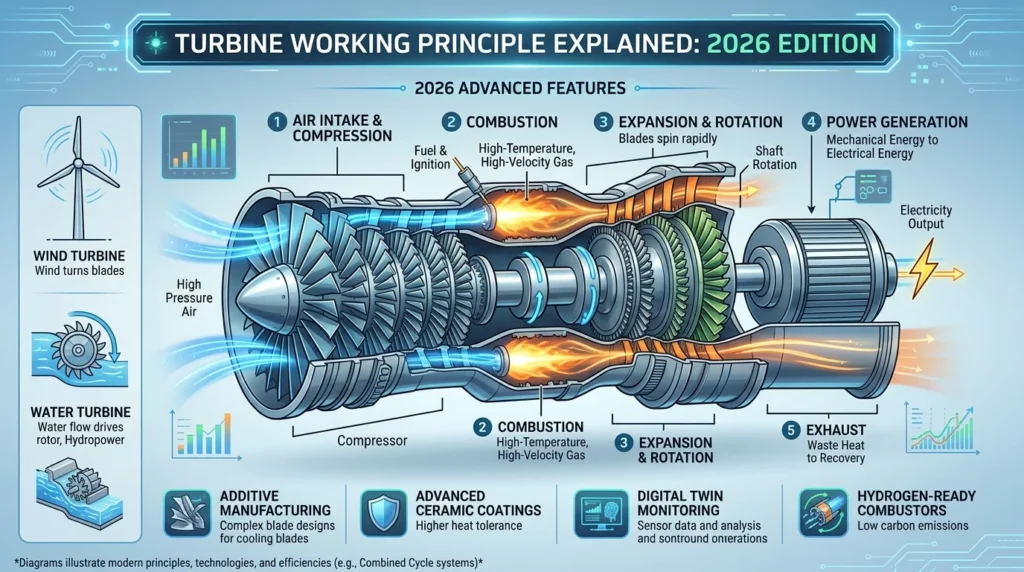
The working principle of a turbine is based on a simple yet highly efficient concept: the energy of a moving fluid is converted into rotational mechanical energy, which is then used to drive a generator or other mechanical equipment. Whether the working fluid is steam, water, natural gas, or wind, the fundamental principle remains the same. Modern turbines used in thermal, hydroelectric, nuclear, gas, and wind power plants all operate using this basic energy conversion process. In 2026, advancements in turbine design, aerodynamics, and digital control systems have made this principle even more efficient and reliable.
Basic Working Principle
A turbine operates by allowing a high-speed fluid to strike specially designed blades mounted on a rotating rotor. As the fluid changes direction while passing through the blades, it transfers its kinetic and pressure energy to the rotor. This causes the rotor and shaft to rotate at high speed. The rotating shaft is then connected to an electrical generator, which converts the mechanical rotation into electrical energy using the principle of electromagnetic induction.
In simple terms, a turbine transforms:
Fluid Energy → Mechanical Energy → Electrical Energy
This energy conversion process forms the foundation of electricity generation in most modern power plants.
Easy Analogy to Understand Turbine Operation
Imagine placing a pinwheel in front of a running fan. As the moving air strikes the blades of the pinwheel, it begins to rotate. The stronger the airflow, the faster the pinwheel spins.
A turbine works on exactly the same principle, but on a much larger and more powerful scale. Instead of a small fan producing airflow, turbines use high-pressure steam, flowing water, hot gases, or natural wind. Instead of spinning a lightweight pinwheel, they rotate massive steel shafts capable of driving generators that produce hundreds or even thousands of megawatts of electricity.
This simple analogy helps beginners understand how fluid energy is converted into useful mechanical motion.
Step-by-Step Working Process of a Turbine
Fluid Supply
The process begins when a working fluid is supplied to the turbine.
Depending on the type of turbine, the fluid may be:
- Water in hydroelectric turbines.
- High-pressure steam in thermal and nuclear power plants.
- Hot combustion gases in gas turbines.
- Moving air in wind turbines.
The fluid possesses pressure and kinetic energy that will be converted into rotational motion.
Nozzle or Guide Vanes
Before reaching the turbine blades, the fluid passes through specially designed nozzles or guide vanes.
Functions
- Increase the velocity of the fluid.
- Direct the fluid at the correct angle.
- Control the flow rate.
- Improve turbine efficiency.
- Ensure smooth and stable operation.
Proper flow control maximizes energy transfer from the fluid to the turbine blades.
Blade Impact
The high-speed fluid then strikes the turbine blades mounted on the rotor.
What Happens?
- Fluid pressure and velocity apply force to the blades.
- The blades change the direction of the fluid flow.
- Energy is transferred from the fluid to the rotating blades.
- The rotor begins to rotate.
This is the primary energy conversion stage within the turbine.
Rotor Rotation
The turbine blades are firmly attached to a rotor, which is connected to a central shaft.
As the blades rotate:
- The rotor spins at high speed.
- Mechanical rotational energy is produced.
- Torque is generated.
- Rotational motion is transmitted through the shaft.
Modern utility turbines can rotate at speeds ranging from 1,500 to 3,600 RPM, depending on the system design and operating frequency.
Mechanical Output
The rotating shaft delivers mechanical power to an electrical generator or industrial machine.
The generator converts this mechanical rotation into electrical energy through electromagnetic induction, producing electricity that can be transmitted through the power grid.
This final stage completes the turbine energy conversion process.
Turbine Working Principle in Simple Points
For quick understanding, the turbine working process can be summarized as follows:
The working fluid flows toward the turbineNozzles or guide vanes control the fluid direction and speed.
The moving fluid strikes the turbine blades.Energy is transferred from the fluid to the rotor.
The rotor and shaft rotate at high speed.The rotating shaft drives the electrical generator.
The generator produces electricity for transmission and distribution.
Importance of the Turbine Working Principle
The turbine working principle is used in almost every major power generation technology because it offers:
- High energy conversion efficiency.
- Reliable continuous operation.
- Large-scale electricity generation.
- Compatibility with multiple energy sources.
- Low operating cost in renewable energy systems.
- Long equipment service life.
This principle enables power plants to efficiently convert natural resources into usable electrical power for homes, industries, hospitals, transportation systems, and commercial facilities.
Types / Classification of Turbine(2026 Edition)
Turbines are classified based on fluid type and working method.
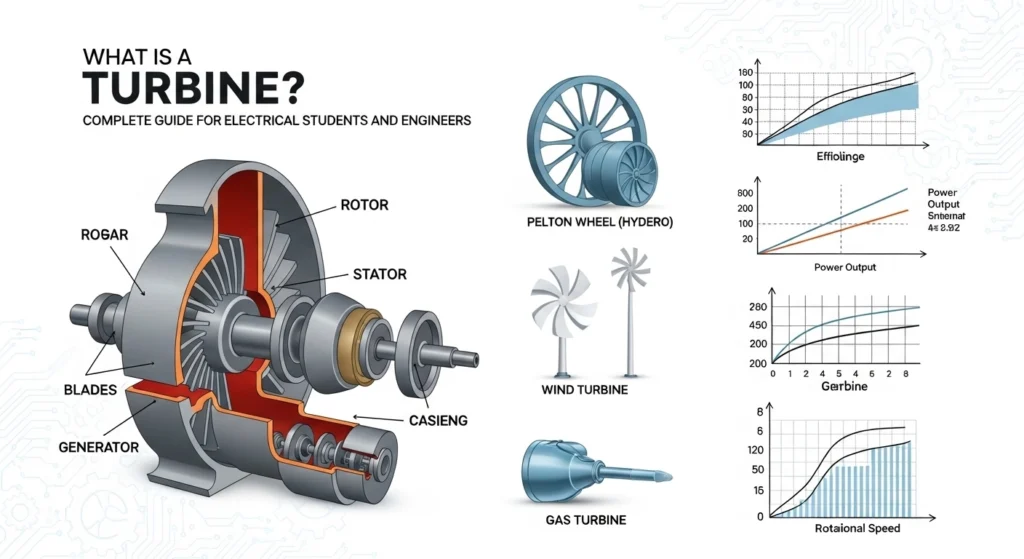
Water Turbine
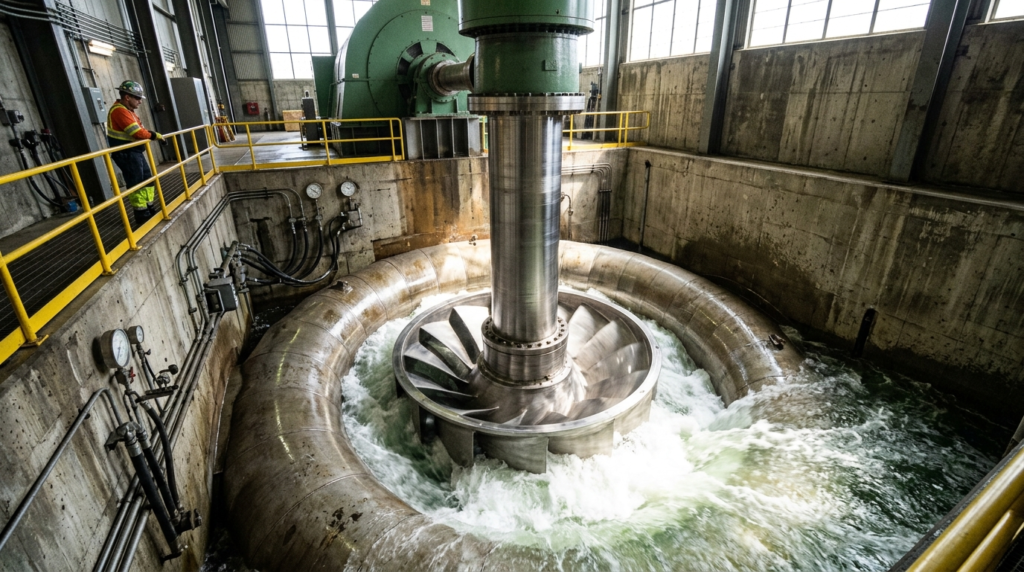
A water turbine is a mechanical device that converts the energy of flowing or falling water into rotational mechanical energy. It works when water strikes the turbine blades and causes the turbine shaft to rotate at high speed. This rotating motion is commonly used to drive generators for electricity production in hydroelectric power plants. Water turbines are highly efficient and environmentally friendly because they use renewable water energy without burning fuel. Different types of water turbines, such as Pelton, Francis, and Kaplan turbines, are designed for different water flow and pressure conditions. Water turbines are widely used in dams, hydroelectric stations, irrigation systems, and small renewable energy projects. They provide reliable power generation, low operating costs, and long service life. Due to their clean energy production and high efficiency, water turbines play an important role in modern renewable energy systems and sustainable electricity generation.
Used in hydroelectric power plants.
Types include:
- Pelton turbine
- Francis turbine
- Kaplan turbine
Water pressure or velocity rotates the blades.
Steam Turbine
Used in thermal and nuclear power plants.
- Steam produced in a boiler rotates turbine blades.
- Common in large-scale electricity generation.
Gas Turbine
Used in power plants and aircraft.
- Hot gases from combustion rotate blades.
- High-speed operation.
Wind Turbine
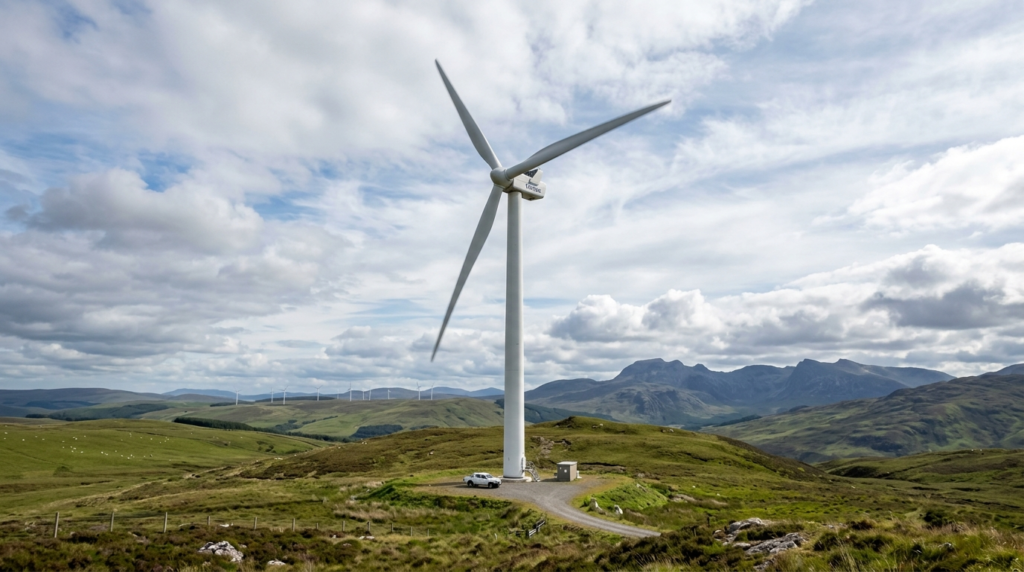
A wind turbine is a renewable energy machine that converts the kinetic energy of moving wind into mechanical and electrical energy. It works when wind strikes the turbine blades, causing them to rotate around a central shaft. This rotating shaft is connected to a generator, which converts the mechanical energy into electricity. Wind turbines are commonly installed in open areas, coastal regions, and wind farms where strong and continuous wind is available. They are available in different sizes, from small household systems to large industrial turbines used for commercial power generation. Wind turbines are environmentally friendly because they produce electricity without fuel combustion or harmful emissions. They help reduce dependence on fossil fuels and support clean energy production. Due to their energy efficiency, low operating costs, and sustainability, wind turbines are widely used in modern renewable energy systems around the world.
Used in renewable energy systems.
- Wind rotates large blades.
- Generator produces electricity.
Impulse and Reaction Turbine
Impulse Turbine
- Fluid hits blades directly.
- Works mainly on velocity.
Reaction Turbine
- Uses both pressure and velocity change.
- More efficient for large systems.
Understanding the difference between impulse turbine and reaction turbine is important for design selection.
Main Components of a Turbine (2026 Edition)
Every turbine consists of several carefully designed components that work together to ensure efficient and reliable operation. Each component performs a specific function in converting fluid energy into mechanical power.
Rotor
The rotor is the rotating assembly of the turbine and is considered one of its most important components. It carries the turbine blades and rotates at high speed when acted upon by steam, water, gas, or wind.
Functions
- Rotates under the action of the working fluid.
- Supports the turbine blades.
- Converts fluid energy into rotational motion.
- Transfers mechanical energy to the shaft.
Modern rotors are manufactured from high-strength alloy steels to withstand high temperatures, pressure, and rotational stresses.
Turbine Blades
The blades are specially designed aerodynamic components attached to the rotor. They receive energy from the moving fluid and convert it into rotational mechanical energy.
Functions
- Capture energy from steam, water, gas, or wind.
- Convert fluid energy into mechanical rotation.
- Improve overall turbine efficiency.
- Maintain smooth and balanced operation.
Advanced blade designs with optimized aerodynamics significantly improve energy conversion efficiency and reduce energy losses.
Shaft
The shaft connects the rotor to the electrical generator or other driven equipment. It transfers the rotational mechanical power produced by the turbine.
Functions
- Transmits mechanical power from the rotor.
- Drives the electrical generator.
- Maintains alignment of rotating components.
- Operates under high rotational speed and torque.
Precision manufacturing ensures smooth operation and minimizes vibration.
Casing
The casing is the outer protective enclosure surrounding the turbine. It safely contains the working fluid and directs its flow through the turbine stages.
Functions
- Protects internal components.
- Controls the direction of fluid flow.
- Maintains operating pressure.
- Enhances operational safety.
- Prevents leakage of steam or gas.
Proper casing design improves efficiency while protecting personnel and equipment.
Nozzle or Guide Vanes
The nozzles or guide vanes direct the working fluid toward the turbine blades at the correct angle and velocity.
Functions
- Accelerate the working fluid.
- Control flow direction.
- Regulate turbine speed.
- Improve energy conversion efficiency.
- Maintain stable turbine operation.
Accurate flow control maximizes turbine performance under different operating conditions.
Bearings
The bearings support the rotating shaft and reduce friction between moving parts, allowing smooth and reliable turbine operation.
Functions
- Support the turbine shaft.
- Minimize mechanical friction.
- Reduce wear on rotating components.
- Maintain proper shaft alignment.
- Improve equipment reliability and service life.
Modern turbines often use advanced lubrication and condition-monitoring systems to protect bearings.
Auxiliary Systems
In addition to the major components, turbines include several supporting systems such as:
- Lubrication systems.
- Cooling systems.
- Sealing systems.
- Vibration monitoring sensors.
- Speed governors.
- Digital control and protection systems.
These auxiliary systems improve operational efficiency, reliability, and safety.
Each turbine component must function correctly to ensure smooth operation, high efficiency, and long service life.
Advantages of Turbines (2026 Edition)
Turbines offer numerous technical and economic advantages, making them indispensable in modern power generation and industrial applications.
Major Advantages
- High Energy Conversion Efficiency: Modern turbines convert fluid energy into mechanical power with excellent efficiency.
- Suitable for Large-Scale Power Generation: Capable of generating electricity from several megawatts to thousands of megawatts.
- Long Operating Life: Properly maintained turbines can operate reliably for several decades.
- Reliable Continuous Operation: Well suited for base-load electricity generation in thermal, hydroelectric, and nuclear power plants.
- Compatible with Multiple Energy Sources: Can operate using steam, water, natural gas, wind, or other working fluids.
- Low Operating Cost: Hydroelectric and wind turbines require little or no fuel, reducing long-term operating expenses.
- High Reliability: Modern turbines provide stable and continuous power generation with minimal interruptions.
- Environmentally Friendly Options: Wind and hydro turbines produce electricity with very low direct emissions.
Real-World Benefit: Large cities, industries, and national power grids depend on turbines to provide a stable, efficient, and reliable electricity supply.
Limitations of Turbines
Although turbines are highly efficient, they also have certain practical limitations.
Common Disadvantages
- High initial installation and construction cost.
- Regular maintenance is required for reliable operation.
- Efficiency depends on fluid pressure, temperature, and flow conditions.
- Large turbines require substantial installation space.
- Noise and vibration may occur during operation.
- Specialized materials and precision manufacturing increase equipment cost.
- Performance may decrease due to blade erosion or mechanical wear.
Example: Wind turbines require locations with adequate and consistent wind speeds to achieve optimum performance, while hydro turbines depend on sufficient water flow and head.
Applications of Turbines (2026 Edition)
Turbines have an extremely wide range of applications across modern engineering, energy production, transportation, and industrial processes.
Power Generation Applications
Turbines are the primary source of mechanical power for electricity generation in:
- Thermal power plants.
- Hydroelectric power stations.
- Nuclear power plants.
- Wind farms.
- Combined-cycle gas turbine (CCGT) power plants.
- Geothermal power stations.
Industrial Applications
Many industries use turbines to drive heavy machinery and process equipment, including:
- Air and gas compressors.
- Oil and gas processing facilities.
- Chemical manufacturing plants.
- Petrochemical industries.
- Industrial cogeneration systems.
Transportation Applications
Specialized turbines are widely used in transportation systems such as:
- Aircraft jet engines (gas turbines).
- Marine propulsion systems.
- Naval vessels.
- High-speed industrial propulsion systems.
Renewable Energy Applications
Turbines play a crucial role in sustainable energy production through:
- Wind energy conversion systems.
- Small hydroelectric projects.
- Offshore wind farms.
- Pumped-storage hydroelectric plants.
Future Applications
Emerging technologies are expanding turbine applications in:
Advanced energy storage and microgrid systems.
Hydrogen-powered energy systems.
Hybrid renewable energy plants.
Smart grids with digital energy management.
Carbon-neutral electricity generation.
Comparison Between Turbine and Engine (2026 Edition)
Many beginners confuse turbines with engines, but these machines operate on different principles. A turbine extracts energy from a moving fluid such as steam, water, gas, or wind, whereas an engine generates mechanical power by burning fuel or converting another energy source inside the machine itself.
Difference Between Turbine and Engine
| Feature | Turbine | Engine |
|---|---|---|
| Energy Source | Fluid energy (steam, water, gas, or wind) | Fuel combustion inside cylinders or combustion chamber |
| Main Output | Rotational motion | Mechanical motion (rotary or reciprocating) |
| Working Principle | Converts fluid energy into mechanical rotation | Converts chemical energy of fuel into mechanical energy |
| Typical Applications | Power plants, aircraft, hydroelectric stations, wind farms | Cars, trucks, motorcycles, construction equipment |
| Operating Speed | Very high rotational speed | Moderate rotational speed |
| Maintenance Requirement | Moderate with scheduled inspections | Generally higher because of multiple moving components |
| Efficiency | High in large-scale continuous power systems | Good for mobile and transportation systems |
| Fuel Requirement | Uses external fluid energy | Burns fuel directly within the engine |
In simple terms, a turbine converts the energy of a moving fluid into rotational power, whereas an engine usually produces mechanical power by burning fuel inside its cylinders or combustion chamber.
Turbine Selection Guide (2026 Edition)
Selecting the correct turbine is essential for achieving maximum efficiency, reliability, and economic performance. Engineers evaluate several technical and environmental factors before choosing a turbine for a particular project.
Type of Working Fluid
The turbine must be selected according to the available energy source.
Examples include:
- Water for hydro turbines.
- Steam for thermal and nuclear power plants.
- Natural gas for gas turbines.
- Wind for wind turbines.
Required Power Output
The expected electrical or mechanical power requirement determines the turbine size and capacity. Large utility power plants require high-capacity turbines, while smaller industrial facilities may require compact turbine systems.
Available Pressure and Flow Rate
Steam pressure, gas pressure, water head, wind speed, and flow rate significantly influence turbine performance and determine the most suitable turbine design.
Installation Location
Environmental conditions, available space, climate, altitude, and accessibility should all be considered during turbine installation and plant planning.
Budget and Operating Cost
Both the initial investment and long-term operating expenses should be evaluated. Efficient turbines often require higher initial investment but provide lower operating costs over their service life.
Environmental Conditions
Modern turbine selection also considers:
- Noise limitations.
- Emission regulations.
- Cooling requirements.
- Water availability.
- Renewable energy compatibility.
Practical Tips for Beginners
Students and new engineers should follow these recommendations when selecting a turbine:
- Calculate the expected load requirement before choosing a turbine.
- Match the turbine type with the available energy source.
- Compare efficiency ratings from different manufacturers.
- Consider installation, maintenance, and operating costs.
- Evaluate long-term reliability and service life.
- Ensure compatibility with safety and environmental regulations.
Proper turbine selection ensures safe operation, maximum efficiency, reduced maintenance costs, and long-term system reliability.
Frequently Asked Questions (FAQs) About Turbines (2026 Edition)
Modern turbines operate under demanding conditions and may experience various mechanical and operational problems. Understanding their causes and solutions helps improve reliability and extend equipment life.
Why does turbine vibration increase?
Excessive turbine vibration is one of the most common operational problems. It may lead to bearing damage, shaft failure, reduced efficiency, and unplanned shutdowns if not corrected promptly.
Causes
- Shaft imbalance.
- Worn or damaged bearings.
- Shaft misalignment.
- Rotor defects.
- Loose foundation bolts.
- Mechanical wear.
Solution
- Perform precision shaft alignment.
- Inspect and replace worn bearings.
- Balance the turbine rotor.
- Tighten mechanical connections.
- Continuously monitor vibration using condition-monitoring sensors.
Why does turbine efficiency decrease?
A reduction in turbine efficiency usually indicates mechanical wear or operating problems that increase energy losses.
Causes
- Blade erosion.
- Steam or gas leakage.
- Fouled turbine blades.
- Excessive friction.
- Poor operating conditions.
Solution
- Conduct regular blade inspections.
- Clean turbine passages and blades.
- Repair leakage points.
- Replace damaged components.
- Maintain proper operating parameters.
Routine maintenance restores efficiency and improves overall power output.
Why does turbine overheating occur?
High operating temperatures can damage turbine components and reduce equipment life.
Causes
- Poor lubrication.
- Excessive mechanical load.
- Cooling system failure.
- Blocked oil passages.
- High ambient temperatures.
Solution
- Check the lubrication system.
- Monitor oil pressure and temperature.
- Reduce excessive operating load.
- Inspect cooling equipment.
- Replace contaminated lubricating oil when necessary.
What causes excessive turbine noise?
Unusual turbine noise often indicates mechanical or aerodynamic problems requiring immediate attention.
Causes
- Loose internal components.
- Airflow or steam flow disturbances.
- Damaged blades.
- Mechanical vibration.
- Casing defects.
Solution
- Tighten loose mechanical components.
- Inspect turbine casing.
- Examine blades for damage.
- Correct airflow restrictions.
- Perform routine mechanical inspections.
Early diagnosis prevents major equipment failures and costly repairs.
Importance of Preventive Maintenance
Regular preventive maintenance plays a vital role in extending turbine life and maintaining reliable performance.
Effective maintenance practices include:
- Scheduled inspections.
- Vibration analysis.
- Lubrication system monitoring.
- Blade cleaning and inspection.
- Bearing replacement when required.
- Digital performance monitoring using AI-based systems.
These practices reduce downtime, improve efficiency, and increase equipment reliability.
Future Trends in Turbine Technology (2026)
Turbine technology is advancing rapidly to meet the increasing global demand for cleaner, more efficient, and sustainable power generation. 2026 significant innovations are expected in turbine design, digital monitoring, renewable energy integration, and environmentally friendly operation. Modern turbines are becoming more intelligent through artificial intelligence (AI), advanced sensors, and automation, enabling higher performance with lower operating costs. These technological developments are helping power plants improve efficiency, extend equipment life, and reduce greenhouse gas emissions while maintaining reliable electricity generation.
High-Efficiency Turbine Designs
One of the most important developments in modern turbine engineering is the introduction of high-efficiency turbine designs. Engineers are improving blade geometry, materials, and cooling systems to maximize energy conversion while minimizing losses.
Key Improvements
- Advanced aerodynamic blade shapes for improved airflow.
- High-strength, lightweight materials for greater durability.
- Better steam and gas flow optimization.
- Improved thermal efficiency with reduced fuel consumption.
- Advanced cooling technologies for high-temperature operation.
- Longer service life and lower maintenance requirements.
These improvements allow turbines to produce more electricity using the same amount of fuel, reducing operating costs and environmental impact.
Smart Monitoring Systems
Modern turbines are increasingly equipped with smart monitoring systems that use digital technologies to continuously monitor equipment health and operating conditions.
Main Features
- Vibration analysis using advanced sensors.
- Real-time performance monitoring.
- Continuous temperature and pressure measurement.
- AI-based fault detection and diagnostics.
- Predictive maintenance to prevent unexpected failures.
- Remote monitoring through cloud-based control systems.
These intelligent monitoring systems improve plant reliability, reduce downtime, and optimize maintenance schedules.
Hybrid Power Systems
Future power generation will rely more on hybrid power systems, where turbines operate alongside renewable energy technologies to improve efficiency and sustainability.
Examples
- Solar + Steam Turbine: Solar thermal energy assists steam generation, reducing fossil fuel consumption.
- Wind + Battery Storage: Wind energy combined with battery systems provides stable and continuous electricity.
- Gas Turbine + Renewable Energy: Gas turbines provide flexible backup power when renewable energy output decreases.
- Integrated Smart Energy Systems: Advanced control systems coordinate multiple energy sources for maximum efficiency.
Hybrid systems increase energy security while lowering carbon emissions.
Eco-Friendly Turbine Designs
Environmental sustainability is becoming a major focus in turbine development. Manufacturers are designing turbines that deliver high performance while minimizing environmental impacts.
Modern Developments
- Low-noise turbine designs to reduce sound pollution.
- Reduced-emission gas turbines with cleaner combustion technology.
- Improved fuel efficiency to lower greenhouse gas emissions.
- Compatibility with hydrogen, biofuels, and other cleaner energy sources.
- Advanced emission control technologies.
- Environmentally friendly manufacturing materials and processes.
These innovations support global efforts to achieve cleaner and more sustainable electricity generation.
Digitalization and Artificial Intelligence
Artificial Intelligence (AI) and automation are transforming turbine operation and maintenance.
Key advancements include:
- AI-driven performance optimization.
- Automated operational control systems.
- Digital twin technology for virtual turbine simulation.
- Intelligent fault prediction and maintenance scheduling.
- Machine learning algorithms for operational efficiency.
- Cybersecurity systems for protecting digital power plant infrastructure.
These technologies improve operational safety, increase efficiency, and reduce maintenance costs.
Conclusion
A turbine is a powerful mechanical device that converts fluid energy into rotational mechanical energy. It plays a critical role in electricity generation across thermal, hydro, nuclear, gas, and wind power plants.
We discussed what is turbine, turbine working principle, types, turbine applications, and turbine advantages and disadvantages in detail. Understanding these fundamentals is essential for every electrical student and engineer.
As a junior engineer, focus on mastering energy conversion concepts and practical operation. Turbines are not just machines; they are the heart of modern power systems. Keep learning, observing real systems, and improving your technical knowledge.