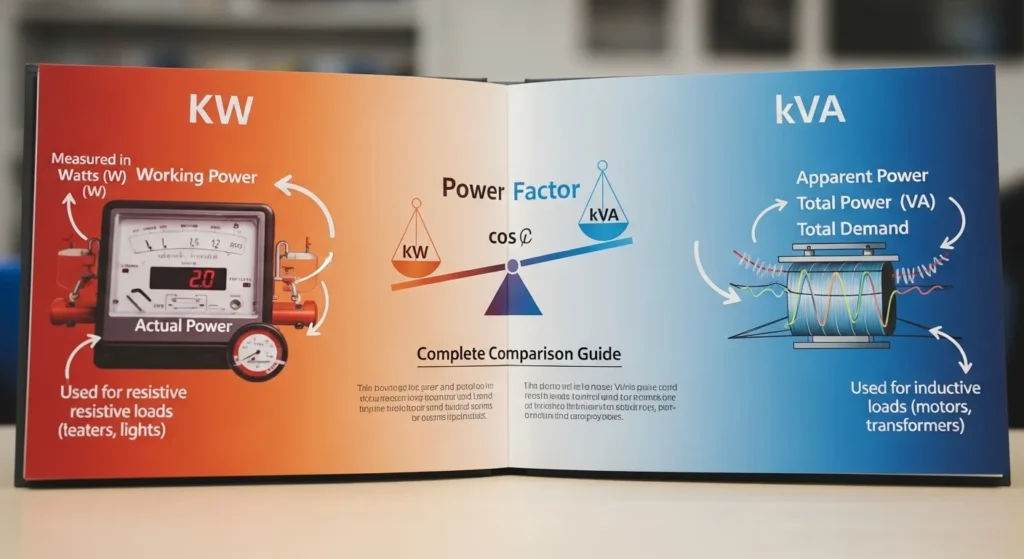

Imagine you are buying a generator for your home or workshop. The supplier asks, “How many kVA do you need?” But when you check your electricity bill, it shows power in kW. Now you are confused — are kW and kVA the same? Which one should you use?
This confusion is very common among electrical students, technicians, and even junior engineers. Understanding kW vs kVA is extremely important in power systems, generator sizing, transformer rating, and load calculations.
If you choose the wrong rating, your equipment may overload or operate inefficiently. That is why knowing the difference between kW and kVA is not just theory — it is practical knowledge.
In this article, I will clearly explain the kW vs kVA working principle, types of power involved, kW vs kVA applications, and kW vs kVA advantages and disadvantages. By the end, you will confidently understand how to convert between them and how to select the correct rating for real-world systems.
What Is kW vs kVA (2026 Edition)
Understanding the difference between kW (kilowatt) and kVA (kilovolt-ampere) is one of the most important concepts in electrical engineering. These two units are widely used when designing, installing, and operating electrical systems such as generators, transformers, UPS systems, motors, solar inverters, and industrial power networks. Although they are closely related, kW and kVA measure different types of electrical power. In 2026, with the rapid growth of renewable energy, smart grids, and energy-efficient technologies, understanding the relationship between kW, kVA, and power factor has become even more essential for students, engineers, and technicians.
Definition of kW (Kilowatt)
A kilowatt (kW) is the unit of real power (also called active power). It represents the portion of electrical power that performs useful work in an electrical system.
Real power is the energy actually consumed by electrical equipment to perform tasks such as:
- Rotating electric motors.
- Producing light in lamps.
- Heating electrical appliances.
- Operating industrial machinery.
- Running pumps, compressors, and air conditioners.
In simple terms, kW measures the usable electrical power that produces useful output.
Definition of kVA (Kilovolt-Ampere)
A kilovolt-ampere (kVA) is the unit of apparent power. It represents the total electrical power supplied to an AC electrical system.
Apparent power consists of:
- Real Power (kW) – Performs useful work.
- Reactive Power (kVAR) – Maintains magnetic and electric fields required for operating inductive equipment.
Therefore:
Apparent Power (kVA) = Real Power (kW) + Reactive Power (kVAR)
Although reactive power does not produce useful work directly, it is essential for the operation of transformers, motors, generators, and other inductive electrical devices.
Simple Explanation
The difference between kW and kVA becomes important in alternating current (AC) systems because not all supplied electrical power is converted into useful work.
Some of the supplied power is used to create magnetic fields inside inductive equipment such as:
- Electric motors.
- Transformers.
- Reactors.
- Compressors.
- Induction furnaces.
Because of this:
- kW = Useful power that performs actual work.
- kVA = Total power supplied by the electrical source.
The difference between the two depends on the power factor (PF) of the electrical system.
A higher power factor means that more of the supplied power is converted into useful work, while a lower power factor means more power is consumed as reactive power.
Relationship Between kW, kVA, and Power Factor
The mathematical relationship is:
kW = kVA × Power Factor (PF)
or
kVA = kW ÷ Power Factor (PF)
Where:
- kW = Real (Active) Power
- kVA = Apparent Power
- Power Factor (PF) = Ratio of useful power to total supplied power
Power factor values typically range between 0 and 1, with most industrial systems operating between 0.8 and 0.95.
Practical Example
Suppose an industrial motor requires 10 kW of real power and operates with a power factor of 0.8.
Using the formula:
kVA = kW ÷ Power Factor
kVA = 10 ÷ 0.8 = 12.5 kVA
This means that although the motor only performs 10 kW of useful work, the electrical system or generator must supply 12.5 kVA because additional power is required to support the motor’s magnetic field.
This is why generators, transformers, and UPS systems are rated in kVA, while motors and electrical loads are often rated in kW.
Why Understanding kW vs kVA Is Important
Knowing the difference between kW and kVA helps engineers and technicians to:
- Select the correct generator size.
- Choose the appropriate transformer capacity.
- Improve power factor.
- Reduce electrical losses.
- Avoid equipment overloading.
- Design efficient electrical distribution systems.
- Optimize energy consumption.
- Lower electricity costs in industrial facilities.
Modern electrical systems also use digital energy meters to monitor kW, kVA, kVAR, voltage, current, frequency, and power factor in real time for improved efficiency and reliability.
kW vs kVA Working Principle(2026 Edition)
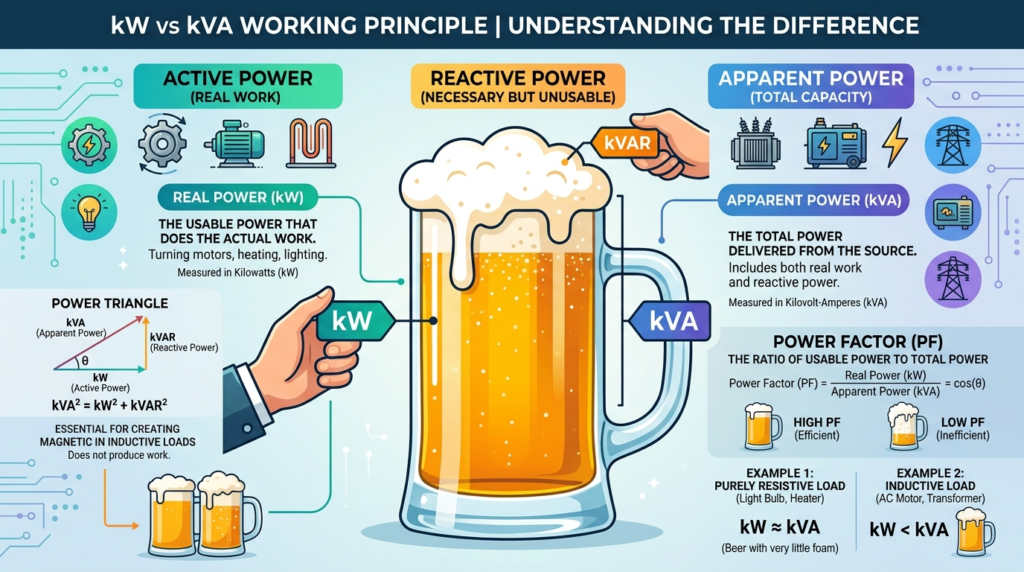
The kW vs kVA working principle explains the difference between real power and apparent power in electrical systems. Kilowatt (kW) represents the actual power that performs useful work, such as running motors, lighting lamps, or operating machines. Kilovolt-ampere (kVA) represents the total power supplied to the electrical system, including both useful power and reactive power. The relationship between kW and kVA depends on the power factor, which shows how efficiently electrical power is being used. In simple terms, kVA is the total power available, while kW is the power actually converted into useful output. For example, generators and transformers are usually rated in kVA because they supply total power, whereas electrical loads and equipment are often rated in kW because they consume real working power. Understanding the kW vs kVA working principle is important for electrical engineers, technicians, and students because it helps in selecting proper generators, transformers, and power systems for efficient electrical operation.
Understanding the kW vs kVA working principle requires knowing three types of power in AC systems.
Real Power (kW)
- Performs useful work.
- Runs motors.
- Produces heat and light.
Reactive Power (kVAR)
- Does not perform useful work.
- Supports magnetic fields in motors and transformers.
- Required for AC system operation.
Apparent Power (kVA)
- Combination of real power and reactive power.
- Total power supplied by source.
Mathematically:
kVA² = kW² + kVAR²
Easy Analogy
Imagine a glass of juice with foam on top:
- Juice = kW (useful part)
- Foam = kVAR (non-working but present)
- Total glass content = kVA
That explains the difference between kW and kVA clearly.
Types / Classification(2026 Edition)
To fully understand kW vs kVA, we must classify types of power.
Active Power (kW)
- Also called real power.
- Measured in kilowatts.
- Used for actual work.
Reactive Power (kVAR)
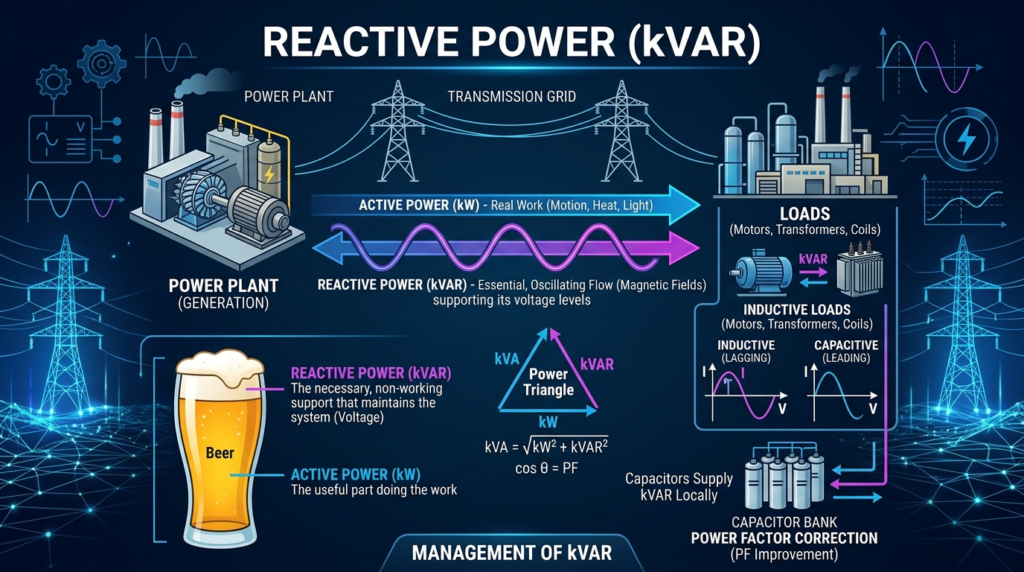
Reactive power (kVAR) is the power in an electrical system that does not perform useful work but is necessary for creating and maintaining magnetic and electric fields in equipment such as motors, transformers, and inductive loads. It is measured in kilovolt-ampere reactive (kVAR). Unlike real power (kW), which operates electrical devices, reactive power continuously moves back and forth between the power source and the load without being fully consumed. This power helps inductive equipment function properly by supporting magnetic field generation. However, excessive reactive power can reduce system efficiency, increase current flow, and cause higher power losses in transmission lines. Power factor correction devices such as capacitors are commonly used to reduce unnecessary reactive power and improve system performance. Understanding reactive power is important for electrical students, engineers, and technicians because it plays a major role in power system efficiency, voltage stability, and proper operation of industrial electrical equipment.
- Measured in kilovolt-ampere reactive.
- Supports magnetic and electric fields.
- Required in inductive loads.
Apparent Power (kVA)
- Combination of kW and kVAR.
- Determines generator and transformer rating.
These three together define AC power behavior.
Advantages of kW and kVA (2026 Edition)
Both kW and kVA provide valuable information for electrical engineers, but each is used for a different purpose. Understanding their advantages helps in selecting the right equipment and improving overall system performance.
Advantages of kW (Kilowatt)
kW measures the actual power consumed by electrical loads to perform useful work. It is the most commonly used unit for calculating energy consumption and system efficiency.
Key Advantages
- Represents the actual usable electrical power.
- Used for calculating real energy consumption.
- Commonly used for electricity billing in residential, commercial, and industrial systems.
- Essential for load calculations and energy audits.
- Helps determine equipment operating efficiency.
- Enables accurate estimation of electricity costs.
- Useful for comparing the energy performance of electrical appliances.
Because kW measures real power, it is the preferred unit for evaluating how much useful work an electrical system performs.
Advantages of kVA (Kilovolt-Ampere)
kVA represents the total apparent power supplied by an electrical system, including both real power (kW) and reactive power (kVAR).
Key Advantages
- Determines the capacity of electrical equipment.
- Used for selecting and rating generators and transformers.
- Helps engineers safely size electrical distribution systems.
- Includes the total electrical demand on the system.
- Essential for designing industrial power installations.
- Useful when power factor varies.
- Supports proper equipment protection and reliability.
Since generators and transformers must supply both real and reactive power, manufacturers specify their ratings in kVA rather than kW.
Both kW and kVA are essential for modern electrical engineering, and they complement each other in system design and operation.
Limitations of kW and kVA
Although both units are extremely useful, each has certain limitations that engineers must understand to avoid equipment sizing errors.
Limitations of kW
While kW accurately measures useful power, it does not provide complete information about the total electrical load.
Common Limitations
- Does not indicate the total system demand.
- Ignores reactive power (kVAR).
- Cannot be used alone to size generators or transformers.
- Does not reflect the effect of low power factor.
- May underestimate equipment capacity requirements in inductive loads.
Because of these limitations, engineers always consider kVA when selecting power system equipment.
Limitations of kVA
Although kVA represents the total electrical demand, it does not indicate how much of that power performs useful work.
Common Limitations
- Does not represent actual usable output power.
- Can be misleading if the power factor is unknown.
- Not normally used for electricity billing.
- Cannot directly determine equipment efficiency.
- Requires power factor information to calculate real power (kW).
These limitations highlight the importance of considering both kW and power factor when interpreting kVA values.
Understanding these limitations helps engineers avoid common design, installation, and equipment selection mistakes.
Advantages of kW and kVA (2026 Edition)
Both kW and kVA provide valuable information for electrical engineers, but each is used for a different purpose. Understanding their advantages helps in selecting the right equipment and improving overall system performance.
Advantages of kW (Kilowatt)
kW measures the actual power consumed by electrical loads to perform useful work. It is the most commonly used unit for calculating energy consumption and system efficiency.
Key Advantages
- Represents the actual usable electrical power.
- Used for calculating real energy consumption.
- Commonly used for electricity billing in residential, commercial, and industrial systems.
- Essential for load calculations and energy audits.
- Helps determine equipment operating efficiency.
- Enables accurate estimation of electricity costs.
- Useful for comparing the energy performance of electrical appliances.
Because kW measures real power, it is the preferred unit for evaluating how much useful work an electrical system performs.
Advantages of kVA (Kilovolt-Ampere)
kVA represents the total apparent power supplied by an electrical system, including both real power (kW) and reactive power (kVAR).
Key Advantages
- Determines the capacity of electrical equipment.
- Used for selecting and rating generators and transformers.
- Helps engineers safely size electrical distribution systems.
- Includes the total electrical demand on the system.
- Essential for designing industrial power installations.
- Useful when power factor varies.
- Supports proper equipment protection and reliability.
Since generators and transformers must supply both real and reactive power, manufacturers specify their ratings in kVA rather than kW.
Both kW and kVA are essential for modern electrical engineering, and they complement each other in system design and operation.
Limitations of kW and kVA
Although both units are extremely useful, each has certain limitations that engineers must understand to avoid equipment sizing errors.
Limitations of kW
While kW accurately measures useful power, it does not provide complete information about the total electrical load.
Common Limitations
- Does not indicate the total system demand.
- Ignores reactive power (kVAR).
- Cannot be used alone to size generators or transformers.
- Does not reflect the effect of low power factor.
- May underestimate equipment capacity requirements in inductive loads.
Because of these limitations, engineers always consider kVA when selecting power system equipment.
Limitations of kVA
Although kVA represents the total electrical demand, it does not indicate how much of that power performs useful work.
Common Limitations
- Does not represent actual usable output power.
- Can be misleading if the power factor is unknown.
- Not normally used for electricity billing.
- Cannot directly determine equipment efficiency.
- Requires power factor information to calculate real power (kW).
These limitations highlight the importance of considering both kW and power factor when interpreting kVA values.
Understanding these limitations helps engineers avoid common design, installation, and equipment selection mistakes.
Applications of kW and kVA (2026 Edition)
Both units are used extensively in residential, commercial, industrial, and modern smart energy systems.
Residential Applications
Common household applications include:
- Electricity consumption measured in kilowatt-hours (kWh).
- Small UPS systems rated in kVA.
- Air conditioners, heaters, and electric appliances rated in kW.
- Home solar power systems.
- Residential battery backup systems.
Industrial Applications
Industrial facilities rely heavily on both kW and kVA for equipment selection and power management.
Examples include:
- Transformers rated in kVA.
- Industrial generators rated in kVA.
- Electric motors rated in kW.
- Power factor correction systems.
- Manufacturing equipment.
- Industrial distribution panels.
- Large HVAC systems.
Modern Technology Applications
With the rapid advancement of electrical technology, both kW and kVA are becoming increasingly important in modern applications such as:
- Data centers.
- Solar photovoltaic (PV) inverters.
- Electric vehicle (EV) charging stations.
- Battery energy storage systems.
- Smart grid infrastructure.
- Microgrids.
- Renewable energy integration.
- Industrial automation and IoT-enabled power systems.
These applications require accurate monitoring of both real power and apparent power to ensure efficient and reliable operation.
Difference Between kW and kVA (2026 Edition)
The following comparison highlights the major differences between kW and kVA.
| Feature | kW (Kilowatt) | kVA (Kilovolt-Ampere) |
|---|---|---|
| Meaning | Real Power | Apparent Power |
| Performs Useful Work | Yes | Not completely (includes reactive power) |
| Depends on Power Factor | Yes | No |
| Primary Use | Load rating and energy consumption | Generator and transformer capacity rating |
| Formula | kW = kVA × Power Factor (PF) | kVA = kW ÷ Power Factor (PF) |
| Electricity Billing | Commonly used | Rarely used |
| Equipment Rating | Motors, heaters, appliances | Transformers, generators, UPS systems |
| Includes Reactive Power | No | Yes |
| Purpose | Measures actual usable power | Measures total electrical demand |
This comparison clearly explains why kW is used to measure useful power, while kVA is used to determine the total capacity required for electrical equipment.
Selection Guide(2026 Edition)
Selecting the correct electrical equipment rating is one of the most important tasks in power system design and installation. Whether choosing a generator, transformer, UPS, inverter, or electrical distribution equipment, engineers must accurately determine the required kW (real power), kVA (apparent power), and power factor (PF). Incorrect equipment sizing can lead to overloading, excessive energy losses, voltage instability, higher operating costs, and reduced equipment life. In 2026, modern engineering practices also consider future load growth, energy efficiency, renewable energy integration, and smart monitoring systems when selecting electrical equipment.
Generator Selection Guide
Generators should never be selected based only on the kW load because generators are rated in kVA, which includes both real power and reactive power.
Calculate the Total Connected Load
Determine the total electrical load by adding the power ratings of all connected equipment.
Examples include:
- Motors
- Lighting systems
- Air conditioners
- Pumps
- Compressors
- Industrial machinery
- Electronic equipment
The total connected load is normally expressed in kilowatts (kW).
Determine the Power Factor
Power factor depends on the type of electrical load.
Typical values include:
- Resistive loads: 0.95–1.0
- Commercial buildings: 0.90–0.95
- Industrial facilities: 0.80–0.90
- Large motor loads: 0.75–0.85
A lower power factor requires a larger generator capacity.
Calculate Generator Rating
Use the standard formula:
Generator kVA = Total kW ÷ Power Factor
Example:
- Total Load = 200 kW
- Power Factor = 0.8
Generator Rating = 200 ÷ 0.8 = 250 kVA
Engineers normally select the next standard generator size to provide additional operating margin.
Transformer Selection Guide
Transformers are also rated in kVA because they supply both real and reactive power.
When selecting a transformer, engineers should consider:
- Total connected electrical load.
- Expected maximum demand.
- Starting current of motors.
- Future load expansion.
- Voltage regulation requirements.
- Ambient operating temperature.
- Continuous operating conditions.
Choosing the correct transformer rating ensures efficient operation, lower temperature rise, and longer service life.
Improve the Power Factor
A low power factor increases kVA demand, resulting in higher electricity costs and reduced system efficiency. Improving the power factor reduces the difference between kW and kVA, allowing electrical equipment to operate more efficiently.
Recommended Methods
- Install capacitor banks or Automatic Power Factor Correction (APFC) panels.
- Use high-efficiency motors.
- Avoid operating lightly loaded transformers.
- Replace oversized motors where possible.
- Regularly maintain electrical equipment.
Target Power Factor: Most industrial facilities aim to maintain a power factor of 0.90 or higher, while many utilities recommend 0.95 or above to minimize penalties and improve efficiency.
Consider Future Expansion
Electrical systems rarely remain unchanged throughout their lifetime. Future increases in electrical demand should always be considered during equipment selection.
Recommended Safety Margin
Engineers typically provide an additional capacity of 10–20% above the current load to accommodate:
- New machinery.
- Building expansion.
- Increased production.
- Future electrical installations.
- Temporary overload conditions.
Providing adequate spare capacity prevents costly equipment replacement and improves long-term system reliability.
Additional Factors to Consider
Modern equipment selection in 2026 also includes several advanced considerations:
- Energy efficiency ratings.
- Load diversity factor.
- Harmonic distortion.
- Renewable energy compatibility.
- Smart grid integration.
- Environmental operating conditions.
- Reliability and maintenance requirements.
- Compliance with national and international electrical standards.
Considering these factors results in safer, more economical, and more reliable electrical installations.
Practical Tips for Beginners
Students and new engineers should remember the following guidelines:
Follow manufacturer recommendations and applicable electrical standards.
Always calculate the total kW load before selecting equipment.
Never size a generator using only the kW value without considering the power factor.
Select transformers according to the expected kVA demand.
Include a 10–20% safety margin for future expansion.
Improve the power factor whenever it falls below 0.9.
Verify voltage, frequency, starting current, and load characteristics before finalizing equipment ratings.
Future Trends in kW, kVA(2026)
Power systems are undergoing a major transformation as industries, utilities, and governments adopt smarter, more efficient, and environmentally sustainable technologies. 2026 the focus is shifting toward intelligent power management, digital monitoring, renewable energy integration, and improved power quality. Modern electrical systems are no longer limited to simply measuring energy consumption—they are now designed to optimize kW (real power), kVA (apparent power), and kVAR (reactive power) in real time. These advancements help reduce energy losses, improve power factor, enhance grid stability, and lower electricity costs for consumers and industries alike.
Smart Energy Meters
One of the biggest developments in modern electrical systems is the widespread use of smart energy meters. Unlike conventional meters that only measure energy consumption, smart meters continuously monitor multiple electrical parameters.
Key Features
- Real-time measurement of kW, kVA, and kVAR.
- Continuous monitoring of voltage, current, frequency, and power factor.
- Automatic transmission of energy data to utility providers.
- Remote billing and energy management.
- Detection of overloads, power quality issues, and abnormal consumption.
- Integration with smart home and industrial automation systems.
Smart meters help consumers understand their electricity usage while enabling utilities to manage power distribution more efficiently.
Automated Power Factor Correction Systems
Maintaining a high power factor is becoming increasingly important for reducing electricity losses and improving system efficiency. Modern facilities are replacing manual capacitor banks with automatic power factor correction (APFC) panels.
Advantages
- Automatic correction of low power factor.
- Reduction in reactive power (kVAR).
- Lower apparent power (kVA) demand.
- Reduced electricity bills and utility penalties.
- Improved voltage regulation and system efficiency.
- Extended life of electrical equipment.
These intelligent systems continuously monitor electrical loads and automatically switch capacitor banks to maintain the desired power factor.
Artificial Intelligence (AI)-Based Load Management
Artificial Intelligence (AI) is revolutionizing the way electrical loads are monitored and controlled. AI-powered energy management systems analyze large volumes of operational data to optimize power usage.
Modern Applications
- Intelligent load forecasting.
- Automatic demand-side management.
- Predictive maintenance of electrical equipment.
- Real-time optimization of energy consumption.
- Detection of abnormal operating conditions.
- Reduction of peak demand and operating costs.
AI-based load management improves energy efficiency while enhancing the reliability of electrical power systems.
Renewable Energy Integration
As renewable energy sources continue to expand, electrical systems are being designed to efficiently integrate solar, wind, hydroelectric, and battery energy storage systems.
Major Developments
- Advanced inverter technology for renewable energy systems.
- Smart synchronization with utility grids.
- Battery energy storage for improved reliability.
- Hybrid energy systems combining conventional and renewable sources.
- Improved voltage and frequency control.
- Better utilization of distributed energy resources.
Renewable integration reduces dependence on fossil fuels while supporting cleaner and more sustainable electricity generation.
Smart Grid Technology
The development of smart grids is transforming conventional electrical networks into intelligent, automated systems capable of responding to changing energy demands.
Key Features
- Two-way communication between utilities and consumers.
- Automatic fault detection and isolation.
- Self-healing electrical networks.
- Real-time monitoring of generation and consumption.
- Digital substations and automated distribution systems.
- Improved grid reliability, security, and efficiency.
Smart grids enable better management of kW, kVA, and kVAR, ensuring stable and efficient electricity delivery.
Future Focus on Power Factor Improvement
One of the primary objectives of future electrical systems is to improve the power factor, thereby reducing the difference between real power (kW) and apparent power (kVA).
Expected Benefits
- Lower transmission and distribution losses.
- Improved utilization of transformers and generators.
- Reduced utility demand charges.
- Better voltage stability.
- Increased overall energy efficiency.
- Lower carbon emissions through optimized energy usage.
Advanced power electronics, intelligent capacitor banks, and AI-driven control systems will play a major role in achieving these improvements.
Growing Importance of Energy Efficiency
Energy efficiency is becoming a global priority due to rising electricity demand, increasing energy costs, and environmental concerns. Governments and industries are investing heavily in technologies that minimize energy wastage while maximizing system performance.
Future electrical systems will emphasize:
Sustainable and renewable energy solutions.
High-efficiency electrical equipment.
Intelligent energy monitoring.
Digital automation and IoT connectivity.
AI-assisted energy optimization.
Carbon footprint reduction.
Conclusion
Understanding kW vs kVA is essential for anyone working in electrical engineering. kW represents real usable power, while kVA represents total apparent power supplied by the system.
We discussed the kW vs kVA working principle, types of power, kW vs kVA applications, and kW vs kVA advantages and disadvantages. You also learned the difference between kW and kVA and how to select the correct rating for generators and transformers.
As a junior engineer, always consider power factor before sizing equipment. Proper understanding of kW and kVA prevents overload, improves efficiency, and ensures safe operation.
Strong fundamentals in power calculations will make you confident in power system design and analysis.
Keep learning and keep practicing.