
Imagine you switch on a light at home, but it does not glow. You check the bulb, and it looks fine. Then you discover that one wire inside the switch is loose. The path of electricity is broken. This situation is called an open circuit.
For every electrical student, technician, and engineer, understanding what is an open circuit is essential. An open circuit is one of the most common electrical conditions encountered during installation, maintenance, and troubleshooting. It may not be as dangerous as a short circuit, but it can stop equipment from working completely.
In this article, I will clearly explain the open circuit working principle, its types, causes, open circuit applications, and open circuit advantages and disadvantages. You will also learn the difference between open circuit and short circuit, along with practical troubleshooting methods.
Think of this topic as a foundation for fault diagnosis in electrical systems.
What is an Open Circuit(2026 Edition)
Definition
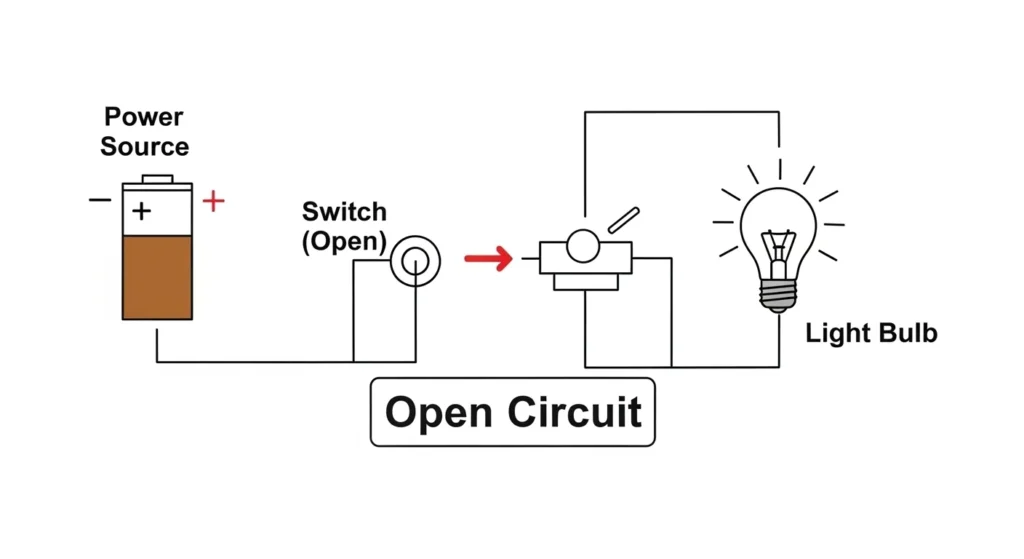
An open circuit is a condition in which the electrical path is broken, and no current flows through the circuit.
In simple words, the circuit is incomplete.
Simple Explanation
In a normal circuit:
- Current flows from the source.
- Passes through the load.
- Returns to the source.
In an open circuit:
- There is a break in the path.
- Current cannot flow.
- The load does not operate.
Even if voltage is present, no current flows because the path is disconnected.
Practical Example
If a switch is turned OFF, the circuit becomes open. Similarly, if a wire is cut or a fuse blows, an open circuit occurs.
When a bulb filament breaks, the bulb stops glowing. That is an open circuit inside the bulb.
Open Circuit Working Principle(2026 Edition)
Understanding the open circuit working principle is simple if you remember one rule:
No complete path = No current flow
Let’s explain step by step.
power is applied.
- Circuit path is complete.
- Current flows through load.
- Device operates normally.
Path Breaks
- Wire disconnects.
- Switch opens.
- Component fails.
- Fuse melts.
Now the circuit is incomplete.
Current Stops
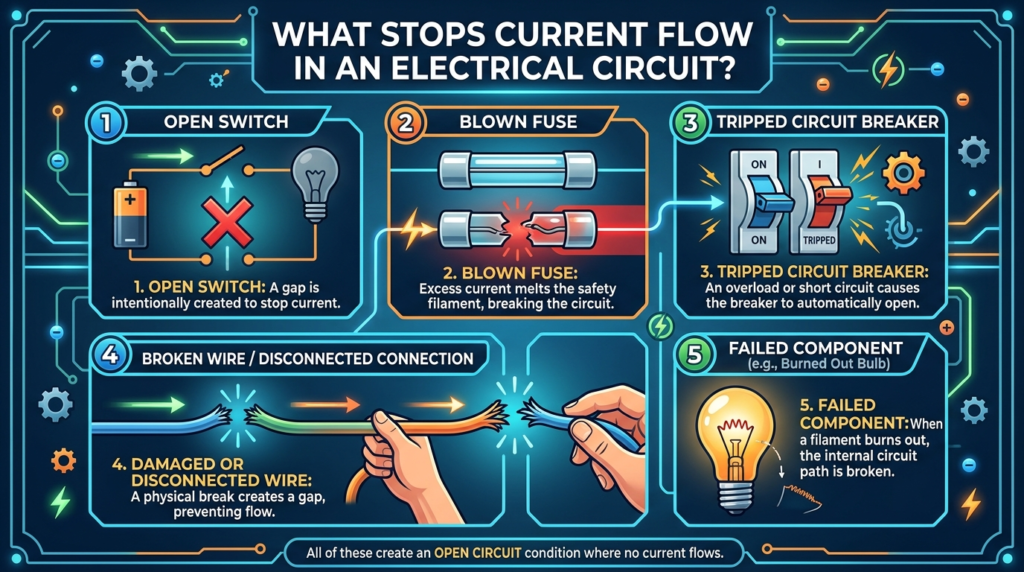
Current stops when the flow of electric charge through a circuit is interrupted or blocked. This usually happens when the electrical path becomes open due to a switch being turned OFF, a broken wire, a blown fuse, loose connections, or a damaged component. Electric current can only flow when a complete and closed path exists between the power source and the electrical load. If the path is incomplete, electrons cannot move through the circuit, and the connected device stops operating. For example, when a room light switch is turned OFF, the circuit opens and current stops flowing to the bulb, causing the light to turn OFF. Understanding why current stops is important for electrical students, engineers, and technicians because it helps in troubleshooting electrical faults, improving safety, and maintaining reliable operation of electrical systems. Proper inspection of wiring, switches, and protective devices can help identify and solve problems that interrupt current flow.
- Resistance becomes extremely high (almost infinite).
- According to Ohm’s Law, if resistance is very high, current becomes nearly zero.
- Load stops working.
Easy Analogy
Imagine a water pipe connected to a tap and a bucket.
- If pipe is continuous, water flows.
- If pipe is cut in the middle, water stops flowing.
An open circuit is like a broken pipe.
Types / Classification
Open circuits can be classified based on cause and location.
Intentional Open Circuit
- Created by design.
- Example: Switch in OFF position.
- Used to control circuits safely.
This is a controlled open circuit.
Unintentional Open Circuit
- Caused by fault.
- Wire breakage.
- Loose connection.
- Burnt component.
This type requires troubleshooting.
Temporary Open Circuit
A temporary open circuit is a condition in which the electrical path becomes disconnected for a short period of time and later reconnects automatically or after slight movement or repair. This type of open circuit usually occurs because of loose wiring, weak connections, damaged switches, vibration, or intermittent contact between electrical components. During the temporary disconnection, electric current stops flowing, causing devices such as lights, fans, or machines to stop working briefly. Once the connection is restored, the circuit starts operating normally again. Temporary open circuits are common in household wiring, automotive systems, industrial machines, and electronic equipment. These faults can be difficult to detect because the problem may appear and disappear repeatedly. Electrical technicians often use continuity testing, inspection tools, and wiring checks to locate temporary open circuits. Understanding temporary open circuits is important because they can lead to unstable system performance, equipment malfunction, and unexpected electrical interruptions if not repaired properly.
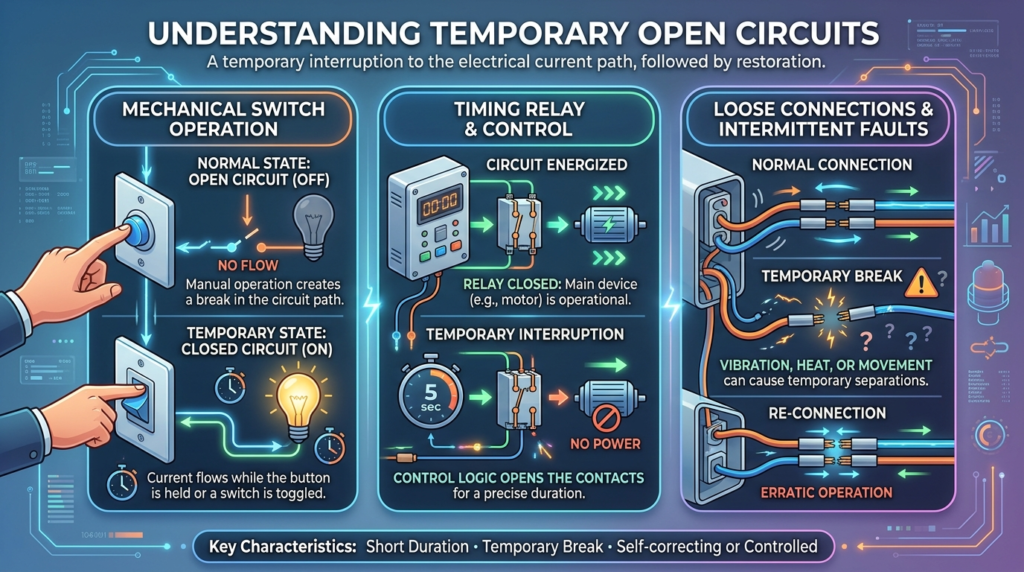
- Occurs due to loose contact.
- May work sometimes.
- Common in vibrating machinery.
Permanent Open Circuit
- Wire completely broken.
- Component permanently damaged.
- Requires repair or replacement.
Understanding types helps in proper diagnosis.
Main Components Involved in Open Circuit Protection and Control (2026 Edition)
Open circuits can occur intentionally or unintentionally in an electrical system. Intentionally created open circuits are essential for switching, protection, maintenance, and safety, while accidental open circuits are usually caused by broken conductors, loose connections, damaged components, or equipment failure. In 2026, modern electrical systems use a combination of switches, fuses, circuit breakers, connectors, terminals, smart sensors, and protective devices to control, detect, and prevent open-circuit conditions. Understanding the function of these components is essential for electrical students, technicians, and engineers.
Switch
A switch is one of the most common electrical control devices used to manually or automatically open and close an electrical circuit. It allows users to safely control the flow of current by connecting or disconnecting the electrical path.
Functions
- Manually opens or closes an electrical circuit.
- Controls the flow of electrical current.
- Starts or stops electrical equipment.
- Provides safe isolation during maintenance.
- Improves operational safety.
Applications
- Household light switches.
- Fan and appliance control.
- Industrial machine control panels.
- Motor starters.
- Electrical distribution systems.
Modern smart switches can also be operated remotely through automation and IoT-based control systems.
Fuse
A fuse is a protective device designed to intentionally create an open circuit whenever excessive current flows through a circuit. It protects wiring and electrical equipment from damage caused by overloads or short circuits.
Functions
- Melts when current exceeds its rated value.
- Interrupts current flow instantly.
- Protects electrical equipment from overcurrent.
- Prevents overheating and fire hazards.
- Provides simple and reliable circuit protection.
Advantages
- Low cost.
- Fast operation.
- Easy replacement.
- Reliable protection for residential and industrial circuits.
Although a fuse must be replaced after operation, it remains one of the most effective protective devices used in electrical systems.
Circuit Breaker
A circuit breaker is an automatic protective switching device that disconnects the electrical circuit whenever abnormal conditions such as overloads or short circuits occur.
Unlike a fuse, a circuit breaker can be reset after the fault has been cleared.
Functions
- Detects electrical faults automatically.
- Opens the circuit during overload or short-circuit conditions.
- Protects wiring and connected equipment.
- Can be reset and reused after operation.
- Provides reliable long-term circuit protection.
Applications
- Residential electrical panels.
- Commercial buildings.
- Industrial power distribution.
- Power substations.
- High-voltage transmission systems.
Modern smart circuit breakers also provide remote monitoring, fault recording, and predictive maintenance features.
Connectors and Terminals
Connectors and terminals provide secure electrical connections between wires, cables, and electrical equipment. Poor-quality or loose connections are one of the most common causes of accidental open circuits.
Functions
- Join electrical conductors safely.
- Maintain continuous current flow.
- Provide reliable mechanical support.
- Simplify installation and maintenance.
- Reduce electrical resistance at connection points.
Causes of Open Circuit Faults
- Loose terminal screws.
- Corroded connectors.
- Broken wire strands.
- Poor-quality electrical joints.
- Mechanical vibration.
Regular inspection and tightening of terminals help prevent unexpected circuit interruptions.
Electrical Wiring and Conductors
Electrical wires and conductors form the current-carrying path within a circuit. Any damage to the conductor may result in an open circuit.
Functions
- Carry electrical current between components.
- Connect power sources with electrical loads.
- Provide safe and reliable energy transmission.
Causes of Failure
- Mechanical damage.
- Excessive bending.
- Corrosion.
- Aging insulation.
- Rodent damage.
- Excessive heating.
Proper cable selection and periodic inspection significantly improve system reliability.
Protective Relays and Smart Monitoring Devices
Modern electrical systems increasingly use protective relays and smart monitoring devices to detect abnormal circuit conditions.
Functions
- Monitor current and voltage continuously.
- Detect open-circuit conditions automatically.
- Send alarm signals to operators.
- Activate circuit breakers when necessary.
- Record fault events for analysis.
These intelligent devices improve system reliability and reduce troubleshooting time.
Importance of These Components
Each of these components plays a critical role in managing open-circuit conditions by:
- Controlling electrical current safely.
- Protecting equipment from damage.
- Improving electrical system reliability.
- Reducing maintenance downtime.
- Enhancing operational safety.
- Supporting modern automated electrical systems.
Proper installation, regular inspection, and preventive maintenance ensure these components operate efficiently throughout their service life
Advantages of an Open Circuit (2026 Edition)
It may seem unusual, but an open circuit offers several important safety and operational benefits when it is intentionally created and properly controlled.
Key Advantages
- Provides Safe Power Isolation: Interrupts the electrical path, allowing maintenance work to be performed safely.
- Prevents Current Flow During Maintenance: Protects technicians from electric shock while servicing equipment.
- Protects Electrical Equipment: Blown fuses and circuit breakers intentionally create an open circuit to prevent damage caused by overloads or faults.
- Essential for Switching Operations: Used in switches, isolators, and disconnectors to safely energize or de-energize electrical systems.
- Reduces Shock Risk: Properly designed open circuits eliminate dangerous current flow through disconnected equipment.
- Improves Electrical Safety: Prevents accidental energization during repairs.
- Supports Emergency Shutdown Systems: Allows immediate disconnection of power in hazardous conditions.
Controlled open circuits are fundamental to electrical safety standards and are widely used in residential, commercial, and industrial installations.
Open Circuit Disadvantages and Limitations
While intentional open circuits improve safety, unplanned open circuits can interrupt normal operation and create significant technical and financial problems.
Disadvantages
- Electrical equipment stops operating immediately.
- Production losses occur in industrial facilities.
- Fault location can be difficult in complex electrical systems.
- May cause voltage buildup or switching transients in certain high-voltage applications.
- Sensitive electronic devices may be affected by voltage spikes.
- Unexpected system downtime increases maintenance costs.
- Interruptions may affect automation and control systems.
For example, in high-voltage transmission systems, a sudden open circuit under load can generate transient overvoltages that require surge protection equipment.
Applications of Open Circuits (2026 Edition)
Open circuits are widely used in electrical engineering for control, protection, maintenance, and safety purposes. Many everyday electrical devices intentionally create an open circuit when switching equipment OFF.
Residential Applications
Common household applications include:
- Light switches.
- Circuit breakers.
- Fuse protection systems.
- Main isolator switches.
- Electrical distribution panels.
- Appliance disconnect switches.
These devices safely interrupt current flow whenever power needs to be disconnected.
Industrial Applications
Industrial facilities rely heavily on controlled open circuits for safe machine operation.
Typical applications include:
- Emergency stop (E-Stop) systems.
- Motor control centers (MCCs).
- Maintenance isolation switches.
- Protection relay operations.
- Industrial automation systems.
- Machine safety interlocks.
- Lockout/Tagout (LOTO) procedures.
These systems protect both personnel and expensive industrial equipment.
Modern Technology Applications
With advances in digital automation, open circuits are now managed by intelligent electronic systems.
Examples include:
- Microcontroller-based switching systems.
- Smart relays.
- Automated shutdown systems.
- Remote monitoring platforms.
- IoT-enabled electrical panels.
- Smart building automation.
- Industrial control and monitoring systems.
These technologies improve fault detection, operational efficiency, and preventive maintenance.
Difference Between Open Circuit and Short Circuit (2026 Edition)
Although both are electrical faults, open circuits and short circuits have completely different characteristics and effects on an electrical system.
| Feature | Open Circuit | Short Circuit |
|---|---|---|
| Path Condition | Broken or interrupted path | Direct low-resistance path |
| Current Flow | No current flows | Extremely high current flows |
| Resistance | Very high (practically infinite) | Very low |
| Voltage Across Fault | Usually present across the open point | Drops significantly at the fault |
| Danger Level | Low to moderate | Very high |
| Typical Example | Switch in OFF position or broken wire | Live and neutral conductors touching |
Understanding the difference between an open circuit and a short circuit is essential for accurate fault diagnosis, troubleshooting, and electrical system protection.
Selection and Handling Guide for Open Circuits (2026 Edition)
Proper electrical design and maintenance significantly reduce the occurrence of unwanted open circuits.
Use High-Quality Components
Always select reliable electrical components such as:
- Switches.
- Connectors.
- Terminal blocks.
- Circuit breakers.
- Fuse holders.
- Electrical cables.
High-quality components improve reliability and reduce unexpected failures.
Select Proper Electrical Cables
Correct cable selection is essential for long-term performance.
Consider:
- Proper conductor size.
- Suitable insulation type.
- Current-carrying capacity.
- Environmental conditions.
- Mechanical protection.
Using correctly rated cables minimizes conductor damage and open-circuit failures.
Perform Regular Maintenance
Preventive maintenance helps identify developing faults before they interrupt operation.
Maintenance tasks include:
- Inspecting loose terminals.
- Tightening electrical connections.
- Checking cable insulation.
- Cleaning distribution panels.
- Verifying switch operation.
- Performing periodic continuity testing.
Routine maintenance improves system reliability and extends equipment life.
Install Proper Protection Devices
Use correctly rated protection devices to ensure safe operation.
Recommended devices include:
- Correctly sized fuses.
- Suitable circuit breakers.
- Residual Current Devices (RCDs).
- Surge protection devices.
- Overload relays.
- Protective isolators.
Proper protection minimizes equipment damage during electrical faults.
Clearly Label Electrical Circuits
Accurate circuit labeling simplifies maintenance and troubleshooting.
Benefits include:
- Faster fault identification.
- Reduced maintenance time.
- Improved electrical safety.
- Easier system modifications.
- Better documentation.
Well-labeled systems reduce human error during repairs and inspections.
Practical Tips for Beginners
Students and new technicians should always follow these best practices:
Follow electrical safety standards and lockout/tagout procedures during maintenance.
Test circuit continuity with a digital multimeter before replacing components.
Verify that the power supply is isolated before working on electrical circuits.
Inspect wiring carefully for broken conductors and loose terminals.
Replace damaged switches, fuses, or connectors with correctly rated components.
Frequently Asked Questions(2026)
Understanding common open-circuit problems and their solutions helps technicians and engineers troubleshoot electrical systems safely and efficiently.
Why is my electrical device not turning ON?
If an electrical device does not start or operate, an open circuit is often one of the first faults to investigate.
Causes
- Open circuit in the wiring.
- Blown fuse.
- Loose or damaged electrical connections.
- Broken conductor or cable.
- Defective switch or relay.
- Damaged terminal connections.
- Faulty circuit breaker.
Solutions
- Check whether the fuse has blown.
- Inspect all wiring and cable connections.
- Tighten loose terminals.
- Test the circuit using a digital multimeter.
- Replace damaged wires or defective components.
- Verify that the power supply is available.
Systematic troubleshooting helps restore normal operation while preventing unnecessary component replacement.
How Can an Open Circuit Be Detected?
Detecting an open circuit is relatively simple when the proper testing equipment is used.
Common Testing Methods
- Use a digital multimeter in continuity mode.
- Measure circuit resistance using the resistance (Ω) setting.
- Inspect wiring visually for broken conductors.
- Verify voltage at different points in the circuit.
- Use cable testers for long wiring systems.
- Perform insulation and continuity testing during maintenance.
Interpretation
- Infinite resistance (OL) generally indicates an open circuit.
- No continuity means the electrical path has been interrupted.
- A normal conductor should show low resistance and continuity.
Regular testing helps identify faults before they cause equipment downtime.
Can an Open Circuit Damage Electrical Equipment?
In most low-voltage electrical systems, an open circuit usually does not damage equipment because the interruption stops current flow.
However, in certain situations, especially in high-voltage and industrial power systems, opening a circuit under load may cause:
- Voltage spikes.
- Electrical arcing.
- Switching transients.
- Insulation stress.
- Damage to sensitive electronic equipment if proper protection is not provided.
Modern protection devices such as surge protectors and circuit breakers help minimize these risks.
Why Does a Fuse Create an Open Circuit?
A fuse is a protective device specifically designed to intentionally create an open circuit when excessive current flows.
Purpose of a Fuse
- Protect wiring from overheating.
- Prevent equipment damage.
- Reduce fire hazards.
- Disconnect faulty circuits quickly.
- Improve electrical system safety.
When current exceeds the fuse rating, the fuse element melts, breaking the electrical path and stopping current flow.
Is an Open Circuit Safer Than a Short Circuit?
In most situations, an open circuit is much safer than a short circuit.
Open Circuit
- Current flow stops.
- Equipment usually shuts down safely.
- Minimal risk of overheating.
- Lower chance of fire or electrical damage.
Short Circuit
- Extremely high current flows.
- Equipment may overheat rapidly.
- High risk of electrical fires.
- Protective devices must operate immediately.
Although open circuits interrupt operation, they generally do not produce the dangerous current levels associated with short circuits.
Future Trends in Open Circuit Detection and Protection (2026)
Electrical systems are becoming increasingly intelligent as digital technologies transform the way faults are detected, monitored, and repaired. 2026 open-circuit protection will rely heavily on automation, artificial intelligence, and real-time diagnostics.
Smart Circuit Breakers
Modern smart circuit breakers provide much more than simple overcurrent protection.
Features
- Remote monitoring and control.
- Real-time fault reporting.
- Automatic event recording.
- Mobile and cloud-based notifications.
- Integration with smart building systems.
- Improved maintenance planning.
These devices allow engineers to identify open-circuit conditions quickly without manual inspection.
Automatic Fault Detection Systems
Advanced protection systems continuously monitor electrical circuits to identify abnormal conditions.
Benefits
- Instant detection of open circuits.
- Faster fault isolation.
- Reduced equipment downtime.
- Improved system reliability.
- Enhanced electrical safety.
- Automatic maintenance alerts.
These systems significantly reduce troubleshooting time in industrial facilities and utility networks.
IoT-Based Electrical Panels
The Internet of Things (IoT) is transforming electrical distribution panels into intelligent monitoring systems.
Modern Capabilities
- Continuous voltage and current monitoring.
- Remote access through cloud platforms.
- Automatic fault notifications.
- Real-time equipment diagnostics.
- Energy consumption analysis.
- Integration with smart grids and industrial automation.
IoT technology allows maintenance teams to monitor electrical systems from virtually anywhere.
Predictive Maintenance Using Smart Sensors
Predictive maintenance is replacing traditional time-based maintenance in many industries.
Applications
- Continuous monitoring of electrical connections.
- Detection of loose terminals before failure.
- Cable health monitoring.
- Temperature and vibration analysis.
- AI-based fault prediction.
- Maintenance scheduling based on equipment condition.
This approach reduces maintenance costs while preventing unexpected electrical failures.
Self-Diagnosing Electrical Systems
Future industrial control systems will incorporate advanced self-diagnostic capabilities.
Expected Features
- Automatic fault identification.
- Intelligent troubleshooting recommendations.
- Remote diagnostic support.
- AI-assisted maintenance planning.
- Digital event logging.
- Automatic system recovery where possible.
These technologies improve operational efficiency while minimizing human intervention.
Conclusion
Now you clearly understand what is an open circuit and why it is important in electrical engineering. An open circuit occurs when the electrical path is broken, preventing current flow.
We discussed the open circuit working principle, types, open circuit applications, and open circuit advantages and disadvantages. You also learned the difference between open circuit and short circuit and how to troubleshoot common problems.
As a junior engineer, always remember that proper wiring, secure connections, and regular inspection prevent most open circuit faults.
Strong understanding of basic circuit conditions like open and short circuits will make you confident in troubleshooting and system design.
Keep learning and keep practicing.