
Imagine you are wiring a small house. The electrician tells you it will use single phase supply. A few days later, you visit a factory where large motors and heavy machines are running smoothly, and you hear the engineer mention three phase power.
Both systems supply electricity, but they are designed for different purposes. If you select the wrong system, you may face voltage drops, overheating, equipment failure, or unnecessary cost.
Understanding Single Phase vs Three Phase is very important for electrical students, technicians, and engineers. It helps in load calculation, motor selection, panel design, and power distribution planning.
In this article, I will explain the Single Phase vs Three Phase working principle, types, components, applications, advantages and disadvantages, and the difference between single phase and three phase in simple language. Think of this as practical site-level guidance from a senior engineer to a junior professional.
What is Single Phase vs Three Phase(2026 Edition)
The term Single Phase vs Three Phase refers to two different methods of supplying alternating current (AC) electrical power.
What is Single Phase?
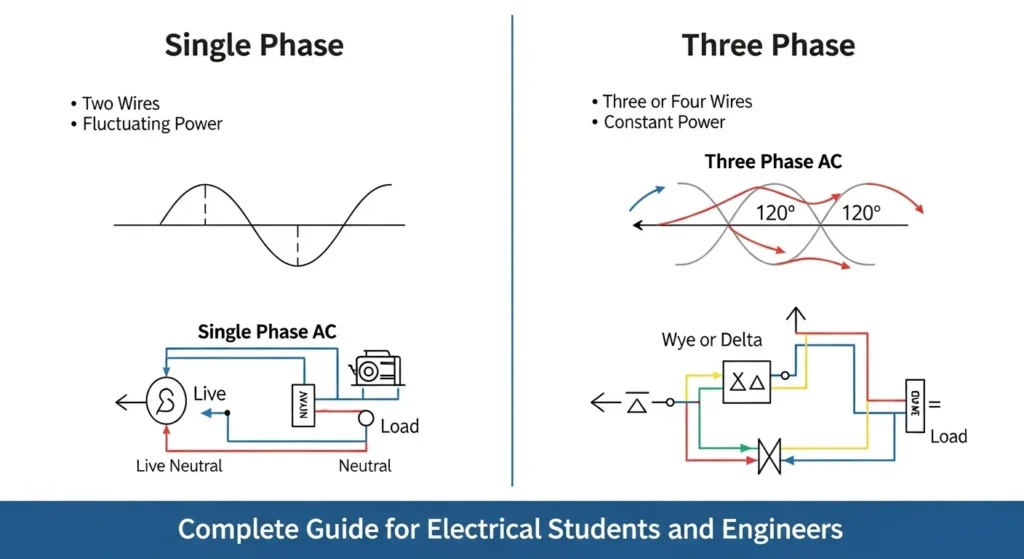
Single phase power uses one live (phase) wire and one neutral wire.
In simple words, electricity flows through one alternating wave.
Practical Example:
Most homes use single phase supply to run lights, fans, refrigerators, and televisions.
What is Three Phase?
Three phase power uses three live wires (phases) and usually one neutral wire.
Each phase carries alternating current, but the waves are separated by 120 degrees.
Practical Example:
Factories use three phase supply to operate heavy motors, compressors, and large machinery.
Single Phase vs Three Phase Working Principle(2026 Edition)
To understand the Single Phase vs Three Phase working principle, imagine pushing a swing.
If one person pushes, the swing moves but may slow down between pushes. That is similar to single phase power.
If three people push the swing at equal intervals, the motion becomes smooth and continuous. That is similar to three phase power.
Single Phase Working Principle
One AC waveform is generated.
Voltage rises and falls in one cycle.
Power reaches zero twice in each cycle.
Motors require additional starting mechanism.
Single phase supply is simple but less efficient for heavy loads.
Three Phase Working Principle
Three AC waveforms are generated.
Each wave is 120° apart.
Power delivery is continuous.
Motors self-start without extra devices.
Three phase supply provides smooth and stable power output.
Types / Classification(2026 Edition)
Types of Single Phase Systems
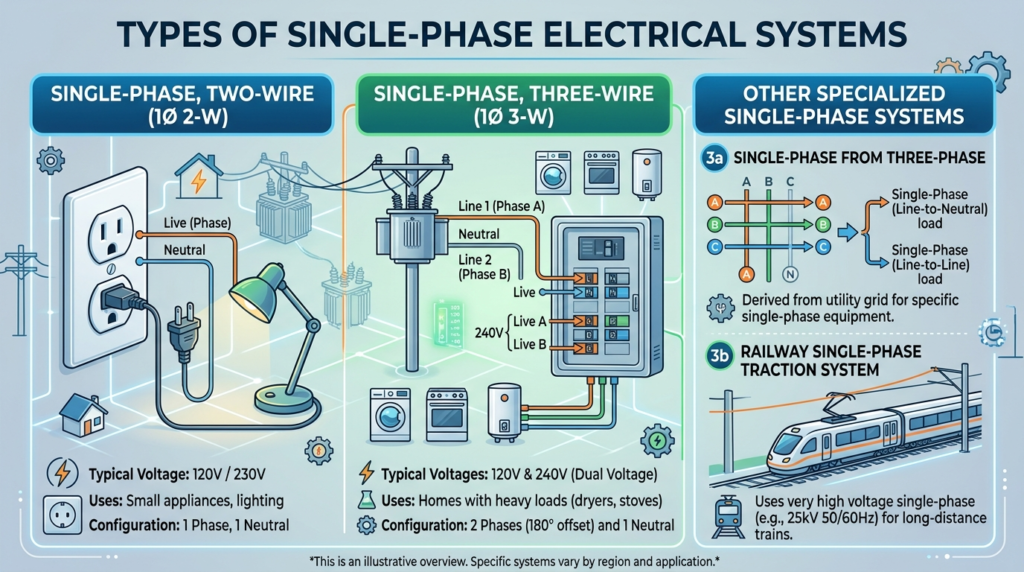
Single phase systems are electrical power distribution systems that use a single alternating voltage waveform to supply electricity to electrical loads. These systems are commonly used in homes, small offices, shops, and light commercial applications because they are simple, economical, and easy to install. There are mainly two types of single phase systems: two-wire single phase systems and three-wire single phase systems. In a two-wire system, one phase wire and one neutral wire are used to supply power to electrical devices. This is the most common type used in residential wiring for lighting, fans, and small appliances. In a three-wire single phase system, two phase wires and one neutral wire are used, allowing different voltage levels and improved power distribution. Single phase systems are suitable for low and moderate power loads but are less efficient for heavy industrial equipment compared to three-phase systems. Understanding the types of single phase systems is important for electrical students, engineers, and technicians because these systems form the foundation of residential and small-scale electrical distribution networks.
Two-Wire Single Phase
One phase and one neutral
Common in homes
Split Phase System
Used in some residential systems
Provides two voltage levels
Types of Three Phase Systems
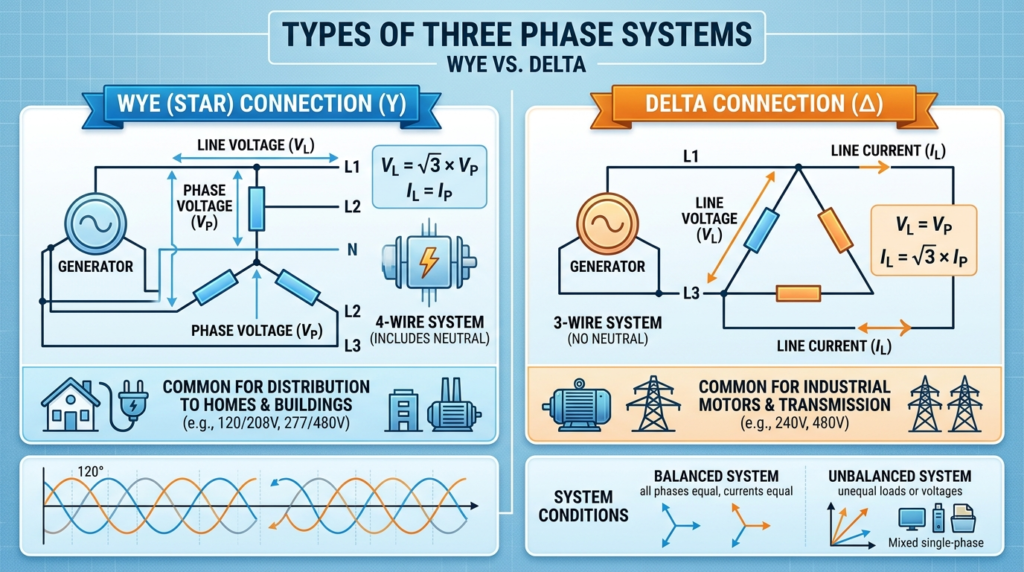
Three phase systems are electrical power systems that use three alternating voltages separated by a phase difference of 120 degrees to transmit and distribute electrical energy efficiently. These systems are widely used in industries, commercial buildings, power plants, and large machinery because they provide smooth power delivery, higher efficiency, and better load handling compared to single phase systems. The main types of three phase systems are star (Y) connection and delta (Δ) connection. In a star connection, one end of each phase winding is connected to a common neutral point, allowing both phase voltage and line voltage to be used. This system is commonly used in power distribution networks because it supports both single phase and three phase loads. In a delta connection, the phase windings are connected in a closed loop without a neutral point. Delta systems are mainly used for heavy industrial motors and high-power equipment because they provide higher starting torque and reliable operation. Understanding the types of three phase systems is important for electrical students, engineers, and technicians because these systems are essential for modern power generation, transmission, and industrial electrical applications.
Star (Wye) Connection
Neutral point available
Used in distribution systems
Delta Connection
No neutral
Used in industrial motors
Both systems serve different engineering needs.
Main Components (2026 Edition)
Understanding the main components of single-phase and three-phase electrical systems is essential for anyone studying or working in electrical engineering. Every electrical power system consists of several key components that work together to safely generate, distribute, control, and protect electrical energy. Although both systems share some common equipment, three-phase systems include additional components designed to handle higher power demands and provide better efficiency. In 2026, modern electrical installations also incorporate smart protection devices, digital energy meters, automated distribution panels, and intelligent monitoring systems to improve safety, reliability, and energy management.
Components of a Single-Phase Power System
A single-phase electrical system is commonly used in residential buildings and small commercial installations. It typically consists of one phase conductor and one neutral conductor that together complete the electrical circuit.
Phase Wire (Live Wire)
The phase wire, also called the live wire, carries electrical current from the power source to the connected load.
Functions
- Supplies electrical power to appliances and equipment.
- Carries the operating current.
- Provides the supply voltage required by the load.
- Connects the utility supply to the electrical installation.
The phase conductor is one of the most important parts of every single-phase electrical system.
Neutral Wire
The neutral wire provides the return path for electrical current, completing the circuit.
Functions
- Completes the electrical circuit.
- Returns current to the power source.
- Helps maintain stable system voltage.
- Improves electrical safety when properly grounded.
A properly connected neutral conductor is essential for the safe operation of household electrical systems.
Circuit Breaker
A circuit breaker protects the electrical installation from overloads and short circuits.
Functions
- Automatically disconnects power during faults.
- Protects wiring and connected equipment.
- Prevents overheating and fire hazards.
- Can be reset after the fault is cleared.
Modern circuit breakers may also include earth leakage and smart monitoring features for enhanced protection.
Energy Meter
An energy meter measures the amount of electrical energy consumed by the user.
Functions
- Records electricity usage.
- Measures energy in kilowatt-hours (kWh).
- Supports accurate utility billing.
- Enables energy consumption monitoring.
- Helps improve energy efficiency.
Many modern smart meters also provide real-time monitoring and remote communication with utility providers.
Components of a Three-Phase Power System
Three-phase electrical systems are widely used in commercial buildings, factories, and industrial plants because they can deliver higher power more efficiently.
Three Phase Wires
A three-phase system contains three phase conductors, commonly identified as L1, L2, and L3.
Functions
- Carry three alternating currents separated by 120 degrees.
- Deliver continuous and balanced electrical power.
- Supply high-power electrical equipment.
- Improve transmission efficiency.
These conductors provide smoother power delivery and are ideal for operating large motors and industrial machinery.
Neutral Wire
Many three-phase systems also include a neutral conductor.
Functions
- Carries unbalanced current.
- Supports single-phase loads connected to the system.
- Stabilizes system voltage.
- Improves electrical safety.
The neutral conductor is especially important in mixed-load systems where both single-phase and three-phase equipment are used.
Three-Phase Circuit Breaker
A three-phase circuit breaker protects all three phase conductors simultaneously.
Functions
- Detects overloads and short circuits.
- Disconnects all phases during a fault.
- Protects industrial machinery and electrical equipment.
- Improves personnel and equipment safety.
Modern three-phase breakers often include digital protection, communication, and remote monitoring capabilities.
Distribution Panel
The distribution panel distributes electrical power to different circuits throughout the facility.
Functions
- Controls power distribution.
- Separates electrical loads into individual circuits.
- Houses protective devices.
- Simplifies maintenance and troubleshooting.
- Supports load balancing across the three phases.
Advanced distribution panels now include smart monitoring, energy analytics, and remote control features.
Transformer
A transformer changes the voltage level to meet the requirements of electrical equipment and power distribution networks.
Functions
- Steps voltage up or down.
- Improves transmission efficiency.
- Reduces transmission losses.
- Provides electrical isolation.
- Supplies appropriate voltage for different applications.
Transformers are essential components of both utility power systems and industrial electrical installations.
Additional Modern Components (2026)
Today’s electrical systems often include advanced components that improve performance and energy management.
Examples
- Smart energy meters.
- Residual Current Devices (RCDs).
- Surge protection devices (SPDs).
- Automatic transfer switches (ATS).
- Power factor correction panels.
- IoT-enabled monitoring sensors.
- Digital protection relays.
- Energy management systems.
These technologies help improve electrical safety, efficiency, and reliability while supporting smart grid integration.
Importance of Understanding These Components
Knowledge of these components helps engineers and technicians to:
- Design efficient electrical systems.
- Select the correct equipment.
- Improve system safety.
- Perform accurate troubleshooting.
- Reduce maintenance costs.
- Optimize power distribution.
- Support future system expansion.
Understanding the function of each component is essential for the proper application of single-phase and three-phase electrical systems.
Advantages of Single-Phase and Three-Phase (2026 Edition)
Both electrical systems offer unique benefits depending on the application, electrical load, and installation requirements.
Advantages of Single-Phase Power
Single-phase power is the most widely used electrical supply for homes and small businesses because of its simplicity and affordability.
Key Advantages
- Simple Wiring: Requires fewer conductors, making installation easier and less complex.
- Low Installation Cost: Reduced wiring and equipment requirements lower the overall installation expense.
- Easy Maintenance: Simpler circuits are easier to inspect, repair, and maintain.
- Suitable for Small Loads: Ideal for lighting, fans, televisions, refrigerators, computers, and household appliances.
- Widely Available: Most residential areas receive a single-phase electricity supply from utility providers.
- Reliable for Domestic Use: Provides sufficient power for everyday household applications.
Because of these advantages, single-phase systems remain the standard choice for residential buildings and small commercial establishments.
Advantages of Three-Phase Power
Three-phase power is designed to deliver higher amounts of electrical energy more efficiently, making it the preferred option for commercial and industrial applications.
Key Advantages
- Higher Power Capacity: Can supply significantly more power than a single-phase system.
- Smooth Motor Operation: Three-phase motors operate with continuous rotating magnetic fields, resulting in smoother performance.
- Better Energy Efficiency: Delivers power more efficiently with lower electrical losses.
- Lower Transmission Losses: More efficient power transmission over long distances.
- Suitable for Heavy Machinery: Ideal for industrial motors, compressors, pumps, elevators, and manufacturing equipment.
- Improved Voltage Stability: Balanced loads help maintain consistent voltage levels.
- Smaller Conductor Size: Can transmit the same amount of power using less conductor material compared to equivalent single-phase systems.
Understanding the advantages and disadvantages of single-phase vs three-phase power helps engineers choose the most suitable electrical system for a specific application.
Disadvantages and Limitations of Single-Phase and Three-Phase Systems
Although both systems are highly effective, each has certain limitations that should be considered during system design and equipment selection.
Single-Phase Limitations
Single-phase systems are not intended for large industrial loads and may experience performance issues under heavy demand.
Limitations
- Not suitable for high-power industrial equipment.
- Greater voltage drop when supplying heavy loads.
- Single-phase motors often require starting mechanisms such as capacitors or starter circuits.
- Limited power transmission capability.
- Lower efficiency for large electrical loads.
- Not ideal for continuous heavy-duty industrial operation.
These limitations make single-phase systems less suitable for factories and large commercial installations.
Three-Phase Limitations
Three-phase systems provide excellent performance for large loads but involve higher installation complexity and cost.
Limitations
- Higher installation cost due to additional wiring and equipment.
- More complex electrical distribution and protection systems.
- Requires specialized installation and maintenance.
- Generally not economical for small homes or light residential loads.
- Equipment costs are typically higher than equivalent single-phase systems.
Despite these disadvantages, three-phase power remains the most efficient solution for medium and large-scale electrical installations.
Applications (2026 Edition)
The applications of each system differ mainly according to the amount of electrical power required.
Single-Phase Applications
Single-phase power is commonly used where electrical demand is relatively low.
Typical applications include:
- Residential homes.
- Apartments.
- Small retail shops.
- Office lighting.
- Household appliances.
- Ceiling fans.
- Air conditioners.
- Computers and office equipment.
- Small water pumps.
- Home solar inverter systems.
Its simplicity and affordability make it the preferred choice for everyday domestic electricity supply.
Three-Phase Applications
Three-phase power is widely used wherever large amounts of electrical energy are required.
applications include:
- Manufacturing factories.
- Large commercial buildings.
- Industrial motors.
- Water pumping stations.
- HVAC systems.
- Data centers.
- Hospitals.
- Shopping malls.
- Food processing plants.
- Mining operations.
- Oil and gas facilities.
- Renewable energy plants.
- Electric vehicle (EV) fast-charging stations.
Three-phase systems provide the reliability, efficiency, and power capacity required for modern industrial and commercial operations.
Why Understanding These Differences Matters
Selecting the correct electrical system helps:
- Improve energy efficiency.
- Reduce operating costs.
- Increase equipment lifespan.
- Ensure reliable power distribution.
- Minimize voltage drops.
- Enhance electrical safety.
- Support future expansion and automation.
Proper system selection is essential for achieving safe, efficient, and cost-effective electrical installations.
Difference Between Single Phase and Three Phase (2026 Edition)
The difference between single phase and three phase is important for interviews and practical work.
| Feature | Single Phase | Three Phase |
| Number of Phases | One | Three |
| Power Delivery | Pulsating | Continuous |
| Cost | Lower | Higher |
| Efficiency | Lower | Higher |
| Motor Starting | Requires starter | Self-starting |
| Applications | Homes | Industries |
This table clearly shows the difference between single phase and three phase systems.
Selection Guide (2026 Edition)
Selecting the right electrical power system is one of the most important decisions in residential, commercial, and industrial electrical installations. The choice between single-phase and three-phase power depends on several factors, including the total electrical load, type of equipment, motor size, voltage requirements, future expansion, energy efficiency, and local utility availability. In 2026, engineers also consider smart energy management, renewable energy integration, and long-term operating costs when designing modern electrical systems. Choosing the correct power supply improves system performance, reduces energy losses, enhances safety, and minimizes maintenance costs.
Selection Guide for Beginners
If you are new to electrical engineering or planning a small installation, follow these basic steps before deciding between a single-phase and three-phase power supply.
Calculate the Total Electrical Load
Begin by calculating the total connected load of all electrical appliances and equipment.
Include items such as:
- Lighting systems.
- Fans.
- Air conditioners.
- Water pumps.
- Kitchen appliances.
- Office equipment.
- Small machinery.
The total load is usually expressed in watts (W) or kilowatts (kW).
Accurate load calculation helps prevent overloading and ensures the electrical system operates safely.
Choose Single-Phase for Small Loads
A single-phase power supply is generally suitable for homes and small businesses where the electrical demand is relatively low.
Typical applications include:
- Houses and apartments.
- Small offices.
- Retail shops.
- Small workshops.
- Household appliances.
- Lighting and socket outlets.
Single-phase systems are simple to install, cost-effective, and adequate for most residential applications.
Consider Three-Phase for Larger Motors
When operating larger electrical motors or heavy industrial equipment, a three-phase power supply is usually the better choice.
As a general guideline:
- Motors above 3 HP are commonly operated using three-phase power.
- Large compressors.
- Industrial pumps.
- HVAC systems.
- Manufacturing machinery.
- Elevators and conveyor systems.
Three-phase motors provide smoother operation, higher efficiency, and better starting torque than equivalent single-phase motors.
Check Local Utility Availability
Before selecting a power system, verify the type of electrical service available from your local utility provider.
Consider:
- Available supply voltage.
- Single-phase or three-phase service.
- Maximum permitted electrical demand.
- Installation requirements.
- Utility connection costs.
In many residential areas, only single-phase service may be readily available, while commercial and industrial zones often provide three-phase connections.
Selection Guide for Engineers
Electrical engineers must evaluate several technical factors before choosing the most suitable power distribution system.
Analyze Peak Load Demand
Rather than considering only the average load, engineers calculate the maximum peak demand expected during operation.
Peak load analysis helps:
- Select properly rated transformers.
- Size generators correctly.
- Choose appropriate circuit breakers.
- Prevent equipment overloading.
- Improve system reliability.
Plan for Future Expansion
Electrical installations often grow over time. Engineers normally provide additional system capacity for future expansion.
Typical considerations include:
- Additional machinery.
- Building extensions.
- Increased production.
- Renewable energy integration.
- Electric vehicle (EV) charging systems.
- Future automation upgrades.
Including a safety margin reduces the need for expensive electrical upgrades later.
Study Voltage Drop
Excessive voltage drop reduces equipment performance and energy efficiency.
Engineers evaluate:
- Cable length.
- Conductor size.
- Load current.
- Installation method.
- Voltage regulation.
Proper cable selection ensures voltage remains within acceptable limits throughout the electrical installation.
Evaluate Power Factor
Power factor has a direct impact on system efficiency and equipment sizing.
- Lower electrical losses.
- Reduced utility penalties.
- Improved voltage regulation.
- Better generator and transformer utilization.
- Increased energy efficiency.
Modern industrial systems often use capacitor banks or automatic power factor correction (APFC) panels to maintain an efficient power factor.
Electrical Standards
Every electrical installation should comply with applicable national and international standards.
Engineers should follow requirements related to:
- Electrical safety.
- Cable sizing.
- Protective devices.
- Earthing systems.
- Voltage limits.
- Equipment ratings.
- Installation practices.
Compliance ensures safe, reliable, and legally approved electrical systems.
Additional Factors
Modern electrical system selection also involves advanced engineering considerations such as:
- Smart grid compatibility.
- Renewable energy integration.
- Solar photovoltaic (PV) systems.
- Battery energy storage systems.
- Energy monitoring and automation.
- IoT-enabled electrical equipment.
- Sustainability and energy efficiency goals.
- Long-term operating and maintenance costs.
These factors help create future-ready electrical installations that are efficient, reliable, and environmentally responsible.
Practical Tips for Beginners and Students
To make the correct selection, always remember these best practices:
Follow electrical codes, safety regulations, and manufacturer recommendations.
Calculate the total connected load accurately.
Select single-phase power for small residential and light commercial loads.
Choose three-phase power for heavy machinery and motors above 3 HP.
Verify the available utility supply before installation.
Consider future expansion and additional load requirements.
Check voltage drop and power factor during system design.
Common Single-Phase and Three-Phase Problems (2026 Edition)
Electrical systems occasionally experience operational problems that can affect performance, efficiency, and safety. Whether working with single-phase or three-phase power systems, understanding the common faults, their causes, and the appropriate solutions is essential for students, electricians, technicians, and engineers. In 2026, modern diagnostic tools, smart monitoring systems, and predictive maintenance technologies make troubleshooting faster and more accurate. Identifying problems early helps prevent equipment damage, reduce downtime, and improve the overall reliability of electrical installations.
Why Do Lights Flicker in a Single-Phase System?
Flickering lights are one of the most common issues in residential and small commercial electrical installations. While occasional flickering may be harmless, continuous flickering often indicates an underlying electrical problem.
Causes
- Overloaded electrical circuit.
- Voltage drop due to excessive load.
- Loose wiring or terminal connections.
- Faulty light switch or socket.
- Defective LED driver or lamp.
- Poor utility power supply.
- Undersized electrical cables.
Recommended Solutions
- Reduce the connected electrical load.
- Tighten all wiring and terminal connections.
- Replace faulty switches or lighting fixtures.
- Measure supply voltage using a multimeter.
- Upgrade wiring if voltage drop is excessive.
- Consult the electricity supplier if the supply voltage is unstable.
Regular inspection and proper circuit design help eliminate flickering and improve lighting performance.
Why Does a Three-Phase Motor Vibrate?
Excessive vibration in a three-phase motor is usually a sign of electrical or mechanical problems. Ignoring vibration can reduce motor efficiency and shorten its service life.
Causes
- Phase voltage imbalance.
- Loose electrical connections.
- Shaft misalignment.
- Worn bearings.
- Rotor imbalance.
- Mechanical coupling problems.
- Overloading of the motor.
Recommended Solutions
- Measure voltage across all three phases.
- Tighten loose electrical terminals.
- Inspect bearings and replace if necessary.
- Align the motor and driven equipment correctly.
- Balance the rotating components.
- Ensure the motor is operating within its rated load.
Routine maintenance and vibration analysis can significantly improve motor reliability.
Can a Three-Phase Supply Operate Single-Phase Loads?
A three-phase electrical system can easily supply single-phase loads by using one phase conductor and the neutral wire.
Applications
- Residential lighting circuits.
- Household appliances.
- Office equipment.
- Small commercial loads.
- Single-phase air conditioners.
- Water pumps.
Proper load distribution across all three phases is important to maintain system balance and prevent overloading of any single phase.
Can a Single-Phase Supply Operate a Three-Phase Motor?
but a standard three-phase motor cannot normally operate directly from a single-phase power supply.
Possible Methods
- Use a single-phase to three-phase converter.
- Install a Variable Frequency Drive (VFD) with single-phase input.
- Use a rotary phase converter.
- Use a static phase converter for light-duty applications.
These devices generate the required three-phase output, allowing the motor to operate efficiently from a single-phase supply.
How Can Phase Imbalance Be Detected?
Phase imbalance occurs when the voltages or currents of the three phases are not equal. Even a small imbalance can reduce motor efficiency and increase operating temperature.
Detection Methods
- Measure voltage between all three phases using a digital multimeter.
- Compare phase-to-phase voltage values.
- Measure phase currents using a clamp meter.
- Use a three-phase power quality analyzer.
- Monitor motor temperature and vibration.
- Analyze power quality using smart energy monitoring systems.
A voltage imbalance greater than approximately 2–3% should be investigated to prevent equipment damage.
Additional Troubleshooting Tips
When diagnosing single-phase or three-phase electrical problems:
- Always disconnect power before performing maintenance.
- Use properly calibrated testing instruments.
- Check for loose, damaged, or corroded connections.
- Verify correct fuse and circuit breaker ratings.
- Inspect cables for overheating or insulation damage.
- Follow manufacturer maintenance recommendations.
- Record voltage and current measurements for comparison over time.
Proper troubleshooting procedures improve safety and reduce unnecessary equipment replacement.
Importance of Preventive Maintenance
Many electrical problems can be avoided through regular inspection and maintenance.
Best Practices
- Periodically inspect electrical panels.
- Tighten electrical terminals.
- Test insulation resistance.
- Measure voltage and current regularly.
- Balance three-phase loads.
- Clean electrical equipment to prevent overheating.
- Monitor power quality using digital meters and smart sensors.
Preventive maintenance increases equipment lifespan, reduces downtime, and improves overall system efficiency.
Future Trends(2026)
Electrical power distribution is rapidly evolving to meet the increasing demand for higher efficiency, renewable energy integration, digital automation, and intelligent energy management. 2026 modern electrical systems are becoming smarter, more reliable, and environmentally sustainable through the adoption of smart grids, advanced power electronics, hybrid energy systems, artificial intelligence (AI), and real-time monitoring technologies. These innovations are transforming the way single-phase and three-phase power systems are generated, distributed, monitored, and controlled, ensuring better performance while reducing energy losses and operating costs.
Smart Grid Technology
One of the most significant developments in modern electrical engineering is the expansion of smart grid technology. Unlike conventional power networks, smart grids use digital communication and automation to optimize electricity generation, transmission, and distribution.
Key Features
- Intelligent load balancing between single-phase and three-phase networks.
- Automatic fault detection and isolation.
- Two-way communication between utilities and consumers.
- Self-healing power distribution systems.
- Improved voltage regulation and frequency control.
- Better integration of renewable energy sources.
- Reduced transmission and distribution losses.
Smart grids improve power quality, increase reliability, and enable more efficient use of electrical energy across residential, commercial, and industrial sectors.
Hybrid Power Systems
The future of electrical distribution increasingly relies on hybrid power systems, which combine traditional grid electricity with renewable energy sources to create a more reliable and sustainable power supply.
Modern Hybrid Systems
- Solar photovoltaic (PV) systems combined with utility grid supply.
- Wind energy integrated with battery storage.
- Diesel generators operating alongside renewable energy systems.
- Smart microgrids capable of independent operation during grid failures.
- Hybrid industrial power systems for uninterrupted electricity supply.
These systems reduce dependence on fossil fuels, improve energy security, and lower carbon emissions while ensuring continuous power availability.
Advanced Power Electronics
Modern power electronics are playing a crucial role in improving the conversion and control of electrical energy between single-phase and three-phase systems.
Major Developments
- High-efficiency inverters and converters.
- Advanced AC-to-DC and DC-to-AC conversion technologies.
- Intelligent voltage regulation.
- Variable frequency drives (VFDs) for motor control.
- Improved harmonic filtering.
- High-performance semiconductor devices using SiC (Silicon Carbide) and GaN (Gallium Nitride) technologies.
These advancements enhance system efficiency, reduce electrical losses, and improve overall power quality.
Real-Time Energy Monitoring Systems
Digital monitoring technologies are becoming essential for managing modern electrical networks. Real-time energy monitoring systems provide continuous visibility into system performance and power consumption.
Key Capabilities
- Continuous phase load tracking.
- Real-time voltage and current monitoring.
- Automatic detection of load imbalance.
- Energy consumption analysis.
- Remote monitoring through cloud-based platforms.
- Predictive maintenance alerts.
- Historical performance reporting for energy optimization.
These systems enable engineers to quickly identify problems, improve energy efficiency, and reduce maintenance costs.
Artificial Intelligence and Automation
Artificial Intelligence (AI) is revolutionizing electrical power distribution by enabling intelligent decision-making and automated system control.
Applications
- AI-based load forecasting.
- Automatic phase balancing.
- Predictive maintenance of electrical equipment.
- Intelligent fault diagnosis.
- Automated switching and protection.
- Demand-side energy management.
- Smart energy optimization for industrial facilities.
AI-powered systems increase reliability while minimizing downtime and operational costs.
Renewable Energy Integration
Renewable energy sources are becoming a central part of future electrical distribution systems.
Future Developments
- Improved integration of solar and wind power.
- Advanced battery energy storage systems.
- Smart inverters with grid-support functions.
- Distributed energy resource (DER) management.
- Electric vehicle (EV) charging infrastructure integration.
- Microgrid and virtual power plant technologies.
These innovations support cleaner electricity generation while maintaining stable and reliable power networks.
Conclusion
Understanding Single Phase vs Three Phase is fundamental in electrical engineering. Single phase is simple, cost-effective, and suitable for residential loads. Three phase provides higher efficiency, smooth power delivery, and supports heavy industrial machinery.
We discussed the Single Phase vs Three Phase working principle, types, components, applications, advantages and disadvantages, and clearly explained the difference between single phase and three phase systems.
As a junior engineer, always analyze load requirements before choosing a supply system. Correct planning ensures safety, efficiency, and long-term reliability. Mastering these basics will strengthen your foundation in power distribution and electrical system design.