
Imagine switching on the lights in your home after sunset. Within a second, electricity travels from a power plant through a complex transmission and distribution network before reaching your house safely. Along this journey, two important electrical facilities play a major role: the grid station and the substation.
Many students and beginners use these two terms interchangeably because they perform similar functions. However, they are not exactly the same. Understanding the Grid Station vs Substation concept is essential for electrical engineering students, technicians, maintenance staff, and professionals working in power systems.
Knowing the difference helps in designing electrical networks, selecting suitable equipment, troubleshooting power system issues, and understanding how electricity is delivered efficiently from generating stations to consumers.
In this article, you will learn the definition of both facilities, their working principle, types, main components, advantages, disadvantages, applications, major differences, selection guide, common problems with solutions, and future trends. Everything is explained in simple English with practical examples, making it easy for beginners to understand while still providing valuable insights for experienced engineers.
What is Grid Station vs Substation?
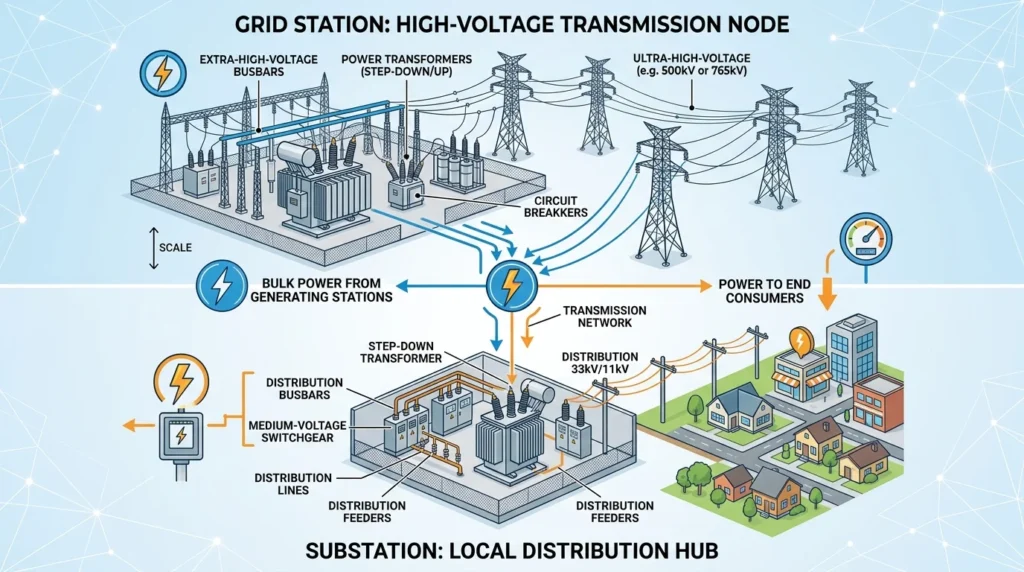
A substation is an electrical installation where voltage is changed, power is controlled, and electricity is safely distributed from one part of the power system to another. It contains equipment such as transformers, circuit breakers, disconnect switches, busbars, relays, and protection systems.
A grid station is a special type of high-voltage substation that forms part of the national or regional electrical transmission grid. Its main purpose is to receive electricity from power generation plants, regulate voltage, and transmit power to other substations or distribution networks.
In simple words:
- Every grid station is a substation.
- Not every substation is a grid station.
Practical Example
Consider electricity generated at a large hydropower plant.
- First, it reaches a grid station, where voltage is controlled and transmitted through long-distance transmission lines.
- Later, electricity reaches smaller distribution substations, where the voltage is reduced before supplying homes, schools, offices, and industries.
This is the basic difference between grid station and substation.
Grid Station vs Substation Working Principle
Understanding the Grid Station vs Substation working principle becomes much easier when compared to a transportation system.
Think of electricity as passengers traveling across a country.
- Grid stations act like major airports connecting different cities.
- Substations act like local bus terminals delivering passengers to neighborhoods.
The working process is as follows:
Electricity Generation
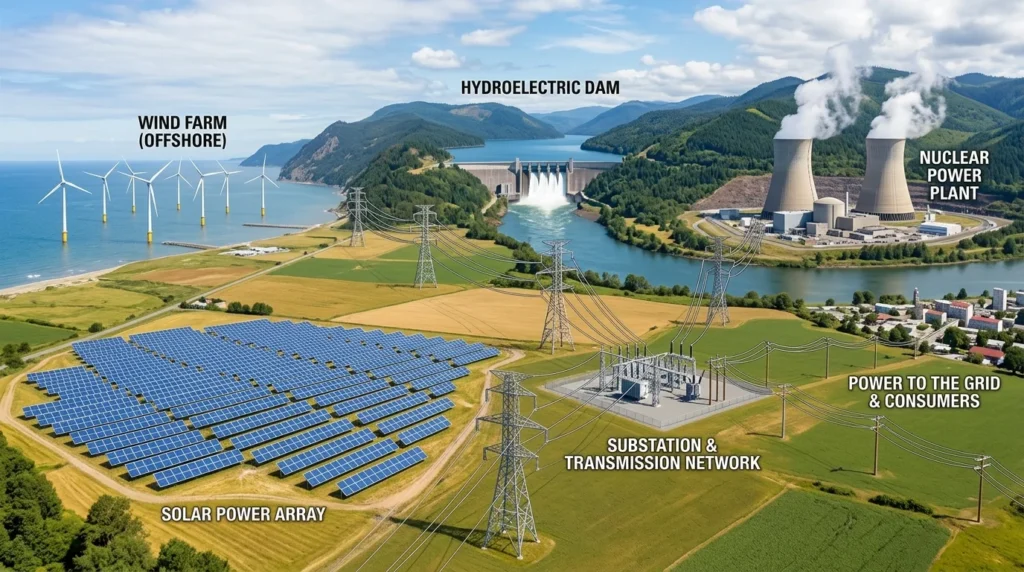
Electricity generation is the process of producing electrical energy by converting other forms of energy, such as mechanical, thermal, chemical, solar, wind, or hydro energy, into electricity. This process usually takes place in power plants, where generators convert the rotational energy of turbines into electrical power through the principle of electromagnetic induction. The turbines may be driven by steam, flowing water, wind, natural gas, or other energy sources. The generated electricity is then transmitted through high-voltage transmission lines to grid stations and substations before being distributed to homes, commercial buildings, and industries. Efficient electricity generation is essential for ensuring a reliable power supply, supporting economic growth, and meeting the increasing global demand for energy.Electricity is produced at power plants.
Voltage Increase
A step-up transformer increases the voltage for efficient long-distance transmission.
Power Reaches Grid Station
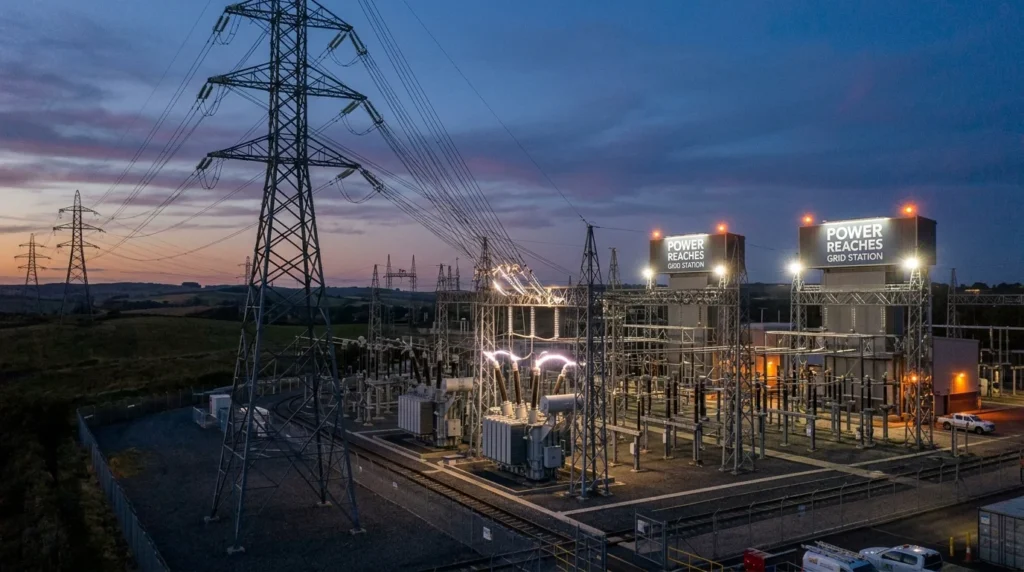
After electricity is generated and its voltage is increased by a step-up transformer, it is transmitted through high-voltage transmission lines to a grid station. The grid station acts as a central hub in the power transmission network, where electricity is received, monitored, controlled, and routed to different regions or substations. It uses equipment such as power transformers, circuit breakers, busbars, protective relays, and switchgear to regulate voltage, protect the system from faults, and ensure a stable and reliable power supply. From the grid station, electricity is transmitted to distribution substations, where the voltage is further reduced before being delivered safely to homes, commercial buildings, and industrial facilities.
The grid station:
- Receives high-voltage electricity
- Controls power flow
- Protects transmission lines
- Routes electricity to different regions
Transmission Network
Electricity travels through high-voltage transmission lines.
Distribution Substation
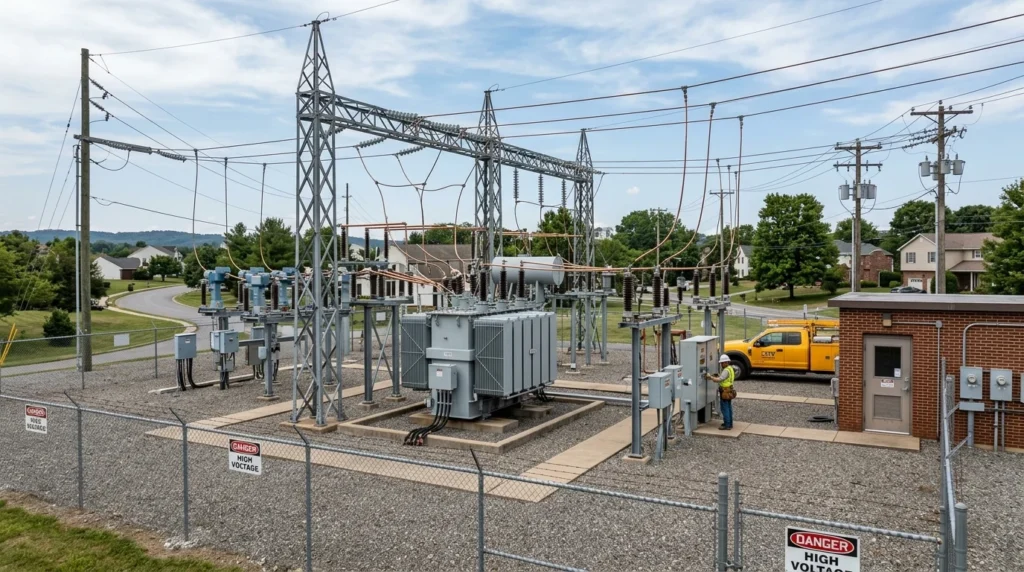
A distribution substation is an electrical facility that receives high or medium-voltage electricity from the transmission network or a grid station and reduces it to lower voltage levels suitable for consumers. Its primary function is to safely distribute electricity to residential areas, commercial buildings, industries, schools, and hospitals. A distribution substation contains essential equipment such as power transformers, circuit breakers, busbars, isolators, protective relays, and control systems to regulate voltage, protect the network from faults, and ensure a continuous and reliable power supply. By reducing voltage to usable levels, distribution substations play a vital role in delivering safe and efficient electricity to end users.The substation reduces voltage to medium or low levels suitable for consumers.
Consumer Supply
Electricity safely reaches:
- Homes
- Commercial buildings
- Factories
- Hospitals
- Schools
This process minimizes transmission losses while maintaining reliable power delivery.
Types of Grid Stations
National Grid Station
These stations connect major power plants and transmission networks across the country.
They usually operate at very high voltages such as:
- 500 kV
- 400 kV
- 220 kV
Regional Grid Station
Regional grid stations distribute electricity to different cities and districts.
Switching Grid Station
These stations mainly switch transmission lines without significantly changing voltage levels.
Types of Substations
Step-Up Substation
Installed near power plants.
Function:
- Increase voltage
- Reduce transmission losses
Step-Down Substation
Reduces transmission voltage for distribution systems.
Distribution Substation
Supplies electricity directly to residential and commercial consumers.
Switching Substation
Controls power flow without changing voltage.
Mobile Substation
Portable substations used during emergencies or maintenance work.
Underground Substation
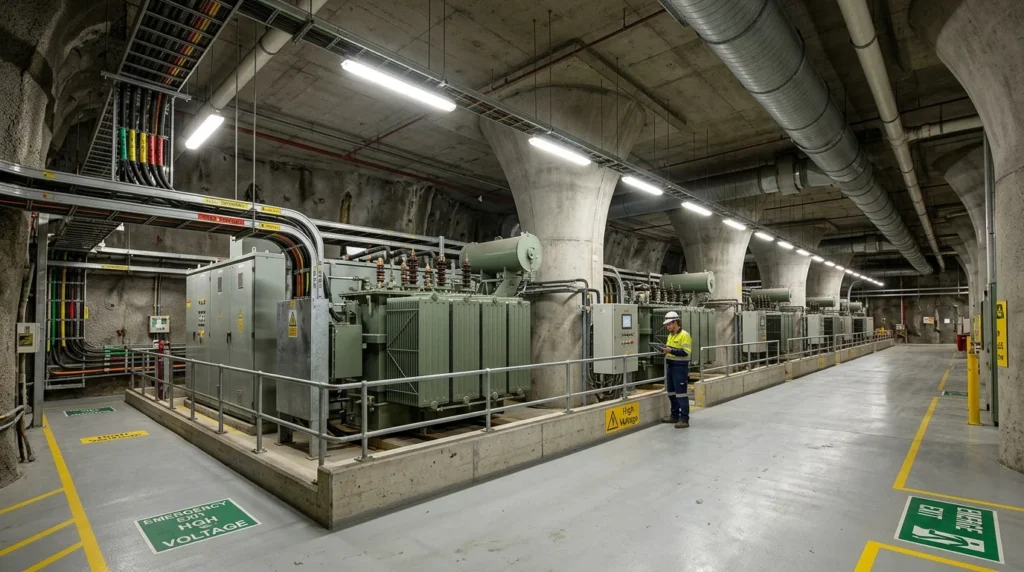
An underground substation is a type of electrical substation built below ground level, mainly in densely populated urban areas where land is limited or expensive. It performs the same functions as a conventional substation, including transforming voltage levels, controlling power flow, and protecting the electrical network. Underground substations house essential equipment such as power transformers, switchgear, circuit breakers, protective relays, and control systems in specially designed underground structures. They offer advantages such as saving valuable surface space, reducing visual impact, improving public safety, and minimizing noise. However, they have higher construction and maintenance costs due to their complex design and limited accessibility.
Installed in crowded urban areas where land is limited.
Main Components
Both grid stations and substations contain similar equipment, although their size and ratings differ.
Power Transformer
The transformer changes voltage levels according to system requirements.
Circuit Breaker
Protects equipment by interrupting fault currents automatically.
Disconnect Switch (Isolator)
Provides safe isolation during maintenance.
Busbars
Collect and distribute electrical power between different circuits.
Current Transformer (CT)
Measures current for protection and metering.
Voltage Transformer (VT/PT)
Measures voltage safely for monitoring and protection.
Protective Relays
Detect electrical faults and operate circuit breakers.
Lightning Arresters
Protect equipment from lightning surges and switching overvoltages.
Control Panel
Monitors and controls the complete operation of the station.
Earthing System
Protects people and equipment by safely directing fault currents into the ground.
Advantages
The Grid Station vs Substation advantages and disadvantages should be understood before designing any electrical system.
Advantages of Grid Stations
- Improve national power reliability
- Enable long-distance power transmission
- Support large power generation plants
- Reduce transmission congestion
- Increase grid stability
- Improve voltage regulation
Advantages of Substations
- Deliver safe voltage to consumers
- Reduce electrical losses
- Improve power quality
- Protect electrical equipment
- Isolate faulty sections quickly
- Ensure reliable electricity supply
Disadvantages / Limitations
Grid Station Limitations
- High installation cost
- Requires large land area
- Complex maintenance
- Needs skilled engineers
- Expensive protection systems
Substation Limitations
- Equipment aging over time
- Regular maintenance required
- Faults can interrupt supply
- Environmental impact due to noise
- High initial investment for large installations
Grid Station vs Substation Applications
The Grid Station vs Substation applications cover almost every part of modern life.
Residential Applications
- Supplying homes
- Apartment buildings
- Housing societies
- Street lighting
Commercial Applications
- Shopping malls
- Hospitals
- Universities
- Office buildings
- Data centers
Industrial Applications
- Manufacturing plants
- Steel industries
- Cement factories
- Oil and gas facilities
- Chemical plants
Utility Applications
- National transmission networks
- Renewable energy integration
- Smart grid systems
- Rural electrification
Modern Technology Applications
- Electric vehicle charging infrastructure
- Solar power plants
- Wind farms
- Battery energy storage systems
- Smart cities
Grid Station vs Substation Comparison
| Feature | Grid Station | Substation |
| Purpose | Transmission network control | Voltage transformation and distribution |
| Voltage Level | Very high voltage | High, medium, or low voltage |
| Network Position | Part of national grid | Located throughout transmission and distribution systems |
| Size | Large | Small to large |
| Power Capacity | Very high | Varies depending on application |
| Consumers Served | Other substations and transmission lines | Homes, industries, and commercial users |
| Equipment Rating | Higher | Moderate to high |
| Installation Cost | Very high | Lower than major grid stations |
| Complexity | More complex | Relatively simpler |
This comparison clearly explains the difference between grid station and substation.
Selection Guide
Choosing the right electrical facility depends on several factors.
Choose a Grid Station When:
- Managing national transmission systems
- Connecting multiple power plants
- Handling very high voltages
- Transferring power over long distances
Choose a Substation When:
- Supplying local communities
- Serving industrial plants
- Feeding commercial buildings
- Distributing electricity to residential areas
Tips for Beginners
- Understand voltage requirements first.
- Study power flow before equipment selection.
- Consider future load expansion.
- Prioritize protection systems.
- Follow national electrical standards.
- Plan for easy maintenance and safety.
Common Problems & Solutions
Why does a transformer overheat?
causes
- Overloading
- Poor cooling
- Internal faults
Solution
Reduce load, improve cooling, and inspect transformer insulation.
Why does a circuit breaker trip frequently?
causes
- Short circuit
- Ground fault
- Equipment failure
Solution
Locate the fault and repair damaged equipment before restoring power.
Why is voltage unstable?
causes
- Heavy load changes
- Transformer tap problems
- Weak transmission system
Solution
Adjust transformer tap settings and improve voltage regulation.
Why do substations require regular maintenance?
Routine maintenance helps prevent failures, improves equipment life, increases safety, and ensures reliable power supply.
Can one grid station supply multiple substations?
Yes. A large grid station usually supplies electricity to several substations across cities and industrial areas.
Future Trends
Power systems are becoming smarter, more efficient, and environmentally friendly.
Some important future developments include:
Smart Digital Substations
Digital communication replaces many traditional control cables, improving monitoring and reliability.
Artificial Intelligence
AI helps predict equipment failures before they happen.
Renewable Energy Integration
Modern stations increasingly connect solar farms, wind farms, and battery storage systems.
Internet of Things (IoT)
Smart sensors continuously monitor equipment health and operating conditions.
Gas-Insulated Substations (GIS)
GIS technology reduces installation space while improving reliability, making it ideal for urban environments.
Cybersecurity
As substations become digital, stronger cybersecurity measures are essential to protect critical power infrastructure.
Eco-Friendly Equipment
New insulating materials and environmentally safer gases are replacing older technologies to reduce environmental impact.
These innovations will make future electrical grids more reliable, efficient, intelligent, and sustainable.
Conclusion
Understanding Grid Station vs Substation is essential for anyone studying or working in electrical engineering. Although both facilities handle electrical power, their roles are different. A grid station mainly manages high-voltage transmission within the national grid, while a substation changes voltage levels and distributes electricity safely to industries, businesses, and homes. Learning their working principle, types, components, applications, advantages, and limitations helps engineers design more reliable and efficient power systems. As smart grids, renewable energy, and digital technologies continue to evolve, both grid stations and substations will become even more advanced and important. Building a strong understanding of these concepts provides a solid foundation for future learning and successful careers in the electrical power industry.