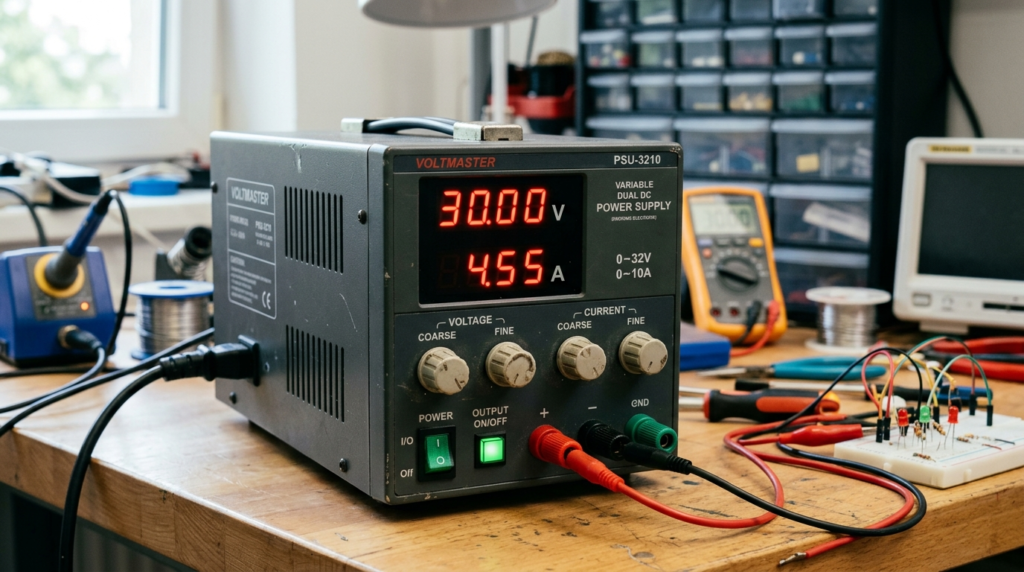

Imagine charging your mobile phone, running a laptop, or powering a small electronic circuit. All these devices do not work directly on household AC supply. Instead, they rely on a stable and constant type of electricity known as DC Power Supply.
In real life, almost every electronic device you use—from smartphones to computers and control systems—depends on DC power. Even renewable energy systems like solar panels generate DC power before converting it for use.
Understanding DC power supply is essential for electrical students, engineers, and technicians because it is the foundation of electronics, automation, and modern digital systems. Without stable DC power, sensitive electronic components can get damaged or fail to work properly.
In this article, you will learn what DC power supply is, how it works, its types, components, advantages, disadvantages, applications, and future trends in a simple and practical way.
What is DC Power Supply?
A DC Power Supply is a system that provides electrical energy in the form of Direct Current (DC), where electricity flows in one constant direction.
In simple words, DC power is steady electricity that does not change direction like AC.
Practical Example
- A mobile phone battery provides DC power.
- A solar panel also produces DC electricity.
- USB ports give DC output (5V).
The DC Power Supply working principle is based on converting electrical energy (often from AC or other sources) into a stable DC output suitable for electronic devices.
Working Principle
The working of a DC power supply is based on converting AC or raw DC into a stable and smooth DC output.
Step-by-Step Working
Input Supply
- AC power (from mains) or DC source is provided.
Step-Down Transformation
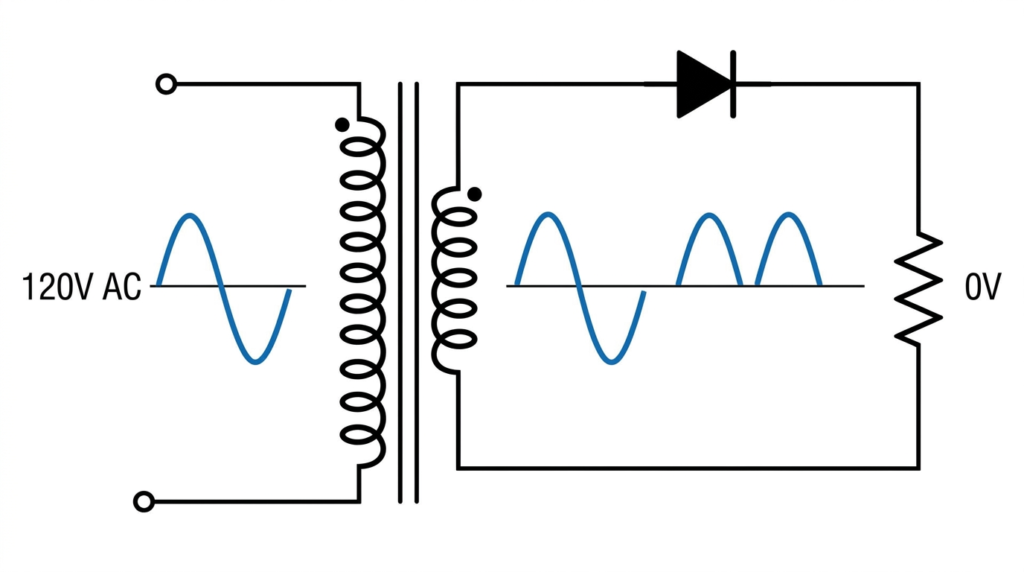
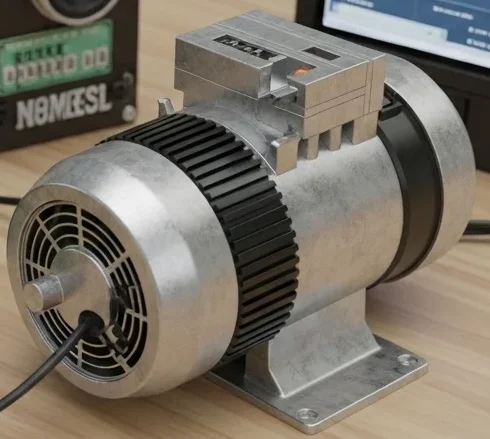
A step-down transformer is the first stage of a DC power supply that reduces the high AC mains voltage to a lower AC voltage suitable for electronic circuits. It works on the principle of electromagnetic induction, where the secondary winding has fewer turns than the primary winding, resulting in a lower output voltage. For example, it can reduce 230 V AC to 12 V AC or 24 V AC before the voltage is converted into DC by the rectifier. In addition to lowering the voltage, the transformer also provides electrical isolation between the mains supply and the electronic circuit, improving safety. Step-down transformers are commonly used in regulated and unregulated DC power supplies, battery chargers, adapters, and various electronic devices.Transformer reduces high voltage AC to low voltage AC.
Rectification
- Diodes convert AC into pulsating DC.
Filtering
- Capacitors smooth out ripples in DC.
Voltage Regulation
- Regulator ensures constant output voltage.
Final DC Output
- Stable DC power is delivered to the load.
Easy Analogy
Think of water flow:
- AC = water flowing forward and backward
- DC = smooth, one-direction water flow
Key Concept
V_{DC} = \text{Constant (steady voltage output)}}
DC power aims to maintain a constant voltage level for stable operation.
Types / Classification
Unregulated DC Power Supply
An unregulated DC power supply is a simple electronic circuit that converts alternating current (AC) into direct current (DC) without maintaining a constant output voltage. It typically consists of a transformer, rectifier, and filter capacitor. Since it has no voltage regulator, the output voltage changes with variations in the input voltage and the connected load. Unregulated DC power supplies are inexpensive, simple to design, and are commonly used in applications where precise voltage is not required, such as battery chargers, relays, lamps, and basic electronic circuits. However, they produce ripple voltage and are not suitable for sensitive electronic devices that require a stable DC supply.
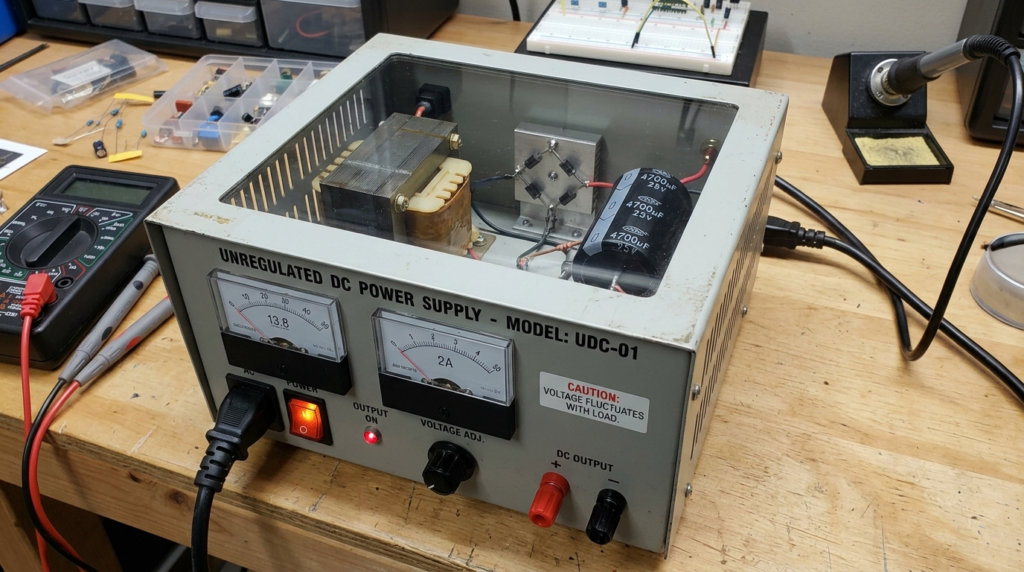
This type provides DC output without voltage control.
Features
- Simple design
- Low cost
- Output varies with load
Applications
- Basic circuits
- Low-cost devices
Regulated DC Power Supply
Regulated DC Power Supply
A regulated DC power supply is an electronic circuit that converts alternating current (AC) into a stable and constant direct current (DC) output, regardless of changes in the input voltage or load conditions. It consists of a transformer, rectifier, filter, and voltage regulator. The voltage regulator maintains a fixed output voltage and minimizes ripple, ensuring reliable operation of sensitive electronic devices. Regulated DC power supplies are widely used in computers, communication systems, laboratory equipment, medical devices, and other electronic circuits that require a precise and stable DC voltage. Although they are more complex and expensive than unregulated power supplies, they provide better performance, higher accuracy, and improved protection for electronic components.
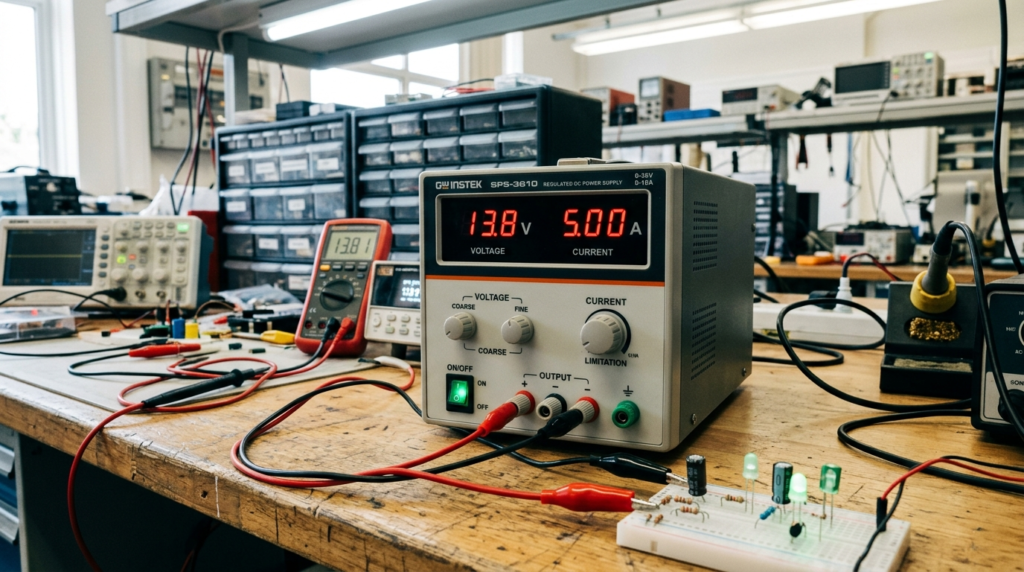
This system maintains a constant output voltage.
Features
- Stable output
- High accuracy
- Used in sensitive electronics
Applications
- Computers
- Communication systems
Linear DC Power Supply
A linear DC power supply is a type of regulated power supply that converts alternating current (AC) into a stable direct current (DC) using a transformer, rectifier, filter, and linear voltage regulator. The linear regulator continuously adjusts its resistance to maintain a constant output voltage, providing very low noise and ripple. These power supplies are simple, reliable, and produce clean DC output, making them ideal for audio equipment, laboratory instruments, communication systems, and other sensitive electronic devices. However, linear DC power supplies are less efficient because excess electrical energy is dissipated as heat, making them larger and heavier than switching power supplies.
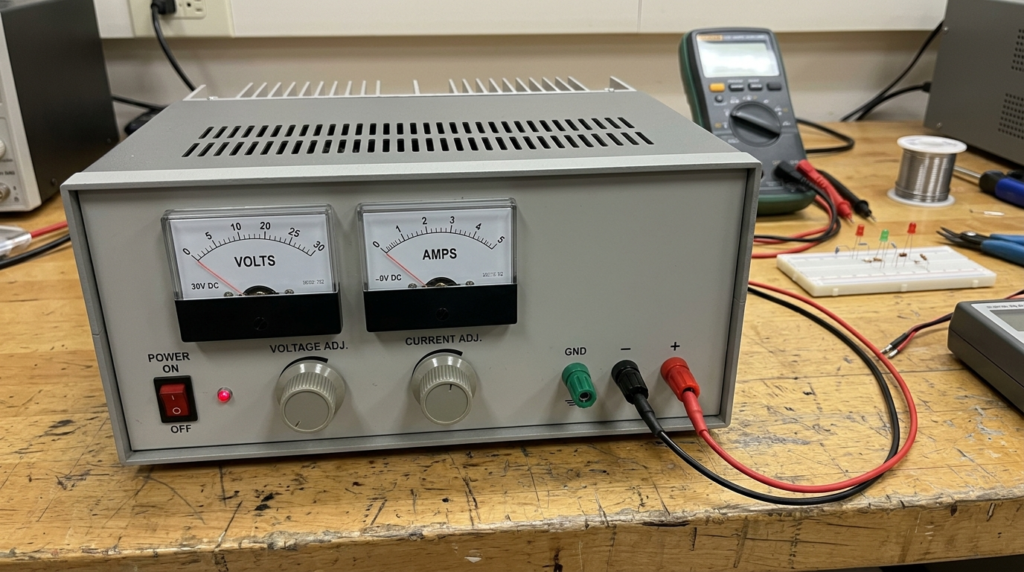
Uses linear regulators to reduce voltage.
Features
- Low noise output
- Simple design
- Low efficiency
Applications
- Audio equipment
- Laboratory use
Switching DC Power Supply (SMPS)
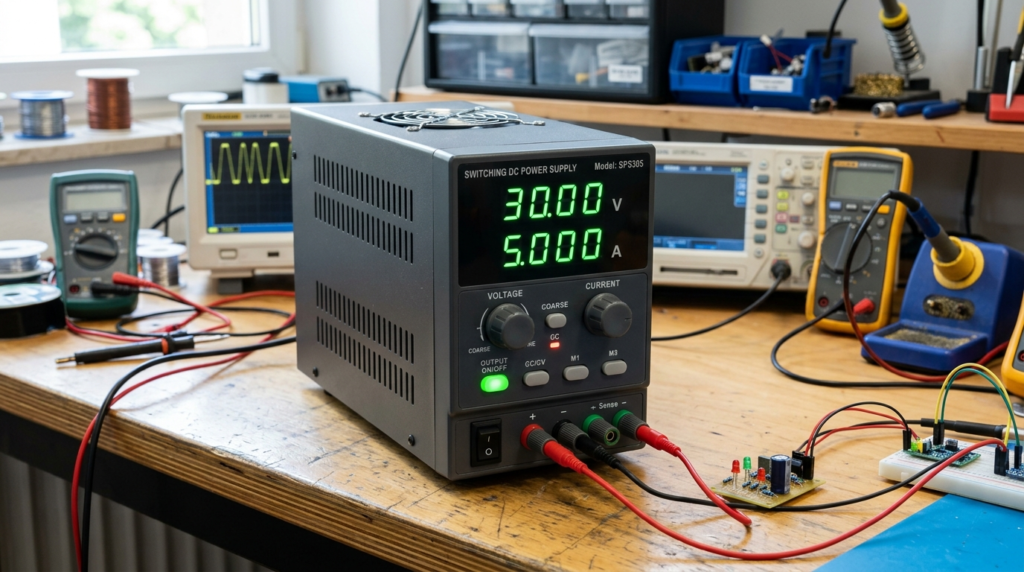
A Switching DC Power Supply, also known as a Switched-Mode Power Supply (SMPS), is an electronic power supply that converts AC or DC input into a regulated DC output by rapidly switching electronic components on and off at high frequency. It uses components such as a rectifier, high-frequency switching transistor, transformer, filter, and control circuit to achieve efficient power conversion. SMPS offers high efficiency, compact size, lightweight construction, and low heat generation compared to linear power supplies. It is widely used in computers, mobile phone chargers, televisions, LED lighting, industrial equipment, and telecommunications systems. Although SMPS is more efficient and portable, it produces more electrical noise and has a more complex design than linear power supplies.
Uses high-frequency switching technology.
Features
- High efficiency
- Lightweight
- Compact size
Applications
- Mobile chargers
- Laptop adapters
5. Main Components
Transformer
Reduces AC voltage to required level.
Rectifier
Converts AC into pulsating DC using diodes.
Filter Circuit
Smooths DC output using capacitors and inductors.
Voltage Regulator
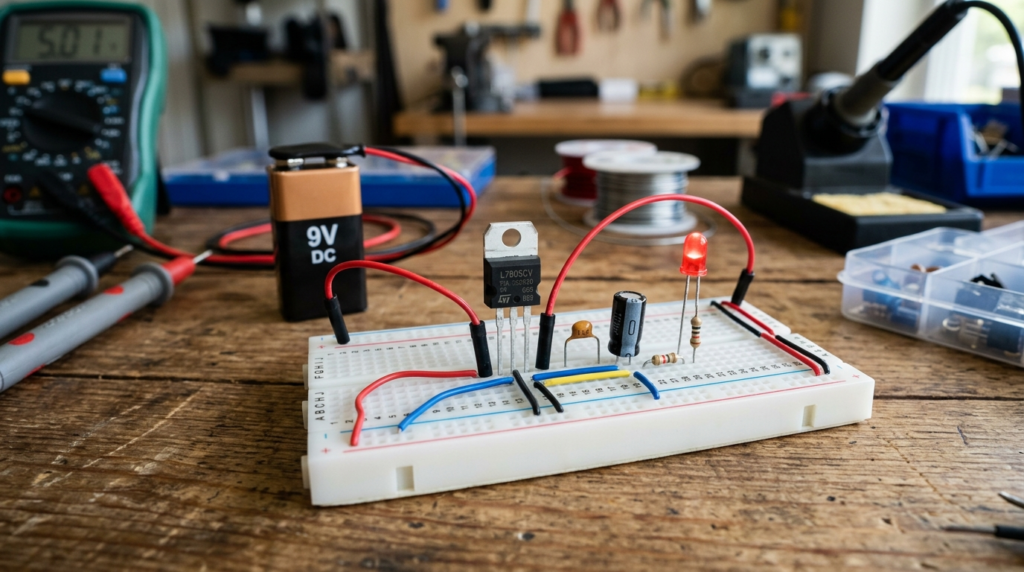
A voltage regulator is an electronic device or circuit that maintains a constant output voltage despite changes in the input voltage or load current. It protects electronic components from voltage fluctuations and ensures stable, reliable operation of electrical and electronic systems. Voltage regulators are commonly used in power supplies, computers, mobile phone chargers, automotive electronics, communication equipment, and industrial control systems. There are two main types of voltage regulators: linear regulators, which provide low-noise and stable output but are less efficient, and switching regulators, which offer high efficiency and compact size by using high-frequency switching techniques. Voltage regulators are essential for supplying clean and regulated DC power to sensitive electronic devices.
Maintains constant output voltage.
Heat Sink
Removes excess heat from components.
Load
Device that consumes DC power.
6. Advantages
Advantages of DC Power Supply
- Stable and constant voltage output
- Ideal for electronic circuits
- Safe for sensitive devices
- Easy to store (battery systems)
- Compatible with renewable energy
- Low noise operation in circuits
Real-World Benefits
- Reliable mobile charging
- Smooth operation of computers
- Efficient solar energy usage
7. Disadvantages / Limitations
Common Limitations
- Not efficient for long-distance transmission
- Requires conversion from AC in most cases
- Voltage drop in long wires
- Heat loss in linear systems
Practical Issues
DC systems need proper regulation, or devices may get damaged due to voltage variations.
8. Applications
Home Applications
- Mobile chargers
- LED lights
- Remote controls
Industrial Applications
- Control systems
- Automation equipment
- PLC circuits
Commercial Applications
- Computer systems
- Communication networks
- Security systems
Modern Applications
- Electric vehicles
- Solar power systems
- IoT devices
The DC Power Supply applications are essential in modern electronics and renewable energy systems.
9. Comparison Section
AC vs DC Power Supply
| Feature | AC Power Supply | DC Power Supply |
| Direction | Changes periodically | One direction |
| Stability | Less stable | Highly stable |
| Transmission | Efficient long distance | Limited range |
| Usage | Homes and industries | Electronics and devices |
| Conversion | Easy transformation | Needs conversion circuits |
Understanding the difference between AC and DC helps in selecting proper power systems.
10. Selection Guide
How to Choose DC Power Supply
- Check required voltage (5V, 12V, 24V, etc.)
- Determine load current capacity
- Choose regulated supply for sensitive devices
- Consider efficiency requirements
- Select SMPS for compact systems
Beginner Tips
- Always match voltage rating
- Avoid overloading the supply
- Use proper cooling for high-power systems
- Learn basic circuit protection
Proper selection ensures safety and long equipment life.
11. Common Problems & Solutions
No Output
Cause
- Faulty fuse or input supply issue
Solution
- Check power source and fuse
Low Voltage Output
Cause
- Overload or damaged regulator
Solution
- Reduce load or replace regulator
Excess Heat
Cause
- High current load or poor ventilation
Solution
- Use heat sinks and proper cooling
Ripple in Output
Cause
- Faulty filter capacitor
Solution
- Replace capacitor or improve filtering
Why is DC Used in Electronics?
DC is used because electronic components need stable and constant voltage for proper operation.
12. Future Trends
High-Efficiency SMPS
Modern switching supplies are becoming more efficient and compact.
Renewable Energy Integration
Solar and wind systems rely heavily on DC power.
Electric Vehicles
EVs use DC battery systems with smart power management.
Fast Charging Technology
Advanced DC fast chargers are improving charging speed.
Smart Power Systems
AI-based systems optimize DC power usage in real time.
The future of DC Power Supply is efficient, compact, and intelligent.
13. Conclusion
The DC Power Supply is a fundamental part of modern electrical and electronic systems. It provides stable, smooth, and reliable power required by sensitive devices and advanced technologies. From mobile phones to solar systems and electric vehicles, DC power plays a critical role in everyday life.
In this article, we explored its working principle, types, components, applications, advantages, disadvantages, and future trends. For students and engineers, understanding DC power supply is essential for building a strong foundation in electronics and power systems.
As technology continues to evolve, DC systems will become even more important, especially in renewable energy and smart devices. Mastering this topic will help you understand the core of modern electrical engineering.