
Imagine you plug in your fan, light, or mobile charger at home and it works instantly. Have you ever thought about where this electricity comes from and why it keeps changing direction? That is the role of an AC Power Supply.
Almost all residential and industrial electrical systems around the world use AC (Alternating Current) power. It is the backbone of modern electricity distribution because it is easy to generate, transmit, and transform into different voltage levels.
For electrical students, engineers, and technicians, understanding AC power supply is very important because it forms the base of power systems, machines, and electronics. Without AC power, large-scale electricity networks would not be efficient or economical.
In this article, you will learn what AC power supply is, how it works, its types, components, advantages, disadvantages, applications, and future trends in a simple and practical way.
What is AC Power Supply?
An AC Power Supply is a system that provides electrical energy in the form of alternating current, where the direction of current changes periodically.
In simple words, AC power is electricity that keeps reversing its direction many times per second.
Practical Example
The electricity supplied in homes (like 230V, 50Hz in many countries) is AC power. It powers lights, fans, refrigerators, and air conditioners.
The AC Power Supply working principle is based on generating alternating voltage and distributing it efficiently over long distances.
Working Principle
The working of AC power supply is based on electromagnetic induction.
Step-by-Step Working
Mechanical Energy Input
- A turbine (steam, water, or wind) rotates.
Generator Action
- The rotating coil inside a magnetic field produces electricity.
Alternating Voltage Creation
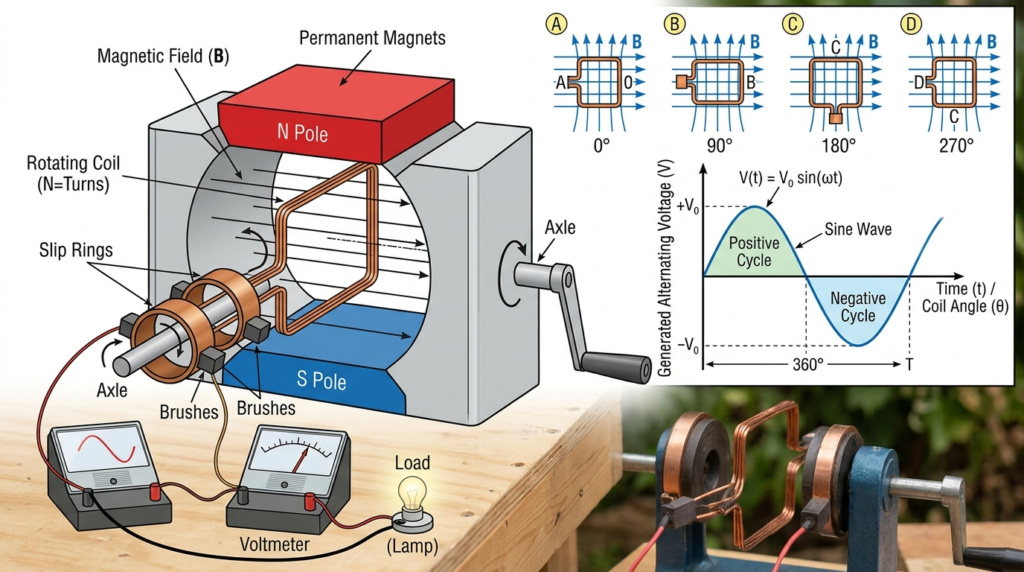
Alternating Voltage Creation is the process of generating an alternating current (AC) voltage in an electrical generator (alternator). It occurs when a coil of wire rotates inside a magnetic field, or when a magnetic field rotates around a stationary coil. According to Faraday’s Law of Electromagnetic Induction, the changing magnetic flux induces an electromotive force (EMF) in the coil. As the coil rotates, the direction of the induced voltage reverses every half rotation, producing a sinusoidal AC waveform that alternates between positive and negative values. This alternating voltage is the standard electrical power supplied by power stations and is used as the input for DC power supplies, where it is later stepped down, rectified, filtered, and regulated to produce a stable DC output.As the coil rotates, the direction of current changes continuously.
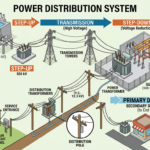
Voltage Transformation
- Step-up transformers increase voltage for transmission.
Distribution
- Electricity is distributed and stepped down for safe usage.
Easy Analogy
Think of a swing:
- It moves forward and backward repeatedly.
- AC current also changes direction repeatedly.
Key Idea
V(t) = V_m \sin(\omega t)
This shows how AC voltage varies in a smooth wave pattern over time.
Types / Classification
Single Phase AC Supply


5
A single-phase AC supply is an electrical power system that uses one alternating voltage waveform to deliver electricity. It consists of one live (phase) wire and one neutral wire, with the voltage alternating in polarity at a fixed frequency (typically 50 Hz or 60 Hz). Single-phase power is commonly used in homes, offices, shops, and small businesses to operate lighting, fans, televisions, refrigerators, computers, and other household appliances. It is simple, economical, and suitable for low to moderate power requirements. However, compared to a three-phase supply, it is less efficient for operating large motors and heavy industrial equipment.
Single phase supply uses one alternating voltage waveform.
Features
- Common in homes
- Simple system
- Suitable for low power loads
Applications
- Houses
- Small offices
- Domestic appliances
Three Phase AC Supply


6
A three-phase AC supply is a system of generating, transmitting, and distributing electrical power using three alternating voltages of the same frequency and magnitude, with each voltage shifted by 120° in phase from the others. This arrangement provides a continuous and balanced flow of power, making it more efficient than a single-phase supply. Three-phase power is widely used in industrial plants, factories, commercial buildings, and power transmission systems because it can operate heavy motors and electrical equipment with higher efficiency, lower power losses, and smoother performance. It is the standard method of electrical power generation and distribution throughout the world.
Three phase supply uses three alternating voltages 120° apart.
Features
- High efficiency
- Smooth power delivery
- Suitable for heavy loads
Applications
- Industries
- Factories
- Large motors
Balanced AC Supply
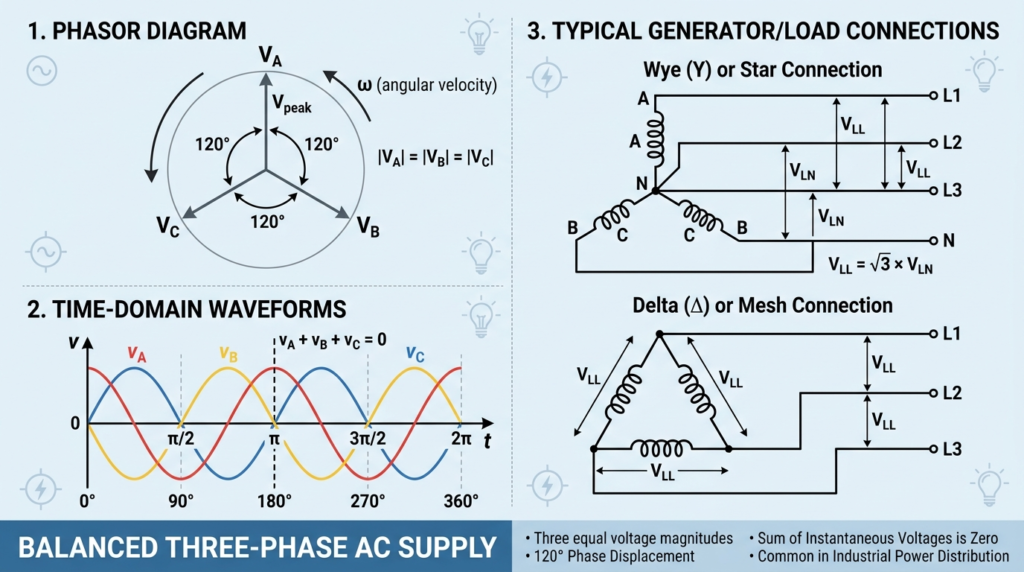
A balanced AC supply is a condition in a three-phase electrical system where all three phase voltages have equal magnitude, the same frequency, and are separated by exactly 120° in phase. In a balanced system, the loads connected to each phase are equal, resulting in equal phase currents and a stable, efficient flow of electrical power. A balanced AC supply minimizes power losses, reduces voltage fluctuations, prevents overheating of equipment, and ensures smooth operation of three-phase motors and other electrical devices. It is the ideal operating condition for power generation, transmission, and distribution systems because it improves efficiency, reliability, and overall system performance.
All phases carry equal load.
Features
- Stable system
- Efficient power use
Unbalanced AC Supply
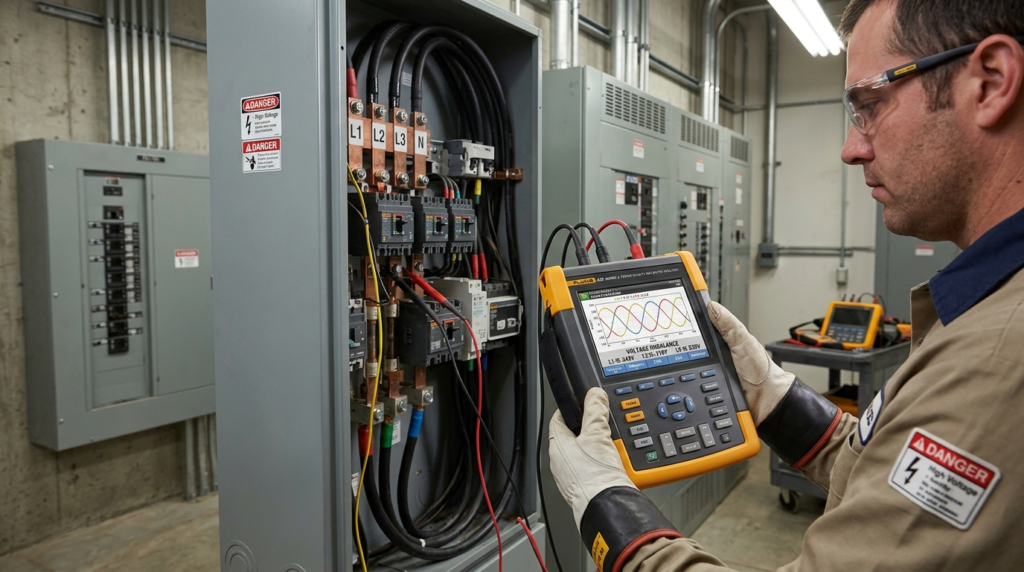
An unbalanced AC supply is a condition in which the voltages or currents of a three-phase AC power system are not equal in magnitude or are not separated by exactly 120° in phase. This imbalance usually occurs due to unequal loading of the phases, faulty wiring, damaged transformers, or poor electrical connections. An unbalanced AC supply can cause excessive heating, reduced efficiency, voltage fluctuations, increased power losses, and vibration in three-phase motors and other electrical equipment. To maintain reliable operation and protect electrical devices, power systems should be designed and maintained to keep the AC supply as balanced as possible.Load is not equally distributed.
Features
- Less efficient
- Can cause system instability
Main Components
Alternator (AC Generator)


6
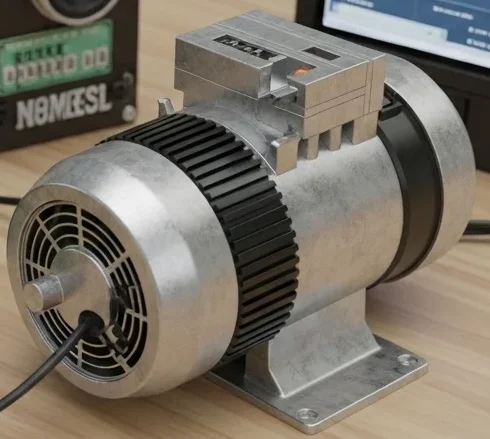
An alternator (AC generator) is an electrical machine that converts mechanical energy into alternating current (AC) electrical energy through the principle of electromagnetic induction. It consists mainly of a rotor (rotating magnetic field) and a stator (stationary armature winding). When the rotor rotates, its magnetic field cuts through the stator windings, inducing an alternating voltage. The direction of the induced voltage reverses every half rotation, producing an AC output. Alternators are highly efficient and are widely used in power stations, automobiles, wind turbines, and diesel generators to generate electricity. They provide the AC power that is transmitted through the electrical grid and is later converted into DC when required by electronic devices.
Produces alternating current using electromagnetic induction.
Prime Mover
Provides mechanical energy (turbine, engine, wind).
Transformers
Increase or decrease voltage levels.
Transmission Lines
Carry electricity over long distances.
Distribution System
Delivers electricity to consumers.
Protective Devices
Include circuit breakers and fuses for safety.
Load
Any device that consumes electrical power.
Advantages
Advantages of AC Power Supply
- Easy voltage transformation using transformers
- Efficient long-distance transmission
- Lower energy losses
- Simple generator design
- Cost-effective power distribution
- Suitable for industrial loads
Real-World Benefits
- Reliable household electricity
- Continuous industrial production
- Stable national grid systems
Disadvantages / Limitations
Common Limitations
- Skin effect increases resistance in conductors
- Reactive power losses
- Complex synchronization in power systems
- Not ideal for certain electronic circuits without conversion
Practical Issues
AC power can cause inductive losses in long cables and heavy industrial systems.
Applications
Home Applications
- Lighting systems
- Fans and air conditioners
- Refrigerators and washing machines
Industrial Applications
- Motors and heavy machinery
- Manufacturing systems
- Welding equipment
Commercial Applications
- Shopping malls
- Hospitals
- Office buildings
Modern Applications
- Smart grids
- Renewable energy integration
- Electric vehicle charging stations
The AC Power Supply applications are essential in almost every electrical system today.
Comparison Section
AC vs DC Power Supply
| Feature | AC Power Supply | DC Power Supply |
|---|---|---|
| Current Direction | Changes periodically | One direction only |
| Transmission | Efficient over long distance | Less efficient for long distance |
| Voltage Conversion | Easy using transformers | Requires electronic converters |
| Generation | Simple and cost-effective | More complex |
| Usage | Homes and industries | Electronics and batteries |
Understanding the difference between AC and DC helps in selecting the right system.
Selection Guide
How to Choose AC Power System
- Determine load requirement
- Choose single or three phase supply
- Consider distance of transmission
- Check voltage level standards
- Ensure safety protection devices
Beginner Tips
- Learn basic waveforms first
- Understand RMS voltage concept
- Study transformer operation
- Focus on safety rules
Proper selection improves system performance and reliability.
Common Problems & Solutions
Voltage Fluctuation
Cause
- Load variation
Solution
- Use voltage stabilizers
Power Loss
Cause
- Resistance in lines
Solution
- Increase transmission voltage
Overloading
Cause
- Excess devices connected
Solution
- Load management and circuit breakers
Harmonics Distortion
Cause
- Non-linear loads
Solution
- Install filters and proper grounding
Why is AC Used Instead of DC?
AC is used because it is easy to transmit over long distances and can be transformed to different voltage levels efficiently.
Future Trends
Smart Grid Systems
Digital monitoring of AC networks improves efficiency and reliability.
Renewable Integration
Solar and wind energy are increasingly connected to AC grids.
High-Efficiency Transformers
Modern transformers reduce energy losses significantly.
AI-Based Power Management
Artificial intelligence helps balance loads and detect faults early.
Hybrid AC/DC Systems
Future networks will combine both AC and DC for better performance.
The future of AC Power Supply is smarter, more efficient, and more sustainable.
Conclusion
The AC Power Supply is the foundation of modern electrical systems. It provides a reliable, efficient, and cost-effective way to generate, transmit, and distribute electricity. From homes to large industries, AC power plays a vital role in everyday life.
In this article, we explored its working principle, types, components, advantages, disadvantages, applications, and future trends. For electrical students and engineers, understanding AC power is essential because it forms the base of power systems and electrical engineering.
As technology advances, AC systems are becoming smarter and more efficient with renewable energy and digital control integration. Mastering this topic is key to building a strong foundation in electrical engineering.