

Imagine you plug in an electric heater at home. The voltage supply is labeled as 230V AC. But if you measure the voltage waveform, you’ll notice it constantly rises and falls—it is not steady like DC. So how do we decide that this fluctuating voltage is equivalent to a steady 230V? This is where the concept of RMS value comes in.
In electrical engineering, we often deal with alternating current (AC), where voltage and current continuously change. To make calculations simple and meaningful, we use a special value called the RMS (Root Mean Square) value.
Understanding RMS Value Explained is very important for electrical students, engineers, technicians, and beginners. It helps in power calculations, equipment ratings, and safe system design.
In this article, you will learn the complete RMS value explained working principle, types, components, applications, advantages and disadvantages, and practical troubleshooting. By the end, you will clearly understand how RMS values represent real electrical power in AC systems.
2. What is RMS Value Explained?
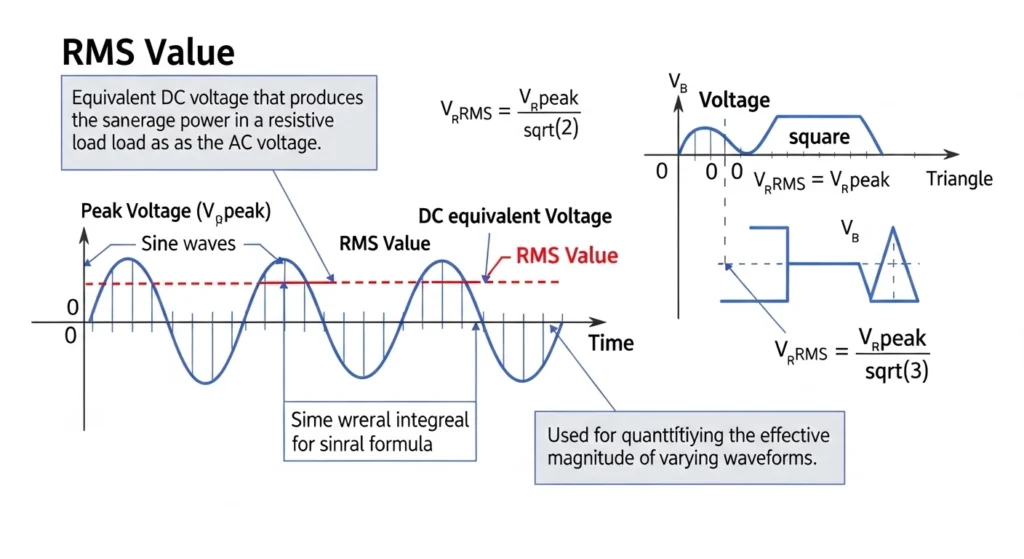
The RMS value is the effective value of an AC voltage or current, which produces the same heating effect as an equivalent DC value.
Simple Explanation
It tells us how much useful power an AC signal can deliver, just like DC.
Practical Example
- 230V AC (RMS) produces the same heat as 230V DC
- Even though AC is constantly changing, RMS makes it easy to compare
3. Working Principle
The RMS value explained working principle is based on calculating the effective power of a varying waveform.
Step-by-Step Explanation
- AC waveform varies continuously
- Square the instantaneous values
- Find the average of these squared values
- Take the square root of the average
- The result is the RMS value
Mathematical Expression
V_{rms} = \sqrt{\frac{1}{T} \int_0^T v^2(t) , dt}
RMS Value for Sine Wave
V_{rms} = \frac{V_{max}}{\sqrt{2}}
Easy Analogy
Think of a fluctuating water flow:
- Water speed changes continuously
- RMS is like the average force of water over time
Key Points
- RMS value represents real power capability
- Used in all AC calculations
- Essential for equipment ratings
4. Types / Classification
RMS Value of Sinusoidal Wave
- Most common in AC systems
- Simple formula (Vmax / √2)
RMS Value of Square Wave
- Equal to peak value
- No variation
RMS Value of Triangular Wave
- Lower than sine wave
- Requires calculation
RMS Value of Complex Waveforms
- Used in electronics
- Calculated using integration
5. Main Components
Waveform
- Determines RMS value
- Shape affects calculation
Peak Value
- Maximum value of waveform
- Used to calculate RMS
Time Period
- Duration of one cycle
- Important for averaging
Measuring Instruments
- True RMS meters
- Oscilloscopes
Load
- Determines power consumption
- Works based on RMS values
6. Advantages
RMS Value Explained Advantages
- Simplifies AC calculations
- Represents real power
- Standard for electrical systems
- Helps in equipment rating
- Useful in design and analysis
- Accurate measurement of power
7. Disadvantages / Limitations
RMS Value Explained Disadvantages
- Complex calculation for irregular waves
- Requires advanced instruments
- Not intuitive for beginners
- Cannot show waveform shape
- Needs proper understanding
8. Applications
RMS Value Explained Applications
Home Applications
- Voltage rating (e.g., 230V supply)
- Appliance design
Industrial Applications
- Power calculations
- Motor operation
- Transformer design
Modern Technology
- Power electronics
- Signal processing
- Renewable energy systems
- Electrical measurements
RMS value is used in almost all AC systems.
9. Comparison Section
Difference Between RMS Value and Average Value
| Feature | RMS Value | Average Value |
| Definition | Effective value | Mean value |
| Power Calculation | Accurate | Not accurate |
| Application | Power systems | Signal analysis |
| Dependence | Squared values | Simple average |
| Usefulness | High | Limited |
10. Selection Guide
Understanding RMS value helps in selecting equipment.
Tips for Beginners
- Always use RMS values for AC systems
- Check equipment ratings in RMS
- Use true RMS meters
Key Factors to Consider
- Waveform type
- Measurement accuracy
- Application requirement
- Instrument quality
Practical Advice
- Avoid using average meters for AC
- Use true RMS measurement tools
- Understand waveform behavior
11. Common Problems & Solutions
Why readings are incorrect?
Using non-RMS meter.
Use true RMS meter.
Why equipment overheats?
Wrong RMS calculation.
Check proper values.
Why AC value seems lower?
RMS is lower than peak.
Understand relationship.
How to measure RMS?
Using true RMS instruments.
Why RMS is important?
It represents actual usable power.
12. Future Trends
RMS measurement is evolving with technology.
Key Trends
- True RMS Smart Meters
- Digital Signal Processing
- AI-Based Measurement Systems
- Advanced Oscilloscopes
- IoT Monitoring Systems
Future systems will focus on accurate and real-time RMS measurement.
13. Conclusion
Understanding RMS Value Explained is essential for working with AC electrical systems. RMS value provides the effective value of voltage and current, making it possible to calculate real power and design efficient systems.
By learning the RMS value explained working principle, types, and applications, you can better analyze circuits and ensure proper equipment operation. While calculations can be complex, modern tools make RMS measurement easier.
For electrical students and professionals, mastering RMS concepts is crucial for safe and accurate system design. Focus on practical applications to build strong expertise.