
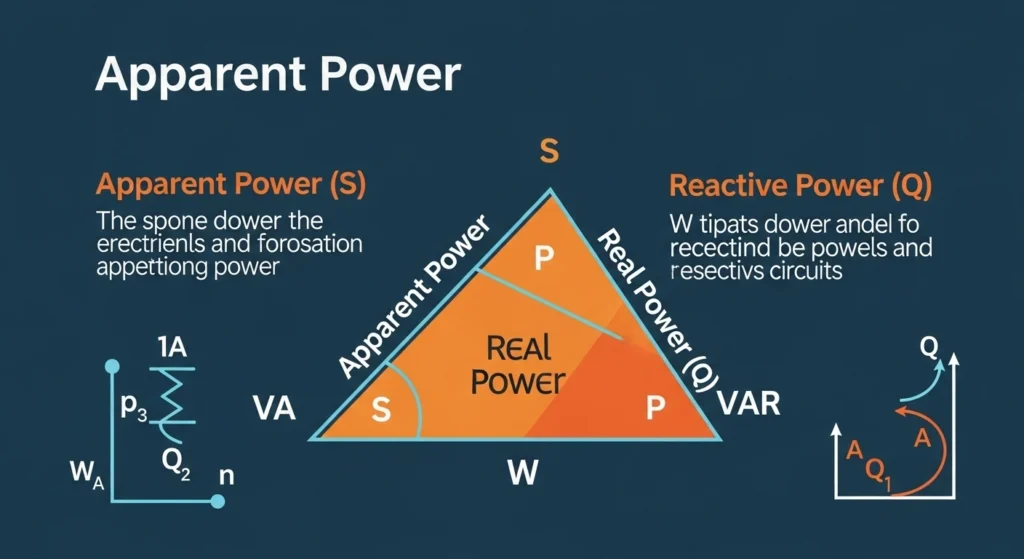

Imagine you install a new air conditioner at home. The label shows power ratings in watts, but your electricity system seems to handle more load than expected. Why? Because the total power drawn from the supply is not just the useful power—it includes another component that does not directly perform work. This total demand is called apparent power.
In AC electrical systems, power is divided into different forms. While real power does useful work, and reactive power supports the system, apparent power represents the total power supplied by the source. It is a critical concept in designing electrical systems, selecting equipment, and managing energy efficiently.
Understanding Apparent Power Explained is essential for electrical students, engineers, and technicians. It helps in analyzing power systems, improving efficiency, and avoiding overload conditions.
In this article, you will learn the complete apparent power explained working principle, types, components, applications, advantages and disadvantages, and practical troubleshooting. By the end, you will clearly understand how apparent power affects real-world electrical systems.
2. What is Apparent Power Explained?
Apparent power is the total power supplied to an AC circuit, combining both real power and reactive power.
Simple Explanation
It is the total electrical power drawn from the source, regardless of how much is actually used for useful work.
Unit
- Measured in Volt-Amperes (VA)
Practical Example
In a motor:
- Real power → runs the motor
- Reactive power → maintains magnetic field
- Apparent power → total power drawn from supply
3. Working Principle
The apparent power explained working principle is based on the relationship between voltage, current, and phase angle in AC circuits.
Step-by-Step Explanation
- AC voltage is applied to a circuit
- Current flows depending on load type
- Voltage and current may not be in phase
- Power splits into:
- Real power (P)
- Reactive power (Q)
- Combined effect gives apparent power (S)
Mathematical Formula
S = V \times I
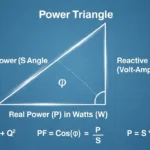
Relation with Power Triangle
S^2 = P^2 + Q^2
Easy Analogy
Think of a delivery truck:
- Real power = goods delivered
- Reactive power = empty space
- Apparent power = total truck capacity
Key Points
- Apparent power is always greater than or equal to real power
- Depends on power factor
- Important for system design
4. Types / Classification
Single-Phase Apparent Power
- Used in home systems
- Simple calculation (V × I)
Three-Phase Apparent Power
- Used in industrial systems
- Higher power handling
Formula:
S = \sqrt{3} \times V \times I
Balanced Load Apparent Power
- Equal load on all phases
- Efficient operation
Unbalanced Load Apparent Power
- Unequal load distribution
- Causes inefficiency
5. Main Components
Voltage Source
- Supplies electrical energy
- Determines voltage level
Current Flow
- Depends on load
- Affects apparent power
Load Types
- Resistive (real power)
- Inductive (reactive power)
- Capacitive (reactive power)
Power Factor
- Ratio of real power to apparent power
- Affects efficiency
Measuring Instruments
- Power meters
- Clamp meters
- Power analyzers
6. Advantages
Apparent Power Explained Advantages
- Helps in system design
- Ensures proper equipment sizing
- Prevents overload conditions
- Improves power system analysis
- Supports efficient energy management
- Essential for industrial planning
7. Disadvantages / Limitations
Apparent Power Explained Disadvantages
- Includes unused power
- Can cause inefficiency
- Misleading if used alone
- Requires power factor correction
- Increases system load
8. Applications
Apparent Power Explained Applications
Home Applications
- Electrical load calculation
- Appliance selection
Industrial Applications
- Transformer and generator sizing
- Motor operation
- Power distribution systems
Modern Technology
- Smart grids
- Renewable energy systems
- Electric vehicle charging
- Data centers
Apparent power is critical in all AC systems.
9. Comparison Section
Difference Between Real Power and Apparent Power
| Feature | Real Power (P) | Apparent Power (S) |
| Definition | Useful power | Total supplied power |
| Unit | Watt (W) | Volt-Ampere (VA) |
| Function | Performs work | Combination of P and Q |
| Dependence | Power factor | Voltage and current |
| Application | Loads | System design |
10. Selection Guide
Understanding apparent power helps in choosing equipment.
Tips for Beginners
- Always consider apparent power rating
- Do not rely only on watt rating
- Maintain good power factor
Key Factors to Consider
- Load type
- Power factor
- Voltage and current
- System efficiency
- Safety margin
Practical Advice
- Use equipment with proper VA rating
- Avoid overloading
- Improve power factor using capacitors
11. Common Problems & Solutions
Why equipment is overloaded?
High apparent power demand.
Use properly rated equipment.
Why system efficiency is low?
Poor power factor.
Improve power factor.
Why current is high?
Use correction devices.
Why transformer heats up?
High apparent power load.
Reduce load or upgrade transformer.
How to reduce apparent power?
Improve power factor.
12. Future Trends
Power systems are evolving with better control of apparent power.
Key Trends
- Smart Power Monitoring Systems
- AI-Based Energy Optimization
- Advanced Power Electronics
- Renewable Energy Integration
- IoT-Based Load Management
Future systems aim for efficient and optimized power usage.
13. Conclusion
Understanding Apparent Power Explained is essential for analyzing and designing AC electrical systems. It represents the total power supplied, combining both useful and non-useful components.
By learning the apparent power explained working principle, types, and applications, you can better manage electrical loads and improve system efficiency. While apparent power includes some unused energy, proper power factor correction can minimize its impact.
For electrical students and professionals, mastering this concept is crucial for safe and efficient system design. Focus on practical applications and real-world scenarios to strengthen your understanding.


Pingback: What Is Reactive Power? Simple Guide with Examples