
Imagine a busy modern city where thousands of homes, offices, hospitals, and factories require uninterrupted electricity every second. In such areas, overhead transmission lines may create safety risks, visual pollution, and frequent outages due to storms or accidents. To solve these problems, engineers often use underground cable systems for safer and more reliable power distribution.
Underground cable systems have become an essential part of modern electrical infrastructure. They are widely used in urban areas, industrial plants, airports, railway systems, and smart cities where reliability and safety are extremely important. Unlike overhead lines, underground cables are protected from weather conditions, falling trees, and external damage.
For electrical students, engineers, technicians, and beginners, understanding underground cable systems is very important because these systems are increasingly used in modern power networks. Knowledge of underground cable construction, working principles, installation methods, and maintenance helps build strong practical electrical engineering skills.
In this article, you will learn the underground cable system working principle, types, components, applications, advantages and disadvantages, troubleshooting methods, and future developments in simple and clear English. The explanations are practical and designed to help beginners understand real-world electrical systems confidently.
What is an Underground Cable System?
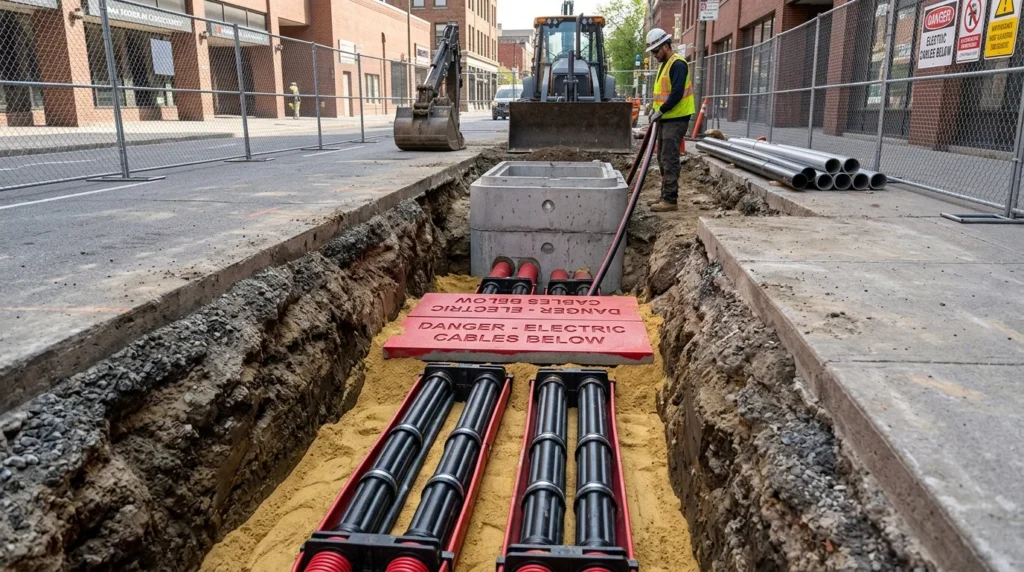
An underground cable system is a method of transmitting and distributing electrical power using insulated cables buried beneath the ground.
In simple words, instead of carrying electricity through overhead wires mounted on poles, underground systems use specially designed cables installed below the Earth’s surface.
These cables are protected with multiple insulation and shielding layers to safely carry electrical current under underground conditions.
For example, in large cities where space is limited and safety is important, electrical power is commonly supplied through underground cable networks instead of overhead transmission lines.
Underground cable systems are used for:
- Power transmission
- Power distribution
- Industrial power supply
- Railway electrification
- Smart city infrastructure
They are designed to improve reliability, reduce environmental impact, and provide better public safety.
Underground Cable System Working Principle
The underground cable system working principle is based on transmitting electrical energy through insulated conductors safely buried underground.
Simple Analogy
Think of water flowing through a protected underground pipeline:
- The pipe safely carries water without external interference.
- Similarly, underground cables safely carry electrical energy below the ground.
Step-by-Step Working Principle
Electricity is Generated
Power is produced at generating stations.
Voltage is Increased
Transformers increase voltage for efficient transmission.
Electrical power transfer follows the basic equation:
P = VI
Where:
- (P) = Power
- (V) = Voltage
- (I) = Current
Higher voltage reduces transmission current and power losses.
Electricity Enters Underground Cables
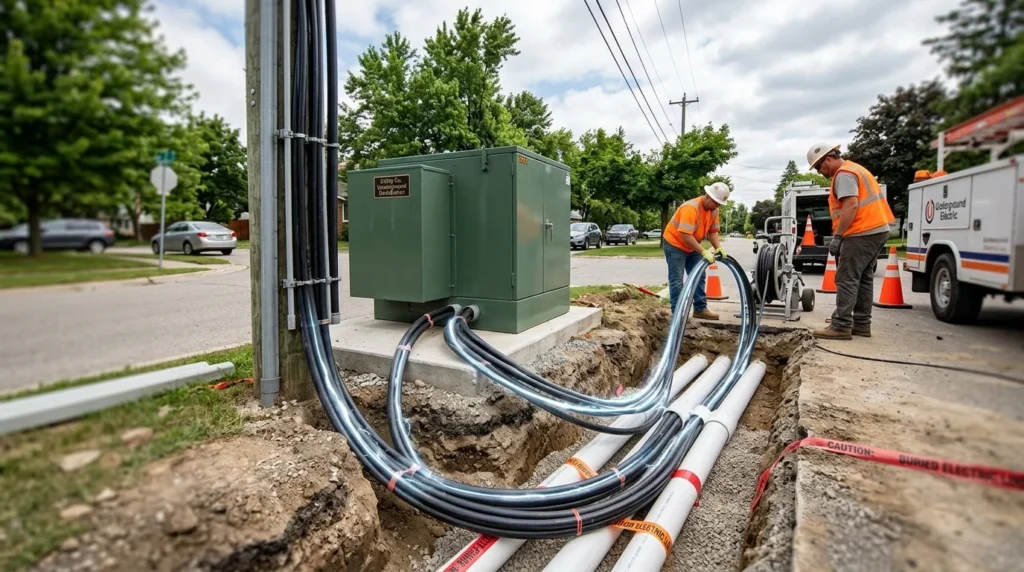
The underground cable system begins when electricity enters the underground cables from a power station or distribution substation. Before entering the cable network, the voltage is adjusted to the required transmission or distribution level using power transformers. The electrical current then flows through the cable’s conductor, which is typically made of copper or aluminum due to its excellent electrical conductivity. Multiple layers of insulation, metallic shielding, and an outer protective sheath surround the conductor to prevent current leakage and protect the cable from moisture, corrosion, and mechanical damage. Once inside the underground cable, electrical energy is transmitted safely and efficiently to substations, industrial facilities, commercial buildings, or residential areas, ensuring a reliable power supply with minimal interruptions and reduced exposure to weather-related faults.
Power flows into insulated underground conductors.
Insulation Prevents Leakage
Special insulation materials stop current leakage into the soil.
Protective Layers Provide Safety
Shielding and armor protect the cable from:
- Moisture
- Mechanical damage
- Chemical corrosion
Power Reaches Distribution Systems
Electricity is supplied to substations, homes, industries, and commercial buildings.
Important Features of Underground Cable System Working Principle
- Safe power transmission
- Reduced environmental exposure
- Lower fault probability from weather conditions
- Better public safety
Types / Classification of Underground Cable Systems
Underground cables are classified based on voltage level, insulation type, and construction method.
Low Voltage Underground Cable
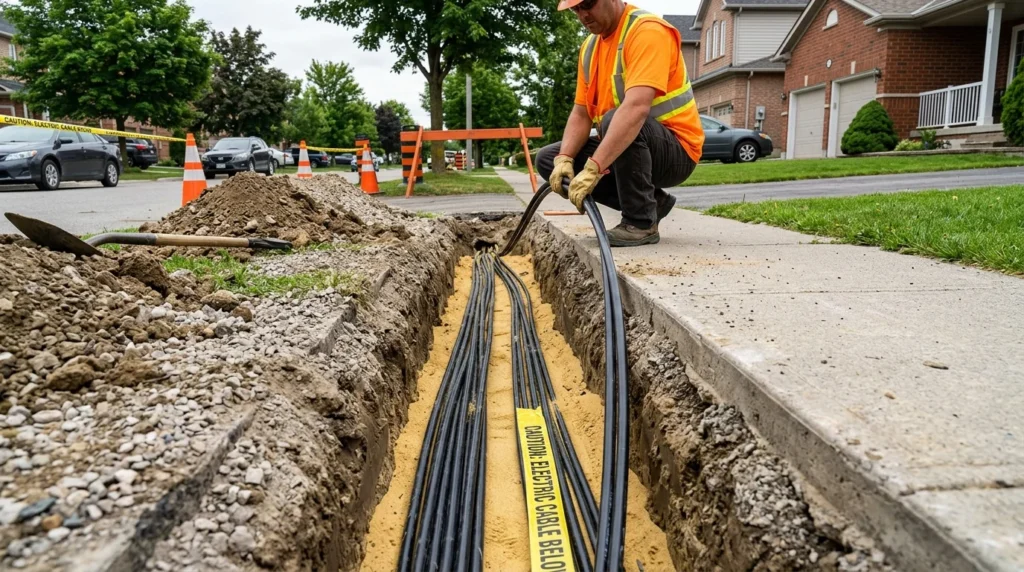
A Low Voltage Underground Cable is an insulated electrical cable used to distribute electricity at low voltage levels, typically 400V/230V, from distribution transformers to residential homes, commercial buildings, and small industrial facilities. It consists of a copper or aluminum conductor surrounded by insulation, protective bedding, armoring (in some types), and an outer sheath that protects the cable from moisture, corrosion, chemicals, and mechanical damage. By being installed below the ground, these cables are less vulnerable to weather conditions such as storms, strong winds, and lightning, resulting in a more reliable and safer power supply. Low voltage underground cables are widely used in urban areas, housing societies, hospitals, airports, shopping centers, and industrial parks where safety, aesthetics, and uninterrupted electricity distribution are important.
These cables operate at lower voltages.
Voltage Range
- Up to 1 kV
Applications
- Residential wiring
- Street lighting
- Small commercial buildings
Medium Voltage Underground Cable
Medium voltage cables are used in distribution systems.
Voltage Range
- 1 kV to 33 kV
Applications
- Industrial plants
- Urban distribution systems
High Voltage Underground Cable
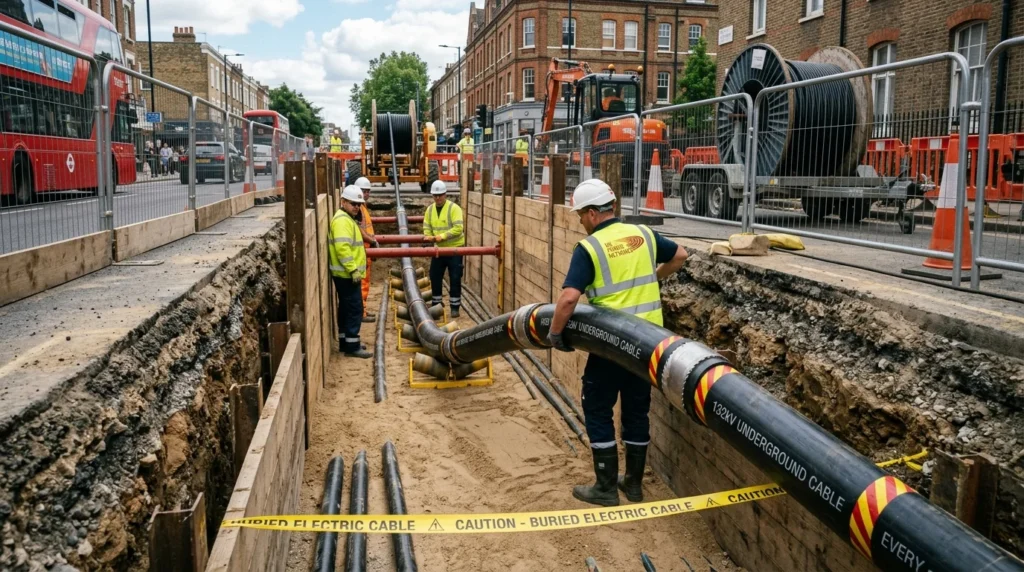
A High Voltage Underground Cable is a specially designed insulated cable used to transmit electrical power at high voltage levels, typically 33kV, 66kV, 132kV, or higher, beneath the ground. It consists of a copper or aluminum conductor, high-quality insulation, metallic shielding, protective bedding, armoring (where required), and a durable outer sheath that protects the cable from moisture, corrosion, mechanical damage, and environmental conditions. These cables are used to transfer large amounts of electrical energy safely and efficiently between power stations, grid stations, substations, and major industrial facilities. High voltage underground cables are commonly installed in densely populated urban areas, airports, tunnels, and environmentally sensitive locations where overhead transmission lines are impractical or undesirable. They provide improved safety, reduced visual impact, greater protection from weather-related faults, and a reliable power supply, although they involve higher installation and maintenance costs than overhead lines.
These cables handle large transmission voltages.
Voltage Range
- Above 33 kV
Applications
- Bulk power transmission
- Large substations
Belted Cable
Belted cables use layers of insulation wrapped around conductors.
Features
- Simple construction
- Lower cost
Limitations
- Suitable only for lower voltages
Screened Cable
Screened cables use metallic shielding around conductors.
Features
- Better electric field control
- Improved safety
Applications
- Medium and high-voltage systems
Pressure Cable
Pressure cables use gas or oil pressure for insulation improvement.
Types
- Oil-filled cables
- Gas-pressure cables
Applications
- Extra high-voltage transmission
Main Components of an Underground Cable System
Understanding cable components is essential for electrical students and technicians.
Conductor
The conductor carries electrical current.
Materials Used
- Copper
- Aluminum
Function
- Transfers electrical energy
Insulation
Insulation prevents current leakage.
Common Materials
- PVC
- XLPE
- Rubber
Function
- Electrically isolates conductors
Metallic Sheath
The sheath protects the cable from moisture.
Function
- Prevents water entry
- Improves safety
Bedding Layer
This layer protects the metallic sheath.
Function
- Provides cushioning
Armoring
Armoring gives mechanical protection.
Materials Used
- Steel wire
- Steel tape
Function
- Protects against physical damage
Outer Sheath
The outermost layer protects the cable externally.
Function
- Prevents environmental damage
Advantages
Understanding underground cable system advantages and disadvantages helps engineers make proper installation decisions.
Advantages of Underground Cable Systems
- Improved public safety
- Better protection from weather
- Reduced power interruptions
- Cleaner appearance
- Lower maintenance frequency
- Reduced risk of electric shock
- Less environmental disturbance
- Improved reliability
Real-World Benefits
Reliable Urban Power Supply
Cities benefit from fewer outages caused by storms and falling trees.
Better Aesthetics
Underground systems remove visible poles and overhead wires.
Increased Safety
Reduced exposure lowers accident risks.
Stable Electrical Performance
Underground cables experience fewer weather-related disturbances.
Disadvantages / Limitations
Despite many benefits, underground cable systems also have limitations.
Disadvantages of Underground Cable Systems
- High installation cost
- Difficult fault detection
- Complex repairs
- Limited heat dissipation
- Longer installation time
- Specialized equipment required
Practical Limitations
Expensive Installation
Excavation and cable laying increase project cost significantly.
Repair Challenges
Fault locations underground are harder to identify and repair.
Cooling Problems
Underground cables may overheat if heat is not dissipated properly.
Applications
Underground cable system applications are increasing rapidly in modern electrical infrastructure.
Residential Applications
- Urban residential supply
- Underground housing societies
Industrial Applications
- Factory power distribution
- Chemical plants
- Oil refineries
Commercial Applications
- Airports
- Shopping malls
- Office complexes
Transportation Applications
- Metro rail systems
- Railway electrification
- Tunnel lighting systems
Renewable Energy Applications
- Solar farms
- Wind power integration
- Smart grid systems
Underground cable system applications continue expanding due to growing urbanization and reliability requirements.
Comparison Section
Difference Between Underground Cable System and Overhead Transmission System
| Feature | Underground Cable System | Overhead Transmission System |
| Installation Cost | High | Lower |
| Maintenance | Lower frequency | Higher frequency |
| Fault Detection | Difficult | Easier |
| Weather Impact | Very low | High |
| Safety | Better | Moderate |
| Appearance | Clean and hidden | Visible lines |
| Cooling | Limited | Better natural cooling |
| Repair Time | Longer | Shorter |
Understanding the difference between underground and overhead systems helps engineers choose suitable transmission methods.
Selection Guide
Selecting the correct underground cable system requires proper engineering analysis.
Voltage Rating
Choose according to system voltage requirements.
Examples:
- Low voltage for homes
- High voltage for transmission
Current Carrying Capacity
Select cable size based on expected load current.
Environmental Conditions
Consider:
- Soil temperature
- Moisture
- Chemical exposure
Installation Location
Urban areas usually prefer underground systems due to space and safety benefits.
Budget Considerations
Underground systems require higher initial investment but offer long-term reliability.
Tips for Beginners
- Learn cable sizing methods
- Understand insulation materials
- Study voltage drop calculations
- Follow electrical safety standards
- Practice reading cable specifications
Common Problems & Solutions
Cable Overheating
Causes
- Excessive load current
- Poor ventilation
Solution
- Reduce load
- Improve heat dissipation
Insulation Failure
Causes
- Aging
- Moisture penetration
Solution
- Replace damaged cable sections
Short Circuit Faults
Causes
- Mechanical damage
- Insulation breakdown
Solution
- Use fault location equipment
- Repair damaged sections
Moisture Damage
Causes
- Broken sheath
- Water entry
Solution
- Improve sealing
- Replace damaged protective layers
Voltage Drop Problems
Causes
- Long cable length
- Undersized conductors
Solution
- Use larger conductor size
Future Trends
Underground cable systems are evolving rapidly with modern electrical technology.
Smart Cable Monitoring
Modern systems now use sensors for:
- Temperature monitoring
- Fault detection
- Load analysis
This improves reliability and maintenance planning.
High-Temperature Superconducting Cables
Future cables may use superconducting materials.
Benefits
- Very low power losses
- Higher transmission efficiency
Eco-Friendly Insulation Materials
New insulation technologies aim to reduce environmental impact.
Smart Grid Integration
Underground systems are becoming important parts of smart electrical grids.
Features
- Automated monitoring
- Real-time fault analysis
- Intelligent power distribution
Renewable Energy Expansion
Future renewable systems will increasingly rely on underground cable networks for reliable energy transmission.
The future of underground cable system applications is closely connected with smart cities, sustainable infrastructure, and modern electrical networks.
Conclusion
Underground cable systems are an important part of modern electrical power transmission and distribution networks. They provide safer, cleaner, and more reliable electricity supply compared to traditional overhead systems. By using insulated and protected conductors below the ground, these systems reduce weather-related faults, improve public safety, and support modern urban infrastructure.
This article explained the underground cable system working principle, types, components, applications, advantages and disadvantages, troubleshooting methods, and future developments in simple and practical language. You also learned the difference between underground and overhead transmission systems and how engineers select suitable cable systems for different environments.
For electrical students, engineers, technicians, and beginners, understanding underground cable systems is essential because modern electrical networks increasingly depend on reliable underground infrastructure. As smart grids and renewable energy systems continue developing, underground cable technology will play an even greater role in future electrical engineering.