
Imagine switching on a ceiling fan on a hot day. Within seconds, the blades start rotating and provide cooling. Or think about a water pump lifting water from underground to your tank. In both cases, a hidden device is doing the real work—an electric motor.
Electric motors are everywhere around us. From household appliances to industrial machines and modern electric vehicles, motors play a vital role in converting electrical energy into mechanical motion. Without them, most of today’s technology would not function.
Understanding what is electric motor is essential for electrical students, engineers, technicians, and beginners. It helps in designing systems, troubleshooting problems, and selecting the right motor for different applications.
In this article, you will learn the complete electric motor working principle, types, components, applications, advantages and disadvantages, and selection guide. By the end, you will have a strong practical understanding of how electric motors work and why they are so important in modern engineering.
2. What is Electric Motor?
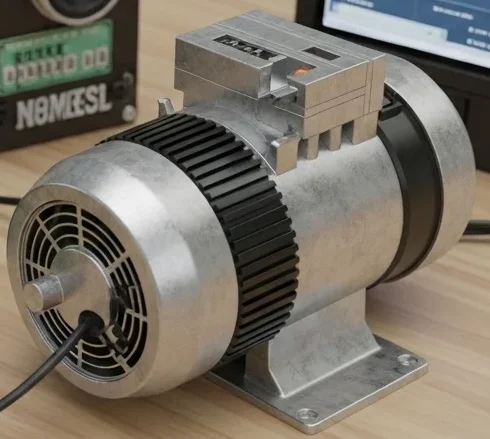
An electric motor is a device that converts electrical energy into mechanical energy.
Simple Explanation
It uses electricity to create motion. When current flows through the motor, it produces a force that rotates the shaft.
Practical Example
- A fan motor rotates blades
- A washing machine motor spins the drum
- An electric vehicle motor drives the wheels
In all these cases, electrical energy is converted into useful mechanical work.
3. Working Principle
The electric motor working principle is based on the interaction between magnetic fields and electric current.
Step-by-Step Explanation
- Electric current flows through the motor winding
- A magnetic field is generated
- This magnetic field interacts with another magnetic field
- A force is produced on the conductor
- This force causes rotation of the rotor
Key Formula
F = B I L \sin(\theta)
Where:
- F = Force
- B = Magnetic field
- I = Current
- L = Length of conductor
Easy Analogy
Think of two magnets:
- When placed near each other, they attract or repel
- This force creates movement
- In motors, this force causes rotation
Important Concept
- More current → More force → Higher torque
- Stronger magnetic field → Better performance
4. Types / Classification
Electric motors are classified based on power supply and design.
Based on Power Supply
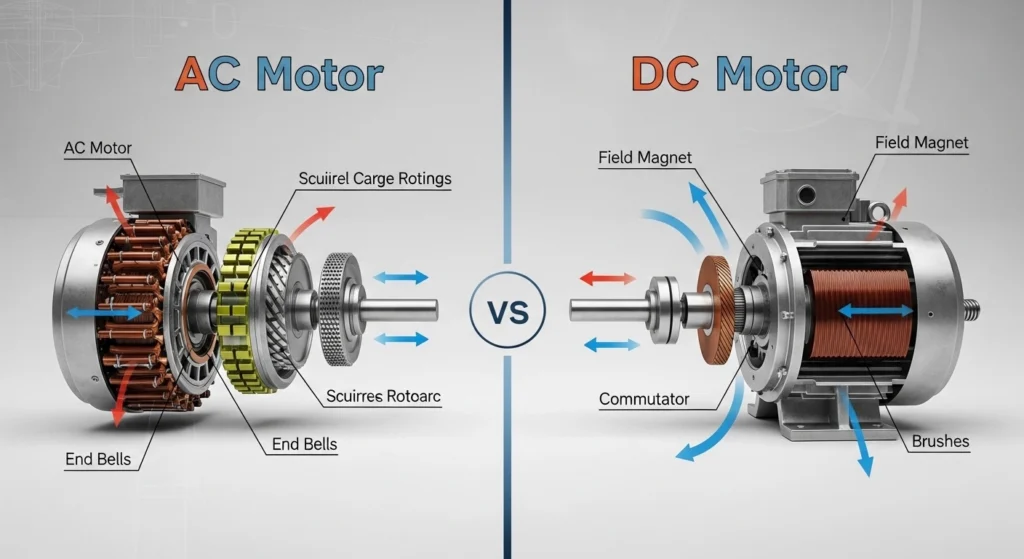
AC Motor
- Operates on alternating current
- Common in homes and industries
Types:
- Induction Motor
- Synchronous Motor
DC Motor
- Operates on direct current
- Used in battery-powered systems
Types:
- Series Motor
- Shunt Motor
- Compound Motor
Based on Construction
Brushed Motor
- Uses brushes for current transfer
- Simple and low cost
Brushless Motor (BLDC)
- No brushes
- Higher efficiency and longer life
Based on Application
Servo Motor
- Precise control of position and speed
- Used in robotics
Stepper Motor
- Moves in steps
- Used in CNC machines and printers
5. Main Components
Stator
- Stationary part
- Produces magnetic field
Rotor
- Rotating part
- Converts electrical energy into motion
Windings
- Carry current
- Generate magnetic field
Commutator (in DC motors)
- Reverses current direction
- Ensures continuous rotation
Brushes
- Transfer current to rotating parts
Shaft
- Delivers mechanical output
Bearings
- Reduce friction
- Support smooth rotation
6. Advantages
Electric Motor Advantages
- High efficiency
- Easy to operate
- Reliable performance
- Low maintenance
- Environment-friendly (no fuel needed)
- Compact and versatile
- Wide range of applications
7. Disadvantages / Limitations
Electric Motor Disadvantages
- Requires electrical supply
- Initial cost can be high
- Heating issues under overload
- Requires protection systems
- Some types need regular maintenance
8. Applications
Electric Motor Applications
Home Applications
- Fans
- Refrigerators
- Washing machines
- Air conditioners
Industrial Applications
- Pumps and compressors
- Conveyor systems
- Machine tools
Modern Technology
- Electric vehicles
- Robotics
- Drones
- Renewable energy systems
Electric motors are essential in almost every industry.
9. Comparison Section
Difference Between AC Motor and DC Motor
| Feature | AC Motor | DC Motor |
| Power Supply | Alternating current | Direct current |
| Maintenance | Low | Higher |
| Speed Control | Difficult | Easy |
| Cost | Lower | Higher |
| Applications | Industrial use | Battery-based systems |
10. Selection Guide
Choosing the right motor is very important.
Tips for Beginners
- For home appliances → AC motor
- For battery systems → DC motor
- For precision control → Servo motor
Key Factors to Consider
- Power requirement
- Speed and torque
- Efficiency
- Operating environment
- Cost
Practical Advice
- Always check motor rating
- Avoid overloading
- Use proper protection devices
11. Common Problems & Solutions
Why does a motor overheat?
Overload or poor ventilation.
Reduce load and improve cooling.
Why motor not starting?
Power supply issue or winding fault.
Check connections and supply.
Why motor makes noise?
Worn bearings or loose parts.
Inspect and replace faulty parts.
Why speed is low?
Voltage drop or load increase.
Check supply and reduce load.
How to increase motor life?
Regular maintenance
- Proper cooling
- Avoid overloading
12. Future Trends
Electric motors are evolving rapidly.
Key Trends
- Brushless Motors: Higher efficiency
- Smart Motors: IoT-based monitoring
- Energy Efficient Designs: Reduced power consumption
- Electric Vehicles: High-performance motors
- Automation: Intelligent motor control
Future motors will focus on efficiency, automation, and sustainability.
13. Conclusion
Understanding what is electric motor is fundamental for anyone in the electrical field. Electric motors convert electrical energy into mechanical motion, making them essential in everyday life and industrial systems.
By learning the electric motor working principle, types, components, and applications, you can better understand how machines operate. Each motor type has its own advantages and limitations, so selecting the right one is crucial.
As technology advances, electric motors are becoming more efficient, smarter, and environmentally friendly. Building strong knowledge in this area will help you grow as a skilled engineer or technician.
Keep exploring practical applications to strengthen your understanding and expertise.